Related Articles
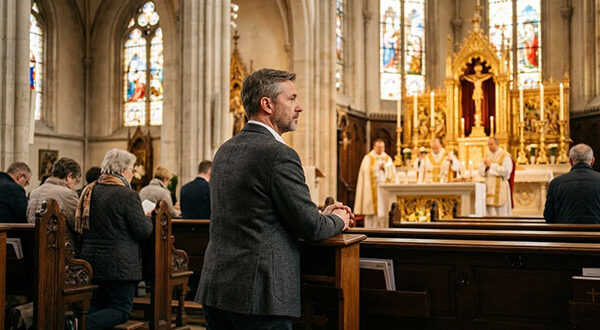
In an age that exalts self-sufficiency, speed, and the constant affirmation of the “self,” the Catholic liturgy preserves a gesture that seems to run against the spirit of the modern world: kneeling. For many contemporary men and women, going down on one’s knees may appear to be a sign of defeat, dependence, or humiliation. Yet for Christian tradition, kneeling before God has never been a degradation of man, but precisely the recognition of his true greatness.
From its origins, the Church has understood that the body also prays. We do not worship merely with ideas, feelings, or interior thoughts: we worship with our whole person. Christianity has never separated the soul from the body. That is why the liturgy is full of gestures: standing, sitting, bowing, making the sign of the cross, walking in procession, striking the breast… and especially kneeling.
The pews in our churches, with their kneelers, remain a silent catechesis. They remind us that man finds his truth not when he proudly stands upon himself, but when he bows before the Creator.
The man on his knees: a forgotten truth
We live in a culture deeply afraid of acknowledging dependence. Modern man wants to feel self-sufficient, autonomous, the absolute master of himself. The idea of bending the knee before someone seems incompatible with the dominant mentality. Yet the spiritual tragedy of the contemporary world is precisely that it has forgotten that we are creatures.
The psalm expresses it with moving beauty:
“Come, let us bow down in worship, let us kneel before the Lord who made us. For He is our God, and we are the people He shepherds” (Ps 95:6–7).
To kneel is to recognize that God is God… and that we are not.
It seems like a simple statement, but it contains an immense spiritual revolution. For original sin was exactly the opposite: the desire “to be like gods” (Gen 3:5). Since then, the human heart has constantly struggled between worship and self-sufficiency.
That is why the liturgy preserves this gesture. Not as an empty formality, but as medicine for the soul.
The body also believes
One of the great errors of our time is to think that faith belongs only to the interior realm. We often hear phrases such as:
- “What matters is what one feels.”
- “God is in the heart.”
- “External gestures are unnecessary.”
But the Incarnation destroys that false opposition. The Son of God took on a human body. Christ touched, walked, wept, embraced, fasted, fell beneath the cross, and physically died for our salvation. Christianity is not a disembodied spirituality.
That is why the Catechism teaches that man expresses and perceives spiritual realities through material signs and symbols.
The gesture of kneeling is not an optional addition: it is part of the language of love and worship.
Just as we embrace those we love or bow our heads before someone worthy of honor, the believer also bodily expresses his relationship with God.
When the knees bend, the heart learns humility.
Kneeling before the Mystery
Sacred Scripture is filled with men and women falling to their knees before the manifestation of the divine.
Abraham prostrates himself.
Moses bows before the burning bush.
Solomon prays on his knees.
The Magi kneel before the Christ Child.
Peter falls before Christ saying:
“Depart from me, Lord, for I am a sinful man” (Lk 5:8).
And Saint Paul writes one of the most powerful phrases in the New Testament:
“At the name of Jesus every knee should bend, in heaven and on earth and under the earth” (Phil 2:10).
The bent knee is the recognition of the sovereignty of Christ.
It is no coincidence that the Book of Revelation continually describes the elders prostrating themselves in worship before the Lamb. The heavenly liturgy is adoration. And the earthly liturgy already participates in that eternal reality.
Eucharistic adoration and the silence of kneeling
Perhaps there is no place where the spiritual meaning of kneeling becomes more visible than in Eucharistic adoration.
Before the Blessed Sacrament, words begin to fail. The knees speak. The soul understands that it stands before a Presence infinitely greater than itself.
Many saints insisted on this truth.
Saint John Paul II affirmed that man cannot understand himself without adoration. And Benedict XVI wrote memorable pages on the importance of recovering genuflection in the liturgy, reminding us that whoever learns to believe also learns to kneel.
The loss of outward adoration often slowly leads to the loss of inward faith.
When the sense of the sacred disappears, man ultimately places himself at the center.
Kneeling during Holy Mass
The Roman liturgy preserves especially meaningful moments when the faithful kneel. These are not merely human customs, but profoundly theological acts.
During the consecration
When the priest pronounces the words of Christ:
“This is My Body… This is My Blood…”
the entire Church kneels.
Why?
Because at that moment the greatest miracle on earth occurs: the bread and wine cease to be bread and wine and truly become the Body, Blood, Soul, and Divinity of Jesus Christ.
Genuflection expresses real adoration.
This is not an emotional symbol. The Catholic kneels because Christ is truly present.
During the Creed at Christmas and the Annunciation
Liturgical tradition also invites the faithful to kneel when proclaiming:
“And by the Holy Spirit was incarnate of the Virgin Mary, and became man.”
The Church bows or kneels because she contemplates the unimaginable mystery of the Incarnation.
The infinite God entered time.
The Creator became a creature.
The Eternal One assumed human flesh.
The knees acknowledge what the intellect can scarcely comprehend.
Good Friday: kneeling before the Cross
One of the most moving moments in the entire liturgy takes place on Good Friday when the cross is solemnly unveiled and the Church sings:
“Behold the wood of the Cross, on which hung the salvation of the world.”
Then the people respond:
“Come, let us adore.”
The Church kneels before the cross because there she contemplates the price of redemption.
The Christian does not kneel before suffering itself, but before the infinite love manifested in Christ crucified.
Kneeling and recognizing oneself as a sinner
There is also a penitential dimension deeply connected to this gesture.
The publican in the Gospel, unable even to lift his eyes, cries out:
“O God, be merciful to me, a sinner” (Lk 18:13).
To kneel is to humbly acknowledge one’s spiritual poverty.
That is why traditionally many faithful confessed on their knees. Not as psychological humiliation, but as a visible expression of repentance and trust.
The bent knee says:
“I cannot save myself.”
And precisely there true conversion begins.
An ancient tradition: not kneeling during Easter
A little-known aspect of ancient liturgical tradition is that during the Easter season Christians refrained from kneeling.
Why?
Because Easter was lived as a great celebration of the Resurrection. Standing expressed the dignity of man risen with Christ.
This demonstrates that the liturgy never uses gestures arbitrarily. Every bodily posture possesses deep spiritual and theological meaning.
The Church has always understood that the body actively participates in the mystery being celebrated.
The current crisis of the sense of adoration
In many places, the gesture of kneeling has been greatly weakened. Some churches remove kneelers, others minimize genuflections, and there are those who consider these signs “outdated.”
Yet the underlying issue is not aesthetic or cultural: it is spiritual.
When adoration disappears, anthropocentrism inevitably appears.
The liturgy ceases to be oriented toward God and begins revolving around man, his emotions, or his comfort.
But the Catholic liturgy has never had as its primary purpose making us “feel good.” Its center is God.
And before God, man simultaneously discovers two things:
his smallness… and his immense dignity as a beloved child.
The humility that elevates
The Gospel contains a constant paradox:
“Whoever humbles himself will be exalted” (Lk 14:11).
Kneeling expresses precisely this truth.
The world thinks that whoever bows loses dignity.
Christ teaches the opposite:
whoever prostrates himself before God finds his true stature.
There is no humiliation in adoration.
There is freedom.
For man truly degrades himself only when he worships false idols:
money,
pleasure,
power,
ideology,
his own image.
Every human being ultimately kneels before something.
The question is not whether we will worship.
The question is whom we will worship.
The priest on his knees: a sign of spiritual fruitfulness
Particularly moving is the moment of priestly ordination. The ordinands kneel while the Church invokes the Holy Spirit.
That gesture contains immense spiritual richness.
The priest does not receive his ministry as a personal conquest, a human merit, or a social promotion. Everything is grace.
The fruitfulness of the priesthood is born from bent knees.
Here too the liturgy silently teaches that the Church does not live by human strategies, but by the power of God.
Recovering the sense of the sacred
Perhaps one of the great spiritual urgencies of our time is precisely to recover the sense of adoration.
We need once again to enter churches where silence spontaneously invites us to kneel.
We need to rediscover the real presence of Christ in the Eucharist.
We need to understand again that the liturgy is not entertainment, but participation in heavenly worship.
The knees educate the soul.
Whoever frequently kneels before God slowly learns:
- to be humble,
- to recognize his limits,
- to live gratefully,
- to stop placing himself at the center,
- to open himself to grace.
Kneeling in order to become truly human again
Paradoxically, modern man believes that always remaining upright is a sign of strength. But Christian tradition teaches something far deeper: man can truly stand only after he has first learned to kneel before God.
Genuflection does not destroy man.
It saves him from himself.
For in the act of kneeling, the believer acknowledges:
- that God is Lord,
- that Christ reigns,
- that grace is necessary,
- that we are creatures,
- that we need mercy,
- and that only divine love can raise us up.
Every time a Christian bends his knees in the liturgy, heaven touches earth.
And perhaps, in a world that has forgotten how to adore, one of the most revolutionary testimonies remains the same as always:
a man on his knees before God.