Related Articles

There are nights that change history. Not because some great visible spectacle takes place, but because the human heart silently prepares itself to receive God. The Vigil of Pentecost is one of those nights. In many parts of the Catholic world, it goes unnoticed, overshadowed by the solemnity of Pentecost Sunday. Yet from a theological, liturgical, and spiritual perspective, this vigil possesses an extraordinary depth.
The traditional Church always understood that the great works of God require preparation. There is no Resurrection without Good Friday. There is no Christmas without Advent. There is no Pentecost without waiting. And that is precisely what the Vigil of Pentecost is: the burning expectation of the Holy Spirit.
We live in an accelerated, hyperconnected, and superficial age where almost nobody knows how to wait anymore. Everything must be immediate. The Vigil of Pentecost teaches the opposite: the Holy Spirit does not enter a noisy soul, but a heart that is ready, humble, and watchful.
What is the Vigil of Pentecost?
The Vigil of Pentecost is the day preceding the solemnity of Pentecost, the feast celebrating the coming of the Holy Spirit upon the Apostles and the Virgin Mary gathered in the Cenacle.
Liturgically, in ancient Catholic tradition, this vigil held enormous importance. In fact, for centuries it was considered one of the great vigils of the liturgical year, alongside those of Easter, Christmas, and certain major feasts. It included fasting, special prayers, and in ancient times even solemn baptisms, especially in Rome.
It was not merely “the evening before.” It was an authentic spiritual preparation.
Pentecost completes the Easter season. If Easter celebrates Christ’s victory over death, Pentecost celebrates the visible birth of the Church through the fire of the Holy Spirit.
Pentecost: far more than “the coming of the Holy Spirit”
Many Catholics reduce Pentecost to an emotional scene: tongues of fire, a mighty wind, and Apostles preaching. But Pentecost is much more than that.
It is:
- The reversal of Babel.
- The public manifestation of the Church.
- The fullness of Easter.
- The inauguration of the universal mission.
- The fulfillment of the Messianic promises.
- The interior transformation of man through grace.
Before Pentecost, the Apostles were hiding. After Pentecost, they went out into the world willing even to embrace martyrdom.
This demonstrates an immense spiritual truth: Christianity cannot be lived merely through human effort. It requires the supernatural action of the Holy Spirit.
Christ did not come merely to teach us morality. He came to communicate His own divine life to us.
Waiting in the Cenacle: the model of all spiritual life
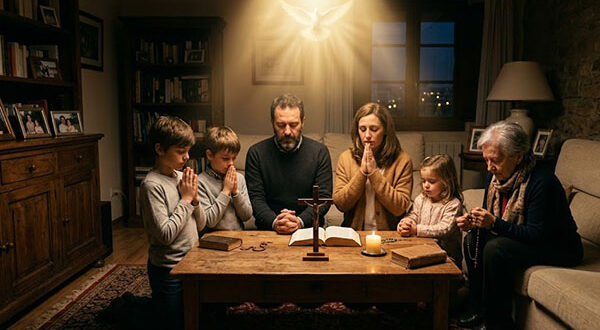
The Book of Acts describes the Apostles persevering in prayer together with Mary while awaiting Christ’s promise.
“All these with one accord devoted themselves to prayer, together with the women and Mary the mother of Jesus.”
— Acts 1:14
Here we encounter one of the deepest and least discussed aspects of Pentecost: the Holy Spirit descended upon a community that was praying.
He did not descend upon a distracted crowd.
He did not descend upon a worldly group.
He did not descend upon self-sufficient men.
He descended upon souls gathered in humility, silence, and expectation.
This has enormous pastoral consequences today.
Many Christians desire to experience God’s action, yet they live permanently scattered: constant noise, screens, anxiety, endless entertainment, activism without prayer, and superficial spirituality.
The Vigil of Pentecost reminds us that the Holy Spirit loves interior recollection.
Mary and the Vigil of Pentecost
One of the most beautiful and least explored details is the role of the Blessed Virgin Mary at Pentecost.
Mary had already received the Holy Spirit in fullness at the Annunciation. She did not need Pentecost in the same way the Apostles did. Yet she is present in the Cenacle because she is the Mother of the newborn Church.
Catholic tradition has always seen in Mary the perfect model of a soul docile to the Holy Spirit.
She:
- listens,
- keeps,
- meditates,
- obeys,
- waits,
- and abandons herself completely to God.
While the modern world exalts self-sufficiency, Mary represents total openness to grace.
That is why many saints recommended preparing for Pentecost especially through prayer with Mary.
Saint Louis-Marie Grignion de Montfort taught that the Holy Spirit acts with particular intensity wherever He finds Mary.
Pentecost and Sinai: a fascinating connection
One of the lesser-known aspects of Pentecost is its connection to the Jewish feast of Shavuot.
The Jewish feast of Pentecost originally celebrated:
- the harvest,
- and later the giving of the Law to Moses on Mount Sinai.
This is not accidental.
At Sinai, God wrote the Law on tablets of stone.
At Pentecost, God writes the Law upon hearts through the Holy Spirit.
Here the prophecy of Ezekiel is fulfilled:
“A new heart I will give you, and a new spirit I will put within you.”
— Ezekiel 36:26
Christianity does not consist merely in obeying external rules. The Holy Spirit transforms the believer interiorly, making him capable of loving God.
That is why Pentecost represents the New Covenant in all its fullness.
Babel and Pentecost: the forgotten miracle
Another profoundly theological aspect is the relationship between Pentecost and the Tower of Babel.
At Babel:
- pride divides,
- languages are confused,
- humanity is fragmented.
At Pentecost:
- the Spirit unites,
- languages are understood,
- the Church is born universal.
This is not merely a linguistic miracle. It is a spiritual restoration of the human unity broken by sin.
Today we are living through a new Babel:
- clashing ideologies,
- relativism,
- polarization,
- doctrinal confusion,
- loss of a common moral language,
- inability for genuine dialogue.
Pentecost therefore appears as God’s answer to contemporary chaos.
Only the Holy Spirit can restore authentic unity, because true unity is not born from political agreements or human strategies, but from truth and charity.
The fire of the Holy Spirit
The symbol of fire runs throughout Sacred Scripture:
- the burning bush,
- the pillar of fire in the Exodus,
- the fire of sacrifice,
- the purifying fire of the prophets.
At Pentecost, the Spirit descends as fire because He:
- illuminates,
- purifies,
- transforms,
- consumes sin,
- ignites divine love.
Many Christians desire God’s consolation, but not His purifying fire.
Yet the Holy Spirit does not come merely to “make us feel good.” He comes to sanctify.
And sanctification implies interior combat:
- against sin,
- against pride,
- against lukewarmness,
- against spiritual mediocrity.
The traditional Vigil of Pentecost
In the traditional Roman liturgy, the Vigil of Pentecost possessed an astonishing richness.
In ancient times it included:
- prophetic readings,
- litanies,
- the blessing of baptismal water,
- clear references to Easter,
- preparatory fasting.
The Church regarded Pentecost as a “second Easter.”
Why?
Because just as Easter gives new life through the Resurrection, Pentecost communicates that life through the Holy Spirit.
The loss of the sense of vigils in the modern world has greatly impoverished Catholic spirituality. In the past, feasts were prepared for. Today they are often merely consumed.
The gifts of the Holy Spirit: a forgotten treasure
One of the great catechetical tragedies today is that many Catholics scarcely know the seven gifts of the Holy Spirit.
They are:
- Wisdom.
- Understanding.
- Counsel.
- Fortitude.
- Knowledge.
- Piety.
- Fear of the Lord.
These gifts are not poetic symbols. They are real graces that perfect the soul.
Wisdom
Makes us taste the things of God.
Understanding
Helps us penetrate the mysteries of the faith.
Counsel
Guides us in difficult decisions.
Fortitude
Sustains us in suffering and persecution.
Knowledge
Helps us see the world through God’s eyes.
Piety
Moves us to filial love toward God.
Fear of the Lord
Is not servile terror, but loving reverence.
The Vigil of Pentecost is a privileged moment to ask for these gifts.
Pentecost and martyrdom
There is a direct relationship between Pentecost and Christian martyrdom.
Before the Holy Spirit:
- Peter denies Christ.
- The Apostles flee.
- fear reigns.
After Pentecost:
- they preach publicly,
- they challenge authorities,
- they accept persecutions,
- they die for Christ.
This reveals a central truth: the Holy Spirit gives supernatural courage.
In an age where many Christians feel cultural pressure, fear ridicule, or suffer ideological persecution, Pentecost takes on enormous relevance.
The Church does not merely need human strategies.
She needs saints filled with the Holy Spirit.
Silence: the forgotten condition for hearing the Spirit
One of the greatest spiritual enemies of our time is noise.
We live:
- permanently connected,
- distracted,
- saturated with information,
- incapable of contemplation.
Many no longer know how to cultivate interior silence.
Yet the Holy Spirit often speaks gently.
The prophet Elijah discovered God not in the earthquake nor in the fire, but in “a still small voice” (1 Kings 19:12).
The Vigil of Pentecost is a concrete invitation to recover:
- adoration,
- examination of conscience,
- slow and prayerful recitation,
- spiritual reading,
- interior silence.
Lesser-known aspects of Pentecost
1. Pentecost has a cosmic dimension
Patristic tradition saw Pentecost as the beginning of the renewal of all creation.
The Holy Spirit sanctifies not only individual souls. He begins the restoration of the entire universe wounded by sin.
2. The Holy Spirit is the great unknown
Many saints lamented that Christians know little about the Holy Spirit.
People speak much about the Father and the Son, but little about the Third Person of the Trinity.
Yet:
- He inspires Scripture,
- forms the saints,
- sustains the Church,
- acts through the sacraments,
- moves conversion,
- strengthens prayer.
3. Pentecost is profoundly sacramental
The Holy Spirit acts especially through the sacraments:
- Baptism,
- Confirmation,
- the Eucharist,
- Confession.
Confirmation, in particular, is a “personal Pentecost.”
Sadly, many receive this sacrament without true spiritual formation.
How can we live the Vigil of Pentecost today?
1. Make a novena to the Holy Spirit
It is one of the Church’s oldest devotions.
2. Go to Confession
Sin hardens the soul and hinders the action of grace.
3. Pray the “Veni Creator Spiritus”
One of the most beautiful hymns in Catholic tradition.
4. Read Acts 1 and 2
This allows us to spiritually enter the Cenacle.
5. Practice silence
Reducing digital noise can become a true modern penance.
6. Ask for a docile heart
The Holy Spirit does not force Himself. He inspires gently.
Pentecost and the current crisis of the Church
We live in difficult times:
- secularization,
- relativism,
- loss of faith,
- vocational crisis,
- doctrinal confusion,
- spiritual lukewarmness.
Many seek exclusively human solutions:
- marketing,
- strategies,
- adaptation to the world,
- religious sociology.
But history demonstrates that the great renewals of the Church have always arisen from souls inflamed by the Holy Spirit.
Pentecost reminds us that the Church is not merely a human organization.
She is the Mystical Body of Christ animated by the Spirit.
The Vigil of Pentecost as a school of hope
Contemporary humanity is exhausted:
- anxiety,
- spiritual emptiness,
- hyper-individualism,
- despair.
The Holy Spirit is called by tradition:
- Consoler,
- Paraclete,
- Giver of Life,
- Sweet Guest of the soul.
The Vigil of Pentecost invites us to hope in God once again.
Not in ideologies.
Not in technologies.
Not in human powers.
But in the silent and transforming action of grace.
Conclusion: returning to the Cenacle
Perhaps the great problem of modern man is that he has forgotten how to wait for God.
We want immediate results.
We want quick emotions.
We want instant solutions.
But Pentecost was born from a community persevering in prayer.
The Vigil of Pentecost invites us precisely to this:
to return to the Cenacle,
to return to silence,
to return to Mary,
to return to prayer,
to return to a sincere desire for holiness.
Because the Holy Spirit still descends today.
He still transforms souls.
He still raises up saints.
He still grants strength in the midst of chaos.
And perhaps, in this confused and weary age, we have never needed more to pray humbly with that ancient prayer of the Church:
“Come, Holy Spirit, fill the hearts of Thy faithful and kindle in them the fire of Thy love.”