Related Articles


We live in a time when many people say things like:
“I believe in God, but not in the Church.”
“Jesus was with the poor, not with the gold of the Vatican.”
“How can the Church preach humility while surrounded by wealth?”
“If Christ returned today, He would drive everyone out of the Vatican.”
These statements have become common. They appear in family conversations, social media, documentaries, viral videos, and cultural debates. And although they are often spoken with resentment or superficiality, it is also true that behind them there is usually a sincere concern: how can the Gospel of poverty be reconciled with the existence of the Vatican and the patrimony of the Church?
The question is not new. It has existed for centuries. But today it carries a special force in a world marked by inequality, scandal, distrust toward institutions, and a profound spiritual crisis.
That is why it is important to respond with serenity, theological rigor, and pastoral honesty. Not with propaganda. Not with easy slogans. Not by denying the sins and errors of men within the Church. But neither by accepting simplistic caricatures that distort reality.
Because the real question is not simply:
“Why does the Vatican have wealth?”
The deeper question is:
“What does wealth really mean within the Church? What did Christ want? What did He condemn? And what did He not condemn?”
The First Great Confusion: Mistaking Personal Wealth for Sacred Patrimony
Many people imagine the Vatican as some kind of gigantic bank where the Pope lives like a billionaire surrounded by luxury while the world starves.
But that image is deeply distorted.
Personal wealth is one thing.
Sacred, historical, and artistic patrimony is something entirely different.
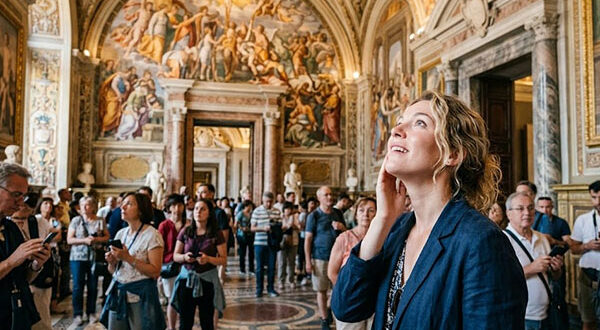
When someone enters Saint Peter’s Basilica and sees marble, art, mosaics, relics, and monumental architecture, they often think:
“All of this could be sold to feed the poor.”
The statement sounds compassionate. But it ignores several realities.
Most of those works:
- do not personally belong to the Pope;
- are part of humanity’s historical patrimony;
- were created over centuries as acts of faith;
- cannot simply be “liquidated” as if they were furniture;
- serve a liturgical, cultural, and spiritual purpose.
Moreover, even if the Church sold all the artistic patrimony of the Vatican, world poverty would still exist. Hunger is not solved by destroying cathedrals. It is solved by transforming social structures, human hearts, and unjust economic systems.
And here something important appears:
many people demand absolute poverty from the Church… while never demanding the same from governments, multinational corporations, celebrities, or economic elites.
Did Jesus Condemn All Wealth?
No.
And this is essential to understand.
Christ condemned disordered attachment to money.
He condemned greed.
He condemned the idolatry of power.
He condemned exploiting the poor.
He condemned turning money into a god.
But He never taught that all material possessions were evil in themselves.
In fact, the Gospel shows wealthy people who followed Christ.
- Joseph of Arimathea was a rich man and offered his tomb for the Lord.
- Zacchaeus possessed wealth.
- Lazarus of Bethany probably belonged to a well-off family.
- Many of the women who accompanied Christ financially supported the mission.
The problem was never possessing goods.
The problem was allowing possessions to own the human heart.
Christ said:
“You cannot serve both God and money.”
(Matthew 6:24)
And also:
“For where your treasure is, there your heart will be also.”
(Matthew 6:21)
The Gospel’s condemnation is not directed against beauty, art, temples, or sacred objects.
It is directed against idolatry.
Then Why Does the Church Use Beauty, Art, and Solemnity?
Because Christianity never understood worship as something miserable or vulgar.
From the Old Testament onward, God commanded beautiful temples to be built.
The Temple of Jerusalem was filled with gold, ornaments, and symbolic richness. And it was God Himself who gave detailed instructions for it.
This surprises many people.
Because there is a modern idea that says:
“if something looks poor externally, then it is holier.”
But Christian tradition never thought that way.
The Church has always understood that the best should be offered to God.
That is why there are:
- cathedrals;
- monstrances;
- precious chalices;
- sacred music;
- iconography;
- monumental architecture;
- liturgical vestments.
Not to glorify the clergy.
But to glorify God.
Beauty has a spiritual function.
It elevates the soul.
It breaks banality.
It reminds us that the sacred is not ordinary.
When someone contemplates the Sistine Chapel, they are not merely looking at luxury. They are contemplating centuries of Christian civilization trying to express something of divine glory.
“But Jesus Was Poor”
Yes.
Christ chose a humble life.
He was born in simplicity.
He lived without comforts.
He drew close to the poor, the sick, and the marginalized.
But be careful:
Jesus did not romanticize misery.
He did not say that material poverty was automatically holy.
In fact, feeding the hungry, healing the sick, and helping those in need were essential parts of His mission.
The Church has always understood that there must be:
- poverty of spirit;
- interior detachment;
- charity;
- humility.
But that does not mean destroying every visible expression of the sacred.
There is an enormous difference between:
- serving worldly luxury,
and - dedicating beauty to divine worship.
The Real Scandal Is Not the Gold of a Monstrance
Here we must be honest.
The Church’s greatest problem has never been a beautiful basilica.
The real scandal appears when:
- priests live like celebrities;
- power replaces service;
- clericalism crushes souls;
- truth is hidden;
- doctrine is abandoned;
- faith becomes worldly.
That truly contradicts the Gospel.
Because Christ did not come to found a political elite.
He came to save souls.
And when men within the Church drift away from that mission, they cause immense harm.
To deny this would be absurd.
The Church is holy because of Christ.
But her members are sinners.
And this was already present from the beginning:
one of the twelve apostles was Judas Iscariot.
“I Believe in God, but Not in the Church”
This phrase sounds spiritual, but it contains a deep contradiction.
Because it was Christ Himself who founded the Church.
Jesus did not leave behind a book falling from heaven.
He did not leave behind merely moral ideas.
He did not leave behind an individualistic spirituality.
He founded a visible Church.
He said to Saint Peter:
“You are Peter, and on this rock I will build my Church.”
(Matthew 16:18)
He did not say:
“Let everyone interpret everything on their own.”
Authentic Christianity has always been communal, sacramental, and visible.
That is why saying:
“Christ yes, Church no”
is similar to saying:
“I want the head, but not the body.”
The Church is not a later human invention.
It is part of Christ’s plan.
The Vatican Is Not Simply a Palace: It Is the Visible Center of the Church
Many people speak about the Vatican without truly understanding what it represents.
Vatican City exists to guarantee the spiritual independence of the Church from political powers.
Without minimal sovereignty, the Pope would be completely dependent on governments.
History shows how dangerous that would be.
Moreover, from there the Church sustains:
- missions;
- historical archives;
- universities;
- charitable aid;
- humanitarian diplomacy;
- cultural preservation;
- worldwide evangelization.
The Catholic Church remains one of the largest charitable organizations on the planet.
Millions of people:
- eat;
- study;
- receive medical care;
- find shelter;
- receive the sacraments;
- survive wars and persecutions;
thanks to Catholic institutions.
And paradoxically, this rarely appears in headlines.
The Modern Mindset Distrusts the Sacred
Today there is a cultural tendency to reduce every reality to economic criteria.
So people look at a cathedral and think:
“How much money is that worth?”
But a temple is not merely money.
It is:
- history;
- faith;
- identity;
- memory;
- culture;
- prayer made visible.
Nobody enters an important museum demanding that all the works be melted down and converted into cash.
Yet many demand exactly that from the Church.
Why?
Because often the issue is not economic.
It is spiritual.
The modern world tolerates luxury when it serves entertainment.
But it becomes deeply irritated when something is dedicated to God.
Catholics Must Also Examine Their Conscience
Now, this article should not be used to justify triumphalism or comfort.
The Church continually needs purification.
Every Catholic — layperson, priest, religious, or Pope — must remember that:
- money can corrupt;
- power can lead astray;
- prestige can empty the soul.
Christ warned severely about these dangers.
That is why the saints insisted so strongly on:
- humility;
- penance;
- charity;
- detachment.
Saint Francis of Assisi is perhaps the most famous example of radical love for evangelical poverty. Yet even he never rejected the Church or sacred worship. He never said churches should be destroyed or profaned. On the contrary: he restored temples and defended reverence toward the Eucharist.
The World’s Problem Is Not That the Vatican Exists
The true modern tragedy is another:
we have lost the sense of God.
We live in a civilization capable of spending obscene fortunes on:
- football;
- fashion;
- technology;
- weapons;
- entertainment;
- celebrities.
But when a basilica appears, suddenly many people discover their “concern for the poor.”
That reveals a profound cultural contradiction.
Because the real issue was never the gold of a chalice.
The issue is the spiritual emptiness of modern man.
The Church Does Not Exist to Please the World
Christ never promised that His Church would be popular.
In fact, He said:
“If the world hates you, know that it hated me before it hated you.”
(John 15:18)
The Church must help the poor.
It must practice charity.
It must denounce injustice.
It must live authentically.
But it must also:
- safeguard truth;
- celebrate worship worthily;
- evangelize;
- preserve the faith it has received.
Reducing the Church to a humanitarian NGO would betray its supernatural mission.
Because man’s greatest poverty is not economic.
It is spiritual.
An Uncomfortable Question for Those Who Criticize the Church
Many say:
“If they sold the Vatican, poverty would end.”
But almost nobody sells:
- their car;
- their phone;
- their television;
- their personal luxuries;
to feed the poor.
And here Christ challenges all of us again.
Not only the Vatican.
But each one of us.
Because it is very easy to denounce the wealth of others while living comfortably oneself.
Evangelical conversion begins in one’s own heart.
The True Wealth of the Church
The Church’s greatest wealth is not its buildings.
It is:
- the sacraments;
- the Eucharist;
- doctrine;
- the saints;
- grace;
- the truth of Christ.
Everything else will disappear one day.
The stones will fall.
Museums will close.
Civilizations will pass away.
But Christ remains.
And the Church continues to exist after twenty centuries not because of gold, power, or politics, but because millions of souls found in her something the world could never give:
salvation, truth, and eternal hope.
Conclusion: Christ Did Not Come to Abolish the Church, but to Sanctify Her
Yes, there are sins within the Church.
Yes, there are human contradictions.
Yes, some men within the Church have scandalized the world.
But that does not invalidate the Church’s divine mission.
If we abandoned every institution that had sinners, nothing on earth would remain standing.
The final question is not:
“Are there sinners in the Church?”
The real question is:
“Where is Christ?”
And for the Catholic, the answer remains the same after two thousand years:
Christ lives in His Church, even amid human misery, because the Church is not sustained by human perfection, but by the grace of God.
So when someone says:
“I believe in God, but not in the Church because of the wealth of the Vatican,”
perhaps the deepest answer is this:
The Church does not need less love for God.
It needs more saints.