
Related Articles
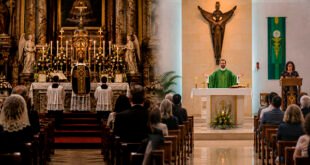

In the midst of the Eucharistic celebration, there is a moment that, at first glance, may seem brief or even secondary, yet it contains immense spiritual depth: the presentation of the offerings. It is not merely about bringing bread and wine to the altar. In truth, it is a gesture that gathers the whole of human life, purifies it in gratitude, and lifts it up to God.
This rite, deeply rooted in the biblical tradition, has its origins in the ancient offerings of the people of Israel, when the first fruits of the land were presented to God. Those first harvests were not simply an agricultural or economic act: they were a confession of faith. The people acknowledged that everything came from God and that He is the Lord of history, of the earth, and of the human heart.
Today, in the Church’s liturgy, this gesture remains alive. The General Instruction of the Roman Missal (140) reminds us that it is fitting for the faithful to participate actively by bringing forward the bread and wine, or even other gifts intended for the Church and for the poor. But beyond the visible gesture, what is taking place is a profound spiritual act: the entire community sets itself in motion toward God.
A People Who Walk Offering
The procession of the offerings is not a mere transfer of objects. It is the sign of a Church on the move. The faithful advance through the temple carrying in their hands what represents their lives: their work, their effort, their joys, their struggles, their hopes. All of this rises to the altar.
In this movement, the community becomes aware of something fundamental: it is surrounded by grace. Nothing it offers is exclusively its own. The bread and wine are the fruit of the earth and of human labor, but above all they are the fruit of divine blessing. Here one of the great modern illusions is shattered: the idea that man is the absolute owner of what he possesses.
To present the offerings is, therefore, an act of humility and truth. It is to recognize that everything is a gift.
Gratitude That Transforms
In a society marked by haste, consumption, and self-sufficiency, this liturgical gesture becomes a true spiritual school. It teaches us to live in a spirit of gratitude.
Modern man tends to appropriate everything: time, success, goods, even people. Yet in the Eucharist he learns to give back. And he does not do so with sadness or resignation, but with joy. Because the one who offers to God does not lose: he enters into communion.
The presentation of the offerings is, in this sense, a true profession of faith in action. Without words, the believer proclaims: “All I have received from You, Lord, and all I return to You with gratitude.”
And here something profoundly mysterious takes place: God takes what man offers—limited, imperfect, small—and transforms it into something infinitely greater. The bread and wine will become the Body and Blood of Christ. But the heart of the one who offers will also be transformed.
Offering to Enter into Communion
This gesture not only unites us to God; it also unites us to our brothers and sisters. The presentation of other gifts—intended for the poor or for the needs of the Church—reveals the social dimension of the Eucharist.
There is no true offering without charity. There is no authentic communion with God if there is no communion with others.
In this sense, the liturgy educates the heart. It frees us from selfish possession and introduces us into the logic of the gift. We learn that depriving ourselves of something does not impoverish us, but enriches us in communion. What we refrain from keeping for ourselves becomes life for others.
Here the witness of the early Church resounds powerfully, as recounted in the Acts of the Apostles: a community where no one was in need because everything was shared. It was not a social utopia, but the fruit of an authentic Eucharistic life.
Poverty That Attracts Grace
In presenting the offerings, man not only expresses his gratitude but also his poverty. He acknowledges that he constantly needs God, that everything is received from Him.
And, paradoxically, it is this poverty that attracts divine fruitfulness. The gratitude of the poor—of the one who knows that everything is grace—becomes the source of new blessings. Every act of thanksgiving opens the door to a renewed communion with God.
Here lies a decisive spiritual key: the one who gives thanks receives more. Not because God “owes” anything, but because the grateful heart is ready to receive grace.
A School of Freedom and Fraternity
The presentation of the offerings is also a school of interior freedom. In a world where happiness is often identified with accumulation, the liturgy teaches the opposite: true joy is found in giving.
It is not deprivation that produces joy, but the communion that arises from the gift. When the “I” opens itself to the “we,” a new joy emerges—deeper, more authentic.
Thus, this liturgical gesture forms a truly Christian community, where reciprocity, solidarity, and fraternity are not abstract ideals, but lived realities.
One might say that a truly “messianic” atmosphere is created: an anticipation of the Kingdom of God, where everything is oriented toward communion.
From Life to the Altar… and from the Altar to Life
The liturgy is not something separate from life. On the contrary, it is born from it and transforms it. The presentation of the offerings gathers what is ordinary—work, effort, relationships—and raises it to God. And then, from the altar, grace returns to life to make it fruitful.
Every moment lived with a sense of gratitude becomes an offering. Every act of love, every sacrifice, every service can be spiritually presented in the Eucharist.
In this way, the whole of existence takes on a Eucharistic character.
Christ, the Perfect Offering
Finally, this gesture finds its full meaning in Christ. Because in the Eucharist we do not simply offer things: we unite ourselves to Christ’s offering, who gives Himself completely to the Father.
He does not offer something external to Himself. He offers Himself.
And in this total self-gift, He gathers scattered humanity and brings it into divine communion.
Therefore, when we present the offerings, we are saying something very profound: we want to unite our lives to Christ’s, we want everything we are to be transformed by His love, we want to share in His self-giving.
Presenting the offerings is not just another rite. It is the moment when the whole life of the believer rises to the altar. It is the instant when the heart learns to give thanks, to share, to trust. It is the beginning of a transformation that culminates in communion.
And perhaps, if we were to live it with full awareness, we would discover that in this simple gesture lies one of the greatest keys of the Christian life:
everything is a gift… and everything is called to become an offering.