Related Articles
We live in an age that idolizes self-sufficiency. Modern man wants to feel strong, independent, autonomous, the absolute master of his own destiny. We are constantly told to “believe in ourselves,” “follow our truth,” and “depend on no one.” And yet, the farther man moves away from God, the emptier he seems to become. More anxiety. More loneliness. More despair. More inner noise.
In the midst of this hyperconnected yet deeply disoriented world, the Church continues to proclaim an ancient and eternal truth: man reaches his true greatness not when he exalts himself, but when he kneels before God.
It seems like a contradiction. The world thinks kneeling is humiliating, degrading, a loss of dignity. But the Catholic faith teaches exactly the opposite: when man kneels before his Creator, he discovers who he truly is. He understands his origin, his destiny, and the meaning of his existence.
Man is never more truly man than when he kneels before God.
And this statement contains immense theological, spiritual, and human depth.
Man Was Created to Worship
The first great truth the modern world has forgotten is this: man was not created merely to produce, consume, entertain himself, or survive. He was created to worship.
Worship is not an optional addition to human life. It is an essential part of our nature. Every human being worships something. Even if someone says he does not believe in God, he will eventually worship something else: money, pleasure, the body, power, ideology, success, politics, fame, or even himself.
Because the human heart needs to bow before something greater.
The difference is that when man worships God, he is elevated. But when he worships creatures, he degrades himself.
That is why Sacred Scripture constantly insists on worship as the central act of human life:
“Come, let us bow down in worship; let us kneel before the Lord who made us.”
— Psalm 95:6
To prostrate oneself before God does not destroy man. It orders him. It heals him. It restores him to the truth.
Kneeling: A Deeply Biblical Gesture
In the Bible, kneeling constantly appears as a sign of worship, humility, supplication, and recognition of God’s sovereignty.
Great biblical figures kneel before God:
- Solomon kneels at the dedication of the Temple.
- Daniel prayed on his knees three times a day.
- Saint Stephen dies on his knees forgiving his executioners.
- Saint Peter kneels before Christ.
- Saint Paul repeatedly speaks of bending the knee before God.
And the supreme example is Jesus Christ Himself.
In the Garden of Gethsemane, before the Passion, Christ kneels to pray to the Father amid the most terrible anguish:
“And kneeling down, He prayed.”
— Luke 22:41
This is extraordinary. God Himself made man chose to kneel. The King of the Universe adopts the posture of the obedient servant. The Almighty humbles Himself freely.
Here we understand an essential truth of Christianity: humility does not diminish man; it divinizes him.
Pride: The Disease of Our Time
If we had to summarize original sin in one word, it would probably be this: pride.
Man wanted to take the place of God.
“I will not serve,” tradition says Lucifer proclaimed before his fall.
Since then, human history has been the story of a constant struggle between two attitudes:
- pride that refuses to kneel,
- and humility that recognizes God as Lord.
Our society has turned pride into a virtue. Today absolute self-sufficiency is glorified, along with permanent rebellion against all authority and the rejection of any dependence on God.
But the result is evident:
- identity crisis,
- destruction of the family,
- loss of the meaning of life,
- spiritual emptiness,
- depression,
- nihilism,
- hopelessness.
The man who refuses to kneel before God ends up enslaved by a thousand worse things.
Because whoever does not worship God ends up worshipping idols.
And idols always end up devouring their worshippers.
The Bent Knee and the Truth About Man
There is something profoundly human in the act of kneeling.
A man on his knees recognizes a fundamental truth: “I am not God.”
And far from destroying his dignity, this protects it.
Why? Because man was not created to bear the weight of being absolute. When he tries to take God’s place, he breaks inwardly. He lives exhausted, trying to control the uncontrollable.
Only when he recognizes his smallness before the Infinite does he find rest.
That is why Saint Augustine of Hippo said:
“You have made us for Yourself, O Lord, and our hearts are restless until they rest in You.”
To kneel is to accept the truth of our condition:
- we are creatures,
- we depend on God,
- we need grace,
- we need salvation.
And paradoxically, that is where true freedom begins.
Eucharistic Adoration: Man Before the Mystery
There are few places where this truth is manifested so powerfully as before the Blessed Sacrament.
When a Catholic kneels before the Eucharist, he is not performing a mere symbolic gesture. He is acknowledging the Real Presence of Christ.
The Church has always understood that bending the knee before the Tabernacle was not optional or merely a cultural custom. It was a logical consequence of faith.
Because if Christ is truly present:
- with His Body,
- His Blood,
- His Soul,
- and His Divinity,
then man can only respond with adoration.
For centuries, entire generations built cathedrals, monasteries, and chapels around this certainty.
The saints understood something many have forgotten today: man becomes more fully human when he recognizes something infinitely greater than himself.
That is why Eucharistic adoration transforms lives.
Before the Blessed Sacrament:
- the proud learn humility,
- the anxious find peace,
- sinners discover mercy,
- the confused find light,
- hardened hearts learn to love again.
The Tragedy of Losing the Sense of the Sacred
One of the great tragedies of our time is the loss of the sense of the sacred.
Many churches have become spaces where everything seems horizontal:
- constant conversations,
- liturgical banality,
- irreverence,
- disappearance of silence,
- loss of wonder before the Mystery.
And when adoration disappears, man also loses the sense of who he is.
Because the liturgy does not only speak about God. It also educates man.
The postures of the body have spiritual importance:
- standing expresses dignity,
- sitting expresses listening,
- but kneeling expresses adoration.
The body participates in prayer. We are not spirits trapped in flesh. We are a unity of soul and body.
That is why Catholicism has always deeply valued bodily gestures:
- genuflection,
- folded hands,
- the Sign of the Cross,
- bowing the head,
- kneeling.
These are not empty formalities. They are spiritual pedagogy.
The body teaches the soul.
Christ the King and Modern Man
The problem of modern man is not merely moral. It is theological.
We have wanted to dethrone Christ.
We want a world:
- without divine law,
- without objective truth,
- without sin,
- without judgment,
- without the need for redemption.
But a society that stops kneeling before God ends up kneeling before the State, ideologies, money, or disordered desires.
The history of the twentieth century demonstrated this brutally.
The great totalitarianisms were born precisely when man tried to replace God:
- communism,
- Nazism,
- atheistic materialism,
- worship of power.
When God disappears from the horizon, man does not become freer. He becomes more manipulable.
That is why the feast of Christ the King has immense importance: it reminds us that only Christ has absolute authority over the human heart.
And that no ideology can take His place.
The Saints on Their Knees
The history of the Church is full of spiritual giants who understood this truth.
Saint Francis of Assisi wept before the Crucifix.
Saint Thomas Aquinas wrote many of his prayers on his knees.
Saint John Mary Vianney spent hours before the Tabernacle.
Saint Teresa of Ávila taught that humility is walking in truth.
Saint Pio of Pietrelcina remained for long periods in silent adoration.
All of them understood something fundamental:
human greatness is born from relationship with God.
Not from ego.
Not from applause.
Not from power.
But from holiness.
Kneeling in a World That Mocks God
Today, kneeling before God has almost become a countercultural act.
We live in a culture that:
- ridicules reverence,
- despises humility,
- trivializes the sacred,
- confuses freedom with the absence of limits.
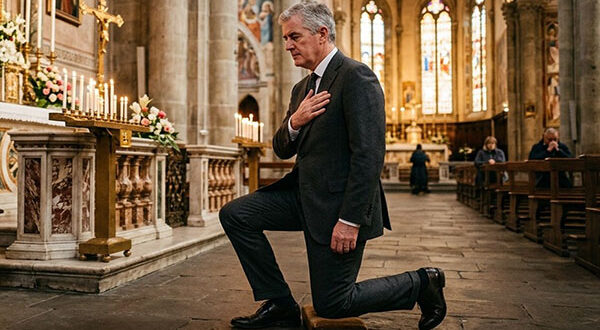
That is why a young man entering a church and kneeling before the Blessed Sacrament gives an enormously powerful silent testimony.
He is saying:
- “God exists.”
- “I am not self-sufficient.”
- “I need salvation.”
- “There is something greater than my desires.”
- “Christ is Lord.”
And that gesture has tremendous evangelizing power.
Because the world is tired of pride.
Even if it does not admit it.
True Masculinity and True Strength
There is also a profound teaching about Christian masculinity in this subject.
Many men think that being strong means depending on no one, showing no weakness, never asking for help.
But the Gospel shows something different.
The truly strong man is the one who knows how to humble himself before God.
The bent knee is not cowardice. It is spiritual courage.
It takes more strength to go to confession than to boast.
More strength to obey God than to follow passions.
More strength to persevere in faith than to let oneself be swept away by the world.
Christ Himself showed true manhood on the Cross:
- obedience,
- sacrifice,
- self-giving,
- self-mastery,
- love to the very end.
The man who kneels before God learns how to stand upright before the world.
Practical Applications for Spiritual Life
1. Recover Conscious Genuflection
Many Catholics genuflect mechanically or have abandoned the practice altogether.
Returning to it consciously transforms spiritual life.
Every time you enter a church:
- remember that Christ is present,
- stop,
- make a slow genuflection,
- adore interiorly.
That small gesture educates the soul.
2. Spend Time Before the Blessed Sacrament
Eucharistic adoration is one of the most powerful spiritual remedies for our time.
Even if only for 15 minutes a week.
In silence.
Without hurry.
Without a phone.
Without noise.
Simply being before God.
Many interior problems begin to fall into order when the soul places itself once again before the Creator.
3. Learn True Humility
Humility does not mean hating or despising yourself.
It means living in truth:
- recognizing our limits,
- accepting our dependence on God,
- understanding that every good comes from Him.
Humility frees us from the constant obsession with appearances.
4. Teach Reverence to Children
Children learn more through gestures than through speeches.
If they see:
- silence in church,
- genuflections,
- recollection,
- respect for the altar,
- love for the Eucharist,
they will intuitively understand that something sacred is happening there.
5. Kneel Also in the Heart
It is possible to bend the knees physically while keeping the heart full of pride.
True worship unites both:
- body,
- soul,
- exterior humility,
- interior humility.
God does not seek religious theater. He seeks hearts surrendered to His will.
“At His Name Every Knee Shall Bend”
Scripture contains a tremendous affirmation:
“That at the name of Jesus every knee should bend, in heaven and on earth and under the earth.”
— Philippians 2:10
Every knee shall bend.
The difference is that some will do so freely in adoration… and others too late.
The Christian kneels now because he lovingly recognizes the lordship of Christ.
Not out of slavery.
Not out of servile fear.
But because he has discovered that only God can fill the human heart.
Conclusion: Man Is Only Understood on His Knees
Modern man has spent centuries trying to explain himself without God.
And the result has been a profound spiritual crisis.
We have conquered technology, speed, and comfort, but many times we have lost:
- silence,
- meaning,
- transcendence,
- wonder,
- adoration.
That is why this phrase contains an immense truth:
“Man is never more truly man than when he kneels before God.”
Because there:
- he recognizes who he is,
- he remembers where he comes from,
- he understands where he is going,
- he discovers true love,
- he learns humility,
- he finds peace.
A man on his knees before God does not become smaller.
He becomes truly free.
And perhaps the world today needs more than ever to see men and women capable of kneeling before the Tabernacle… so that they may rise again and transform the world with the strength of Christ.