

Related Articles


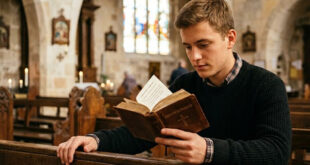
We live in a strange age. Never before have there been so many ways to learn about the faith… and yet never has it been so easy to forget it. There are people who years ago prayed every day and today can barely remember the last time they went to confession. Catholics who once defended the truth passionately and now feel indifferent. Souls who did not abandon God all at once, but slowly, almost without noticing it.
And therein lies one of the most dangerous spiritual realities: faith is usually not lost overnight. Rarely does someone wake up one morning saying, “Today I’m going to stop believing.” What is far more common is something much quieter, more gradual, and more tragic.
Faith can go out like a lamp running out of oil.
Little by little.
Without noise.
Without scandal.
Without realizing it.
Faith: A Supernatural Gift, Not a Passing Feeling
Before going deeper, we must understand something fundamental: faith is not simply a religious emotion or a cultural tradition. Faith is a theological virtue infused by God into the soul.
The Catechism teaches that faith is:
“The theological virtue by which we believe in God and believe all that He has said and revealed.”
It is not merely about “feeling” God. Many people think that as long as they have religious emotions, their faith is alive. But true faith can exist even amid dryness, doubts, suffering, and interior darkness.
True faith is the adhesion of the intellect and the will to God who reveals Himself.
That is why it can weaken when we stop nourishing that adhesion.
Just as the body needs food, the soul needs nourishment as well. No one is surprised when a muscle atrophies from lack of use. Yet many believe that faith will remain strong even if they never pray, never read the Gospel, never go to confession, and live immersed in an environment opposed to God.
Faith usually does not die from a gunshot.
It dies from starvation.
Christ’s Warning: Spiritual Cooling
Our Lord spoke clearly about this danger. In the Gospel of Matthew we find these chilling words:
“And because wickedness is multiplied, most men’s charity will grow cold.”
(Mt 24:12)
Notice the expression: will grow cold.
It does not say that it will disappear suddenly.
It does not say that it will be violently torn away.
It speaks of a progressive process.
Something that once burned begins slowly to fade.
First prayer grows cold.
Then love for the truth grows cold.
Then horror for sin grows cold.
Later the desire to attend Mass grows cold.
And finally the soul ends up living far from God without even noticing the tragedy.
The Great Danger of Habit
One of the greatest spiritual enemies is routine without interior life.
Many Catholics continue “fulfilling obligations” externally while interiorly drifting farther and farther from God. They attend Mass but without attention. They pray mechanically. They confess without deep examination. They have lost their sense of wonder before the sacred.
And the soul gradually becomes accustomed to living lukewarm.
Spiritual lukewarmness is especially dangerous because it usually produces no visible scandal. The lukewarm soul does not necessarily fall into monstrous sins. It simply ceases to love God intensely.
And that eventually affects everything.
In the book of Book of Revelation, Christ addresses harsh words to the church of Laodicea:
“Because you are lukewarm, neither cold nor hot, I will spit you out of my mouth.”
(Rev 3:16)
Lukewarmness does not appear suddenly. It settles in slowly. It is an interior erosion.
Today one prayer is omitted.
Tomorrow a sin is relativized.
Then a moral compromise is justified.
Later frequent confession is abandoned.
Finally the soul begins to see as normal what once horrified it.
And many times all of this happens without the person being fully aware.
How Does Faith Begin to Be Lost?
1. By Abandoning Prayer
Prayer is the oxygen of the soul.
A soul that does not pray eventually begins to think like the world. This is inevitable.
There is no spiritual neutrality. If we stop listening to God, we will begin listening to other voices: ideologies, social media, empty entertainment, dominant opinions, or disordered passions.
Alphonsus Liguori said:
“He who prays is saved; he who does not pray is damned.”
This may sound harsh to the modern man, but it expresses a profound reality: without persevering prayer, the soul becomes spiritually defenseless.
Many people began simply by abandoning daily prayer.
Nothing more.
But that small abandonment slowly opened the door to spiritual cooling.
2. By Normalizing Sin
Grave sin not only offends God. It also darkens spiritual intelligence.
Every consented sin hardens the heart a little more.
The first time, conscience screams.
The second time, it protests less.
The third time, it is almost silent.
Until the soul begins comfortably living with what once caused it sorrow.
This happens constantly today with impurity, cohabitation outside marriage, abortion, contraception, hatred, pride, or lack of charity.
Modern culture does not merely tolerate many sins: it celebrates them.
And a Catholic who constantly consumes content, series, music, speeches, and ideologies contrary to the Gospel may end up adapting without realizing it.
The human soul has an enormous capacity for habituation.
3. By Losing the Sense of the Sacred
When the sense of the sacred disappears, faith begins to weaken.
The traditional Church always understood this deeply. That is why it cared so much about silence, reverence, liturgical beauty, fasting, sacred signs, recollection, and adoration.
Because man needs to experience that he is before something divine.
When everything is trivialized, faith becomes superficial.
A generation that no longer kneels easily will eventually stop adoring.
It is no coincidence that so many saints insisted on Eucharistic reverence. The way we outwardly treat God ends up shaping our interior life.
4. By Living Absorbed in the World
Never before have there been so many distractions.
Screens.
Notifications.
Seconds-long videos.
Constant noise.
Continuous information.
Permanent stimulation.
The devil does not always need to make us fall into great sins. Sometimes it is enough for him to keep us permanently distracted.
Because a distracted soul stops looking toward God.
The spiritual life requires interior silence. And that has become almost revolutionary.
Many people can no longer endure even five minutes of silence.
And a heart incapable of recollection will hardly be able to hear the voice of God.
5. Intellectual Pride
Another common path toward the gradual loss of faith is intellectual pride.
Modern man often believes that only what can be measured, demonstrated, or controlled is true. Mystery is ridiculed, tradition is despised, and simple faith is considered naïve.
But faith requires humility.
Not irrational humility, but the humility of recognizing that God is infinitely greater than our intelligence.
Thomas Aquinas taught that reason and faith do not contradict one another, but he also reminded us that human reason has limits.
When a person begins placing himself above Revelation, he ends up creating a god in his own image.
And that god, in reality, is no longer God.
The Loss of Faith Is Rarely Instantaneous
There is an image that helps explain this.
Imagine a ship sailing away from the harbor.
During the first minutes it barely seems to move. Everything appears the same. But after hours of navigation, the distance becomes enormous.
This is how it happens with many souls.
Small renunciations that seem insignificant produce enormous spiritual distances over time.
That is why the devil usually prefers small steps.
He does not need to destroy a spiritual life in one night.
It is enough for him to cool it little by little.
The Symptoms of a Faith That Is Weakening
Many people may be going through this without recognizing it. Some common symptoms are:
- Loss of the desire to pray.
- Boredom at Mass.
- Indifference toward sin.
- Relativizing the teachings of the Church.
- Shame in publicly expressing the faith.
- A life centered only on material things.
- Lack of concern for the salvation of the soul.
- Disappearance of the spirit of sacrifice.
- Constant search for entertainment.
- Persistent spiritual coldness.
These symptoms do not necessarily mean that faith has died, but they may indicate that it is seriously weakening.
Can a Weakened Faith Be Recovered?
Yes.
And this is one of the most beautiful truths of Christianity.
As long as a person lives, God’s grace continues seeking him.
God never tires first.
In the parable of the prodigal son in the Gospel of Luke, the father never stops waiting. And when the son returns, the father runs toward him.
That image reveals the heart of God.
Many people believe they are beyond remedy because they have spent years distant, lukewarm, or full of sins. But divine mercy is greater than our misery.
What is dangerous is not falling.
What is truly dangerous is becoming accustomed to living fallen.
How to Strengthen Faith Again
1. Return to Daily Prayer
Even when it is difficult.
Even when there is dryness.
Even when nothing is “felt.”
Faithful prayer slowly rebuilds the soul.
Especially important are:
- The Holy Rosary.
- Silent prayer.
- Reading the Gospel.
- Eucharistic adoration.
- The traditional prayers of the Church.
Padre Pio called the Rosary “the weapon.”
And he was not exaggerating.
2. Recover Frequent Confession
Confession is not merely an “eraser” of sins.
It is a sacrament that strengthens the soul.
Many rediscover the faith precisely when they return to sincere confession after years away.
Confession breaks interior hardness.
It restores spiritual sensitivity.
It causes the soul to see clearly again.
3. Guard What Enters the Soul
Not all content is harmless.
What we watch, hear, and consume ultimately shapes us.
A soul constantly fed with vulgarity, superficiality, or anti-Christian ideologies will eventually weaken.
The modern spiritual battle is also fought through the eyes, the ears, and the imagination.
4. Seek Silence
Exterior silence helps interior silence.
Many saints sought moments of solitude precisely to listen better to God.
Today that often means turning off the phone, reducing unnecessary noise, and recovering moments of contemplation.
5. Draw Near to the Living Tradition of the Church
Catholic tradition is not archaeological nostalgia. It is wisdom accumulated over centuries.
The saints, traditional liturgy, the Fathers of the Church, ancient devotions, sacred chant, fasting, and spiritual discipline greatly help strengthen faith because they constantly remind us that Christianity is not something superficial or adapted to the world.
The Current Crisis of Faith
We cannot ignore that we are living through an enormous spiritual crisis.
Many baptized people no longer truly believe in:
- The Real Presence of Christ in the Eucharist.
- Mortal sin.
- Hell.
- The need for conversion.
- Objective truth.
- The divine authority of the Church.
And much of this crisis did not arise from open rebellion, but from decades of progressive cooling.
Modern secularism has created a culture in which God seems unnecessary. Everything pushes toward a life centered on consumption, immediate pleasure, and individualism.
But the human heart still hungers for eternity.
Because man was created for God.
A Warning That Should Awaken Us
Christ asked a disturbing question in the Gospel of Luke:
“When the Son of Man comes, will He find faith on earth?”
(Lk 18:8)
It is a question directed at us as well.
It is not enough to have had faith once.
Faith must be cared for, nourished, and defended.
Just as a marriage must be cultivated so that it does not grow cold, our relationship with God also requires daily fidelity.
Conclusion: No One Usually Loses Faith Suddenly
Most of the time, the loss of faith begins with small things:
- a neglected prayer,
- a postponed confession,
- a justified sin,
- a tolerated lukewarmness,
- a life absorbed by the world.
And little by little the soul becomes accustomed to living far from God.
But the opposite is also true.
Faith can slowly be reborn.
Through small acts of fidelity.
Through humility.
Through repentance.
Through perseverance.
Through grace.
God can rekindle a soul that seems extinguished.
And perhaps this very moment is already a call from God to awaken spiritually.
Because the greatest tragedy is not losing money, health, or prestige.
The greatest tragedy is becoming accustomed to living without God… and not realizing it.