Related Articles



An Ancient Practice That Can Transform Your Spiritual Life Today
We live in an age marked by haste, constant distractions, and noise. Never before has it been so easy to be connected to everything and, at the same time, so difficult to truly encounter oneself and God. Amid this reality, the Church preserves a millennia-old practice that seems to go against the current of the modern world: the vigil.
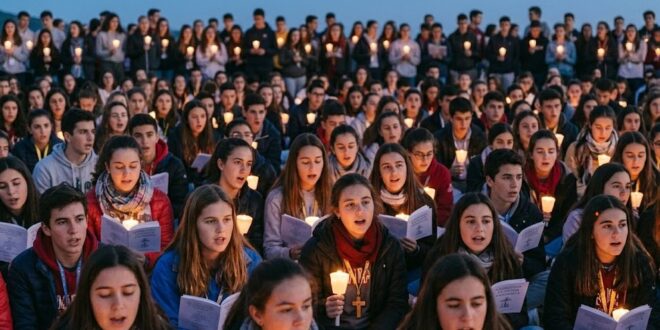
For many Catholics, the word “vigil” evokes images of dimly lit churches, burning candles, nighttime adoration, or the solemn Easter Vigil. However, few people truly understand the biblical, theological, and spiritual depth contained within this practice.
What exactly is a vigil? Why have Christians kept watch during the night since apostolic times? Does it still make sense in the twenty-first century? How can an ordinary believer make a vigil?
The answer leads us to the very heart of the relationship between God and man.
What Does the Word “Vigil” Mean?
The word comes from the Latin vigilia, which means “to stay awake,” “to keep watch,” or “to stand guard.”
In the Roman world, vigils were the nighttime watches kept by soldiers responsible for guarding a city or military camp. The Church adopted this image and gave it a profound spiritual meaning.
The Christian is a watchman.
Not because he fears an enemy invasion, but because he awaits the coming of his Lord.
For this reason, the Christian vigil consists fundamentally in remaining awake for God through prayer, adoration, meditation on the Word, and penance.
It is not simply about staying awake.
It is about keeping spiritual watch.
The Biblical Foundation of the Vigil
The practice of keeping watch appears throughout Sacred Scripture.
God constantly calls His people to remain spiritually awake.
Christ Himself insists on this repeatedly.
When speaking about His Second Coming, He says:
“Watch therefore, for you know neither the day nor the hour.” (Mt 25:13)
And also:
“Be on guard, keep awake. For you do not know when the time will come.” (Mk 13:33)
Vigilance is not an optional recommendation.
It is an essential attitude of the disciple.
Jesus Spent Entire Nights in Prayer
Before choosing the Twelve Apostles, we read:
“In these days he went out to the mountain to pray, and all night he continued in prayer to God.” (Lk 6:12)
Christ, true God and true man, devoted entire nights to dialogue with the Father.
If the very Son of God felt the need to withdraw during the night to pray, how much more do we?
The Vigil in Gethsemane
One of the most moving moments in the Gospel occurs during Christ’s agony in the Garden of Olives.
Jesus asks Peter, James, and John to keep watch with Him.
But He finds them asleep.
Then He says to them:
“Watch and pray that you may not enter into temptation.” (Mt 26:41)
This phrase summarizes the entire spirituality of the vigil.
To keep watch is not merely to wait.
It is to engage in spiritual combat.
It is to remain beside Christ when others sleep.
It is to accompany Him in His suffering.
It is to resist temptation through prayer.
The Vigil Among the First Christians
The first Christians inherited this practice directly from the Apostles.
We know from ancient writings that Christian communities frequently gathered during the night to pray.
This was especially true during times of persecution.
The darkness offered a certain protection from pagan authorities.
But it also had a symbolic meaning.
Christ was the Light shining in the midst of darkness.
Christians kept watch awaiting the dawn of the Resurrection.
The Vigils of the Martyrs
In the first centuries, the faithful often gathered during the night before the feast of a martyr.
They prayed, listened to biblical readings, and celebrated the Eucharist.
These nighttime celebrations became the origin of many liturgical vigils that still exist today.
The Great Easter Vigil: Mother of All Vigils
Among all the vigils of the Church, one occupies a unique place.
The solemn Easter Vigil.
The Fathers of the Church called it:
“The mother of all holy vigils.”
During this celebration, the Church remains awake awaiting the Resurrection of Christ.
Every symbol points toward this reality:
- The night.
- The new fire.
- The Paschal Candle.
- The readings recounting salvation history.
- The singing of the Exsultet.
- The proclamation of the Resurrection.
It is the most perfect liturgical representation of the Christian’s vigilant expectation.
The Theological Dimension of the Vigil
The vigil is not merely a pious devotion.
It has deep theological roots.
1. It Expresses Expectation of the Kingdom
The entire Christian life is a waiting.
We await Christ’s glorious return.
We await the resurrection of the dead.
We await eternal life.
The vigil symbolizes this expectation.
Like the wise virgins of the Gospel who kept their lamps burning while awaiting the bridegroom.
2. It Is a Participation in Christ’s Prayer
When we keep vigil, we unite ourselves to the nights of prayer spent by Jesus.
We spiritually enter into His eternal dialogue with the Father.
The vigil introduces us into the intimacy of Trinitarian life.
3. It Is an Act of Love
Love seeks the presence of the beloved.
Whoever loves desires to spend time with the one he loves.
For this reason, the saints understood that remaining awake out of love for Christ possessed immense spiritual value.
Not because God needs our hours.
But because our hearts need to offer them to Him.
4. It Has a Penitential Character
Voluntarily giving up rest can become a small mortification offered to God.
Spiritual tradition has always seen the vigil as a moderate form of penance.
Not to punish the body.
But to educate the will and order one’s affections.
What Is the Purpose of Keeping a Vigil?
Many people wonder what concrete fruits it can produce.
The experience of centuries answers clearly.
It Strengthens the Life of Prayer
During the night there are fewer interruptions.
Silence fosters recollection.
The mind becomes more receptive to God’s action.
It Helps Us Hear the Lord’s Voice
The prophet Elijah discovered that God was not in the earthquake nor in the fire.
He revealed Himself in a gentle whisper.
The vigil creates the conditions necessary to perceive that voice.
It Purifies the Heart
Remaining in prayer when the body desires rest involves a small sacrifice.
That effort strengthens the interior life.
It Increases Love for the Eucharist
Many vigils are carried out before the Blessed Sacrament.
Prolonged adoration deeply transforms the soul.
The saints are unanimous on this point.
No one remains for long before Christ in the Eucharist without being changed.
It Protects Against Temptations
Christ’s words in Gethsemane remain as relevant as ever:
“Watch and pray that you may not enter into temptation.”
Vigilant prayer strengthens the soul against sin.
How to Make a Catholic Vigil
There is no single method.
It can be adapted to each person’s circumstances.
Nevertheless, certain elements are especially recommended.
1. Begin with a Specific Intention
The vigil should be offered for something.
For example:
- Personal conversion.
- Reparation for sins.
- The Church.
- The souls in Purgatory.
- The family.
- Priests.
- The sick.
- Peace.
A clear intention gives spiritual unity to the entire prayer.
2. Create a Suitable Environment
If the vigil is done at home:
- Turn off unnecessary devices.
- Seek silence.
- Place a crucifix nearby.
- Light a candle if possible.
Everything should foster recollection.
3. Read Sacred Scripture
The Word of God should occupy a central place.
Especially appropriate are:
- The Gospels.
- The Psalms.
- The Passion of Christ.
- The eschatological discourse in Matthew 24–25.
4. Pray
This may include:
- The Rosary.
- The Chaplet of Divine Mercy.
- The Liturgy of the Hours.
- Spontaneous prayers.
- An examination of conscience.
5. Remain in Silence
Many people speak constantly during prayer.
The vigil also invites us to listen.
God often speaks in silence.
6. End with Thanksgiving
Every vigil should conclude by thanking God for the time spent with Him.
Is It Necessary to Stay Awake All Night?
No.
There is a mistaken idea that a vigil must necessarily last until dawn.
The Church’s tradition is far more flexible.
A vigil may last:
- One hour.
- Two hours.
- Part of the night.
- The entire night on special occasions.
The essential thing is not its duration.
It is the interior disposition.
God looks at love, not at the clock.
The Saints and Vigils
Saint Benedict of Nursia organized monastic life around nighttime prayer.
Saint Dominic de Guzmán spent long hours in vigil interceding for sinners.
Saint Francis of Assisi devoted entire nights to contemplation.
Saint John Mary Vianney drastically reduced his hours of sleep in order to remain in prayer.
However, all of them taught that vigils must be practiced with prudence and humility.
They are not an ascetical competition.
They are an expression of love.
The Vigil in a World That Never Rests
Paradoxically, our society spends many nights awake.
But not keeping watch for God.
Screens, social media, streaming platforms, video games, and entertainment consume hours that once belonged to rest or recollection.
The problem is not merely sleeping less.
It is remaining awake for everything except God.
The Christian vigil thus appears as a prophetic response.
It is a way of saying:
“Lord, in the midst of a distracted world, I want to reserve this time for You.”
An Invitation for Our Time
Perhaps you have never made a vigil.
Maybe you consider it something reserved for religious communities or exceptionally devout people.
The Church’s tradition teaches otherwise.
Every baptized person is called to keep watch.
Not necessarily throughout the entire night.
But certainly to cultivate a vigilant heart.
A heart that waits.
That listens.
That loves.
That remains spiritually awake while the world sleeps.
Because the true vigil does not consist merely in keeping one’s eyes open during the night.
It consists in keeping the soul awake for God.
And when a soul learns to keep watch with Christ, it discovers something extraordinary: that in the silence of the night, when everything seems to stand still, God continues speaking to the heart of the one who seeks Him.
As the prophet says:
“My soul yearns for you in the night; my spirit within me earnestly seeks you.” (Is 26:9)
This is, ultimately, the essence of every Christian vigil: to remain with the Lord, to await His coming, and to allow the light of Christ to illuminate the nights of our lives until He leads us to the eternal dawn of the Resurrection.