Related Articles



If you have ever begun the Rosary with the best intentions and suddenly found yourself thinking about work, the grocery shopping, a pending conversation, or even completely random things, you are not alone.
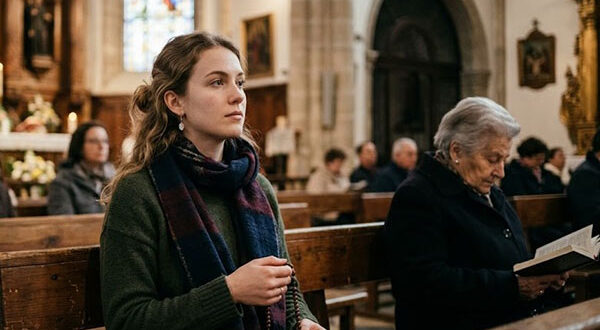
If during Holy Mass you have caught yourself looking at the clock, observing other people, thinking about family problems, or planning the rest of your day, you are not an exception either.
In fact, one of the most universal experiences of the spiritual life is the struggle against distractions.
Many Catholics feel guilty about it. Some even come to think that their prayers are worthless. Others believe they are bad Christians because they cannot maintain constant attention on God.
However, the spiritual tradition of the Church teaches something very different: distractions are part of the fallen human condition and, far from being a reason to abandon prayer, they can become an opportunity for spiritual growth.
The real question is not whether you get distracted or not.
The real question is what you do when you realize that you have become distracted.
This article aims to answer that question from the perspectives of theology, spirituality, and the pastoral experience of the Church.
A Reality as Old as Humanity
Distractions are not a modern problem.
Many people believe that lack of concentration is a consequence of the internet, social media, or smartphones. While these things certainly aggravate the problem, distractions existed long before them.
The Desert Fathers of the fourth century spoke extensively about them.
Those monks lived isolated in the deserts of Egypt, far from the noise of the world, without phones, television, or internet.
And yet they suffered constant distractions during prayer.
Why?
Because the problem is not only outside of us.
It is also within us.
Our imagination, our memory, our worries, our desires, and our wounds continually produce thoughts that compete for our attention.
A monk could be alone in a cave and still have his mind filled with memories, concerns, and fantasies.
The same thing happens to us.
The Theological Root of the Problem
Catholic theology explains this phenomenon through the consequences of Original Sin.
Before the Fall, human faculties were perfectly ordered.
The intellect illuminated the will.
The will governed the passions.
Everything was harmonized under God.
However, after sin entered the world, what theologians call concupiscence appeared: a tendency toward interior disorder.
This does not mean that man is totally corrupt.
It means that there is a permanent inclination toward dispersion, selfishness, and spiritual disorganization.
That is why it is easier to think about a thousand things during prayer than to remain focused on God.
The human mind, wounded by sin, has a natural tendency to wander.
Prayer requires an effort that goes against that tendency.
Even the Saints Struggled with Distractions
One of the devil’s greatest lies is making us believe that the saints prayed without difficulties.
The reality is very different.
Many saints described authentic interior battles.
Saint Teresa of Ávila compared the imagination at times to a madwoman impossible to control.
At certain moments she said that her mind seemed like a wild horse running from one place to another.
Saint Francis de Sales taught that patience with oneself is essential when distractions arise.
Saint Alphonsus Liguori explained that the merit of prayer does not consist in feeling fervor but in persevering.
Even Saint John Vianney, the Curé of Ars, had to fight continually against thoughts that sought to draw him away from God.
The saints were not people incapable of becoming distracted.
They were people who learned to return to God again and again.
What the Bible Says
Sacred Scripture repeatedly shows the need to keep the heart centered on God.
Our Lord said:
“Watch and pray that you may not enter into temptation; the spirit indeed is willing, but the flesh is weak” (Matthew 26:41).
These words were spoken in Gethsemane.
The Apostles, instead of accompanying Christ in prayer, fell asleep.
Human weakness was already present.
We also find this exhortation:
“Be still, and know that I am God” (Psalm 46:10).
Prayer requires recollection.
Not because God needs our silence, but because we need to silence our interior noise in order to hear Him.
And Saint Paul exhorts us:
“Pray without ceasing” (1 Thessalonians 5:17).
This does not mean constantly repeating words.
It means living oriented toward God.
Do Distractions Invalidate Prayer?
This is one of the most common questions.
The answer is clear:
No.
An involuntary distraction does not invalidate prayer.
Nor does it invalidate participation in Holy Mass.
Catholic moral theology distinguishes between what is voluntary and what is involuntary.
If a person sincerely tries to pray and, without intending it, his mind wanders, he is not sinning.
The situation changes when someone deliberately entertains thoughts unrelated to prayer or consciously refuses to pay attention to God.
But spontaneous distractions are simply part of our fragility.
The merit lies precisely in returning.
Every time you return to God, you are performing an act of love.
The Spiritual Value of Returning Again and Again
Imagine a small child trying to walk toward his father.
He takes a few steps.
He falls.
He gets back up.
He advances a little farther.
He stumbles again.
Does the father become angry?
On the contrary.
Each effort increases his tenderness.
Something similar happens with God.
Many times we think that perfect prayer is prayer in which we never become distracted.
The spiritual tradition teaches something else.
Prayer pleasing to God is prayer in which we continue seeking Him even when it is difficult.
Every return of the mind to God is a small act of love.
Every time we leave aside a worry in order to return to Christ, we are saying:
“Lord, I choose You.”
The Devil and Distractions
The Catholic tradition recognizes that some distractions may be encouraged by demonic temptations.
Not because every strange thought comes directly from the devil.
That would be an exaggeration.
But because Satan hates prayer.
He knows that a soul that prays is a soul that grows stronger.
That is why he tries to scatter, disturb, and discourage.
His favorite strategy is usually not to prevent us from praying.
It is to convince us that our prayer is worthless.
When after a distraction we think:
“There is no point in continuing.”
“I prayed badly.”
“God is disappointed with me.”
Then the enemy has achieved something far more dangerous than a simple distraction.
He has succeeded in sowing discouragement.
Distractions During Holy Mass
The Mass deserves special attention because it is the most important act of Christian life.
There, the Sacrifice of Calvary becomes sacramentally present.
We are not simply attending a religious gathering.
We are entering into Christ’s redemptive mystery.
However, precisely because of its importance, Mass often becomes a battlefield of the spiritual life.
Distractions arise continually.
Thoughts.
Noises.
Worries.
Observations about other people.
Fatigue.
Boredom.
Everything seems to conspire to draw us away from the altar.
The solution is not to despair.
It is to return constantly to the mystery being celebrated.
When you discover that you have become distracted, simply return interiorly:
“Jesus, here I am.”
Nothing more.
The Modern Problem: A Culture of Distraction
Although distractions have always existed, our time presents particular difficulties.
We live in a culture designed to fragment attention.
Notifications.
Short videos.
Instant messages.
Constant advertising.
Permanent stimulation.
The brain becomes accustomed to changing focus every few seconds.
Then we try to pray for fifteen minutes and it seems impossible.
That is not accidental.
We have trained our minds for dispersion.
That is why prayer requires greater discipline today than it did a few decades ago.
Attention has become a form of asceticism.
Keeping silence is a modern penance.
Turning off the phone can become a spiritual practice.
Practical Advice for Fighting Distractions
1. Arrive a Few Minutes Early for Mass
Recollection does not usually appear instantly.
Arriving early helps prepare the heart.
2. Pray Before You Begin
A brief prayer can make a great difference:
“Lord, help me to be with You and not to depart from Your presence.”
3. Use a Missal
Following the texts helps keep attention centered on the liturgical action.
4. Take Care of Your Rest
Many distractions come simply from fatigue.
The body also participates in the spiritual life.
5. Do Not Fight Thoughts Obsessively
Sometimes the more we try to expel a distraction, the stronger it becomes.
Recognize it and gently return to God.
6. Practice Moments of Silence Throughout the Day
The capacity for recollection is trained.
It does not appear automatically.
7. Persevere
Perseverance is worth more than passing enthusiasm.
A Teaching from the Catechism That Everyone Should Know
The Catechism of the Catholic Church teaches that distractions reveal what we are attached to.
This may seem uncomfortable, but it is profoundly useful.
When a concern continually appears during prayer, it may be pointing to an area of our life that needs to be surrendered to God.
Distractions thus become a spiritual mirror.
They show us where our heart truly is.
Perfect Prayer Does Not Exist in This Life
Many people seek absolute concentration.
They want prayer without effort, without struggle, and without interruptions.
But that perfection belongs more to Heaven than to earth.
As long as we live in this world, we will continue to experience weakness.
We will continue to have good days and bad days.
Inopportune thoughts will continue to arise.
Holiness does not consist in completely eliminating distractions.
It consists in loving God in the midst of them.
The Secret of the Saints: Always Return to Christ
If the entire spiritual teaching of the Church on this subject had to be summarized in a single sentence, it would be this:
Do not worry so much about having become distracted; worry more about returning to God.
Every return is a victory.
Every act of recovered attention is a small triumph of grace.
Every time you say:
“Lord, I became distracted, but I return to You,”
you are performing an act of love that deeply pleases God.
Conclusion: God Looks at Your Heart, Not Your Performance
We live obsessed with efficiency, performance, and results.
Sometimes we transfer that mentality into the spiritual life.
We think that prayer is valuable only if we remain perfectly concentrated.
But God is not an examiner measuring percentages of attention.
He is a Father.
And a father looks primarily at the love of his children.
If you become distracted during prayer or during Mass, do not be discouraged.
Do not give up.
Do not think that you have failed.
Return to Christ.
Return once.
Return ten times.
Return a hundred times.
Because the spiritual life does not consist in never falling, but in always returning to God.
And perhaps you will discover that those constant little returns to Him are precisely the path by which He is teaching you to love Him with humility, perseverance, and trust.
In the end, when we stand before God, He will probably not ask us how many times we became distracted, but how many times, after becoming distracted, we chose to return to Him.