Related Articles


When the Church Fills Stadiums and Social Media Lights Up
We are living in a unique era in the history of the Church. Never before has it been possible for millions of people to follow a religious celebration simultaneously from any corner of the world. A papal Mass celebrated in a major city can be watched live by faithful from all five continents. A large youth gathering can generate thousands of videos, photographs, and posts within minutes. The words of the Holy Father travel around the world even before he has finished speaking them.
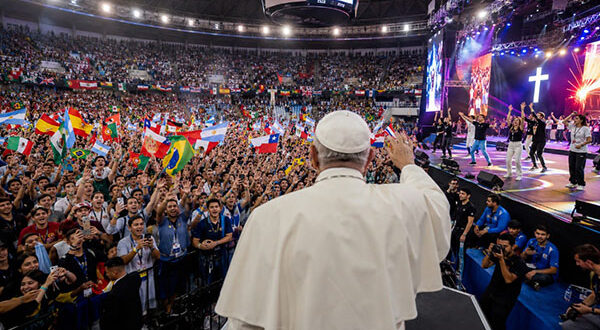
The recent visit of the Pope to Spain has once again highlighted this reality. Large gatherings, monumental stages, giant screens, musical performances, personal testimonies, massive celebrations, and an enormous media presence have accompanied days that many have experienced with emotion, hope, and joy.
Yet alongside this legitimate enthusiasm, questions have also arisen. Some faithful have looked with concern upon certain elements that seemed more characteristic of a modern concert or entertainment event than of a religious gathering. Others have celebrated precisely this ability of the Church to connect with younger generations through contemporary forms of expression.
Who is right?
The answer, as is often the case with complex matters, requires discernment. It is not enough to applaud everything, nor is it enough to condemn everything. Catholic tradition has always sought to distinguish carefully between what is essential and what is accidental, between the deposit of faith and the historical forms through which that faith is transmitted.
For this reason, it is worthwhile to reflect calmly upon both the lights and the shadows of contemporary large-scale Catholic events.
The Church Has Always Gathered Multitudes
Some people think that massive gatherings are a recent innovation. History, however, proves otherwise.
Our Lord Jesus Christ preached before thousands of people. The Gospels recount the multiplication of the loaves and fishes for five thousand men, not counting women and children (cf. Mt 14:13–21). Crowds followed Christ through cities and along roads.
The early Church also experienced large gatherings. Pilgrimages, patronal feasts, jubilees, and major celebrations have accompanied Catholic life for centuries.
The Middle Ages witnessed immense processions, the preaching of saints such as Saint Vincent Ferrer and Saint Bernardino of Siena before vast crowds, and gatherings of faithful who traveled hundreds of miles to venerate relics or participate in special celebrations.
Therefore, the issue is not the crowd itself.
The Church has never feared gathering thousands or even millions of people when the purpose is to glorify God.
The fundamental question is another one: what occupies the center?
The Decisive Criterion: Christ Must Be the Protagonist
Catholic theology teaches that every action of the Church must lead people to Christ.
The permanent risk of any large event is that the center shifts.
At times it may seem that the protagonist is the artist, the speaker, the influencer, the organizers, or even the Pope himself.
Yet the Pope is not the center of the Church.
Christ is the center.
The Successor of Peter possesses precisely the mission of pointing toward Christ, not toward himself.
The words of Saint John the Baptist should constantly resonate in every ecclesial activity:
“He must increase, but I must decrease” (Jn 3:30).
When an event leaves participants with a deeper love for Jesus Christ, a greater devotion to the Eucharist, a more intense sacramental life, and a sincere desire for conversion, we can say that it has fulfilled its purpose.
But if the experience ends up reduced to a passing emotion, a photograph for social media, or a sentimental memory without spiritual consequences, something essential has been lost.
The Evangelizing Power of Large Gatherings
It would be unfair to ignore the abundant spiritual fruits that can arise from such events.
Many young people discover for the first time that they are not alone.
In an increasingly secularized society, many Catholics live their faith with a sense of isolation. Seeing thousands of people praying together can become a profoundly transformative experience.
Many priests have recounted conversions that began during large gatherings.
Numerous priestly and religious vocations have emerged during youth events, pilgrimages, or mass celebrations.
Many confessions after years of spiritual distance have taken place precisely in these contexts.
The communal experience possesses enormous spiritual power.
Human beings need visible signs.
They need to see that the Church is still alive.
They need to witness that Christ continues to attract souls.
From this perspective, major events can become authentic instruments of evangelization.
The Temptation of Religious Spectacle
Yet alongside the lights come the shadows.
Contemporary society is deeply marked by a culture of entertainment.
Everything must be fast.
Everything must be emotionally stimulating.
Everything must create visual impact.
Everything must compete for our attention.
This cultural context inevitably affects religious life.
There is a constant temptation to adapt the faith to the logic of spectacle.
When this happens, the risk is enormous.
The liturgy ceases to be perceived as worship and becomes a performance.
Sacred music ceases to elevate the soul and becomes mere entertainment.
Participants cease to feel like pilgrims and become spectators.
Silence disappears.
Contemplation disappears.
Adoration disappears.
And when adoration disappears, the very heart of the Christian religion begins to weaken.
The Problem Is Not Christian Joy
Some mistakenly believe that every festive expression is incompatible with faith.
Catholic tradition proves precisely the opposite.
Patronal feasts, pilgrimages, processions, popular celebrations, and many cultural expressions of Catholicism have always included joy, music, and celebration.
Christian faith is not sadness.
The Resurrection is a cause for rejoicing.
The problem is not joy.
The problem is superficiality.
There is an immense difference between joy born of God and excitement produced by entertainment.
The first leads to interior peace.
The second disappears when the show ends.
The first transforms the soul.
The second merely stimulates emotions.
For this reason, the Church must constantly discern which elements truly help evangelization and which merely imitate the models of the world.
Screens: Opportunity and Danger
One of the most characteristic phenomena of our age is the omnipresence of screens.
Millions of people know the activities of the Church exclusively through short videos, livestreams, or social media posts.
This represents an extraordinary opportunity.
Never before has it been so easy to proclaim the Gospel.
A priest can explain Catholic doctrine to hundreds of thousands of people using nothing more than a mobile phone.
A Eucharistic adoration can reach places where there are no churches.
A message from the Pope can be spread instantly throughout the world.
But there is also an obvious danger.
Faith can be reduced to content.
Spiritual life can be confused with digital consumption.
We may end up watching videos about God without spending time in prayer.
We may listen to homilies for hours without going to confession.
We may share religious images without truly living the Gospel.
Technology must be a bridge to Christ, never a substitute for Christ.
The Liturgy Is Not a Concert
This statement deserves special attention.
The liturgy constitutes the supreme sacred action of the Church.
It is not an act of entertainment.
It is not a spectacle.
It is not a motivational gathering.
It is not a concert.
The Holy Mass sacramentally makes present Christ’s redemptive sacrifice on Calvary.
Nothing could be more important.
For this reason, Catholic tradition has always insisted upon the dignity, beauty, and sacred character of divine worship.
When excessively worldly elements invade the liturgical space, many faithful experience confusion.
This is not necessarily nostalgia or resistance to change.
Often it is a profound spiritual intuition: the need to preserve transcendence.
Modern man is surrounded by noise.
Precisely for that reason he needs places where he can encounter silence.
He is saturated with entertainment.
Precisely for that reason he needs spaces of adoration.
The Church should not compete with the world in terms of spectacle.
She must offer what the world cannot offer.
The presence of God.
The Risk of Papolatry
Papal visits naturally generate enthusiasm.
This is understandable.
The Pope is the Successor of Peter.
He is the Vicar of Christ.
He is the visible sign of the unity of the Church.
However, Catholic tradition has always warned against an excessive exaggeration of papal prominence.
The Catholic faith does not consist in following the personality of a particular pontiff.
It consists in following Jesus Christ.
Popes come and go.
Christ remains.
Crowds change.
The Church remains.
Fashions disappear.
Truth remains.
A papal visit, properly lived, should strengthen love for the Church, the sacraments, and daily Christian life.
It should not generate an emotional dependence based solely on extraordinary events.
What Remains When the Spotlights Go Out
Every papal visit comes to an end.
The stages are dismantled.
The screens are turned off.
The songs cease.
The crowds return home.
Then the decisive question emerges.
What remains?
If after the event there are more confessions, more Eucharistic adoration, more families praying together, more young people discerning their vocation, and more faithful living the Gospel coherently, then the event will have borne fruit.
But if only memories, photographs, and passing emotions remain, the seed will have fallen upon shallow ground.
Christ Himself warned us:
“You will know them by their fruits” (Mt 7:16).
That is the definitive criterion.
Not the number of attendees.
Not the media coverage.
Not the social media trends.
Spiritual fruits.
A Call to Catholic Discernment
The recent visit of the Pope to Spain invites all Catholics to undertake an exercise of calm and balanced discernment.
We must not fall into the naivety of approving everything without reflection.
Nor should we fall into a constant criticism that sees only defects.
The authentically Catholic perspective always seeks the whole truth.
It gives thanks for the fruits of evangelization.
It recognizes the existing risks.
It defends the sacredness of the liturgy.
It values Christian joy.
It takes advantage of modern means of communication.
But it never sacrifices the essence of the faith in order to adapt to the spirit of the world.
The Church has the mission of evangelizing every age.
Including our own.
She must speak to contemporary man.
She must use the means available.
She must go out to meet new generations.
But she must always remember that her greatest treasure is not stages, screens, or communication strategies.
Her greatest treasure is Jesus Christ.
Yesterday, today, and forever.
And when He remains at the center, every celebration, no matter how large, truly becomes a path leading to God.