Related Articles

Introduction: Two Liturgical Reforms Separated by Four Centuries, Yet with Similarities Worth Examining
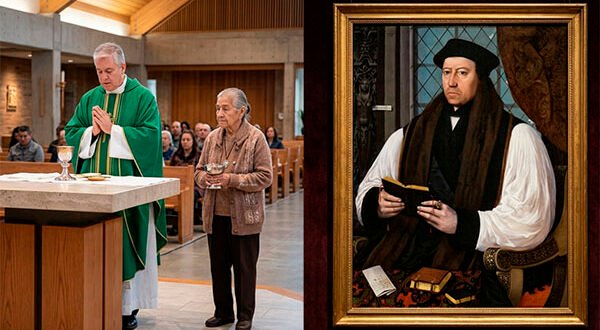
In 1549, Thomas Cranmer, Archbishop of Canterbury, published the first Book of Common Prayer, which profoundly transformed the liturgy of the Church of England. Three years later, in 1552, a second edition appeared, introducing even more substantial changes that broke with traditional Catholic Eucharistic theology.
Four centuries later, in 1969, Pope Paul VI promulgated the new Roman Missal, the fruit of the liturgical reform that followed the Second Vatican Council.
A considerable historical distance separates these two events, yet they also raise a question that has generated intense debate among historians, liturgists, and Catholic theologians: Why do certain changes introduced by Cranmer in sixteenth-century English liturgy bear similarities to some of the changes that we find in the Novus Ordo?
This comparison is not merely a superficial question of liturgical aesthetics. It concerns elements as important as:
- The replacement of the ancient Offertory prayers.
- The modification of sacrificial language.
- The presentation of the Eucharist as a sacrifice or as a memorial.
- The transformation of the altar and its meaning.
- The simplification of ceremonial gestures.
- The participation of the congregation.
- The modification of the words and formulas used for Holy Communion.
- The relationship between the ministerial priesthood and the community of the faithful.
These are questions that deserve careful examination.
However, we must establish one fundamental distinction from the outset: identifying similarities between two reforms does not automatically prove that one copied the other. Demonstrating direct historical influence requires documents, testimonies, or evidence of intellectual transmission.
Our purpose, therefore, will be to compare the texts and liturgical transformations, identify genuine points of convergence, and examine their doctrinal differences without presenting as established facts what are merely hypotheses.
The question accompanying us throughout this examination will be this: To what extent did the changes introduced by Cranmer in English liturgy anticipate forms and principles that would reappear centuries later in the reform of the Roman Rite?
1. The First Key: There Was Not Just One Cranmer Reform
To compare the two reforms correctly, we must distinguish between the two principal editions of the Book of Common Prayer.
This distinction is essential because the 1549 book still preserved numerous elements of the ancient English Catholic liturgy, whereas the 1552 edition introduced much more profound changes.
The 1549 Book: Preserving the Structure While Modifying the Content
The first edition retained a structure recognizable to those familiar with the ancient Roman Mass, particularly the Sarum Rite, one of the principal medieval liturgical traditions of England.
It preserved elements such as:
- The Kyrie.
- The Gloria.
- The Creed.
- The Sanctus.
- A Eucharistic prayer with a structure inherited from the ancient Canon.
- Certain traditional vestments and ceremonies.
Nevertheless, it introduced important theological modifications. For example, the Eucharistic Prayer spoke of the bread and wine becoming for the faithful the Body and Blood of Christ, using wording different from the traditional expression that they should become such.
The change might have appeared minor from a linguistic perspective, but it was connected to a much deeper theological controversy.
The 1549 edition was therefore a transitional reform: it retained a considerably traditional appearance while introducing elements capable of expressing a Reformed understanding of the Eucharist.
The 1552 Book: Removing the Ambiguities
The second edition went considerably further.
The revision sought to eliminate expressions and ceremonies that could be interpreted according to the traditional Catholic doctrine of the Mass.
Historical research into this reform identifies deliberate changes in the terminology of the altar, vestments, gestures of the celebrant, and structure of the Communion service.
This second edition is the one we must primarily use when establishing comparisons with the Novus Ordo.
We must not indiscriminately compare the Missal of Paul VI with any version of the Book of Common Prayer: the most significant model for examining the similarities is the 1552 rite.
2. First Similarity: The Transformation of the Offertory
This is probably one of the most important comparisons from the perspective of liturgical theology.
The Offertory in the Traditional Roman Mass
In the traditional Roman Missal, the Offertory contains prayers that explicitly express the sacrificial nature of what is taking place.
The priest presents the Host and the chalice to God, anticipating sacramentally the offering of Christ.
Among these prayers we find:
Suscipe, sancte Pater, omnipotens aeterne Deus, hanc immaculatam hostiam…
“Receive, O Holy Father, almighty and eternal God, this spotless Host…”
And also:
Offerimus tibi, Domine, calicem salutaris…
“We offer unto Thee, O Lord, the chalice of salvation…”
The vocabulary is unequivocally sacrificial: it speaks of a Host, an offering, and a sacrifice.
The Offertory in Cranmer
In the 1552 reform, the language characteristic of the sacrificial Offertory was eliminated from the Communion service.
The presentation of the elements became fundamentally associated with the collection and preparation of the Communion Table.
This was not simply a matter of replacing some words with others: it formed part of a programme of theological transformation intended to eliminate the Catholic interpretation of the Eucharistic sacrifice.
The Offertory in the Novus Ordo
In the Missal of Paul VI, we find an important modification.
The ancient Offertory prayers were replaced by the formulas:
Benedictus es, Domine, Deus universi…
“Blessed are you, Lord God of all creation…”
The priest presents the bread and wine as gifts received from God’s generosity, fruits of the earth, the vine, and human labour.
The difference from the traditional Offertory is evident.
| Traditional Mass | Novus Ordo | Cranmer, 1552 |
|---|---|---|
| Explicit prayers offering the Host and chalice. | Blessing and presentation of the gifts. | Elimination of the traditional sacrificial language of the Offertory. |
| References to sacrifice and expiation. | Sacrificial language is developed principally in the Eucharistic Prayer. | Reorientation of the celebration towards the Communion service. |
Here we find an important formal similarity: the disappearance of the ancient explicit formulas of the sacrificial Offertory.
However, there is also an essential difference: in the Novus Ordo, the sacrificial offering of the Mass does not disappear. It is explicitly expressed in the Eucharistic Prayer.
Furthermore, there is a historical detail worth noting: the new formulas for the presentation of the gifts in the Novus Ordo have a very close textual relationship with Jewish table blessings, the berakhot. There is insufficient evidence to attribute them directly to Cranmer.
We can therefore speak of a similarity in the outcome of the Offertory reform, but not of textual identity or demonstrated historical dependence.
3. Second Similarity: The Shift from the Altar Towards the Communion Table
The altar is one of the most significant elements of Christian liturgy.
In Catholic tradition, it represents the place of the Eucharistic sacrifice and, at the same time, the Lord’s Table at which sacramental food is offered.
Cranmer’s reform profoundly modified this understanding.
The English Transformation of 1552
In the second Book of Common Prayer, the designation altar systematically disappeared in favour of communion table.
The transformation was not merely terminological.
The replacement of the old stone altars with wooden Communion Tables was promoted. Regulations were also established concerning their placement and the position of the minister.
The objective was connected with the new Protestant understanding of the Eucharist and the rejection of the Mass as a propitiatory sacrifice.
The table expressed a different conception of the celebration: the gathering of the faithful around the Lord’s Supper.
The Transformation of Liturgical Space in the Novus Ordo
In numerous Catholic churches, following the reform, free-standing altars were introduced, and the celebration facing the congregation became widespread.
The visual result can recall certain arrangements found in Reformed churches.
The priest is positioned facing the congregation, and the altar table acquires a more immediate visual presence within the celebratory space.
Here there is a similarity worth acknowledging.
However, an important difference must be noted: the reformed Roman Missal continues to designate this place as an altar and maintains its sacrificial meaning. The General Instruction of the Roman Missal, in numbers 296-298, expressly regulates the altar as the place where the Eucharistic sacrifice is made present.
Nor did the Second Vatican Council order all priests to celebrate facing the congregation.
We cannot therefore claim that the present arrangement of Catholic altars is a direct copy of Cranmer’s Communion Table.
What we can observe is a transformation in the visual perception of the celebration: in certain contexts, the traditional altar as the visual centre of the sacrifice has given way to an arrangement that emphasises the relationship between the celebrant and the congregation.
The theological question is whether this arrangement sufficiently preserves the twofold dimension of the altar as both the place of sacrifice and the Lord’s Table.
4. Third Similarity: The Simplification of Ceremonies and the Reduction of Priestly Gestures
The traditional Roman liturgy possesses a highly developed ceremonial language.
Bows, genuflections, kisses of the altar, incensations, signs of the Cross, silences, and movements of the celebrant are not mere decorations.
They express reverence, adoration, sacrifice, and the sacred nature of the liturgical action.
Cranmer and the Elimination of Traditional Ceremonies
The 1552 edition considerably reduced the ceremonial elements associated with the ancient Mass.
Among the modifications we find:
- The suppression of traditional sacrificial vestments.
- The elimination of certain manual actions performed by the priest.
- The disappearance of gestures associated with Eucharistic adoration.
- The transformation of the arrangement of the liturgical space.
- The suppression of elements that could suggest the Real Presence according to the Catholic understanding.
These modifications had a recognizable doctrinal motivation: to eliminate what the Reformers considered to be expressions of an erroneous understanding of the Eucharist.
Simplification in the Novus Ordo
The 1969 Missal also introduced a simplification of certain ceremonies.
Some genuflections, signs of the Cross, private prayers, and repetitions found in the previous Missal were reduced.
Certain prayers accompanying the priest’s gestures also disappeared.
This produced an outwardly simpler celebration.
The similarity with Cranmer lies in the reduction of certain ceremonial elements inherited from the medieval tradition.
But here we must establish a fundamental difference: Catholic simplification was not officially intended to deny the Real Presence or eliminate the sacrificial dimension of the Mass.
Indeed, the new Missal retains genuflections, adoration, incensation, and other signs of reverence towards the Eucharist, although they are distributed differently.
The similarity lies in the transformation of ritual language; the difference lies in the doctrine underpinning each reform.
5. Fourth Similarity: The Priest and the Congregation in the Celebration
Another aspect deserving attention is the relationship between the priest and the faithful.
In the traditional Mass, the priest’s orientation towards the altar symbolically expresses that priest and people are together directing themselves towards God.
It is not a matter of the priest turning his back on the faithful, but rather of both looking towards the same spiritual destination.
Cranmer’s Liturgy
The English reform of 1552 reorganised the space and the position of the minister around the Communion Table.
The minister was to stand at the north side of the table, which was arranged differently from the ancient altar.
The celebration acquired a configuration closer to that of the gathering of the faithful for Communion.
The Evolution in the Reformed Roman Rite
The Novus Ordo encouraged more visible participation by the faithful through:
- The habitual use of vernacular languages.
- The responses and acclamations of the congregation.
- The expansion of the interventions of readers and other ministers.
- The possibility of celebrating with the priest facing the congregation.
- Greater visibility of the different moments of the celebration.
The similarity with certain Protestant practices is perceptible, particularly when the celebration is viewed from an external perspective.
However, it would be a mistake to consider the participation of the faithful a Protestant innovation.
Active participation is deeply rooted in Christian tradition. The faithful are not passive spectators: they participate in the liturgy through their Baptism and unite themselves spiritually to the offering of Christ.
The problem arises when active participation is confused with constant intervention, the congregation becoming the protagonist, or the transformation of the Mass into a community gathering.
Catholic participation consists above all in interiorly uniting oneself to the sacrifice of Christ, not in becoming the protagonist of the celebration.
6. Fifth Similarity: The Language of the Lord’s Supper and the Understanding of the Eucharist
This is probably the most important doctrinal question in the entire comparison.
For Cranmer, the Catholic understanding of the Mass as a propitiatory sacrifice was unacceptable.
The 1552 reform sought to ensure that the liturgy expressed a different theology.
The very title of the Eucharistic service became The Order for the Administration of the Lord’s Supper or Holy Communion.
In other words, “Order for the Administration of the Lord’s Supper or Holy Communion”.
The traditional designation of Mass disappeared.
The celebration was organised around the Word, prayer, and reception of Communion, without preserving the sacrificial structure of the ancient Roman rite.
What Happens in the Novus Ordo?
The new Missal also makes extensive use of expressions related to the Lord’s Supper, the breaking of bread, and Communion.
The structure of the celebration clearly presents:
- The Liturgy of the Word.
- The Presentation of the Gifts.
- The Eucharistic Prayer.
- Communion.
The Lord’s Supper occupies a very visible place in the pastoral understanding of the celebration.
Nevertheless, we must point out an essential difference: the Eucharistic Prayer of the Novus Ordo is not simply a prayer of blessing over a communal meal.
It contains thanksgiving, the invocation of the Holy Spirit, the institution narrative, the anamnesis, the sacrificial offering, and the intercessions.
The Catholic Church continues to teach that the Mass is a propitiatory sacrifice, as defined by the Council of Trent.
Therefore, the use of more accessible language concerning the Lord’s Supper is not equivalent to accepting Cranmer’s Eucharistic theology.
Nevertheless, it is legitimate to ask whether, in certain celebrations and in the catechesis accompanying them, the banquet dimension has acquired a prominence that may make the sacrificial dimension less perceptible.
7. Sixth Similarity: The Words of Communion and the Reception of the Eucharist
Comparing the formulas used for distributing Communion is particularly interesting because it allows us to observe how a liturgical modification can express a particular theological understanding.
Cranmer’s Reform
In 1549, the formula used to distribute Communion retained an explicit reference to the Body and Blood of Christ.
In 1552, Cranmer introduced a significant modification.
The formula came to express:
“Take and eat this in remembrance that Christ died for thee, and feed on him in thy heart by faith, with thanksgiving.”
This wording emphasised the spiritual reception of Christ through faith and the remembrance of His sacrifice.
In the 1559 revision, the formulas of 1549 and 1552 were combined, producing an expression that would subsequently be retained in the 1662 Book of Common Prayer.
The evolution of these formulas allows us to appreciate the effort to orient the understanding of Communion towards Reformed theology.
The Formula in the Novus Ordo
In the Missal of Paul VI, the priest presents the Host saying:
Corpus Christi.
“The Body of Christ.”
The faithful respond:
Amen.
This formula does not deny the Real Presence. On the contrary, it expresses faith in what is being received.
Here we find a substantial difference from Cranmer’s 1552 formula.
Therefore, although both reforms modified elements related to the administration of Communion, there is no doctrinal identity between their formulas.
This example demonstrates why a serious comparison must examine the actual words rather than simply point out that two reforms changed the same moment of the celebration.
8. Seventh Similarity: The Simplification of the Eucharistic Prayer and the Loss of Prominence of the Roman Canon
Here we find another important difference which, at the same time, allows us to explore the comparison more deeply.
Cranmer’s Eucharistic Prayer
The 1549 book preserved a Eucharistic Prayer that retained recognisable elements of the ancient Sarum Canon.
However, it introduced modifications to its content and wording.
In 1552, the structure was transformed more profoundly. Elements that could be interpreted as expressions of the Catholic sacrificial offering were eliminated.
The purpose was to make the Communion service express Reformed theology more clearly.
The Roman Canon and the New Missal
In the Roman tradition, the Roman Canon had occupied a central place in the celebration for centuries.
The Novus Ordo retained the Roman Canon in its entirety, which became known as Eucharistic Prayer I.
However, it incorporated three other principal Eucharistic Prayers, in addition to other formulas approved subsequently.
This represented an important modification of the liturgical experience.
The Eucharistic Prayer was no longer ordinarily a single unchanging composition but offered different possibilities.
From a traditional perspective, one may question whether this plurality has weakened the perception of continuity with the Roman Canon, especially when Eucharistic Prayer II is used habitually.
Nevertheless, we must not confuse plurality with Protestantism.
The new Eucharistic Prayers contain references to the sacrifice of Christ and to the offering of the Church.
Furthermore, there is no basis for claiming that they were copied from Cranmer’s prayers.
It is also important to remember that Eucharistic Prayer II has as one of its historical antecedents an ancient anaphora traditionally attributed to Hippolytus of Rome, although the history of its reconstruction and modern composition is more complex.
The similarity with Cranmer is not found in textual identity, but in the transformation of an inherited liturgical structure and the introduction of new formulations.
9. Eighth Similarity: The Vernacular Language and the Comprehensibility of the Celebration
One of the most visible characteristics of both reforms was the use of the language of the people.
Cranmer and the Liturgy in English
The Book of Common Prayer replaced the Latin liturgical celebration with a celebration in English.
The intention was to enable the faithful to understand the prayers and participate in them.
This decision had enormous importance in shaping Anglican worship.
The Novus Ordo and National Languages
The Second Vatican Council also encouraged the use of vernacular languages.
However, it is important to clarify that Sacrosanctum Concilium 36 established that the use of Latin would be preserved in the Latin rites, although it permitted the extension of national languages.
Number 54 contemplated their use especially in the readings and in certain prayers and chants.
The subsequent implementation of the reform considerably expanded the use of vernacular languages.
The outward similarity with the English reform is evident: the celebration came to be conducted habitually in the language of the faithful.
But the vernacular is not an exclusively Protestant characteristic. The Eastern Catholic Churches have traditionally celebrated their liturgies in various languages.
Nor should we forget that Latin remains the proper language of the Roman Rite and that the Missal of Paul VI can be celebrated in Latin.
Therefore, the problem is not the use of an understandable language, but rather whether the widespread replacement of Latin may contribute to weakening awareness of the universality and historical continuity of Roman worship.
10. An Overall Comparison: Cranmer 1552 and the Novus Ordo
Having examined the principal elements, we can bring together the main similarities and differences.
| Element | Cranmer, 1552 | Novus Ordo, 1969 |
|---|---|---|
| Offertory | Eliminates the traditional language of the sacrificial Offertory. | Replaces the ancient prayers with formulas for the presentation of the gifts. |
| Altar | Replacement of altars with Communion Tables. | Altars are retained, although free-standing altars become widespread. |
| Ceremonies | Suppression of numerous traditional gestures and elements. | Simplification of certain ceremonies and prayers. |
| Vestments | Abandonment of traditional Mass vestments. | Catholic liturgical vestments are retained. |
| Priest | Minister positioned at the north side of the table. | Celebration facing the congregation becomes widespread, without being obligatory. |
| Language | English. | Vernacular languages become widespread, but Latin is retained. |
| Eucharistic Prayer | Revision oriented towards Reformed theology. | The Roman Canon is retained and new prayers are incorporated. |
| Communion | Formula modified to express spiritual reception through faith. | Explicit confession of the Body of Christ is retained. |
| Sacrifice | Rejection of the propitiatory sacrifice of the Mass. | Catholic doctrine of the Eucharistic sacrifice is retained. |
| Real Presence | Rejection of the Catholic doctrine of substantial presence. | The true, real, and substantial presence of Christ is retained. |
The table allows us to draw an important conclusion: the similarities principally concern certain forms, structures, and principles of reform, but they do not imply that both rites profess the same Eucharistic doctrine.
11. Were Protestants Involved in the Preparation of the Novus Ordo?
This question frequently arises in debates about the liturgical reform.
It is a historical fact that representatives of other Christian confessions participated as observers in certain activities related to the liturgical reform following the Second Vatican Council.
Their presence has been controversial, particularly regarding the influence their observations and opinions may have had.
However, we must distinguish between participating as an observer, offering comments, and having the authority to draft or approve liturgical texts.
The preparation of the new Missal belonged to the competent Catholic bodies, under the authority of the Holy See and Pope Paul VI.
It is incorrect to claim, without specific documentary evidence, that Protestants drafted the Novus Ordo or determined its doctrinal content.
Nor should we ignore the fact that certain Protestant observers may have viewed some aspects of the reform favourably.
But a positive assessment by a Protestant interlocutor does not prove that the Catholic Church adopted Protestant theology.
The more interesting question is another one: To what extent might the desire to make the liturgy more understandable and acceptable to other Christians have encouraged certain decisions that are also found in Protestant reforms?
This is a legitimate question for historical research, but it must not be transformed into an accusation of Protestant authorship without evidence.
12. The Brief Critical Examination of 1969: The Warnings of Ottaviani and Bacci
The comparison between the traditional reform and the new liturgy was not a concern that appeared many years later.
In September 1969, Cardinals Alfredo Ottaviani and Antonio Bacci presented Pope Paul VI with the well-known Brief Critical Examination of the Novus Ordo Missae.
The document expressed their concern about how certain modifications might affect the Catholic understanding of the Eucharistic sacrifice.
Its authors particularly highlighted:
- The modification of the Offertory.
- The presentation of the Mass.
- The importance attributed to the congregation.
- The expression of the sacrificial character.
- The doctrinal clarity of certain formulations.
The document stated that the new Missal represented, in the judgment of its authors, a notable departure from the Catholic theology of the Mass formulated by the Council of Trent.
It is important to remember that this was a critical study prepared by a group of theologians and presented by the two cardinals, not a magisterial declaration condemning the new Missal.
Nor should the document be credited with proving that the Novus Ordo originated with Cranmer: its criticism was directed at the liturgical reform and its theological implications; it did not establish a historical genealogy between the two books.
Its importance lies in showing that reservations about the orientation and expression of the new liturgy emerged from the very moment of its promulgation.
13. What Can We Conclude from the Similarities Between the Two Reforms?
After examining the principal elements, we can establish several conclusions.
First: the liturgical similarities exist.
It is not an invention to state that certain modifications of the 1552 reform find formal parallels in changes introduced into the Roman Missal of 1969.
This is particularly true regarding ceremonial simplification, the transformation of the Offertory, the arrangement of liturgical space, and the greater visibility of the congregation.
Second: the doctrinal differences are equally real.
Cranmer promoted a transformation that rejected essential elements of Catholic Eucharistic theology.
The Novus Ordo, on the other hand, maintains Catholic doctrine concerning the sacrifice of the Mass and the Real Presence of Jesus Christ.
Third: the similarities do not prove direct copying.
We do not have sufficient documentation to claim that the authors of the Missal of Paul VI took Cranmer’s rite as their model.
Some similarities may be explained by common tendencies towards simplification, the use of ancient liturgical sources, or principles of renewal that were also present in other Christian reforms.
Fourth: the similarities deserve theological examination.
The fact that two reforms had different intentions does not mean that their formal results are irrelevant.
A reform may officially preserve doctrine and, at the same time, modify ceremonial language in such a way that certain aspects of that doctrine become less perceptible to the faithful.
This is one of the most important questions raised by this comparison.
Conclusion: When Two Reforms Resemble Each Other, History and Theology Must Speak
The comparison between Thomas Cranmer’s Book of Common Prayer and Paul VI’s Novus Ordo Missae constitutes a subject of considerable historical and theological interest.
We should not be afraid to examine their similarities, but neither should we turn them into a conclusion that the historical sources do not allow us to sustain.
What truly matters is understanding that the liturgy is not simply a succession of ceremonies that can be modified without consequences for the expression of the faith.
The Church prays as she believes and, through her liturgy, transmits to future generations what she has received from Jesus Christ and the Apostles.
That is why, when we observe that certain transformations of the Roman Rite bear similarities to those introduced by Cranmer, it is reasonable to ask whether every decision made during the modern reform was truly appropriate and whether it has always preserved the greatest possible clarity in expressing the Eucharistic mystery.
It is not a matter of denying the validity of the Novus Ordo or automatically attributing Protestant theology to it. It is a matter of rigorously studying what was modified, what was preserved, and what consequences that transformation may have for the understanding of the Holy Mass.
For there is one truth that no liturgical debate should ever obscure:
The Holy Mass is not simply a commemorative supper, nor a gathering of believers, nor a celebration of the community. It is the sacrifice of Our Lord Jesus Christ, made sacramentally present upon the altar.
The Catholic must approach this mystery with faith, adoration, and reverence.
And he must strive to ensure that the outward forms of the liturgy always manifest, with the greatest possible clarity, the greatness of what takes place before his eyes: the redemptive sacrifice of Christ, offered to the Father for the salvation of the world.
Ad maiorem Dei gloriam.
Sources for Further Study
Historical Sources
- Thomas Cranmer, The Book of Common Prayer (1549 and 1552). Fundamental texts for comparing the two versions of the English liturgy.
- Diarmaid MacCulloch, Thomas Cranmer: A Life. A major historical and biographical study of Cranmer and the English Reformation.
- Historical studies on the development of the English Communion service and the influence of Martin Bucer on the 1552 revision.
Catholic Sources
- Council of Trent, Session XXII: Doctrine on the Holy Sacrifice of the Mass.
- Second Vatican Council, Sacrosanctum Concilium, especially numbers 23, 36, 47, 50, and 54.
- Paul VI, Apostolic Constitution Missale Romanum, 3 April 1969.
- Alfredo Ottaviani and Antonio Bacci, Brief Critical Examination of the Novus Ordo Missae, 1969.
- Catechism of the Catholic Church, numbers 1362-1381.