Related Articles
We live in an age that tends to regard all things as having equal value, in which reality is understood exclusively in terms of what we can see and measure, and in which man is ultimately considered the absolute master of his own existence. The Christian vision of the universe, however, begins with a radically different understanding: reality is not a collection of isolated, equal and meaningless things, but a creation possessing structure, degrees of perfection and an orientation towards God, the source of everything that exists.
From classical metaphysics to the theology of Saint Thomas Aquinas, passing through the Church Fathers and the scholastic tradition, we encounter a fundamental idea: there is an order within being. Minerals, plants, animals, human beings, angels and, above all created things, God, do not belong to the same degree of reality, nor do they possess identical perfection.
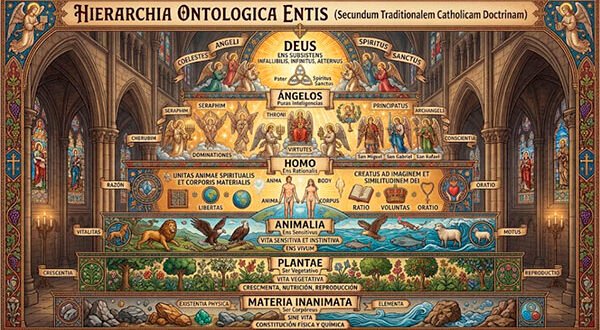
This conception is known as the ontological hierarchy of being.
Although it may appear to be a subject reserved for philosophers and theologians, its implications profoundly affect the way we understand life, human dignity, nature, morality, education and our relationship with the Creator.
Understanding this hierarchy allows us to recover a truth that the contemporary mindset has increasingly forgotten: not everything that exists possesses the same degree of perfection, but every created being has its own place, its own nature and its own value within the order established by God.
1. What Does the Ontological Hierarchy of Being Mean?
The word ontology comes from the Greek and refers to the study of being as being. Ontology asks what it means to exist, what the fundamental principles of reality are and what differences exist between the various modes of being.
When we speak of the ontological hierarchy, we refer to the order of beings according to their degree of perfection, their capacities and their particular mode of participation in existence.
It is not simply a matter of classifying things according to their usefulness, size, complexity or economic importance. It is a matter of recognising that reality possesses different levels of perfection and that each nature has properties that distinguish it from the others.
A stone exists, but it does not live. A plant lives, but it does not feel. An animal feels and moves according to its own impulses, but it does not possess the rational capacity proper to man. The human being understands, deliberates and can freely direct his actions towards the good. Angels, for their part, are spiritual creatures endowed with intelligence and will, without possessing a material body.
And God is not simply the highest being within this classification. He is infinitely different from every creature: God is Being by essence, whereas creatures exist through participation and receive from Him everything they are.
This distinction constitutes one of the foundations of Christian metaphysics.
2. God: Absolute Being and the Foundation of All Existence
To understand the ontological hierarchy correctly, we must begin with its principle and foundation: God.
The Catholic faith does not present God as one more element within the universe, nor even merely as the most powerful of all. God completely transcends the order of creatures because He does not depend on any prior reality and does not need to receive existence from another.
In the Book of Exodus, we find one of the fundamental revelations of the Old Testament. When Moses asks God what His name is, he receives this answer:
“I AM WHO I AM” (Exodus 3:14).
This expression reveals an essential truth: God is. His existence does not depend on any external condition. He has not begun to exist, He cannot cease to exist, and He needs nothing in order to be.
In the metaphysics of Saint Thomas Aquinas, we find an especially profound formulation of this truth: God is Ipsum Esse Subsistens, that is, Subsistent Being Itself.
What does this mean?
In created beings, we distinguish between what something is and the fact that it exists. We can understand the nature of a tree without that tree necessarily having to exist. The same applies to a person, an animal or any other created reality.
In God, however, there is no such composition between essence and existence. His essence is to exist. Therefore, God does not receive being: He is Being itself, eternal, necessary and independent.
Saint Thomas develops this doctrine particularly in the First Part of the Summa Theologiae, Question 3, Article 4, where he examines whether God’s essence and existence are the same.
This teaching has a decisive consequence: everything that exists outside God depends radically upon Him.
The Book of Revelation contains an expression that manifests God’s eternity and sovereignty:
“I am the Alpha and the Omega, the beginning and the end” (Revelation 21:6).
God does not simply occupy the summit of a pyramid. He is the very foundation of all reality and the ultimate end towards which creation is ordered.
3. Creation: All Beings Receive Their Existence from God
If God is Being by essence, creatures possess a received existence.
Catholic doctrine teaches that God freely created all things out of nothing. This truth is traditionally known as creatio ex nihilo.
It does not mean that God transformed pre-existing matter, but rather that everything existing outside Him has its First Cause in God.
The Catechism of the Catholic Church teaches:
“We believe that God needs no pre-existent thing or any help in order to create” (CCC, 296).
Creation is not an extension of the divine substance, nor is it a part of God that has separated itself from Him. This distinction is essential in order to avoid confusing the Christian faith with pantheistic conceptions, according to which God and the universe would ultimately be one and the same reality.
God is distinct from His creation, yet He is present within it, sustaining it in existence.
The Book of Wisdom expresses this dependence of creatures upon their Creator:
“You love all things that exist, and detest none of the things that you have made” (Wisdom 11:24).
Therefore, the ontological hierarchy does not mean that independent beings have placed themselves on different levels. All receive their existence from God and all their perfections ultimately come from Him.
The Catechism, in paragraphs 295-301, develops this doctrine concerning creation, its order and its continual dependence upon God.
Existence itself is a gift.
And precisely because every being receives its existence from God, creation is neither absurd nor meaningless. It possesses an order that can be contemplated, studied and recognised by human reason.
4. The Degrees of Perfection in Creation: From Matter to Spiritual Life
Creation displays an extraordinary diversity of beings. Each possesses its own characteristics and manifests, in a limited way, some perfection whose ultimate origin is God.
The philosophical and theological tradition generally distinguishes several degrees of perfection within the created world.
This classification helps us understand that reality is not made up of undifferentiated elements, but of distinct natures, each with its own capacities and operations.
4.1. Inanimate Beings: Existence Without Life
At the most elementary level, we find material beings that lack life: minerals, rocks, water and other elements of nature.
These beings exist, possess definite properties and act according to the laws proper to their nature. However, they have no capacity to nourish themselves, grow biologically through their own activity, reproduce or perceive the world.
A stone exists, but it does not live.
This does not mean that it lacks value. Its existence is good insofar as it comes from God and forms part of the order of creation.
Matter is also the physical foundation of many higher realities: living organisms need material elements in order to carry out their functions.
The material universe is therefore not something contemptible or accidental. It is God’s work and deserves respect.
4.2. Plant Beings: The Emergence of Life
Above inanimate beings we find plant organisms.
Plants possess life. They nourish themselves, grow, develop and reproduce. They perform operations that inanimate beings cannot carry out through their own activity.
Classical Aristotelian-Thomistic philosophy explains these differences through the concept of the soul.
It is important to clarify that, in this context, the soul should not be understood exclusively as a spiritual and immortal reality, as is the case with the human soul. The term designates the vital principle through which an organism is a living being and performs its proper operations.
Plants possess what is traditionally called a vegetative soul, whose fundamental faculties are nutrition, growth and reproduction.
Their life does not involve sensory knowledge or rational will.
In the account of Genesis, we find the appearance of vegetation within God’s creative work:
“Let the earth put forth vegetation: plants yielding seed, and fruit trees bearing fruit according to their kinds” (Genesis 1:11).
Plant life manifests a degree of perfection superior to that of inanimate matter because it incorporates capacities that the latter does not possess.
4.3. Animals: Sensible Life
A higher degree corresponds to animals.
In addition to vegetative functions, they possess sensation, perception and the capacity for movement. They can experience sensations of pain and pleasure, react to stimuli and act according to their natural inclinations.
The Thomistic tradition speaks of the sensitive soul, which constitutes the principle of their vital and sensory operations.
Animals can perceive pain and pleasure, recognise their surroundings and develop complex behaviours. However, their operations are not equivalent to the rational intelligence and free will proper to human beings.
It is important not to confuse animal intelligence, understood in a broad sense, with the human intellectual capacity to know universal realities, formulate moral judgements and reflect upon the meaning of one’s own existence.
Sacred Scripture recognises the value of animals within creation. In the Book of Psalms we read:
“How many are your works, O Lord! In wisdom you have made them all” (Psalm 104:24).
The Catechism of the Catholic Church, in paragraph 2416, reminds us that animals are God’s creatures and are under His providence. Therefore, man must treat them with respect and avoid causing them unnecessary suffering.
However, recognising their value does not require attributing to them a nature identical to that of human beings.
An animal deserves respect for what it is, not because it is an inferior version of man.
4.4. Man: The Material and Spiritual Creature
Within the visible world, the human being occupies a singular place.
Man is not merely a biological organism more complex than others. Nor is he a spirit accidentally imprisoned in a body.
Man is a substantial unity of body and spiritual soul.
This teaching belongs to the very heart of Christian anthropology and was developed especially by Saint Thomas Aquinas, who explains that the rational soul is the substantial form of the human body.
In other words, the soul is not an independent inhabitant who uses the body as though it were a tool. It is the vital principle that makes the human body precisely a human body.
The Catechism expresses this in paragraph 365:
“The unity of soul and body is so profound that one has to consider the soul to be the ‘form’ of the body.”
The human soul possesses vegetative and sensitive faculties, but also intellectual and volitional faculties.
Through intelligence, man can know the truth, understand universal concepts and reflect upon his own existence. Through the will, he can choose freely and direct his actions towards the good.
This rational and spiritual capacity distinguishes the human being from other material creatures.
But his dignity does not come solely from his intellectual abilities, productivity or autonomy.
Its deepest foundation lies in the fact that he was created in the image and likeness of God:
“Let us make man in our image, after our likeness” (Genesis 1:26).
Man is the image of God because he has received a spiritual nature, capable of knowing and loving, and because he is called to enter into communion with his Creator.
For this reason, his dignity does not depend upon age, health, intelligence, wealth or social position.
A newborn child, a person with an intellectual disability, a dependent elderly person and a man in the prime of life all possess the same fundamental human dignity.
Man’s dignity is not measured by what he can produce, but by what he is.
The Catechism develops this teaching in paragraphs 355-357.
4.5. Angels: Purely Spiritual Creatures
Above man, within the order of creatures, we find the angels.
Catholic doctrine teaches that they are spiritual, personal, intelligent and free beings, created by God.
They do not possess a material body like human beings. Their nature is spiritual and, for this reason, their manner of knowing and acting differs from ours.
The existence of angels is not simply a poetic representation of the forces of nature. It is a truth of faith belonging to the doctrine of the Church.
The Catechism, in paragraph 328, expressly states:
“The existence of the spiritual, non-corporeal beings that Sacred Scripture usually calls ‘angels’ is a truth of faith.”
The Bible offers numerous testimonies concerning their existence and mission.
In the Letter to the Hebrews we read:
“Are they not all ministering spirits sent forth to serve, for the sake of those who are to obtain salvation?” (Hebrews 1:14).
Angels serve God and participate in His providential designs. They are messengers, protectors and servants of His will.
Their spiritual nature places them at a degree of ontological perfection superior to that of material creatures, including man considered from the perspective of his purely human nature.
This does not mean that man is an insignificant creature, nor that his destiny is inferior in the order of salvation. God has called the human being to a supernatural communion with Him that surpasses the possibilities of his own nature.
The natural ontological superiority of angels must not be confused with an automatic superiority in holiness over all human beings.
A faithful angel remains in God’s grace; a human being can attain holiness through grace and be glorified by Christ.
The history of salvation is not a competition between natures, but the manifestation of God’s love for His creatures.
5. The Hierarchy of Angels and Christian Tradition
Reflection upon the order of spiritual beings has a long history in Christian theology.
One of the authors who most influenced this field was the so-called Pseudo-Dionysius the Areopagite, a Christian author from the late fifth or early sixth century.
It is important to clarify that he should not be historically identified with Dionysius mentioned in the Acts of the Apostles, although his writings circulated under that name for centuries.
His work The Celestial Hierarchy developed a theological interpretation of the order of angelic beings, distinguishing nine choirs grouped into three hierarchies.
The traditional classification is as follows:
First hierarchy:
- Seraphim.
- Cherubim.
- Thrones.
Second hierarchy:
- Dominions.
- Virtues.
- Powers.
Third hierarchy:
- Principalities.
- Archangels.
- Angels.
This classification is related to various angelic designations found in Sacred Scripture, especially in Isaiah 6:2-3, Ezekiel 10, Colossians 1:16 and Ephesians 1:21.
Pseudo-Dionysius interpreted these names within a system of order, illumination and participation in divine goodness.
The fundamental idea is that spiritual creatures receive their perfections from God and participate in His gifts according to their own nature.
This conception profoundly influenced medieval theology, especially Saint Thomas Aquinas.
Nevertheless, we must distinguish between the existence of angels, which is a doctrine of faith, and theological explanations concerning the exact distribution of their choirs and their functions, which belong to the development of theological tradition and should not all be presented as dogmatic definitions.
The Church teaches the reality of angels, but it has not defined every detail of each traditional classification as dogma.
6. Saint Thomas Aquinas: The Perfection of Being and Participation
The ontological hierarchy finds one of its most profound philosophical formulations in the thought of Saint Thomas Aquinas.
His fundamental contribution consists in explaining that created beings do not possess existence through themselves, but participate in being received from God.
In the First Part of the Summa Theologiae, Question 44, Article 1, Saint Thomas addresses precisely whether all beings proceed from God as their First Cause.
His answer is based upon an essential distinction: God is Being by essence; creatures are beings by participation.
To understand this, we can use a simple comparison.
A lamp can illuminate because it receives energy. Its ability to illuminate is not an independent property existing without any source of energy.
In an analogous way, although the comparison is limited, creatures possess being because they receive it from God, who depends upon no cause.
Saint Thomas maintains that the different degrees of perfection among creatures are related to their different modes of participating in being.
Not all creatures possess the same perfections, nor do they receive them in the same way.
A plant possesses life, but not sensation. An animal possesses sensation, but not spiritual intelligence. Man possesses a bodily and spiritual nature. An angel possesses a purely spiritual nature.
This diversity is not a defect in creation. It forms part of its richness.
In Question 47 of the First Part of the Summa Theologiae, Saint Thomas examines the distinction and multiplicity of things. There he explains that the perfection of the universe requires a diversity of creatures and different degrees of perfection.
A creation composed exclusively of identical beings would be less rich in diversity of perfections than a universe in which multiple natures exist, each with its own capacities.
Here we find an especially important idea: the perfection of the whole does not require every creature individually to possess all possible perfections, but rather that ordered diversity manifests the richness of divine wisdom.
This allows us to understand why the existence of different beings does not in itself constitute an injustice.
A stone does not need intelligence to fulfil its nature. A plant does not need freedom. An animal does not need to become a human being.
Every creature has its own perfection and contributes, in its own way, to the universal order.
7. The Ontological Hierarchy Does Not Mean That All Creatures Have the Same Moral Value
We must pause over an issue that can cause confusion.
Recognising different degrees of ontological perfection does not mean claiming that human beings can be classified into categories of dignity according to their intelligence, strength, wealth, health or social position.
The hierarchy of being does not justify any hierarchy of dignity among human persons.
All human beings share the same human nature. Therefore, all possess an inviolable fundamental dignity.
The most intelligent person is no more human than someone who has difficulty understanding. A powerful man does not possess a higher essential dignity than a poor man. A healthy person is not worth more than a sick person.
Christian doctrine rejects any interpretation that turns natural differences between people into a justification for oppression, exploitation or contempt.
We must also distinguish between ontological perfection and moral perfection.
A human being retains his nature and dignity even when he commits morally evil acts. However, his actions can either perfect or morally deform his life.
A man may possess great intellectual abilities and use them for evil. Another may have limited education and yet live with profound charity and humility.
In the moral order, holiness is not measured by social position or intellectual capacity, but by union with God and growth in the virtues.
For this reason, the ontological hierarchy must not be used to establish human privileges or justify the domination of some people over others.
Legitimate authority, according to Christian doctrine, must be ordered towards service of the common good.
Christ Himself taught His disciples:
“Whoever would be great among you must be your servant” (Matthew 20:26).
True human greatness does not consist in imposing oneself upon others, but in living according to the order of the good.
8. Grace: Man Is Called to a Destiny Beyond His Nature
Until now, we have spoken mainly about the natural order of creation. But the Catholic faith reveals something even deeper.
Man has not been created merely to live, develop his natural faculties and disappear.
He has been called to participate in the supernatural life of God.
This reality is known as sanctifying grace.
Grace does not destroy human nature or replace it with another. It elevates it, heals it and enables it to participate in divine life.
Saint Peter expresses this vocation in an extraordinary way:
“That you may become partakers of the divine nature” (2 Peter 1:4).
This participation does not mean that man becomes God by essence, nor that the distinction between Creator and creature disappears.
It means that God, through pure generosity, communicates to man a supernatural participation in His own life.
The Catechism explains this doctrine in paragraph 1997:
“Grace is a participation in the life of God.”
Here we encounter a fundamental distinction for understanding the Catholic vision of being.
One thing is the perfection that belongs to a nature by virtue of what it is; another is the supernatural elevation that God freely grants.
Man cannot attain the Beatific Vision through his own strength. No intellectual, moral or scientific effort can, by itself, produce supernatural union with God.
It is a gift of grace.
Therefore, the ultimate purpose of human existence is not simply to achieve the greatest possible development of natural capacities, but to attain eternal communion with God.
This is the vocation for which we were created.
9. Jesus Christ: The Centre of All Creation and of History
The ontological hierarchy reaches its definitive meaning when we contemplate it in the light of Jesus Christ.
Christianity does not present a universe whose order ends with man or the angels. All creation finds its principle and purpose in Christ.
Saint Paul writes:
“For in him all things were created, in heaven and on earth, visible and invisible” (Colossians 1:16).
And he adds:
“All things were created through him and for him” (Colossians 1:16).
Christ is not one more creature within the hierarchy. He is the eternal Son of God, the Second Person of the Most Holy Trinity, consubstantial with the Father.
In the Incarnation, the Word assumed a true human nature without ceasing to be God.
For this reason, Jesus Christ is true God and true man.
His humanity does not turn His divine Person into a creature, nor does it divide Christ into two persons. In Him there are two natures, divine and human, united in the one Person of the Word.
This doctrine was solemnly defined at the Council of Chalcedon, held in the year 451.
The Incarnation reveals something extraordinary: God does not despise creation, but has chosen to assume our human nature.
The human body, far from being an unworthy or contemptible reality, has been elevated to incomparable dignity through the mystery of the Incarnation.
And through the Resurrection, Christ inaugurates the new creation.
The Catechism, in paragraph 349, explains that the first creation finds its meaning and fulfilment in the new creation inaugurated by Christ’s Resurrection.
For this reason, the ontological hierarchy must not be understood as a mere philosophical classification. Its ultimate meaning is Christological.
Everything proceeds from God, everything subsists through His power, and everything is called to find its fulfilment in Christ.
10. The Ontological Hierarchy in the Face of the Contemporary Mindset
The Christian understanding of the ontological hierarchy has particular importance in our time, because many cultural currents have weakened the idea that an objective order exists within reality.
In certain contemporary approaches, there is a tendency to reduce all differences to subjective constructions, social conventions or mere power relations.
From the Catholic perspective, however, reality possesses a structure that does not depend exclusively upon what man thinks about it.
Human nature is not a cultural invention. The difference between an animal and a person is not merely a convention. Good and evil do not depend exclusively upon individual preferences either.
Human reason can discover aspects of this order because it participates in an intellectual capacity that allows it to know the truth.
This question has several important consequences.
10.1. Against Materialism: Man Is More Than Matter
Philosophical materialism, in its various formulations, maintains that reality is fundamentally explained through matter and its processes.
The Christian vision, without denying the importance of the natural sciences, affirms that reality cannot be reduced to the material.
Man possesses a spiritual dimension that cannot be adequately explained as a mere sum of physical processes.
Human intelligence does not merely react to stimuli. It can know universal truths, reflect upon the good, formulate moral judgements and ask about the meaning of its own existence.
It can also recognise that certain actions are good or evil, even when their immediate consequences appear unfavourable.
The Catholic faith maintains that the spiritual soul is created directly by God and is immortal. The Catechism explains this in paragraph 366.
This truth has decisive consequences for our understanding of death, moral responsibility and man’s eternal destiny.
If the human being were exclusively matter, his existence would be reduced to a temporary biological process. But if he possesses an immortal spiritual soul, his life has a dimension that transcends bodily death.
10.2. Against Transhumanism: Human Dignity Does Not Depend on Technical Perfection
Scientific and technological development raises increasingly important questions about human nature.
Artificial intelligence, genetic engineering, body-modification technologies and research related to extending life oblige us to reflect upon what it means to be human.
The fundamental question is not whether we should indiscriminately reject scientific progress. Science and technology can provide great benefits when placed at the service of the person and the common good.
The problem arises when human nature is considered a defective reality that must be overcome through any technological intervention, or when a person’s worth is identified with his performance, intellectual capacity or physical perfection.
From the perspective of Catholic anthropology, the body is not an object over which we may exercise unlimited control. It forms part of our personal identity.
The Catechism, in paragraphs 2288-2291, establishes moral principles concerning respect for health, bodily integrity and human dignity.
Technology must serve man, not man be subjected to an unlimited conception of technological progress.
We do not need to become something different from what we are in order to discover our true dignity: we need to understand our nature and direct it towards the good for which we were created.
10.3. Against Disordered Environmentalism: Respecting Creation Without Confusing Its Natures
The ontological hierarchy also allows us to understand correctly the relationship between man and the rest of creation.
The Church teaches that the human being occupies a singular position within the visible world and that he has received a special responsibility over it.
In Genesis 1:28, we find God’s command to man to have dominion over the earth and exercise authority over living creatures.
But this dominion does not mean that he may destroy, exploit or irresponsibly use everything that exists.
The Catechism, in paragraphs 2415-2418, explains that man’s dominion over creation is subject to moral requirements and that animals must be treated with respect.
We must avoid two opposing errors.
The first consists in considering nature a reality without value of its own, destined exclusively to satisfy human desires.
The second consists in placing man as just another element of nature, without recognising his singular dignity and responsibility.
The Christian vision maintains both truths: man is superior to other material creatures because of his rational and spiritual nature, but precisely for this reason he has a greater moral responsibility towards the world he has received.
We are not absolute owners of creation. We are responsible stewards before God.
11. The Order of Creation and the Moral Order
The ontological hierarchy is also related to natural law.
If every being possesses a definite nature, that nature implies certain inclinations and proper ends.
Through reason, the human being can recognise certain fundamental goods: preserving life, seeking truth, living in society, forming a family and directing one’s existence towards God.
Christian morality does not consider good and evil to be mere changing opinions.
There is a relationship between what man is and what enables him to attain his true perfection.
For example, human intelligence is ordered towards truth. When a person uses his intelligence to deliberately deceive, he is not acting according to the proper purpose of that faculty.
The will is ordered towards the good. When man voluntarily chooses evil, he disorders his conduct and harms his own moral perfection.
Freedom, therefore, does not consist in being able to do absolutely anything without restrictions.
It consists in having the capacity to choose responsibly and direct one’s actions towards the good.
The Catechism, in paragraph 1954, presents natural law as the participation of the rational creature in the eternal law.
This doctrine allows us to understand that morality is not an arbitrary imposition of religion, but has foundations related to human nature itself.
Sin, from this perspective, can also be understood as a rupture of the proper order: man places inferior goods above superior goods, or uses in a disordered manner that which should lead him towards his true purpose.
An everyday example is our relationship with material goods.
Money is an instrumental good, but it cannot become the ultimate purpose of existence. Pleasure has its legitimate place, but it cannot occupy the place of virtue. Social recognition may be pleasant, but it must not replace the search for truth and holiness.
When inferior goods occupy the place of superior ones, man loses the proper direction of his life.
12. How Can We Live According to the Order of Being?
The ontological hierarchy is not merely a philosophical theory. It can also become a practical guide for spiritual life.
Understanding that an order exists within creation invites us to order our own existence.
12.1. Putting God First
If God is the foundation of everything that exists and the ultimate end of creation, our lives must be directed towards Him.
We cannot build a truly ordered existence if we make any temporal reality the absolute centre of our decisions.
Work, family, responsibilities, projects and material goods all have their importance, but none can replace God.
Christ expresses this clearly:
“Seek first his kingdom and his righteousness” (Matthew 6:33).
This means restoring the proper place of prayer, participation in Holy Mass, reception of the sacraments and doctrinal formation.
It is not a matter of abandoning our earthly responsibilities, but of living them from a supernatural perspective.
12.2. Ordering Our Passions Through Virtue
Man is not merely intelligence and will. He also possesses passions, desires, emotions and sensible inclinations.
These realities are not evil in themselves. They form part of human nature.
However, they need to be ordered by reason and directed towards the good.
Temperance, fortitude, justice and prudence enable man to live according to his rational nature.
A person dominated by his impulses progressively loses self-mastery.
On the contrary, someone who learns to order his desires through virtue attains a deeper freedom.
The Christian spiritual tradition has always attached great importance to this inner formation.
Fasting, mortification, prayer and examination of conscience are not practices intended to despise the body, but means of educating our desires and directing our lives towards God.
12.3. Restoring Order Within the Family
The family is another sphere in which the importance of natural order becomes evident.
Catholic doctrine considers marriage a community of life and love between a man and a woman, founded upon their mutual self-giving and open to the transmission of life.
Parental authority must not be understood as an arbitrary exercise of power, but as a responsibility directed towards the education and well-being of children.
Children, for their part, are called to honour and respect their parents.
The Fourth Commandment expresses this fundamental relationship.
A family needs order, responsibility, legitimate authority, sacrifice and love. When each member understands his duties and fulfils them generously, family life becomes stronger.
Hierarchy must not become an excuse for tyranny, but rather a structure of service and responsibility.
12.4. Recovering Silence and Contemplation
The contemporary mindset often identifies a person’s worth with activity, productivity and the amount of information he consumes.
However, man needs more than producing and receiving stimuli.
He needs to contemplate.
To contemplate means to pause before reality, recognise its meaning and raise the intellect towards truth.
The beauty of a landscape, reading Sacred Scripture, silence before the Blessed Sacrament or contemplation of nature can become opportunities to recognise the presence and greatness of the Creator.
Psalm 19 begins with an extraordinary affirmation:
“The heavens declare the glory of God; and the firmament proclaims his handiwork” (Psalm 19:1).
The universe can become a constant invitation to adoration.
Not because nature is God, but because its perfections point us towards its Author.
12.5. Understanding That Our Goal Is Not to Dominate, but to Attain Holiness
Finally, the ontological hierarchy reminds us that man’s true greatness does not consist in accumulating power, knowledge or possessions.
It consists in attaining the fullness for which he was created.
Holiness does not mean acquiring a nature different from human nature, but allowing grace to transform our lives and conform us to Jesus Christ.
A man living in sin may possess great natural abilities and yet remain spiritually disordered.
On the contrary, a simple person who humbly lives out charity may be much closer to the supernatural purpose for which God created him.
Holiness is, in this sense, the true fullness of Christian life.
13. An Ordered Creation That Finds Its Fulfilment in God
The ontological hierarchy of being offers us an extraordinarily rich vision of reality.
It teaches us that existence is a gift, that creation possesses an objective order and that every creature manifests, according to its nature and capacities, some perfection that comes from God.
From inanimate matter to spiritual beings, we find different degrees of perfection. Man occupies a singular place within the visible world because he has been created in the image of God and possesses an immortal spiritual soul.
Angels manifest the richness of the invisible world, while Jesus Christ, true God and true man, constitutes the centre of all creation and the history of salvation.
But this vision also reminds us that we must not confuse the natural order with the supernatural order, ontological perfection with moral dignity, or the differences between creatures with a supposed inequality of dignity among human beings.
Everything comes from God, and everything is called to glorify Him.
Creation is not a chaotic reality nor a collection of elements without purpose. It is a work of divine wisdom whose diversity reflects, in a limited way, the infinite richness of its Creator.
Saint Paul summarises this truth in words that contain one of the most profound affirmations in all Christian theology:
“For from him and through him and to him are all things. To him be glory for ever. Amen” (Romans 11:36).
This, ultimately, is the key to understanding the ontological hierarchy: God is the principle of all being, the foundation of all perfection and the ultimate end of all creation.
Man finds his true place when he ceases to consider himself the absolute master of reality and humbly recognises that he has received his existence from God.
And when he understands this truth, he also understands something essential for his spiritual life: he was not created to live with his back turned towards his Creator, but to know Him, love Him, serve Him and enjoy Him eternally.
For the greatest perfection to which man can aspire does not consist in rising above other creatures through his own power, but in attaining, through the grace of Jesus Christ, eternal union with God.
This is the true order of being. And this is also the supernatural destiny to which we are called.
Doctrinal and Theological Sources for Further Study
- Sacred Scripture: Genesis 1-2; Exodus 3:14; Psalm 19; Psalm 104; Colossians 1:15-20; Romans 11:33-36; Hebrews 1:1-14.
- Catechism of the Catholic Church: paragraphs 295-301 (creation); 328-336 (angels); 337-354 (the visible world and the hierarchy of creatures); 355-368 (man); 1954-1960 (natural law); 1996-2005 (grace); 2415-2418 (respect for creation).
- Saint Thomas Aquinas: Summa Theologiae, First Part, Questions 3, 44, 47, 50-64, 75-76 and 90-93.
- Pseudo-Dionysius the Areopagite: The Celestial Hierarchy, a fundamental work for understanding the historical development of theological doctrine concerning the angelic orders.
- Council of Chalcedon (451): Christological definition concerning the unity of Person and the two natures of Jesus Christ.