Related Articles
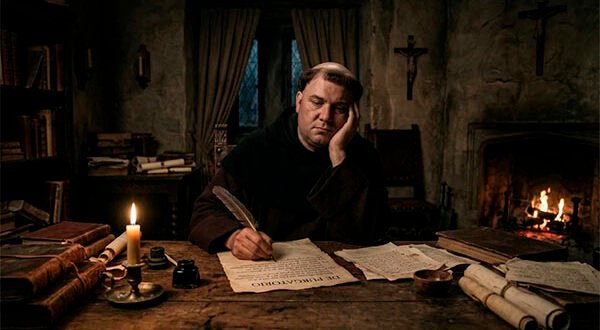
Did you know that Martin Luther, the man who would eventually confront Rome and set the Protestant Reformation in motion, initially acknowledged the existence of Purgatory? In fact, during the early years of his controversy with the Catholic Church, he still operated within an understanding of the afterlife in which Purgatory occupied an important place.
This historical fact is particularly interesting because it helps us understand something that is often overlooked: Luther’s break with Catholic doctrine did not happen overnight, but was accompanied by an evolution—and a progressive transformation—of his theological positions.
Purgatory was precisely one of the issues in which this change became especially evident. Luther went from acknowledging its existence and debating certain aspects related to indulgences to openly rejecting the claim that it could be affirmed as a Christian doctrine founded upon Revelation.
But what did he actually say? When did he begin to change his mind? What relationship did this have with his criticisms of Rome? And, above all, what does the Catholic Church teach about Purgatory, beyond the controversies of the Reformation?
To answer these questions, we must turn to historical documents and distinguish between what Luther maintained at different stages, what the Church teaches, and what belongs to later interpretations.
1. Martin Luther and His First References to Purgatory
Wittenberg, October 31, 1517
To understand this story, we must go back to 1517, when Luther published his famous 95 Theses against indulgences.
At that time, Luther had not yet developed all the theological positions that would later characterize Protestantism. He was an Augustinian religious, a priest and professor of Sacred Scripture, formed within the Western theological tradition.
His initial controversy focused particularly on the preaching and practice of indulgences, as well as the way in which some preachers presented their spiritual effects.
And here we find an extraordinarily revealing fact.
In his 95 Theses, Luther repeatedly mentions Purgatory, not as a reality to be dismissed, but as a state whose existence and characteristics he takes for granted in developing his arguments.
Let us look at some examples.
Theses 15, 16, 17, 18 and 19
In Thesis 15, Luther relates the fear and horror of death to the punishments of Purgatory.
In Thesis 16, he establishes a comparison between hell, Purgatory and heaven, relating them to different states of the soul.
Thesis 17 states that, in the souls of Purgatory, fear should diminish and charity increase.
However, Theses 18 and 19 are particularly interesting.
In them, Luther maintains that it does not appear to be proven, either by reason or by Scripture, that the souls in Purgatory are excluded from a state of growth in charity. He also questions whether all of them necessarily have complete certainty of their salvation.
It is important to observe the language he uses: he is not denying Purgatory, but raising questions about certain conditions of the souls who are there.
Thesis 22 mentions it again when discussing the punishments which, according to the penitential canons, would be due to souls after death.
And Thesis 25 explicitly addresses the Pope’s authority regarding Purgatory.
Therefore, the historical document allows us to establish a clear conclusion: in 1517, Luther still spoke of the souls in Purgatory and did not reject it as a doctrine, but rather regarded it as a reality within his theological understanding.
Nevertheless, an important qualification must be made: this does not mean that he accepted without reservation every medieval theological explanation concerning Purgatory, or every practice associated with indulgences. Some of his theses were already questioning important aspects of the traditional understanding.
The distinction is fundamental: acknowledging Purgatory does not necessarily mean accepting every interpretation that had developed around it.
2. The Problem of Indulgences: The Beginning of a Break
Why did Luther begin to question matters he had previously accepted?
To understand this, we must distinguish between two realities which, although related, are not identical: Purgatory and indulgences.
Catholic doctrine teaches that Purgatory is the final purification of those who die in the grace and friendship of God but still need to be purified in order to attain the holiness required to enter heaven.
Indulgences, on the other hand, concern the remission of the temporal punishment due to sins whose guilt has already been forgiven.
In the preaching of indulgences at that time, there were practices and abuses that provoked profound controversy. Luther reacted particularly against statements made by certain preachers that could give the impression that a financial contribution automatically guaranteed the release of a soul from Purgatory.
His famous Thesis 27 specifically criticized the claim attributed to certain preachers that, as soon as a coin rang in the collection box, a soul flew out of Purgatory.
This must not be confused with the Church’s official doctrine on indulgences.
The Church has never taught that a person’s salvation can be purchased, nor that a sum of money obliges God to release a soul.
An indulgence is an application of the spiritual authority of the Church, not a commercial transaction with God.
Here we find one of the keys to the controversy: Luther began by questioning certain abuses related to indulgences, but his theological reflection gradually advanced until he began to question the doctrinal foundations supporting those practices.
The discussion ceased to be merely disciplinary and pastoral and progressively became a controversy concerning the authority of the Church, Tradition and the interpretation of Sacred Scripture.
3. From Acceptance to Denial: Luther’s Change of Position
Luther’s evolution regarding Purgatory should not be presented as an instantaneous change that occurred on a single day.
During the following years, his theological positions became increasingly radical and moved further away from Catholic doctrine.
A particularly important document for understanding this process appeared in 1530.
It is a work entitled in German Ein Widerruf vom Fegefeuer, which can be translated as “A Recantation of Purgatory” or “A Renunciation of Purgatory.”
In this treatise, Luther expressly rejected Catholic doctrine.
HISTORICAL DOCUMENT · 1530
A work preserved in its original edition
The University and Archdiocesan Library of Paderborn preserves a historical edition of this work, printed in Wittenberg by Georg Rhau in 1530 and catalogued under reference VD16 L 7544.
We are therefore not dealing with a phrase attributed to Luther by his opponents, nor with an anecdote transmitted centuries later, but with an identifiable historical work preserved in a university collection.
The title of the treatise already clearly reveals the direction his thinking had taken.
Luther questioned whether the existence of Purgatory could be imposed as an article of faith, considering that it was not sufficiently grounded in Scripture.
His rejection was also related to his understanding of justification, the sufficiency of Christ’s redemptive work and his opposition to certain ecclesiastical practices.
The rejection would become even more explicit. In the Smalcald Articles of 1537, Luther went so far as to describe Purgatory as a diabolical deception.
The historical contrast is significant:
- 1517: Luther speaks of the souls in Purgatory and develops arguments that presuppose its existence.
- 1530: He publishes a specific treatise to recant the doctrine of Purgatory.
- 1537: His rejection is expressed in much more forceful terms.
Therefore, it would be historically incorrect to present Luther as someone who had always denied Purgatory. The documents reveal a genuine evolution in his thinking.
4. What Does the Catholic Church Actually Teach About Purgatory?
To understand the importance of this controversy, we must return to Catholic doctrine.
Purgatory is neither a medieval invention nor a second chance for those who have died separated from God. Nor is it a place where souls can decide whether they wish to be saved or condemned.
The Church teaches that it is a final purification of souls who die in God’s grace and friendship and whose salvation is assured, but who are not yet perfectly purified.
The Catechism of the Catholic Church explains this in paragraphs 1030 and 1031.
The fundamental teaching can be summarized as follows:
- The souls in Purgatory belong to the elect.
- Their eternal salvation is assured.
- They need purification before entering the glory of heaven.
- This purification is radically different from eternal damnation.
Therefore, Purgatory is neither a temporary hell nor a place where God keeps the eternal destiny of a person undecided.
Whoever is in Purgatory is already saved. What remains necessary is to attain complete purification in order to enter God’s presence.
This distinction is essential to avoid mistaken interpretations.
Why must a soul that is already saved undergo purification?
Let us think of a person who has received forgiveness for their sins, who sincerely loves God and who dies in His grace.
However, during their life, they may have retained imperfections, disordered attachments, spiritual wounds and the consequences of their sins.
Divine forgiveness does not necessarily mean that all the consequences and inner disorders disappear instantly.
God forgives, restores and sanctifies. And holiness requires complete transformation of the soul.
Purgatory expresses precisely this reality: nothing impure can enter God’s presence.
As the Book of Revelation teaches:
“Nothing unclean will enter it.”
(Revelation 21:27).
This is not a matter of any insufficiency in Christ’s Redemption. Quite the opposite: purification is possible precisely because of the merits of Jesus Christ and the grace He has won for us.
Purgatory adds nothing to the Cross of Christ. It is the fruit of His redemptive work fully applied to the soul.
5. The Biblical Foundations of Purgatory
One of Luther’s main objections was that the existence of Purgatory could not be sufficiently demonstrated through Sacred Scripture.
However, the Catholic Church does not base this doctrine on a single isolated verse, but on a comprehensive reading of various biblical passages, illuminated by apostolic Tradition.
Let us consider some of the most important ones.
1. The Book of Maccabees: Praying for the Dead
One of the fundamental texts is found in the Second Book of Maccabees.
In 2 Maccabees 12:38-46, we read how Judas Maccabeus, after a battle, discovered that some of the deceased Jewish soldiers were carrying objects consecrated to idols, in violation of the Law.
Faced with this situation, Judas and his men prayed for the dead and collected money to offer a sacrifice in Jerusalem for their sins.
The passage concludes:
“Therefore he made atonement for the dead, that they might be delivered from their sin.”
(2 Maccabees 12:45).
This passage is extraordinarily important.
Why?
Because it reveals a deeply significant religious practice: praying for those who have died and offering sacrifices on their behalf, in the hope that they may receive spiritual benefit.
If death necessarily meant that no spiritual assistance could ever again be received through the prayers of the living, this practice would make no sense.
It is worth remembering that 2 Maccabees is part of the Catholic biblical canon, whereas Protestant traditions generally classify it among the Apocrypha or Deuterocanonical books excluded from their Old Testament canon.
Here we find an important difference between the Catholic and Protestant understandings of the authority of Scripture.
2. Saint Paul and Purification Through Fire
Another fundamental text is found in Saint Paul’s First Letter to the Corinthians:
“Each one’s work will become manifest; for the Day will disclose it, because it will be revealed with fire, and the fire will test what sort of work each one has done.”
(1 Corinthians 3:13).
And it continues:
“If the work which any man has built on the foundation survives, he will receive a reward. If any man’s work is burned up, he will suffer loss, though he himself will be saved, but only as through fire.”
(1 Corinthians 3:14-15).
This passage has traditionally been associated with the doctrine of purification after death.
Saint Paul speaks of someone whose work does not withstand the test, who suffers loss, but who is ultimately saved.
The Church recognizes in this text an image that helps us understand the reality of a purification distinct from condemnation.
It is important, however, not to present these verses as though they literally mention the term Purgatory. Their interpretation requires placing them within the whole of Revelation and the Christian Tradition.
3. Jesus Christ Speaks of Forgiveness in the Age to Come
In the Gospel according to Saint Matthew, we find another reference:
“Whoever says a word against the Son of man will be forgiven; but whoever speaks against the Holy Spirit will not be forgiven, either in this age or in the age to come.”
(Matthew 12:32).
The Church has seen in these words a foundation for understanding that certain faults may be forgiven in the world to come.
The Catechism refers to this interpretation in paragraph 1031, also citing a teaching of Saint Gregory the Great.
This passage, considered together with the other biblical testimonies, helps establish Catholic doctrine.
The teaching on Purgatory is not based on human speculation about what happens after death, but on the understanding of Revelation transmitted by the Church.
6. The Early Church Already Prayed for the Dead
One of the most important aspects of this controversy is that prayer for the dead did not appear in the Middle Ages, nor was it a practice invented to justify indulgences.
It is documented in ancient Christianity.
The first Christians understood that death did not break the spiritual communion between members of the Body of Christ.
The Church on earth did not cease to remember those who had died, and the Eucharistic celebration and prayers for them formed part of its religious life.
Among the most significant testimonies, we find the following.
Tertullian (2nd-3rd Centuries)
Tertullian, one of the earliest Latin Christian writers, mentions in his work De corona (3) the custom of offering suffrages for the deceased and celebrating the anniversary of their death.
He also addresses the practices of prayer for the dead in De monogamia (10).
These testimonies show that the liturgical remembrance of the deceased and prayer for them were already present in the life of the first Christian communities.
Saint Cyril of Jerusalem (4th Century)
In his Mystagogical Catecheses (V, 9-10), Saint Cyril explains that, during the Eucharistic celebration, the dead are remembered and Christ’s sacrifice is offered on their behalf.
His reasoning is particularly interesting: if prayer is offered for those who have died, it is because the Church believes they can receive spiritual benefit.
This is not merely a sentimental custom, but an expression of faith in the Communion of Saints.
Saint Augustine (4th-5th Centuries)
Saint Augustine also addresses this question in several of his works.
In the Enchiridion on Faith, Hope and Charity (69), he discusses the possibility that some of the deceased may receive relief through the suffrages of the living.
Likewise, in The City of God (XXI, 24), he examines the possibility of purification after death and its relationship with prayers offered for the deceased.
His reflection is especially important because it shows that the question of final purification was not unknown to the great theologians of Christian antiquity.
These testimonies do not mean that all the Fathers used exactly the same theological language, or that a systematic explanation identical to the one developed later already existed from the beginning.
What they do demonstrate is a fundamental continuity: the ancient Church prayed for its dead and recognized the possibility of purification after death.
We are therefore not dealing with a devotion that suddenly emerged in the sixteenth century in response to Luther.
7. The Council of Trent: The Church Solemnly Reaffirms Purgatory
The Protestant controversy compelled the Church to clarify and reaffirm certain teachings in response to the new doctrines.
One of the most important moments was the Council of Trent.
At its twenty-fifth session, held on December 3 and 4, 1563, the Council promulgated a specific decree on Purgatory.
Its teaching was unequivocal.
The Council declared that the Catholic Church, instructed by the Holy Spirit and relying on Sacred Scripture and the ancient Tradition of the Fathers, had always taught the existence of Purgatory.
It also reaffirmed that the souls there can receive assistance through the suffrages of the faithful, especially through the Holy Sacrifice of the Mass.
But there is one particularly interesting aspect of the decree.
The Council did not wish to encourage unnecessary speculation about the exact characteristics of Purgatory. On the contrary, it asked bishops to avoid in popular preaching excessively difficult questions and explanations that did not contribute to the spiritual edification of the faithful.
It also warned against superstitions and abuses associated with this doctrine.
This demonstrates that the Church did not intend to encourage fear or morbid curiosity about the afterlife, but rather to preserve a truth of faith and correctly guide the spiritual lives of Christians.
The doctrine of Purgatory was thus solemnly reaffirmed in response to the denials that arose during the Reformation.
8. What Does Purgatory Mean for a Catholic Today?
We might think that this controversy belongs exclusively to the sixteenth century and has little relevance to our daily lives.
However, the doctrine of Purgatory contains spiritual teachings of enormous relevance today.
We live in a society that frequently attempts to avoid any reference to death, God’s judgment, sin and the need for conversion.
There is much talk about emotional well-being, personal experiences and self-fulfilment, but considerably less about holiness.
Purgatory reminds us of a fundamental truth: it is not enough to want to reach heaven; we must allow ourselves to be transformed by God’s grace.
Holiness Is Not Optional
Heaven is perfect communion with God.
But how could a person enter into that communion if they were still clinging to selfishness, pride, resentment or the disorders that separate them from Him?
God does not simply call us to be reasonably good people.
He calls us to be saints.
That is why Purgatory also invites us to take our spiritual lives seriously.
Every sin leaves a wound, every cultivated vice weakens our freedom, and every disordered attachment makes our surrender to God more difficult.
Conversion does not consist merely in avoiding certain actions. It consists in allowing Christ to transform our hearts.
The Importance of Praying for the Dead
One of the most beautiful consequences of this doctrine is the possibility of spiritually helping those who have died.
The Church invites us to keep this practice alive through:
- Having Holy Mass celebrated for the deceased.
- Offering prayers and suffrages for the souls in Purgatory.
- Praying the Holy Rosary for our deceased family members.
- Offering works of charity for their intention.
- Gaining and applying indulgences in accordance with the Church’s requirements.
We must not forget our parents, grandparents, relatives, friends and acquaintances who have died.
Christian charity does not end at the grave.
When we pray for the dead, we express our faith in the Communion of Saints and our hope in divine mercy.
The Best Preparation for Death Begins During Life
Purgatory should also make us reflect on our own death.
We should not live in anguish, but neither should we live with indifference.
Death is a reality that we will all have to face, and our encounter with God requires serious spiritual preparation.
That is why it is so important to:
- Receive the Sacrament of Penance frequently.
- Participate worthily in Holy Mass.
- Nourish our souls with the Holy Eucharist.
- Practise charity and forgiveness.
- Fight against our vices and shortcomings.
- Make reparation, insofar as possible, for the harm caused by our sins.
- Live in a state of grace.
We must not postpone our conversion, thinking that we will have time later.
The best way to prepare ourselves for heaven is to begin living already in friendship with God.
9. Purgatory Does Not Diminish the Value of Christ’s Redemption: It Reveals Its Power
There is an objection that frequently arises in discussions between Catholics and Protestants: if Jesus Christ died for our sins, why would purification after death be necessary?
This question deserves a serious answer.
The Catholic Church has never taught that Purgatory is a human work that completes an insufficient Redemption.
Christ accomplished a perfect and sufficient redemptive work.
His sacrifice on the Cross is the source of all grace, all forgiveness and all salvation.
Purgatory is not a second redemption, nor an alternative path to Jesus Christ.
It is precisely the application of the fruits of His Redemption to souls who die in His grace but still need to be purified.
We can understand this through a simple comparison.
Imagine a person who has committed an injustice and, having repented, receives forgiveness from the person they have offended.
Forgiveness is real, but that does not mean that all the consequences of the injustice automatically disappear.
It may be necessary to repair the damage, rebuild trust and correct the habits that led to committing that injustice.
In an analogous way, the forgiveness of sins does not necessarily imply the disappearance of every spiritual consequence of sin.
Catholic doctrine distinguishes between the guilt of sin and the temporal punishment that may remain after the guilt has been forgiven.
This distinction also helps us understand the meaning of penance, reparation and indulgences.
Therefore, Purgatory does not compete with Christ.
It is Christ who purifies, Christ who saves and Christ who leads the soul to the fullness of holiness.
10. A Final Reflection: Let Us Not Forget the Souls in Purgatory
The story of Luther and his evolution regarding Purgatory allows us to discover a historical and theological question of great interest.
A man who, in 1517, still spoke of Purgatory as a reality within his religious understanding would eventually reject it explicitly years later.
This historical fact does not, by itself, prove the truth of Catholic doctrine, but it does allow us to correct a historical oversimplification: Luther did not always maintain the same position on this matter.
And, above all, it invites us to return to what truly matters: what do we Catholics believe when we speak of Purgatory?
We believe that God is infinitely holy and merciful.
We believe that Jesus Christ has conquered sin and death.
We believe that salvation is a gift of divine grace and that we are called to attain true holiness.
We also believe that death does not destroy the spiritual communion of those who belong to Christ.
That is why, when a Catholic prays for a deceased relative, has a Mass offered for the souls in Purgatory or performs an act of penance for the dead, they are practising one of the most profound expressions of Christian charity.
We do not know exactly how the purification of each soul takes place, nor do we know God’s particular designs concerning each deceased person.
But we trust in divine mercy and in the Communion of Saints.
Perhaps this is one of the most beautiful lessons we can draw from this doctrine: our charity does not end when someone dies.
Let us continue praying for our deceased. Let us offer the Holy Sacrifice of the Mass for them. Let us ask God to purify them and lead them as soon as possible into eternal glory.
And let us not forget that we, too, must prepare ourselves for that definitive encounter.
For our goal is not simply to die in peace.
Our goal is to die in God’s grace and one day attain the Beatific Vision, contemplating the face of Our Lord Jesus Christ for all eternity.
Sources and References for Further Study
Historical Documentation on Luther
- Martin Luther, Disputatio pro declaratione virtutis indulgentiarum (1517), especially Theses 15-28.
- Martin Luther, Ein Widerruf vom Fegefeuer (1530).
- Smalcald Articles (1537), Part II, Article II.
- Historical edition of Ein Widerruf vom Fegefeuer, University and Archdiocesan Library of Paderborn, 1530.
Sacred Scripture
- 2 Maccabees 12:38-46.
- Matthew 12:32.
- 1 Corinthians 3:10-15.
- Revelation 21:27.
The Tradition of the Church
- Tertullian, De corona, 3; De monogamia, 10.
- Saint Cyril of Jerusalem, Mystagogical Catecheses, V, 9-10.
- Saint Augustine, Enchiridion, 69; The City of God, XXI, 24.
The Magisterium of the Church
- Council of Florence, decree Laetentur caeli (1439).
- Council of Trent, Session XXV (1563), Decree on Purgatory.
- Catechism of the Catholic Church, paragraphs 1030-1032.