Related Articles

Introduction: Can Man Repair the World Without God?
We live in an age fascinated by the idea of transforming the world. We constantly hear about social justice, solidarity, equality, sustainability, reconciliation, human rights, and the construction of a better society. These are aspirations which, considered in themselves, may contain genuine goods and respond to profoundly human needs.
However, behind certain proposals for social transformation lies a much deeper question: Can humanity truly repair the world through its own efforts, or does it need to be redeemed by God?
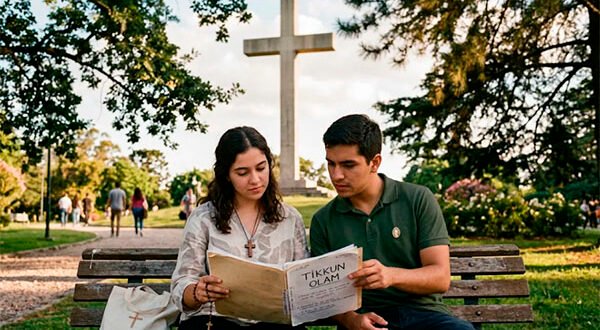
This question leads us to a concept within Jewish religious tradition known as Tikun Olam (תיקון עולם), an expression usually translated as “repairing the world”, “restoring the world”, or “perfecting the world”.
In certain contemporary Jewish circles, this expression is used to describe a commitment to social justice, solidarity, the protection of the vulnerable, and the moral responsibility to contribute to the improvement of society.
At first glance, many of these aspirations seem to coincide with fundamental teachings of Christianity. The Catholic Church also requires Christians to care for their neighbours, fight injustice, practise mercy, and work for the common good.
But there is a fundamental theological difference that deserves examination: for Christianity, the definitive restoration of the world is not something humanity can accomplish autonomously, but rather God’s work, brought to fulfilment in Jesus Christ.
Here we encounter the question we wish to address: What objections can a Catholic raise against Tikun Olam? Where does the legitimate human responsibility to improve society end, and where does a conception of salvation that dispenses with Christ begin?
To answer rigorously, we must avoid two mistakes: portraying Judaism as a homogeneous reality, ignoring the diversity of its traditions, or attributing to Tikun Olam claims that are not necessarily part of its meaning.
Catholic criticism must be directed towards specific conceptions that may be incompatible with the Christian faith, not towards the dignity of those who profess the Jewish religion or their legitimate commitment to the common good.
Because the essential question is not whether we should repair the world. The question is who can truly redeem it.
1. What Does Tikun Olam Really Mean?
The Hebrew expression Tikun Olam consists of two words:
- Tikkun: repair, correction, restoration, or rectification.
- Olam: world, universe, or temporal reality.
Its usual translation is “repairing the world”.
However, it would be historically incorrect to claim that this expression has always meant the same thing or that it constitutes a single doctrine shared identically by all Jews.
Its historical development is more complex.
Early Rabbinic Origins
One of the earliest relevant appearances of the expression is found in the Mishnah, specifically in the tractate Gittin 4:2 and other passages within the same tractate.
The Mishnah is a compilation of Jewish legal teachings and traditions whose redaction is generally dated to the beginning of the third century.
In these texts, the expression mipnei tikkun ha-olam appears, which can be translated as “for the sake of the order of the world” or “for the proper functioning of society”.
It is used to justify certain legal provisions intended to prevent abuses, protect vulnerable people, and promote stability in social relationships.
For example, some regulations concerning divorce documents are justified on these grounds.
In this context, Tikun Olam does not mean that man must construct a perfect world or that he can attain supernatural salvation through social transformation.
Its meaning is primarily legal and communal: establishing provisions that promote order and prevent certain forms of harm.
The Mystical Dimension: The Kabbalah of Isaac Luria
Another important development appears in Jewish mystical tradition, particularly in the Lurianic Kabbalah of the sixteenth century.
Rabbi Isaac Luria (1534–1572), known as the Ari, developed a complex mystical interpretation of creation and the relationship between God and the universe.
Within this tradition appears a conception of cosmic restoration connected with the doctrine of the breaking of the vessels (shevirat ha-kelim) and the dispersion of the divine sparks of light.
According to this mystical interpretation, created reality is affected by a primordial rupture whose restoration is connected with the fulfilment of the commandments and religious actions.
Human beings thus participate, through their actions, in a process of spiritually restoring the order of creation.
It is important to clarify that we are discussing a specific current within Jewish mysticism, not a belief that can indiscriminately be attributed to all Jews.
Contemporary Meaning: Social Justice
In recent decades, Tikun Olam has acquired an important presence in certain sectors of contemporary Judaism.
Its meaning has expanded to include issues such as:
- The fight against poverty.
- The protection of human rights.
- Assistance to vulnerable people.
- The defence of social justice.
- Environmental protection.
- Cooperation between communities.
- The construction of more just societies.
This contemporary usage has historical and intellectual connections with earlier developments, but it should not automatically be confused with the legal meaning found in the Mishnah or with the cosmology of Lurianic Kabbalah.
It is important to recognise this diversity so that Catholic criticism is not built upon a simplified or inaccurate definition.
The expression can refer to anything from a legitimate concern for the common good to broader religious interpretations concerning the restoration of the universe.
And it is precisely in this latter area that theological questions arise which deserve particular attention.
2. The First Catholic Objection: The World Needs Redemption, Not Merely Repair
Christianity begins with a fundamental affirmation: the world was created good by God, but sin has deeply wounded the relationship between man, his Creator, his fellow human beings, and creation itself.
Humanity’s problem does not consist merely in the existence of unjust institutions, defective structures, or antisocial behaviour.
The problem is much deeper.
Sin has introduced pride, greed, violence, arrogance, envy, and rebellion against God into the human heart.
Man does not merely need to improve his external conditions. He needs to be reconciled with his Creator.
The Book of Genesis presents the origin of this rupture:
“When the woman saw that the tree was good for food and pleasing to the eyes, and that the tree was desirable for gaining wisdom, she took some of its fruit and ate it” (Genesis 3:6).
Original sin was not simply an error in social organisation. It was disobedience towards God, a rupture in the fundamental relationship between the creature and its Creator.
From that moment onwards, humanity has experienced a wound affecting its entire existence.
That is why, although social reforms are necessary, they cannot resolve man’s fundamental drama by themselves.
We can improve laws, build hospitals, fight poverty, develop institutions, and establish protective mechanisms. All of this can be good and necessary.
But no political reform can erase original sin.
No legislation can bestow sanctifying grace.
No social justice programme can, by itself, reconcile man with God.
Here we find a first essential difference between a purely humanistic vision of repairing the world and the Christian understanding of redemption.
Christianity does not consider man simply to be a damaged world that needs reorganising. It considers him a creature wounded by sin who needs to be saved by Jesus Christ.
Saint Paul expresses this reality with extraordinary clarity:
“All have sinned and fall short of the glory of God, and are justified by his grace as a gift, through the redemption which is in Christ Jesus” (Romans 3:23–24).
Salvation does not arise from human self-sufficiency. It is a gift from God.
3. The Second Objection: No Human Work Can Replace Divine Grace
One of the great differences between Christian thought and any conception of salvation based exclusively on human capacity is found in the doctrine of grace.
The Catholic Church teaches that man needs grace to attain supernatural life.
This does not mean that human works are unimportant. Quite the contrary.
The Catholic faith teaches that grace transforms man and enables him to perform genuinely good works.
But there is an order that cannot be reversed: we do not perform good works to purchase salvation; we perform good works because God grants us His grace and calls us to live in charity.
Saint Paul explains this in his Letter to the Ephesians:
“For by grace you have been saved through faith; and this is not your own doing, it is the gift of God—not because of works, lest any man should boast. For we are his workmanship, created in Christ Jesus for good works, which God prepared beforehand, that we should walk in them” (Ephesians 2:8–10).
The order is fundamental.
First, divine initiative.
Then, man’s free response.
Finally, a life transformed by grace, manifested through works of love.
The Catechism of the Catholic Church develops this doctrine particularly in paragraphs 1996–2001.
Grace is God’s gratuitous gift, introducing us into His life and enabling us to participate in the divine nature.
It is not a reward that man obtains through his own natural merits.
Nor is it an energy that he can produce through his moral efforts.
It is a supernatural gift.
This raises an important objection to any interpretation of Tikun Olam that seeks to turn the moral or social transformation of humanity into a kind of autonomous path to salvation.
A more just world is not necessarily a redeemed world.
A more prosperous society is not automatically a holy society.
A human being committed to noble causes is not thereby reconciled with God.
Social justice is a good. Holiness is much more than social justice.
And eternal salvation cannot be reduced to either of these things considered in isolation.
4. The Third Objection: The Definitive Restoration of the World Belongs to Christ
Here we reach the heart of the Christological question.
The Catholic faith does not teach that humanity should simply wait passively for divine intervention.
Christians have concrete responsibilities in transforming society.
Nevertheless, Christianity carefully distinguishes between human progress and the fullness of the Kingdom of God.
This distinction is fundamental.
Sacred Scripture presents Jesus Christ as the centre of universal restoration.
Saint Paul writes:
“To unite all things in him, things in heaven and things on earth” (Ephesians 1:10).
It is not man who constitutes the ultimate principle of the restoration of the universe.
It is Christ.
The world does not find its definitive destiny in a perfect civilisation constructed through human capacities, but in the recapitulation of all things in Jesus Christ.
This teaching has a profound eschatological dimension.
Eschatology is the branch of theology that studies the last things: death, judgement, resurrection, eternal life, and the definitive consummation of creation.
According to the Catholic faith, history does not simply move towards a future of indefinite progress.
It moves towards a definitive event: Christ’s Second Coming and the fullness of His Kingdom.
The Book of Revelation describes this hope:
“Then I saw a new heaven and a new earth; for the first heaven and the first earth had passed away” (Revelation 21:1).
And it adds:
“He will wipe away every tear from their eyes, and death shall be no more, neither shall there be mourning nor crying nor pain any more, for the former things have passed away” (Revelation 21:4).
Let us observe something important.
Humanity can alleviate suffering, but it cannot definitively eliminate death.
It can develop medicine, but it cannot grant the resurrection.
It can fight injustices, but it cannot establish the perfect justice of divine judgement through its own efforts.
It can build more humane societies, but it cannot create the new heavens and the new earth by itself.
The definitive restoration will not be the final result of a human political, cultural, or religious project. It will be the sovereign work of God.
The Catechism develops this teaching in paragraphs 1042–1050.
Particularly important is paragraph 1049, which reminds us that the hope of a new earth must not diminish our concern for the present world.
On the contrary, it should encourage it.
However, the same text insists that earthly progress must be carefully distinguished from the growth of Christ’s Kingdom.
This distinction constitutes one of the most important criteria for evaluating any proposal for transforming the world.
5. An Important Clarification: Christianity Does Not Despise the Restoration of the World Either
It would be a mistake to conclude that the Catholic Church rejects the idea of working towards the restoration of society.
The Church has never taught that Christians should remain indifferent to poverty, injustice, violence, or human suffering.
Nor does it consider social concerns incompatible with spiritual life.
In fact, Sacred Scripture contains numerous exhortations to practise justice.
The prophet Micah summarises some of the fundamental requirements of the moral life:
“He has shown you, O man, what is good; and what does the Lord require of you but to do justice, and to love kindness, and to walk humbly with your God?” (Micah 6:8).
Justice, mercy, and humility are virtues deeply rooted in biblical revelation.
Jesus Christ Himself identifies with those in need in the Gospel of Saint Matthew:
“Truly, I say to you, as you did it to one of the least of these my brethren, you did it to me” (Matthew 25:40).
Christianity cannot be reduced to a disembodied spirituality that ignores the material needs of our neighbours.
Man is a unity of body and soul.
For this reason, Christian charity must be expressed both through attention to material needs and through concern for people’s eternal salvation.
In this sense, a Catholic can fully agree with many initiatives carried out under the name of Tikun Olam.
He can collaborate in projects against poverty, defend the sick, help refugees, protect children, fight labour exploitation, or participate in environmental protection initiatives.
There is no contradiction whatsoever between these actions and the Catholic faith.
The contradiction arises when these actions are attributed a salvific meaning that excludes the need for grace, redemption, or Jesus Christ.
Catholics can collaborate in repairing the wounds of the world, but they must never confuse this collaboration with the ability to redeem the world.
6. The Fourth Objection: The Danger of a Purely Earthly Messianism
One of the most delicate questions arises when the idea of repairing the world becomes a project of historical perfection that no longer recognises the limitations of human nature.
Man can build better societies, but he remains a creature marked by fragility and sin.
History demonstrates that even projects born from elevated ideals can end up producing injustices when they seek to impose an absolute vision of the good through power.
The temptation consists in thinking that, if we manage to establish the appropriate political, economic, and cultural conditions, we will be able to achieve a humanity that is definitively reconciled.
This hope can acquire an almost messianic dimension.
The problem is not desiring a just society. The problem is attributing to a historical project something that belongs exclusively to definitive salvation.
The Church has repeatedly warned against this confusion.
The Second Vatican Council’s Pastoral Constitution Gaudium et spes, in paragraph 39, addresses precisely the relationship between earthly progress and the Kingdom of God.
It teaches that they must be carefully distinguished, while recognising that human progress can contribute to the better ordering of society and have significance for the Kingdom of God.
This teaching avoids two extremes:
- Spiritualism, which considers the material world irrelevant.
- Temporalism, which identifies salvation with the construction of a perfect earthly society.
The Christian is neither a revolutionary who expects to establish paradise through political transformation nor an indifferent person who passively observes injustices while waiting for heaven.
He is a disciple of Christ who works for the good, practises justice, serves the poor, and awaits the definitive consummation that only God can grant.
Here the teaching of Saint Augustine on the two cities is particularly illuminating.
In The City of God, the Bishop of Hippo distinguishes between two loves that profoundly shape human existence: love of God to the contempt of self, and love of self to the contempt of God.
The two cities should not be mechanically identified with two particular political states or institutions.
They are spiritual realities defined by the love that moves their members.
Saint Augustine reminds us that no political organisation can become the heavenly city.
Earthly society possesses genuine goods that must be protected, but it cannot offer definitive beatitude.
Political peace is a good. Eternal peace is an infinitely greater good.
This distinction is especially necessary in an age in which certain discourses present social transformation as though it were the definitive answer to the human problem.
7. The Fifth Objection: It Is Not Enough to Repair Structures if the Conversion of the Heart Is Forgotten
Another fundamental question concerns the relationship between social structures and personal conversion.
Catholic doctrine recognises that unjust structures exist which encourage sin, perpetuate abuses, and hinder the development of individuals.
But it also teaches that these structures originate and are maintained through human decisions.
We cannot effectively combat injustice without confronting the moral roots of many of our actions.
The Gospel places this question in the human heart.
Jesus teaches:
“For out of the heart come evil thoughts, murder, adultery, fornication, theft, false witness, slander” (Matthew 15:19).
Evil does not arise exclusively from economic or social circumstances.
It also originates in the human will when it turns away from God.
A society can pass excellent laws and still be inhabited by selfish people.
It can establish social protection systems and continue to suffer from corruption.
It can proclaim equality and tolerate new forms of exploitation.
It can speak constantly about solidarity while despising its neighbour in everyday life.
That is why Christian transformation must begin with conversion.
Saint John the Baptist did not simply invite people to reform the political structures of his time.
His preaching began with a radical call:
“Repent, for the kingdom of heaven is at hand” (Matthew 3:2).
And Jesus Christ begins His public preaching with the same call (Matthew 4:17).
Conversion does not consist merely in adopting socially acceptable behaviour.
It means returning to God, recognising sin, repenting, receiving His mercy, and directing one’s entire existence towards Him.
The Church teaches that conversion is a profound transformation of the person, not merely a change of political mentality or cultural preferences.
That is why any programme for repairing the world that forgets the need for personal conversion is insufficient from a Catholic perspective.
It is not enough to change the external world if the human heart remains enslaved to sin.
8. What Relationship Exists Between Tikkun Olam and the Jewish Messianic Hope?
To understand properly the differences between Judaism and Christianity, we must also address the question of the Messiah.
Messianic hope occupies a fundamental place in the history of Israel.
The prophets announced a future of justice, peace, and restoration associated with God’s intervention.
Isaiah describes an extraordinary image:
“The wolf shall dwell with the lamb, and the leopard shall lie down with the kid” (Isaiah 11:6).
The text presents a creation reconciled under the reign of the descendant of Jesse.
For the Christian faith, these promises find their fulfilment in Jesus Christ, although their definitive consummation is still awaited.
Christ inaugurated the Kingdom of God through His Incarnation, preaching, death, and Resurrection.
Nevertheless, we still await its fullness.
This tension between the “already” and the “not yet” constitutes a fundamental characteristic of Christian hope.
The Kingdom is present, but it has not yet manifested itself in all its glory.
In Judaism, on the other hand, the interpretation of the messianic promises follows different paths, since Jesus is not recognised as the expected Messiah.
The Catechism of the Catholic Church, in paragraph 840, expresses this difference clearly.
It explains that the Jewish people and the new People of God are oriented towards a hope connected with the coming or return of the Messiah, but points out that Christians await the return of the One who died and rose again, whereas Judaism awaits the coming of a Messiah whose features remain concealed.
This difference is not secondary.
For Christians, the Messiah is not an unknown future figure.
He is a concrete historical person: Jesus Christ, true God and true man.
Christianity does not expect humanity to discover by itself how to attain messianic fulfilment.
It expects the return of the One who has already conquered sin and death.
Therefore, if Tikun Olam is interpreted as human cooperation in preparing a more just world, there is not necessarily any moral contradiction with the Catholic faith.
But if it becomes an autonomous messianic hope, detached from Jesus Christ and presented as an alternative to His redemptive work, a fundamental doctrinal incompatibility arises.
Christians cannot accept a vision of human fulfilment that dispenses with the One who is Lord of history.
9. An Especially Important Question: What Does the Church Teach About the Jewish People?
When addressing these questions, we must remember something that must never be obscured by any theological criticism: the relationship between the Church and the Jewish people possesses a uniqueness that distinguishes it from the Church’s relationship with other religions.
Christianity was born within the people of Israel.
Jesus Christ was born Jewish.
The Virgin Mary was Jewish.
The apostles belonged to the Jewish people.
The first Christian communities were deeply connected to the Scriptures of Israel.
The Church cannot understand her own identity without recognising these roots.
Saint Paul develops this question in chapters 9, 10, and 11 of his Letter to the Romans.
In Romans 11, he uses the image of the olive tree to explain the relationship between Israel and Christians who come from the pagan nations.
The Gentiles have been grafted into an olive tree whose root they did not create.
That is why Saint Paul warns:
“Do not boast over the branches. If you do boast, remember that it is not you that support the root, but the root that supports you” (Romans 11:18).
This is a warning of extraordinary importance.
Christians must not look with contempt upon the people from whom they received the Scriptures, the patriarchs, and the promises.
In the same chapter, we find one of the most important statements for understanding this relationship:
“For the gifts and the call of God are irrevocable” (Romans 11:29).
This teaching is included in the Catechism of the Catholic Church, paragraphs 839–840.
It is also one of the foundations of the declaration Nostra aetate, promulgated by Saint Paul VI on 28 October 1965.
In paragraph 4, the Second Vatican Council recalls the spiritual bonds that unite the people of the New Testament with the descendants of Abraham.
The document recognises that the Church received the Scriptures of the Old Testament through the Jewish people and that the beginnings of her faith are found in the patriarchs, Moses, and the prophets.
Furthermore, it expressly rejects the portrayal of the Jews as a people rejected or cursed by God.
It also condemns antisemitism and any persecution directed against them.
These affirmations are essential to any serious Catholic reflection.
We cannot use doctrinal differences to encourage contempt, hostility, or unjust generalisations.
Catholics are called to recognise the spiritual heritage of Israel, study its Scriptures, and maintain respectful dialogue with Jewish people.
But this respect does not require renouncing the confession of Jesus Christ as the only Saviour.
Charity and truth are not enemies.
10. Can a Catholic Participate in Tikkun Olam Initiatives?
The answer depends on the specific nature of the initiative and the religious convictions accompanying it.
If it involves collaborating in a charitable action, defending human dignity, helping the poor, protecting the sick, or fighting an injustice, there is no Catholic objection simply because the initiative uses the expression Tikun Olam.
Catholics can cooperate with people of other religions in pursuing genuine human goods.
The Church’s own Magisterium recognises the possibility of such cooperation.
In Evangelii gaudium, paragraphs 247–249, Pope Francis recalls the spiritual relationship that unites Christians and Jews, recognises the importance of their shared heritage, and points out that they can share ethical convictions and concerns about justice and the development of peoples.
Therefore, it would be incorrect to claim that every contemporary use of Tikun Olam is incompatible with Catholicism.
Nevertheless, certain distinctions should be maintained.
First: social cooperation does not mean doctrinal adherence.
A Catholic can collaborate with a Jewish organisation in an initiative to assist people in need without thereby adopting all its religious convictions.
Second: respecting a religious tradition does not mean accepting all its interpretations.
Interreligious dialogue requires knowledge, respect, and sincerity, not a renunciation of one’s own identity.
Third: the common good cannot become a substitute for salvation.
Building a just society is a moral responsibility, but it does not in itself constitute the fullness of the Kingdom of God.
Fourth: no social initiative should justify actions contrary to Christian morality.
Cooperation has limits when it involves accepting practices incompatible with human dignity or the moral law.
Ultimately, Catholics can collaborate in repairing the wounds of society, but they must do so from within their Christian identity and without confusing temporal transformation with supernatural redemption.
11. The Contemporary Danger: A Religion Reduced to Improving the World
The question of Tikun Olam allows us to address a problem that also affects certain Christian environments.
There is a tendency to present Christianity primarily as an ethical and social proposal.
According to this perspective, what matters would be building a more just society, encouraging solidarity, fighting discrimination, and promoting peaceful coexistence.
All these things can be good.
But where do sin, grace, the Cross, the Resurrection, eternal life, and the need for conversion fit into this picture?
What happens when the Church stops speaking about God’s judgement and begins to present her mission primarily as an activity of social transformation?
What happens when Jesus Christ is no longer proclaimed as the Saviour and becomes merely a moral example of solidarity?
The problem is not that Christians work for justice.
The problem is that they forget why they do so and where the strength to accomplish it comes from.
The Gospel is not a theory of social organisation.
Nor is it one moral philosophy among many others.
It is the proclamation that God has entered history to save mankind.
The Cross is not simply a symbol of resistance against injustice.
It is the redemptive sacrifice through which Jesus Christ reconciles humanity with the Father.
The Resurrection does not merely represent the victory of ideals over adversity.
It is a real event that inaugurates a new life and radically transforms humanity’s destiny.
The Church does not exist merely to help make societies more pleasant places to live.
She exists to proclaim Christ, administer the sacraments, preach revealed truth, and lead mankind towards salvation.
And precisely because she believes in eternal life, she cannot remain indifferent to the needs of present life.
Christian charity is not an alternative to evangelisation, but a consequence of it.
12. True Christian Restoration: Conversion, Holiness, and Charity
At this point, we can ask a more personal question:
What does repairing the world mean from a Catholic perspective?
The answer does not consist in rejecting every initiative for social transformation, but in understanding it from a supernatural perspective.
Christians are called to cooperate with God in restoring all things in Christ.
But this cooperation has a specific spiritual order.
Restoration Begins with Conversion
We cannot claim to transform the world while refusing to recognise our own sins.
Before pointing out the corruption of others, we must examine our own conscience.
Before demanding justice, we must ask ourselves whether we are just.
Before denouncing a lack of charity, we must examine how we treat our relatives, colleagues, and people we find difficult.
Christian conversion is not an abstract idea.
It becomes concrete through repentance, sacramental confession, renunciation of sin, and the sincere desire to live according to the Gospel.
Restoration Continues Through Holiness
Holiness does not mean becoming a socially impeccable person.
It means living in union with God, allowing His grace to transform our intellect, will, and affections.
A father who raises his children in the Christian faith, a mother who supports her family with patience, a worker who rejects corruption, an employer who treats employees justly, and a priest who remains faithful to his vocation all contribute to transforming the world.
Holiness has social consequences.
Sin destroys relationships, families, and communities.
Virtue helps restore them.
Restoration Is Expressed Through Charity
Saint Paul devotes chapter 13 of his First Letter to the Corinthians to the excellence of charity.
There he reminds us that even extraordinary works are devoid of supernatural value if they are not animated by love.
Christian charity does not simply seek to perform actions that are socially admired.
It seeks to love one’s neighbour for the love of God.
That is why material assistance must be accompanied by respect, mercy, humility, and concern for the integral good of the person.
Christians do not help the poor in order to feel morally superior.
They help them because they recognise in them the dignity of creatures loved by God.
Restoration Requires Prayer and Sacramental Life
We must not forget that Christian transformation cannot be sustained exclusively through human willpower.
We need grace.
The Eucharist unites us sacramentally to Christ and nourishes our supernatural life.
Confession reconciles us with God when we have fallen into sin.
Prayer enables us to maintain our relationship with the Lord.
Without this supernatural dimension, Christian commitment risks becoming activism.
We may end up doing many things in God’s name while neglecting our personal relationship with Him.
And then we will have lost the centre of our mission.
13. The Church Does Not Expect a Perfect Humanity Built Through Its Own Strength
There is a profound difference between Christian hope and purely historical optimism.
Human optimism may trust that scientific development, education, political reforms, and cultural evolution will progressively lead to a better humanity.
Christians can value all these advances.
But they know that sin will not disappear simply through progress.
Humanity needs something that no technological development can provide.
It needs redemption.
Christians do not identify the Kingdom of God with a particular political structure, a specific civilisation, or an economic model either.
The pilgrim Church lives in history, but she does not belong to any historical project as though it could exhaust her mission.
Her hope is much greater.
She awaits the glorious coming of Jesus Christ.
She awaits the resurrection of the dead.
She awaits the Last Judgement.
She awaits the new heavens and the new earth.
She awaits definitive communion with God.
This hope does not distance us from the world.
It makes us responsible for it.
Precisely because we believe that the world belongs to God, we must treat it with respect, defend human life, care for the weak, and fight evil.
But we must also remember that the ultimate destiny of creation does not depend on our capacity for organisation.
It depends on God’s faithfulness to His promises.
Conclusion: The World Needs Justice, but Above All It Needs Jesus Christ
Tikun Olam confronts us with a question that deserves serious examination: the responsibility of human beings to contribute to improving the world in which they live.
In its legal, social, and charitable dimensions, it contains concerns that Catholics can legitimately share.
Justice, mercy, the defence of the vulnerable, and responsibility towards creation are not values foreign to Christianity.
They form part of the biblical tradition itself and of the Church’s moral teaching.
Nevertheless, the Catholic faith establishes a fundamental distinction: man can cooperate in improving the world, but he cannot redeem it through his own strength.
He can repair certain forms of damage, but he cannot eliminate original sin.
He can build more just societies, but he cannot establish definitive justice.
He can alleviate suffering, but he cannot definitively conquer death.
He can work for peace, but he cannot grant supernatural reconciliation with God.
All of this belongs to Jesus Christ.
That is why Catholic objections should not be directed indiscriminately against the concept of Tikun Olam or against those who practise it according to their own religious convictions.
They should be directed against any interpretation that turns human restoration into an alternative to divine redemption, reduces salvation to a historical project, or considers the saving mediation of Christ unnecessary.
Christianity does not simply proclaim that we can build a better world.
It proclaims something infinitely greater: God has come into the world to save us.
The eternal Word became flesh.
The Son of God assumed our human nature.
He died on the Cross for our sins.
He rose again on the third day.
And He will return in glory to judge the living and the dead.
This is our hope.
We do not await a humanity that saves itself through an indefinite process of moral improvement.
We await Jesus Christ.
And while we await His return, we have the obligation to work, love, serve, forgive, protect the weak, and defend the truth.
But we must never forget who the true Redeemer is.
Because the world needs justice, it needs mercy, it needs solidarity, and it needs peace.
But above all, the world needs Jesus Christ.
And no human act of restoration, however noble, will ever be able to replace the saving work of the Cross.
Biblical and Doctrinal Sources for Further Study
Sacred Scripture
- Genesis 3: Original sin and the rupture in man’s relationship with God.
- Isaiah 11:1–9: Messianic hope and the reconciliation of creation.
- Micah 6:8: Justice, mercy, and humility before God.
- Matthew 4:17: Christ’s call to conversion.
- Matthew 25:31–46: The Last Judgement and charity towards those in need.
- Romans 3:21–26: Justification by grace through the redemption of Christ.
- Romans 9–11: The mystery of Israel and its relationship with the Church.
- Ephesians 2:8–10: Salvation by grace and good works.
- Ephesians 1:3–14: The recapitulation of all things in Christ.
- Revelation 21:1–5: The new heavens and the new earth.
Catechism of the Catholic Church
- 1996–2001: Grace as God’s gratuitous gift.
- 839–840: The relationship between the Church and the Jewish people.
- 1042–1050: The hope of the new heavens and the new earth.
Magisterium of the Church
- Second Vatican Council, Nostra aetate, no. 4 (1965): The Church’s relationship with the Jewish people.
- Second Vatican Council, Gaudium et spes, no. 39 (1965): Human progress and Christian hope.
- Francis, Evangelii gaudium, nos. 247–249 (2013): Dialogue and the relationship with Judaism.
Sources for Understanding the Historical Development of Tikkun Olam
- Mishnah, tractate Gittin 4:2: Rabbinic use of the expression in the context of legal order.
- Lurianic Kabbalistic tradition: Mystical development of the concept of restoration associated with Isaac Luria.
- Lawrence Fine, studies on the Lurianic motif of Tikun in contemporary Jewish thought.
The distinction between these different historical contexts is essential to avoid attributing a single interpretation of the concept to the entire Jewish tradition.