
Related Articles



The dignity of human life in the face of one of the most delicate issues of our time
We live in an age in which science has achieved astonishing accomplishments. Today it is possible to fertilize an egg in a laboratory, select embryos, preserve them frozen for years, and even implant them later. For many couples suffering the drama of infertility, these techniques appear to offer hope. Yet behind these medical possibilities arises a deeply human, moral, and spiritual question: what happens to those frozen embryos? What does the Catholic Church say about this? Is it morally acceptable to freeze human beings in their earliest stage of life?
The Church’s answer does not arise from a rejection of science or from indifference toward the suffering of infertile couples. On the contrary. The Church looks with compassion upon the pain of those who long to have children and cannot conceive. But precisely because she deeply loves the human person, she reminds us that not everything technically possible is morally good.
The issue of embryo freezing touches the very heart of Christian anthropology: what is man? When does human life begin? Can a human being become an object of laboratory manipulation, storage, or selection?
The Church answers clearly: from the very instant of conception there exists a human life possessing inviolable dignity.
The embryo: a human being, not “biological material”
The foundation of the Church’s entire teaching on this matter lies here. For the Church, the embryo is not “something”; it is “someone.”
From the union of the egg and the sperm, a new human being appears with his or her own genetic identity, distinct from the parents, with autonomous and continuous development. The embryo will not “become” human later; it already is human.
For this reason, the Church insists that human dignity does not depend on size, age, consciousness, or the ability to speak or think. Dignity comes from being created in the image of God.
Sacred Scripture already expresses this truth in a moving way:
“Before I formed you in the womb I knew you.”
— Jeremiah 1:5
And also:
“For you created my inmost being; you knit me together in my mother’s womb.”
— Psalm 139:13
For Christian thought, every embryo is willed by God from all eternity. Each one possesses a spiritual soul and an unrepeatable vocation.
Therefore, when millions of embryos are frozen in laboratories around the world, the Church sees a silent human tragedy: human persons artificially suspended, stored away, and often condemned to abandonment or destruction.
What is embryo freezing?
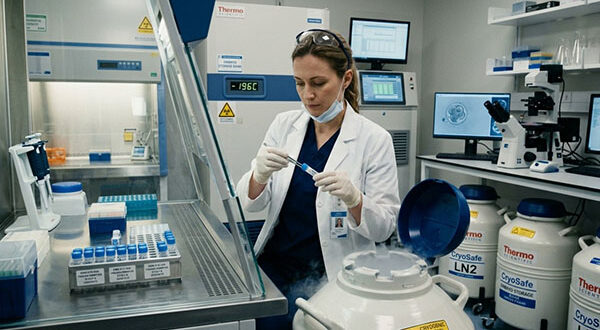
Embryo freezing — also called embryo cryopreservation — is used mainly in in vitro fertilization (IVF) procedures.
The process generally works like this:
- The woman is hormonally stimulated to produce numerous eggs.
- The eggs are fertilized in a laboratory.
- Several embryos are created.
- Some are implanted into the womb.
- The remaining embryos are frozen at extremely low temperatures for future attempts.
Here one of the greatest ethical problems appears: the production of “surplus” embryos.
Many remain frozen indefinitely. Others are discarded. Some are used for research. Others die during the thawing process.
The Church considers this a grave offense against human dignity.
The official position of the Church
Catholic teaching on this issue has been developed especially in two major documents:
- Donum Vitae
- Dignitas Personae
Both documents affirm that artificial fertilization and embryo freezing are morally illicit.
The principal reason is twofold:
1. They separate procreation from the marital act
For the Church, a child should not be produced through a technical procedure but received as the fruit of married love.
The transmission of human life possesses a sacred dimension. The marital act is not merely biology; it is participation in God’s creative work.
When technology completely replaces the marital act, the child risks becoming a “product” rather than a gift.
2. They expose the embryo to manipulation and destruction
Freezing places human beings in an artificial and extremely vulnerable situation.
Dignitas Personae denounces the fact that embryos are “used, selected, and discarded,” subjected to a utilitarian logic.
The Church reminds us that no human being may be treated as material available for experimentation, storage, or disposal.
The great silent tragedy: millions of frozen embryos
One of the most painful aspects of this reality is that millions of cryopreserved embryos currently exist throughout the world.
Many have been abandoned by their biological parents. Others will never be implanted.
The Church sees this situation as an unprecedented moral tragedy: human lives suspended in a kind of biotechnological limbo.
Donum Vitae already warned decades ago about this problem and stated that these embryos were exposed to an “absurd fate.”
Modern science has created a situation for which there are no completely satisfactory solutions.
And here another intensely debated question arises even among Catholic moral theologians: is it licit to “adopt” frozen embryos?
Can a woman adopt a frozen embryo?
This question generates intense ethical and pastoral debate.
Some people argue that implanting an abandoned embryo into another woman’s womb would be a way of saving a human life.
However, Dignitas Personae expresses strong moral reservations about this practice.
Why?
Because even if the intention is good, the procedure still involves an artificial separation between procreation, gestation, and marriage.
Furthermore, it could generate new forms of surrogate motherhood and additional ethical complications.
The Church recognizes that the situation is profoundly tragic and that no simple answers exist. Many theologians consider this one of the greatest contemporary bioethical challenges.
The deeper root of the problem: the technological mentality
The issue is not merely medical. It is spiritual and cultural.
We live in a society that often believes every desire must be technically satisfied. If something can be done, many assume it should be done.
But the Church reminds us of a fundamental truth: the human being is not the absolute master of life.
A child is not a right to be demanded. A child is a gift.
This may be difficult to accept in a culture marked by individualism and technological domination. Yet the Christian vision protects precisely the dignity of the weakest.
When human life enters into a logic of production, selection, and control, the temptation inevitably appears to classify some lives as more valuable than others.
That is why embryo freezing is closely linked to other grave issues:
- genetic selection,
- embryo destruction,
- destructive research,
- surrogacy,
- prenatal eugenics.
All these realities arise from the same root: reducing the human person to a manipulable object.
Is the Church against science?
Absolutely not.
Historically, the Church has supported medical research that is authentically ethical.
What she rejects is not science, but science without moral limits.
Medicine must be at the service of the human person, never the other way around.
There are licit treatments for infertility that seek to assist the marital act without replacing it. The Church encourages the development of ethical methods that simultaneously respect:
- the dignity of the spouses,
- the dignity of the child,
- and the sacredness of human life.
The suffering of infertility: a real wound
The Church does not ignore the pain of those who cannot have children.
It is a profound, silent, and often misunderstood suffering.
Many married couples experience infertility as a true cross. Therefore, the Church’s pastoral response must be filled with tenderness, closeness, and mercy.
This teaching should never be presented as a cold or legalistic condemnation.
Christ Himself approached those who suffered with compassion.
The Church invites couples to discover that fruitfulness is not limited solely to biology. There are many forms of spiritual motherhood and fatherhood:
- adoption,
- service,
- education,
- accompaniment,
- charity,
- self-giving to others.
Authentic love always gives life.
A call to defend human dignity from the very beginning
The debate over frozen embryos is not a distant issue reserved for laboratories and specialists. It concerns all of us.
Because the way we treat the weakest human life reveals the kind of society we are building.
The Church raises her voice to remind the world of something essential: no human being may become an object of storage.
Every embryo possesses infinite dignity because it has been willed by God.
In a culture that often measures the value of life according to usefulness, productivity, or the desires of others, Christianity proclaims a revolutionary truth: human life has value in itself.
From the very first instant.
Until the very last.
Christ and the little ones
There is something profoundly evangelical in this defense of nascent life.
Jesus always identified Himself with the most defenseless:
“Whatever you did for one of the least of these brothers and sisters of mine, you did for me.”
— Matthew 25:40
Frozen embryos are today, perhaps, among the smallest and most silent members of our world.
They have no voice.
They cannot defend themselves.
They cannot claim rights.
But the Church speaks for them.
Not out of ideology.
Not out of politics.
But out of love for the human person.
Conclusion: human life can never be morally frozen
The Church’s teaching on embryo freezing may appear demanding in a society dominated by technology and relativism. Yet at its core it is a passionate defense of human dignity.
The Church reminds us that life cannot be industrially produced or stored as merchandise.
Every human being is a sacred mystery.
The true greatness of science does not consist in being able to do everything, but in knowing how to respect what must never be manipulated.
And among all sacred realities, none is more precious than a human life beginning its existence.
Because even the smallest embryo already bears the eternal imprint of God.