Related Articles


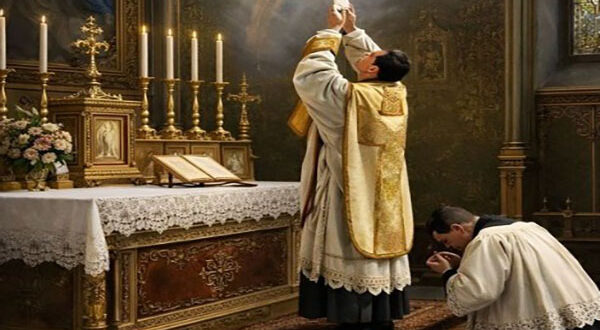
In 1969, the Catholic Church introduced a new way of celebrating the Mass. Millions of faithful witnessed the change without fully understanding it. Today, decades later, many Catholics have never known what was lost. This article is for them.
Introduction: A Heritage of Twenty Centuries
Imagine arriving one day at your parish church and discovering that the frescoes have been repainted, the altars removed, the prayers changed, and the entire celebration reorganized. You are told it is a “renewal.” That everything remains the same “in essence.” But something inside you senses otherwise.
That is, broadly speaking, what millions of Catholics experienced in 1969–1970 when Pope Paul VI promulgated the Novus Ordo Missae — the New Mass — in the context of the reforms following the Second Vatican Council. The Mass that had been celebrated, with only minor variations, for more than a millennium — known as the Tridentine Mass, the Mass of St. Pius V, the Traditional Mass, or the Extraordinary Form — was practically withdrawn overnight.
What many people do not realize is that the reform was not simply a “translation into the vernacular” nor a mere “simplification.” It was a profound restructuring that eliminated, reduced, or transformed entire parts of the liturgy that the Church had guarded for centuries. Parts that were not merely medieval ritualisms, but living theology, distilled prayer, doctrine expressed through gesture and word.
This article is not intended as an attack on anyone nor as a merely nostalgic defense. It is an exercise in memory, theology, and love for the liturgy. Because in order to appreciate what we have — or what we have lost — we must first understand it.
We are going to walk through, part by part, everything that the Novus Ordo eliminated, reduced, or significantly altered compared to the traditional Mass. And we are going to explain why each of those parts mattered.
1. The Prayers at the Foot of the Altar: The Beginning That Was Erased
The Traditional Mass began long before the priest reached the altar. It began when he descended the steps of the sanctuary and, standing before the altar steps, initiated a solemn dialogue with the altar servers. These prayers are called the Prayers at the Foot of the Altar.
The priest and the servers alternately recited Psalm 42 (43 in modern numbering): “Judge me, O God, and distinguish my cause from the nation that is not holy; deliver me from the unjust and deceitful man… Send forth Thy light and Thy truth; they have conducted me and brought me unto Thy holy hill and into Thy tabernacles…”
Then the celebrant pronounced the Confiteor — the general confession of sins — first alone, deeply bowed: “I confess to Almighty God, to blessed Mary ever Virgin, to blessed Michael the Archangel, to blessed John the Baptist, to the holy Apostles Peter and Paul, to all the saints, and to you, brethren, that I have sinned exceedingly in thought, word, deed, and omission…” The servers responded with their own Confiteor. Then the priest pronounced absolution over them, and they over him.
All of this disappeared in the Novus Ordo.
What was lost theologically?
These prayers expressed unequivocally that the priest was not simply an “animator” or a “presider of the assembly.” He was a sinner who, before approaching the altar, needed to acknowledge his unworthiness and beg for mercy. The physical movement — descending to the foot of the altar, bowing deeply, then ascending — was a gestural catechesis on the humility of the minister before divine majesty. Psalm 42 introduced the faithful into the spirit of one who longs to approach the altar of God with a purified heart.
The Novus Ordo replaced all this with a greeting to the people, a brief and optional penitential act, and an opening that focuses attention more on the gathered assembly than on the minister’s unworthiness before the sacred.
2. The Last Gospel: The Theology of St. John’s Prologue Removed
At the end of the Traditional Mass, after the final blessing, something extraordinary happened: the priest, turned toward the altar, read quietly — or chanted in a solemn Mass — the opening of the Gospel of St. John: “In the beginning was the Word, and the Word was with God, and the Word was God…” (Jn 1:1–14).
This text, called the Last Gospel, concluded the Mass like a cosmic hymn. The faithful knelt at the verse Et Verbum caro factum est — “And the Word was made flesh” — genuflecting before the mystery of the Incarnation they had just celebrated and received in Holy Communion.
Why did it matter so much?
The Prologue of John was considered by the Fathers of the Church one of the summits of revealed theology. St. Augustine said this text deserved to be inscribed in letters of gold and placed in churches. Ending the Mass with it reminded the faithful that the entire Eucharistic celebration is grounded in the mystery of the Incarnation: the same Word who became flesh at the beginning of time becomes present under the Eucharistic species. It was a perfect theological synthesis.
Furthermore, popular tradition attributed to these words an almost palpable sacramental dimension: many faithful awaited this moment with devotion, and priests could recite this Gospel in situations of danger as a prayer of exorcism and protection.
The Novus Ordo eliminated the Last Gospel entirely. It simply vanished.
3. The Leonine Prayers: The Post-Mass Prayer That Was Suppressed
Since the pontificate of Leo XIII (1878–1903), at the end of every Low Mass the faithful recited aloud, kneeling, the so-called Leonine Prayers: three Hail Marys, the Salve Regina, a prayer to the Sacred Heart of Jesus, and the famous Prayer to St. Michael the Archangel: “St. Michael the Archangel, defend us in battle; be our protection against the wickedness and snares of the devil…”
Originally prescribed to implore the freedom of the Papal States, Leo XIII extended them to the entire Universal Church with a specifically spiritual intention: the protection of the Church against the powers of evil.
The prayer to St. Michael was removed from the end of Mass during the liturgical reform. Today many pastors have reintroduced it on their own initiative, and Popes John Paul II and Francis explicitly encouraged its recitation. But it is no longer part of the official structure of the new Mass.
What message did its suppression send?
For many traditional theologians and liturgists, the removal of this prayer was symptomatic of a worldview tending to minimize spiritual warfare and the real existence of the devil as an active adversary. The Traditional Mass was fully conscious that every Eucharistic celebration was a spiritual battlefield. The Novus Ordo, in its original formulation, seemed to present a more “pleasant” vision of the supernatural order.
4. The Unique Roman Canon: The Destruction of Sacred Exclusivity
This is perhaps the deepest theological point of all.
The Traditional Mass had only one Canon: the Roman Canon, whose essential formulas date back to the fourth century or earlier, and which St. Gregory the Great (6th century) practically fixed in the form that came down to us. This Canon was essentially the same prayer, practically word for word, pronounced by all priests of the Latin Church for more than a thousand years.
The Roman Canon is a masterpiece of theological density:
- It begins with the Te igitur, praying for the Church and the Pope.
- It continues with the Memento of the living, naming the faithful and their intentions.
- The Communicantes lists the Virgin Mary and a long line of martyrs and saints, invoking their communion.
- The Hanc igitur makes a specific oblation of the present Mass.
- The Quam oblationem asks God to accept and transform the offerings.
- The words of Consecration are pronounced with absolute precision and solemnity.
- The Unde et memores makes the anamnesis — the memorial of the sacrifice.
- The Supra quae and Supplices te rogamus implore acceptance of the sacrifice by comparing it to those of Abel, Abraham, and Melchizedek.
- A second Memento for the dead.
- The Nobis quoque peccatoribus, where the priest includes himself among sinners imploring mercy.
- The final doxology.
In the Novus Ordo, the Roman Canon became “Eucharistic Prayer I,” one option among four original choices (today there are many more). And although the text was largely preserved, its status as the unique, exclusive, and irreplaceable prayer was destroyed. Priests could choose among various Eucharistic prayers, many newly composed, some significantly shorter and theologically less precise.
What does this imply?
The exclusivity of the Roman Canon was not a historical accident: it expressed that the Church had ONE way of consecrating, one single verbal path toward the Sacrifice. The multiplication of Eucharistic prayers — which in some episcopal conferences expanded into dozens — relativized this unity. Moreover, some of the new prayers were criticized by theologians such as Cardinal Ottaviani in his famous Short Critical Study of 1969, who argued that certain formulas could be interpreted ambiguously regarding the sacrificial nature of the Mass.
5. The Gestures and Signs of the Cross over the Offerings
During the Roman Canon of the Traditional Mass, the priest made a series of signs of the cross over the chalice and paten at specific moments. Altogether, throughout the Canon, more than fifty signs of the cross were made. Each had a precise theological meaning.
For example, in the Quam oblationem, immediately before the Consecration, the priest made five crosses over the offerings while asking that they become “blessed, approved, ratified, reasonable, and acceptable”: each term and gesture expressed a different aspect of what would happen during the Consecration.
After the Consecration, the signs of the cross over the Host and Chalice expressed that it was this same Body and Blood being offered to the Father.
In the Novus Ordo, the number of crosses was drastically reduced — from more than fifty to barely two or three — and many gestures disappeared entirely.
The theology of gestures
The Traditional Mass understood that the body prays together with the voice. Gestures were not decoration: they were theology made flesh, visible and participatory. The systematic elimination of these signs impoverished the symbolic richness of the celebration and contributed to a more “verbal” and less sacramental perception of the liturgy.
6. Genuflections and Adoration: When the Body Stopped Praying
In the Traditional Mass, the priest made numerous genuflections (kneeling on one knee) at specific moments of the Canon and during the distribution of Communion. After the Consecration of the Host, he genuflected. After the Consecration of the Chalice, he genuflected. Before and after receiving Holy Communion, he genuflected. When showing the consecrated Host to the people, he genuflected.
Furthermore, at many moments the priest bowed deeply (inclinatio profunda) before the altar, at the name of Jesus, at the name of Mary, and during certain prayers.
The Novus Ordo significantly reduced the number of genuflections and practically eliminated the profound bows of the Canon, replacing them in many cases with simple bows of the head.
At the same time, the practice of receiving Communion kneeling and on the tongue — which had been the universal norm in the Latin Church — was replaced, through successive indults, by Communion in the hand and standing, now the majority practice in many countries.
The language of the body before the sacred
Bodily posture is not neutral. Genuflection is the physical expression of adoration: it acknowledges that before us there is something — Someone — worthy of our prostration. When a faithful Catholic received Communion kneeling and on the tongue, his posture proclaimed: “I am unworthy, but I approach the Lord.” When Communion is received standing and in the hand, the posture may communicate something different — not necessarily incorrect, but certainly different.
Cardinal Ratzinger — the future Benedict XVI — wrote extensively about this in his book The Spirit of the Liturgy, arguing that bodily posture in the liturgy is not indifferent and that the loss of genuflection before the Blessed Sacrament has contributed to the erosion of belief in the Real Presence.
7. The Ancient Offertory: The Silenced Oblation
The Offertory of the Traditional Mass was a complex and rich liturgy that symbolically anticipated the sacrifice. The priest pronounced specific prayers while offering the bread and wine, acknowledging his unworthiness and asking God to accept the oblation.
Among the prayers of the ancient Offertory were:
- The Suscipe, Sancte Pater: “Receive, O Holy Father, Almighty and eternal God, this spotless Host, which I, Thy unworthy servant, offer unto Thee, my living and true God, for my countless sins, offenses, and negligences, and for all here present, and also for all faithful Christians living and dead…”
- The Deus qui humanae substantiae: the prayer while mixing water with wine, filled with theology concerning the divinization of man.
- The Offerimus tibi: “We offer unto Thee, O Lord, the chalice of salvation, beseeching Thy clemency…”
- The Veni, Sanctificator: invoking the Holy Spirit upon the offerings.
- The Lavabo prayer with Psalm 25: “I will wash my hands among the innocent and will compass Thine altar, O Lord…”
- The Suscipe, Sancta Trinitas: an offering to the entire Trinity.
- The Orate, Fratres and the response of the people.
- The Secret Prayer.
The Novus Ordo replaced this entire Offertory with blessings inspired by the Jewish Berakah rite: “Blessed are you, Lord God of all creation, for through your goodness we have received the bread/wine we offer you: fruit of the earth/vine and work of human hands; it will become for us the bread/wine of life.”
The theological controversy
The change was not merely formal. Critics — including leading liturgists — pointed out that the Novus Ordo blessings emphasize bread and wine as “fruit of the earth and work of human hands,” expressions which, without context, can sound more like a presentation of human gifts than a sacrificial oblation. The ancient Offertory, by contrast, was explicitly sacrificial from the beginning: it spoke of a “spotless Host,” of “sins” needing expiation, of an offering that must be “accepted.” The new Offertory resembled Jewish blessings so closely that some Protestants found it entirely acceptable, which for Catholic liturgists was a warning sign regarding whether the sacrificial nature of the Mass was being expressed clearly enough.
8. The Sacred Silence of the Canon: When God Was Heard in Silence
In the Traditional Low Mass (Missa Lecta), the Canon — from the Preface to the final doxology — was recited by the priest in a low voice, almost in silence, while the people prayed or followed the Mass in their missals. Only the words of Consecration might be spoken slightly louder, and the altar bell announced the key moments: the elevation of the Host and Chalice.
This silence was not exclusion of the faithful. It was a way of communicating that what was happening at the altar belonged to a reality different from ordinary human discourse. The priest was not “leading a meeting” nor “explaining something.” He was offering the Sacrifice, mediating between the world and God, and silence was the proper language for that mystery.
The Novus Ordo prescribes that the Eucharistic prayers be recited aloud and in the vernacular. The Roman Canon in the Traditional Mass was in Latin, which added another layer of sacredness: Latin, dead for ordinary use, became the language of eternity.
The theology of liturgical silence
Josef Pieper, Romano Guardini, Hans Urs von Balthasar — and more recently Pope Benedict XVI — wrote about the importance of silence in the liturgy. Silence is not a flaw to be corrected nor an obstacle to participation. It is the most appropriate human response before the mystery of God. When the Canon was recited silently, the faithful were not excluded: they were invited into recollection. The priest prayed on behalf of all, and the silence of the people was the highest form of interior participation.
9. Orientation Toward the East (Ad Orientem): The Priest Who Faced God
In the Traditional Mass, the priest celebrated ad orientem: facing the altar, with his back to the people, oriented toward the East — the direction of the rising sun, symbol of Christ who returns. It was not that the priest was “turning his back on the people.” Rather, priest and people together faced the same direction: toward God.
This orientation was universal in the ancient Church. The first Christian basilicas were built with the altar to the East. The Fathers of the Church explained that prayer toward the East is prayer toward the light, toward Christ the Sun of Justice, toward the Parousia.
The Novus Ordo introduced — though it never explicitly prescribed it — the versus populum celebration: the priest facing the people, looking at the assembly. This arrangement, which spread throughout the Catholic world, radically changed the perception of what the Mass is.
The symbolic implications are enormous
When the priest faces the people, attention centers on him as the “presider of the assembly.” When the priest faces the altar, attention centers on what is happening on the altar. Cardinal Ratzinger noted that versus populum turns the liturgy into a self-enclosed spectacle, a gathering contemplating itself instead of a collective procession toward God. He wrote: “There should not be a dialogue between priest and people, but a common service directed toward the Lord.”
10. The Consecration: Altered Words with Doctrinal Consequences
This point is technical but crucial. The words of the Consecration of the Chalice in the Traditional Mass are: Hic est enim calix Sanguinis mei, novi et aeterni testamenti: mysterium fidei: qui pro vobis et pro multis effundetur in remissionem peccatorum. Which means: “For this is the chalice of My Blood, of the new and eternal testament: the mystery of faith: which shall be shed for you and for many unto the remission of sins.”
The key expression: pro multis = “for many.”
In the Novus Ordo, the formula was modified to: pro vobis et pro omnibus = “for you and for all.” This translation was used in vernacular versions from 1969 until around 2012, when Benedict XVI ordered the restoration of the correct translation of pro multis in all languages.
Why does it matter?
“For many” and “for all” are not equivalent. The words of the Gospel (Mt 26:28; Mk 14:24) say “for many,” not “for all.” The expression “for many” does not imply that salvation is exclusive, but rather expresses the effective fruit of the sacrifice — those who receive it with proper disposition — as distinct from its sufficient fruit — which is for all mankind. Replacing “for many” with “for all” created decades of theological ambiguity concerning whether the Mass automatically guaranteed universal salvation, contradicting doctrine on the necessity of faith and personal disposition.
Furthermore, the expression mysterium fidei — “the mystery of faith” — was removed from the words of Consecration and relocated to the people’s acclamation afterward, where it became simply one among several optional texts.
11. The Priest’s Preparation for Communion
In the Traditional Mass, before receiving Communion, the priest recited quietly a series of deeply personal and humble preparatory prayers. Among them were:
- The Domine, non sum dignus three times, striking his breast: “Lord, I am not worthy that Thou shouldst enter under my roof, but only say the word and my soul shall be healed.”
- The Quid retribuam Domino: “What shall I render unto the Lord for all He hath rendered unto me? I will take the chalice of salvation and call upon the name of the Lord.”
- Separate prayers preparing to receive the Body and the Blood, with distinct formulas for each species.
In the Novus Ordo, these prayers were simplified or eliminated, and the Domine non sum dignus was reduced to a single recitation (instead of three in the ancient rite).
The separate Communion of the ministers before the people was also removed: in the Traditional Mass, the priest communicated first, then distributed Communion. The ceremonial clearly marked the distinction between the ministerial priesthood and the common priesthood of the faithful.
12. Votive Masses and the Traditional Calendar
The liturgical calendar of the Traditional Mass was profoundly reformed with the Novus Ordo. Numerous saints’ feast days were eliminated or moved, including some with deep popular devotion. Among the saints who lost their universal liturgical feast or were “downgraded” in rank were figures such as St. Christopher, St. Philomena, St. Peter Nolasco, St. John Nepomucene, and many others.
Moreover, the Traditional Mass possessed a rich system of Votive Masses: special Masses celebrated in honor of specific mysteries (the Holy Trinity, the Five Precious Wounds, the Precious Blood, the Holy Name of Jesus…) or in particular circumstances (time of war, thanksgiving, for the sick, for those traveling by sea…). These Masses had their own texts, antiphons, and prayers — a treasure of applied spirituality that was greatly reduced.
The cycle of readings was also restructured: the Traditional Mass had a one-year cycle, with fixed Epistle and Gospel readings for each Sunday. The Novus Ordo introduced a three-year cycle (A, B, C) for Sundays and a two-year cycle for weekdays. Although this expanded the number of biblical texts proclaimed, some critics argue that the annual repetition of the same Gospel on the same Sunday had catechetical value — the faithful memorized and interiorized the texts year after year.
13. The Rite of the Fraction and the Agnus Dei
In the Traditional Mass, while the Agnus Dei was sung, the priest performed the rite of Fraction: he broke off a small portion of the consecrated Host and placed it into the chalice. This gesture — called the commixtio — has extremely ancient roots and symbolically expresses the union of Christ’s humanity (represented in the Host) with His shed Blood, as well as the union between the present Mass and all Masses throughout the world. In ancient times, popes would send a particle of the Host consecrated at the papal Mass to the priests of Rome so they could place it into their own chalices as a sign of ecclesial communion.
Additionally, the Agnus Dei in the Traditional Mass concluded with the invocation dona eis requiem sempiternam (“grant them eternal rest”) in Requiem Masses, and always ended with dona nobis pacem (“grant us peace”), preceded by two invocations of miserere nobis (“have mercy on us”).
The rite of the commixtio was simplified to the point of nearly disappearing visually in the Novus Ordo, and its meaning was obscured because it is now carried out quickly and without the faithful being able to perceive it clearly.
14. The Second Confiteor and Collective Absolutions
The Traditional Mass included several moments of acknowledging sin and imploring forgiveness, creating a spiritual architecture of progressive purification throughout the celebration. In addition to the Confiteor at the beginning, there was a second Confiteor before distributing Communion to the faithful, in which the priest or deacon once again invited those present to recognize themselves as sinners.
This second Confiteor was removed in the Novus Ordo.
The penitential structure of the Traditional Mass communicated something important: that approaching Communion requires a path of purification, that one cannot come to the Body of the Lord in just any manner or disposition. The multiplication of acts acknowledging sin was not spiritual masochism: it was supernatural realism.
15. Latin: The Sacred Language as Guardian of the Faith
Although Latin is not a “part” of the Mass in the same sense as the others, its near-elimination from ordinary liturgy deserves separate analysis.
The Traditional Mass was celebrated — and is still celebrated where permitted today — entirely in Latin, except for the homily and a few optional parts. Latin was not a medievalist whim. It was the sacred language of the Latin Church for profound reasons:
Unity
A Catholic in Tokyo, Buenos Aires, or Moscow attended the same Mass with the same words. The language was the visible sign of the unity of the faith.
Immutability
Latin, being dead for ordinary use, does not evolve. The formulas do not wear out, acquire new connotations, or lend themselves easily to ideological reinterpretations.
Sacredness
A language reserved exclusively for liturgy communicated that the Mass belonged to a realm different from ordinary life. Hearing Latin psychologically and spiritually disposed the faithful to recollection and adoration.
Historical continuity
Praying in Latin meant praying with the Fathers of the Church, with the martyrs of the catacombs, with medieval saints, with the missionaries who evangelized the world. It meant participating in a living tradition spanning twenty centuries.
The Second Vatican Council, in its Constitution on the Sacred Liturgy Sacrosanctum Concilium (1963), did not abolish Latin. On the contrary, it stated: “The use of the Latin language is to be preserved in the Latin rites” (n. 36). The opening to the vernacular was more limited than what was later implemented. The practical elimination of Latin was a radical interpretation — and according to many scholars, a forced one — of what the Council had prescribed.
Conclusion: Why Does All This Matter Today?
Perhaps at this point you are asking yourself: isn’t all this ancient history? Wouldn’t it be better to look forward?
The answer is that the liturgical past is not past. It is present. The crisis of faith affecting the Western world — the dramatic decline in religious practice, the loss of the sense of the sacred, the confusion about what the Mass is and who God is — has many roots. It would not be fair to blame the liturgical reform for every evil. But neither is it honest to ignore the correlation between the transformation of the liturgy and the transformation — for the worse — of the spiritual vitality of many communities.
Pope Benedict XVI, in his Apostolic Letter Summorum Pontificum (2007), liberalized the celebration of the Traditional Mass, affirming that “what earlier generations held as sacred remains sacred and great for us too.” He recognized that the Ancient Mass had never been formally abolished and that it possessed enduring value for the Church.
Pope Francis, with the Motu Proprio Traditionis Custodes (2021), reimposed significant restrictions. The debate continues, and it is a genuinely important debate: which form of celebration best expresses the faith of the Church? What was gained and what was lost with the reform?
This article does not intend to resolve that debate. It seeks something more modest but equally necessary: that you know what once existed. That when you hear about the “Mass of the Ages,” you know what people are talking about. That when you see a priest celebrate ad orientem, or follow the Roman Canon in an old missal, or hear the Prologue of St. John at the end of Mass, you understand that you are not witnessing an archaeological eccentricity, but the distilled fruit of twenty centuries of faith, prayer, and theology.
The liturgy is not merely a set of rites. It is the way the Church prays. And the way we pray determines, to a great extent, what we believe. Lex orandi, lex credendi: the law of prayer is the law of faith. When prayer changes, something in faith changes as well.
The Traditional Mass is not perfect in the sense of being absolutely irreformable. But it is profound, beautiful, dense with meaning, and worthy of being known, loved, and handed on. Not as a museum fossil, but as a living treasure the Church safeguards for the generations to come.
“The liturgy is the point of contact between time and eternity. To touch the liturgy with impure hands is to touch the burning bush with the indifference of one who does not remove his sandals.” — Romano Guardini
To Learn More
If this article has awakened your curiosity or your love for the traditional liturgy, we recommend these readings:
- The Spirit of the Liturgy — Romano Guardini
- The Spirit of the Liturgy — Pope Benedict XVI
- The Reform of the Roman Liturgy — Klaus Gamber
- The Trojan Horse in the City of God — Dietrich von Hildebrand
- Short Critical Study of the Novus Ordo Missae — Cardinals Ottaviani and Bacci (1969)
- Catechism of Saint Pius X — On the Mass and the Sacraments
Have you ever attended a Traditional Mass in the Extraordinary Form? What struck you the most? Leave us your comment. The liturgy is not debated: it is lived, contemplated, and loved.