
Related Articles



We live in a fascinating and unsettling age. Never before has humanity had access to so much information, such technological power, and so many tools capable of imitating functions that for centuries seemed exclusively human. Artificial intelligence already writes texts, creates images, answers questions, translates languages, drives vehicles, diagnoses illnesses, and even holds conversations that appear deeply personal.
Many wonder: what place does God have in a world governed by algorithms? Can a Catholic use artificial intelligence? Is it a legitimate tool, or are we facing a new form of modern idolatry? Does AI bring us closer to good or further away from our humanity and our relationship with God?
These questions are not exaggerated. They are profoundly relevant today. And the Church, though prudent, does not remain silent in the face of this technological revolution.
The issue is not merely technological. The real issue is spiritual.
Because behind every great human advancement, the same ancient temptation always appears: to build a modern Tower of Babel and believe that man can save himself without God.
Humanity’s Desire to “Create Intelligence”
From the dawn of humanity, man has desired to dominate nature. God Himself gave mankind authority over creation:
“Fill the earth and subdue it” (Gen 1:28).
Science and technology, in themselves, are not evil. The Church has never been an enemy of true progress. In fact, many of history’s great scientists were believers: priests, monks, or devoted Catholics.
Artificial intelligence is born precisely from that rational capacity God granted to humanity. Man can create tools because he was created in the image and likeness of God:
“Let us make man in our image, after our likeness” (Gen 1:26).
Here we find an essential truth: human intelligence participates, in a limited way, in divine intelligence.
Therefore, developing technology is not automatically sinful. The problem begins when man forgets that he is a creature and starts acting as though he were the absolute creator.
That is where the spiritual danger begins.
What Is Artificial Intelligence Really?
Although the name sounds almost mystical, artificial intelligence possesses neither a soul, nor consciousness, nor authentic freedom.
It does not think the way a person thinks.
It does not love.
It does not pray.
It has no moral conscience.
It cannot sin.
It has no human dignity.
AI is, essentially, an extremely advanced tool capable of analyzing enormous quantities of data and generating responses according to learned patterns.
It can imitate human emotions, but it cannot feel them.
It can generate religious prayers, but it cannot have faith.
It can explain the Bible, but it cannot know God.
This distinction is fundamentally important theologically. The human being is not merely intelligence. Man possesses a spiritual and immortal soul. Therein lies his incomparable dignity.
Saint Thomas Aquinas taught that the rational soul is what elevates man above the rest of material creation. No machine, no matter how sophisticated, possesses a soul created by God.
Therefore, even the most advanced artificial intelligence will never truly replace a human person.
The Great Risk: Turning Technology Into an Idol
The danger is not only in the machine.
The real danger lies in the human heart.
Salvation history demonstrates that mankind constantly tends to create idols. In the Old Testament they were statues of gold or pagan gods. Today idols are often more sophisticated: money, power, pleasure, ideologies, fame, success… and also technology.
Artificial intelligence can easily become a new “golden calf.”
Why?
Because it promises something deeply seductive:
- almost unlimited knowledge,
- instant answers,
- control,
- efficiency,
- power,
- even a false sense of omniscience.
Many are beginning to turn to AI the way people once turned to human wisdom or even religion. Some seek existential answers, emotional comfort, or absolute moral guidance from it.
But no machine can take the place of God.
The prophet Jeremiah warned:
“Cursed is the man who trusts in man and turns his heart away from the Lord” (Jer 17:5).
Modern idolatry no longer always kneels before a statue. Sometimes it kneels before a screen.
The Temptation to Play God
One of the great dangers of our age is transhumanism: the idea that mankind can overcome all its limitations through technology.
Some dream of “enhancing” the human being to eliminate suffering, aging, and even death. Others speak of merging the human mind with machines or achieving a kind of digital immortality.
Behind these ideas lies something profoundly spiritual: the rejection of the human condition created by God.
The serpent already promised something similar in Eden:
“You will be like gods” (Gen 3:5).
Original sin was not simply disobedience. It was the desire for absolute autonomy from God.
And today that temptation reappears under technological language.
Modern man believes he can redesign himself, redefine human nature, and construct a purely technical salvation.
But no technology can redeem the soul.
No algorithm can forgive sins.
No machine can grant eternal life.
Christ remains the only Savior.
Can a Catholic Use Artificial Intelligence?
Yes, he can.
And in many cases it can be very useful.
The key is not rejecting all technology, but using it rightly.
The Church has always taught that human tools can be used for good or evil depending on the intention and the use.
Artificial intelligence can help in:
- education,
- medicine,
- evangelization,
- translation of religious texts,
- access to knowledge,
- pastoral organization,
- spreading the Gospel,
- preserving Christian heritage,
- assisting those in need.
It can even make it easier for millions of people to discover religious content they otherwise would never have encountered.
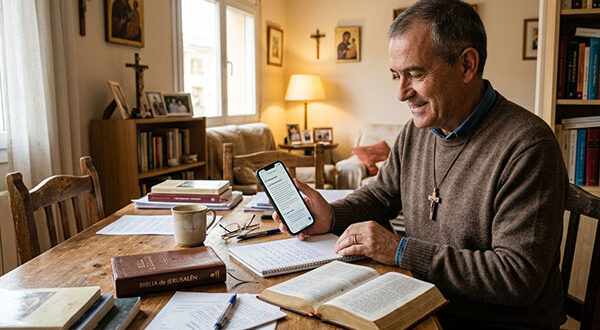
A priest can use AI to organize catechesis.
A student can research theology.
An evangelizer can spread Catholic content.
A sick person can find initial help or guidance.
The tool itself is not the problem.
The real question is whether man continues to govern the tool or eventually becomes enslaved by it.
When AI Replaces Spiritual Life
Here we encounter one of the greatest pastoral risks of our time.
Many people already live permanently connected, yet spiritually empty.
They consume religious information, but they do not pray.
They watch videos about God, but never enter a church.
They speak about spirituality, but never go to confession.
They read inspirational phrases, but they do not convert.
Artificial intelligence could increase this illusion of superficial religiosity.
Because knowing much about God does not mean knowing God.
A person may read thousands of theological explanations and still have a soul far from the Lord.
Christian life does not consist in accumulating information, but in living in grace.
The devil knows much theology. And yet he hates God.
True faith involves:
- prayer,
- sacraments,
- conversion,
- obedience,
- humility,
- charity,
- the cross,
- interior life.
No artificial intelligence can replace the action of divine grace.
The Problem of Modern Loneliness
Another troubling aspect is the emotional use of AI.
More and more people speak with artificial systems seeking companionship, understanding, or affection. This reveals a deep wound in our society: loneliness.
We live hyperconnected and, at the same time, profoundly isolated.
The Church reminds us that man was created for real communion, not virtual existence.
God Himself said:
“It is not good that the man should be alone” (Gen 2:18).
Authentic human relationships are irreplaceable.
No program can replace:
- true friendship,
- a family,
- a Christian community,
- a priest,
- an embrace,
- a real conversation,
- human presence.
There is a danger of taking refuge in artificial interactions in order to avoid the demands of real love.
Because true love involves sacrifice, patience, and vulnerability.
A machine will never demand moral conversion from us.
God will.
Artificial Intelligence and the Manipulation of Truth
We also live in an extremely dangerous age for truth.
AI can generate fake images, fake speeches, fake voices, and fake news with enormous ease.
This has tremendously serious moral implications.
The Eighth Commandment still stands:
“You shall not bear false witness.”
The manipulation of reality can become a massive instrument of deception, propaganda, and moral destruction.
The Christian is called to love truth.
Christ said:
“I am the way, and the truth, and the life” (Jn 14:6).
For this reason, Catholics must develop discernment.
Not everything viral is true.
Not everything technological is good.
Not everything efficient is moral.
Technique without ethics can become an instrument of destruction.
The Danger of Replacing Wisdom With Information
Never before has there been so much access to knowledge and, paradoxically, so much confusion.
Why?
Because information is not the same as wisdom.
Wisdom is born from truth illuminated by God.
Today many people know “facts,” but they do not know how to live.
Artificial intelligence can answer questions quickly, but it cannot form holy souls.
True wisdom begins with the fear of God:
“The fear of the Lord is the beginning of wisdom” (Prov 9:10).
Modern man runs the risk of trusting algorithms more than prayer, automated analysis more than Christian prudence, technology more than Divine Providence.
And there again idolatry appears.
How Should a Catholic Approach Artificial Intelligence?
1. Use It Without Idolizing It
AI should be a tool, never the master of our lives.
It must remain subordinate to moral and spiritual good.
2. Maintain a Real Sacramental Life
Nothing can replace:
- the Eucharist,
- confession,
- prayer,
- spiritual reading,
- spiritual direction,
- the Christian community.
Faith cannot be lived solely through screens.
3. Practice Discernment
The Christian must continually ask:
- Does this bring me closer to God?
- Does it make me more virtuous?
- Does it steal time from prayer?
- Does it make me superficial?
- Does it make me emotionally dependent on a machine?
4. Defend Human Dignity
Man must never be reduced to data, productivity, or efficiency.
Every person possesses an immortal soul redeemed by Christ.
5. Remember That Only God Saves
Technology may alleviate human problems, but it will never eliminate sin or spiritual death.
Salvation does not come from Silicon Valley.
It comes from Calvary.
Christ Remains the Center
In the midst of this technological revolution, Christians should not live in fear, but neither should they live naively.
Artificial intelligence can be useful.
It can serve evangelization.
It can help in many areas.
But it can also become an instrument of dehumanization if mankind loses its sense of God.
The decisive question is not what AI can do.
The real question is:
What is happening to the human soul?
Because a technologically advanced society can still be spiritually sick.
Man will continue to need:
- redemption,
- truth,
- grace,
- mercy,
- meaning,
- hope,
- authentic love.
And none of these can be artificially manufactured.
Saint Paul wrote:
“All things are lawful for me, but not all things are helpful” (1 Cor 6:12).
This phrase perfectly summarizes the current challenge.
Technology can do many things.
But the Christian must always ask whether those things are beneficial for the soul.
A Final Reflection for Our Time
Perhaps the greatest danger of artificial intelligence is not that machines become human.
Perhaps the greatest danger is that humans become increasingly mechanical:
- without silence,
- without contemplation,
- without prayer,
- without depth,
- without the capacity to love,
- without relationship with God.
Christianity reminds us of something revolutionary: man is not an advanced biological machine.
He is a creature loved by God.
Christ did not die for algorithms.
He died for souls.
And as long as there is one human soul searching for truth, the Gospel will remain more necessary than any technology.