Related Articles


In a time like ours—marked by doctrinal confusion, the relativization of truth, and a faith often diluted into something merely emotional—it becomes almost prophetic to look back at a practice that, although it may sound distant today, holds an immense spiritual force: the Anti-Modernist Oath.
It was not a mere formula nor just another disciplinary gesture. It was, in essence, a declaration of spiritual warfare against one of the greatest internal crises the Church has ever faced. And perhaps, if we know how to listen, it can also illuminate our present challenges.
What was the Anti-Modernist Oath?
The Anti-Modernist Oath was instituted in 1910 by Pope Saint Pius X, as a direct response to a theological movement known as modernism, which he himself defined as “the synthesis of all heresies.”
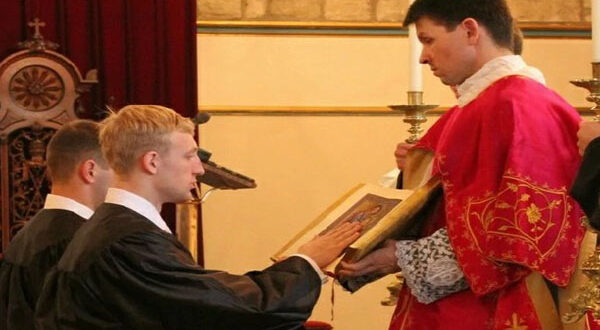
This oath had to be taken by priests, bishops, theology professors, and preachers. In it, they solemnly committed themselves to:
- Defend the objective truth of the faith.
- Reject subjectivist interpretations of Scripture.
- Maintain fidelity to the Magisterium of the Church.
- Oppose doctrinal evolution understood as an essential change in revealed truth.
It was not a mere formality. It was a clear stance: faith does not change according to the times; it is man who must convert to eternal truth.
The context: a silent but devastating crisis
At the end of the 19th century and the beginning of the 20th, many theologians began to reinterpret the faith based on modern philosophical assumptions:
- Truth was no longer absolute, but relative.
- Revelation was reduced to an interior experience.
- Dogmas were seen as changing symbols.
- Christ was interpreted more as a historical figure than as the Son of God.
This approach, though presented as an “update,” actually eroded the very foundations of Christianity.
Saint Pius X clearly saw the danger: this was not a visible and concrete heresy, but a mindset that dissolved the faith from within.
An act of doctrinal courage
The Anti-Modernist Oath was, therefore, an act of pastoral courage. It did not seek to impose fear, but to protect the deposit of faith.
In it, it was clearly affirmed, for example:
- That God can be known with certainty through reason.
- That the Gospels are historically reliable.
- That dogmas do not evolve in their essence.
- That faith is not the result of feeling, but adherence to revealed truth.
This oath reminded the faithful of something fundamental:
the Catholic faith is not a human construction, but a received gift.
Biblical foundation: fidelity to the truth
The Anti-Modernist Oath was not an isolated invention. It is deeply rooted in Scripture.
Saint Paul warns forcefully:
“For the time will come when people will not endure sound doctrine, but having itching ears they will accumulate for themselves teachers to suit their own passions” (2 Timothy 4:3).
Does this not seem to describe our time?
Christ Himself also declares:
“Heaven and earth will pass away, but my words will not pass away” (Matthew 24:35).
Revealed truth is not subject to trends or majorities. It is eternal.
Why was it abolished?
The Anti-Modernist Oath was suppressed in 1967, in the context following the Second Vatican Council.
This does not mean that the Church renounced the truth, but rather that it sought new ways to dialogue with the modern world. However, many believe that this suppression coincided with a period of:
- Doctrinal confusion.
- Vocational crisis.
- Loss of identity in certain ecclesial sectors.
Here arises an uncomfortable but necessary question:
have we managed to maintain the balance between openness to the world and fidelity to the truth?
Current relevance: do we need a “new oath” today?
Although the Anti-Modernist Oath is no longer formally required, its spirit is more necessary today than ever.
We live in a culture where:
- Truth is subjective.
- Morality is relative.
- Religion is reduced to feeling.
- Faith adapts to the world instead of transforming it.
In this context, every Christian is called to make, in his or her heart, a “silent oath”:
- To remain faithful to the teachings of the Church.
- To seek the truth with humility.
- Not to be swept away by ideologies.
- To live a coherent, uncompromising faith.
Practical applications for spiritual life
This topic is not merely historical. It has concrete consequences for your life today.
1. Be formed in the faith
It is not enough to “feel.” It is necessary to know. Read the Catechism, study Scripture, deepen your understanding of Tradition.
2. Love the truth, even when it is uncomfortable
Truth is not always easy, but it always sets us free.
“The truth will set you free” (John 8:32).
3. Discern what you hear
Not everything presented as “Catholic” truly is. Learn to distinguish.
4. Live with coherence
The greatest witness today is not controversy, but everyday holiness.
5. Pray for the Church
The crisis is not resolved by analysis alone, but by grace.
A call to fidelity in times of confusion
The Anti-Modernist Oath leaves us with a clear lesson:
the Church does not need to reinvent itself, but to remain faithful to Christ.
Today, more than ever, we need Christians who are:
- Firm in truth.
- Humble in heart.
- Courageous in witness.
- Rooted in the living tradition of the Church.
This is not about nostalgia, but about fidelity.
Conclusion: a promise that still lives
Although the words of the oath no longer resound at the altar, its spirit continues to challenge us.
Every time you choose truth over comfort,
every time you defend the faith with charity,
every time you remain faithful amid doubt…
you are silently renewing that oath.
And in that humble act, you are participating in something immense:
the safeguarding of the truth that saves the world.
Furthermore, with due reverence, I submit and adhere with my whole heart to the condemnations, declarations, and all the prescripts contained in the encyclical Pascendi and in the decree Lamentabili,especially those concerning what is known as the history of dogmas. I also reject the error of those who say that the faith held by the Church can contradict history, and that Catholic dogmas, in the sense in which they are now understood, are irreconcilable with a more realistic view of the origins of the Christian religion. I also condemn and reject the opinion of those who say that a well-educated Christian assumes a dual personality-that of a believer and at the same time of a historian, as if it were permissible for a historian to hold things that contradict the faith of the believer, or to establish premises which, provided there be no direct denial of dogmas, would lead to the conclusion that dogmas are either false or doubtful. Likewise, I reject that method of judging and interpreting Sacred Scripture which, departing from the tradition of the Church, the analogy of faith, and the norms of the Apostolic See, embraces the misrepresentations of the rationalists and with no prudence or restraint adopts textual criticism as the one and supreme norm. Furthermore, I reject the opinion of those who hold that a professor lecturing or writing on a historico-theological subject should first put aside any preconceived opinion about the supernatural origin of Catholic tradition or about the divine promise of help to preserve all revealed truth forever; and that they should then interpret the writings of each of the Fathers solely by scientific principles, excluding all sacred authority, and with the same liberty of judgment that is common in the investigation of all ordinary historical documents.
Finally, I declare that I am completely opposed to the error of the modernists who hold that there is nothing divine in sacred tradition; or what is far worse, say that there is, but in a pantheistic sense, with the result that there would remain nothing but this plain simple fact-one to be put on a par with the ordinary facts of history-the fact, namely, that a group of men by their own labor, skill, and talent have continued through subsequent ages a school begun by Christ and his apostles. I firmly hold, then, and shall hold to my dying breath the belief of the Fathers in the charism of truth, which certainly is, was, and always will be in the succession of the episcopacy from the apostles. The purpose of this is, then, not that dogma may be tailored according to what seems better and more suited to the culture of each age; rather, that the absolute and immutable truth preached by the apostles from the beginning may never be believed to be different, may never be understood in any other way.
I promise that I shall keep all these articles faithfully, entirely, and sincerely, and guard them inviolate, in no way deviating from them in teaching or in any way in word or in writing. Thus I promise, this I swear, so help me God. . .