
Related Articles

The Story of a Woman Who Forever Changed the Way the Church Honors the Real Presence of Christ
Among the great feasts of the Catholic liturgical calendar, few possess such profound beauty, such extraordinary theological richness, and such transformative spiritual power as the Solemnity of Corpus Christi. Every year, millions of Catholics participate in Eucharistic processions, solemn adorations, and celebrations that publicly proclaim a central truth of the faith: Jesus Christ is truly, really, and substantially present in the Eucharist.
Yet few people know the story of the woman who, moved by an intense life of prayer and a deep devotion to the Blessed Sacrament, became the instrument chosen by God to give birth to this universal feast: Saint Juliana of Cornillon.
Her life is a fascinating testimony of how God can use seemingly insignificant people to accomplish immense works in the Church. It also reminds us that authentic spiritual renewal is always born from prayer, contemplation, and love for Christ.
Today, in an age marked by religious indifference, the loss of the sense of the sacred, and a crisis of faith in the Real Presence of Christ in the Eucharist, the figure of Saint Juliana has a surprisingly timely relevance.
The Historical Context: Christian Europe in the Thirteenth Century
To understand the importance of Saint Juliana, we must place ourselves in the thirteenth century.
Europe was experiencing an extraordinary period of religious flourishing. The great Gothic cathedrals were being built, mendicant orders such as the Franciscans and Dominicans were emerging, and theology was reaching unprecedented heights thanks to figures such as Saint Thomas Aquinas.
At the same time, however, a growing concern existed: although the Mass occupied the center of Christian life, there was still no feast dedicated exclusively to honoring the mystery of the Eucharist outside the context of Holy Thursday.
The Church celebrated the institution of the Eucharist during Holy Week, but that day was marked by the remembrance of Christ’s imminent Passion. A celebration specifically focused on the joyful adoration of the Blessed Sacrament was missing.
Providentially, God was preparing the answer.
Juliana’s Childhood: Suffering as a School of Holiness
Saint Juliana was born around the year 1193 near Liège, in present-day Belgium.
She became an orphan at a very young age. Together with her sister Agnes, she was taken in by the Augustinian religious women of the monastery of Mont-Cornillon.
From childhood she displayed remarkable intelligence and an extraordinary inclination toward prayer.
She learned Latin, studied the Holy Scriptures, and developed a profound devotion to the Blessed Sacrament.
The Eucharist became the absolute center of her spiritual life.
While others sought prestige or recognition, Juliana found her greatest joy in spending long hours before Christ in the Eucharist.
That intimacy with Jesus would become the source of the mission God entrusted to her.
The Mysterious Vision of the Moon
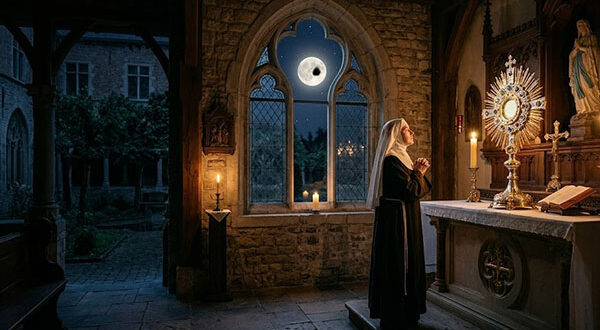
At the age of sixteen, she began to experience a recurring vision.
She saw a bright and beautiful full moon.
However, the moon had a strange dark spot.
For years she did not understand its meaning.
She persevered in prayer and asked God for light to interpret the experience.
Eventually she understood the message.
The moon symbolized the liturgical life of the Church.
The dark spot represented an absence: a special feast dedicated exclusively to the Blessed Sacrament was missing.
It was not a personal idea or a human initiative.
Juliana was convinced that God desired a universal celebration in honor of the Eucharist.
Yet, far from seeking attention, she remained silent for many years.
True mystical experience always leads to humility.
A Difficult Mission Filled with Opposition
When Juliana began sharing her vision with a few trusted individuals, she encountered support, but also resistance.
There was no shortage of criticism, suspicion, and misunderstanding.
The history of the saints reveals a constant pattern: God’s works often pass through trials before bearing fruit.
Juliana eventually became prioress of her community, but internal tensions and ecclesiastical disputes forced her to leave the monastery several times.
She experienced rejection, persecution, and suffering.
Yet she never abandoned her love for the Church.
This is an important lesson for our own time.
We live in an age in which many abandon religious practice when they encounter human weaknesses within the Church.
Juliana did exactly the opposite.
She loved the Church even more when it became more difficult to do so.
She understood that the holiness of the Church comes from Christ and not from the perfection of its members.
The Support of Important Church Figures
Gradually, Juliana’s proposal began to gain support.
Among those who encouraged her was the Archdeacon of Liège, Jacques Pantaléon.
Decades later, that same man would be elected Pope under the name of Pope Urban IV.
This detail would prove decisive.
Numerous theologians also recognized the spiritual depth of her initiative.
Eucharistic devotion was growing intensely throughout Europe.
Providence was preparing the right moment.
The Miracle of Bolsena and Providential Confirmation
In 1263, an event occurred that would leave a mark on history.
A German priest who was struggling with doubts about the Real Presence of Christ in the Eucharist was celebrating Mass in the Italian town of Bolsena.
During the consecration, according to tradition, the Host began to bleed.
Drops of blood stained the corporal and the altar.
The event was reported to Pope Urban IV.
Although the Church has always exercised prudence regarding miracles, this event reinforced the movement toward a universal celebration of the Eucharistic mystery.
The Official Birth of Corpus Christi
In 1264, Pope Urban IV promulgated the bull Transiturus de hoc mundo.
Through this document, he established the feast of Corpus Christi for the entire Church.
The spiritual intuition that Juliana had received decades earlier was finally becoming a universal celebration.
The humble religious sister did not live to see her dream fully realized.
She had died in 1258.
Yet, as so often happens in the history of holiness, the seed planted in silence ultimately bore immense fruit for generations to come.
Saint Thomas Aquinas and the Theology of Corpus Christi
To enrich the new solemnity, the Pope commissioned Saint Thomas Aquinas to compose its liturgical texts.
The result was a masterpiece of theology and Christian poetry.
From his pen came hymns that remain part of the Church’s spiritual treasury to this day:
- Pange Lingua
- Tantum Ergo
- Lauda Sion
- Adoro Te Devote
These compositions express with extraordinary depth the Catholic doctrine of the Real Presence.
The Theological Heart of Corpus Christi
The Solemnity of Corpus Christi is not simply another religious feast.
It is a public proclamation of a fundamental truth:
Jesus Christ is truly present in the Eucharist.
The Church teaches that during the consecration, the bread and wine truly become the Body, Blood, Soul, and Divinity of Christ.
They are not mere symbols.
They are not simple reminders.
They are not representations.
They are Christ Himself.
For this reason, Jesus declared:
“I am the living bread that came down from heaven. Whoever eats this bread will live forever. This bread is my flesh, which I will give for the life of the world” (John 6:51).
And also:
“My flesh is real food and my blood is real drink” (John 6:55).
These words scandalized many of His disciples.
Yet Jesus neither softened nor corrected them.
On the contrary, He reaffirmed them.
The Church has faithfully preserved this teaching for two thousand years.
The Eucharist: Presence, Sacrifice, and Communion
From a theological perspective, the Eucharist possesses three inseparable dimensions.
1. Presence
Christ is truly present.
That is why we adore the Blessed Sacrament.
Eucharistic adoration is not idolatry.
It is worship directed to the Lord Himself, present under the sacramental species.
2. Sacrifice
Every Mass sacramentally makes present the one sacrifice of Christ on the Cross.
Calvary is not repeated.
Rather, it is made sacramentally present.
As Saint Paul teaches:
“For whenever you eat this bread and drink this cup, you proclaim the Lord’s death until He comes” (1 Corinthians 11:26).
3. Communion
The Eucharist unites the believer intimately with Christ.
We do not merely receive a blessing.
We receive the Savior Himself.
Saint Juliana’s Message for the Modern World
The figure of Saint Juliana seems especially providential for our time.
We live in a culture characterized by:
- Spiritual superficiality.
- Individualism.
- The loss of the sense of the sacred.
- A decline in sacramental practice.
- Doctrinal confusion.
In response to all this, Juliana invites us to return to the center.
And the center is Christ present in the Eucharist.
The renewal of the Church is never born primarily from strategies, programs, or structures.
It is born from an encounter with Jesus Christ.
And that encounter reaches a unique intensity in the Blessed Sacrament.
Practical Applications for Christian Life
Recover Eucharistic Adoration
Many saints affirmed that one hour before the Blessed Sacrament can transform a life.
Spending time in adoration strengthens faith, illuminates decisions, and grants interior peace.
Participate in Mass with Greater Awareness
The Mass is not a social gathering.
It is the most important act taking place on earth.
Every celebration places us before the mystery of Redemption.
Prepare Well to Receive Holy Communion
The Church has always emphasized the importance of receiving Communion in a state of grace.
Frequent confession helps us experience the Eucharist more fruitfully.
Give Public Witness to the Faith
Corpus Christi processions remind us that faith should not remain confined to the private sphere.
Christ desires to walk through our streets, our cities, and our families.
Corpus Christi and Evangelization
There is a profound relationship between the Eucharist and mission.
Whoever truly encounters Christ at the altar cannot remain indifferent.
Adoration leads to evangelization.
Contemplation leads to apostolic action.
Communion leads to charity.
For this reason, the Eucharist has always been at the heart of every great spiritual renewal throughout history.
Conclusion: A Saint Who Pointed Toward Christ
Saint Juliana of Cornillon did not found great religious orders, write massive theological treatises, or command armies.
She did something that seemed far simpler.
She fell deeply in love with Jesus present in the Eucharist.
And through that love, she transformed the liturgical life of the entire Church.
Her story reminds us that God can accomplish immense works through humble and faithful souls.
In an age marked by noise, haste, and constant distraction, Saint Juliana invites us to turn our gaze once again toward the tabernacle.
There Christ continues to wait.
There He continues to speak the same words heard by the disciples twenty centuries ago:
“Come to me, all you who are weary and burdened, and I will give you rest” (Matthew 11:28).
Corpus Christi was born from the adoring heart of a woman who believed deeply in the Real Presence of Jesus. And perhaps the greatest challenge for Christians today is precisely this: to rediscover, with renewed wonder, that the God of the universe remains truly present on every altar in the world, waiting to be loved, adored, and received.