Related Articles


Is Having Religion the Same as Studying Theology?
We live in a paradoxical age. Never before has so much information about God been so readily available, and yet never has there been so much confusion about who God truly is and how we can come to know Him.
It is common to hear statements such as:
- “I have religion, but I don’t know anything about theology.”
- “Theology is for priests.”
- “What matters is believing, not studying.”
- “All religions speak about the same God.”
These statements, although very common, reveal a profound confusion between two concepts that are closely related but not identical: religion and theology.
Understanding the difference between them is not merely an intellectual exercise. It is a matter that directly affects our spiritual life, the way we pray, our relationship with Christ, and our ability to defend the faith in an increasingly secularized world.
The Church has always maintained that a solid faith requires both religious practice and knowledge of revealed truth. Saint Peter exhorted the first Christians:
“Always be ready to give an answer to everyone who asks you to give the reason for the hope that you have.” (1 Peter 3:15)
One cannot give an explanation of something one does not know.
For this reason, it is essential to discover what religion truly is and what theology truly is.
What Does the Word “Religion” Mean?
According to the classical explanation of Lactantius and Saint Augustine, the word religion comes from the Latin verb religare, meaning to bind again or to reconnect.
Man, separated from God by Original Sin, needs to be reunited with his Creator.
Religion is precisely that path.
Saint Thomas Aquinas defines religion as a moral virtue belonging to the virtue of justice.
Why?
Because it consists of giving God what is rightfully His:
- adoration
- worship
- obedience
- love
- sacrifice
- prayer
In other words:
Religion is man’s response to God.
It does not arise merely from religious feelings.
Nor does it originate simply from human desire.
Its origin is God Himself, who reveals Himself to mankind.
Natural Religion and Revealed Religion
Human beings have always sought God.
Every civilization possesses some form of religion.
The ancient Egyptians.
The Greeks.
The Romans.
Eastern peoples.
The native cultures of the Americas.
This demonstrates a profoundly Christian truth:
Man was created for God.
As Saint Augustine famously wrote:
“You have made us for Yourself, O Lord, and our hearts are restless until they rest in You.”
However, there is an enormous difference between natural religion and revealed religion.
Natural religion attempts to reach God through human reason.
Revealed religion is God Himself coming to meet humanity.
Christianity belongs to this second category.
It is not a religion invented by men.
It is God who speaks.
It is God who teaches.
It is God who saves.
The Christian Religion Is Not a Philosophy
Many people consider Christianity to be merely a philosophy of life.
But this understanding is insufficient.
Christianity is not simply a moral system.
It is not a collection of rules.
It is not an ethical code.
It is not merely a cultural tradition.
It is the living relationship between God and man founded upon Divine Revelation.
Christ did not come merely to teach.
He came to redeem.
He Himself declares:
“I am the way and the truth and the life. No one comes to the Father except through Me.” (John 14:6)
The Christian religion is therefore a participation in the divine life through grace.
So Then, What Is Theology?
If religion is our relationship with God,
theology is the rational and systematic knowledge of God based upon Divine Revelation.
The word comes from Greek:
- Theos = God
- Logos = study, discourse, word
Literally:
the study of God.
But not just any study.
Theology does not invent doctrines.
It does not create new truths.
It does not alter the Gospel.
Its mission is to understand more deeply what God has already revealed.
Saint Anselm expressed this with an immortal phrase:
“Fides quaerens intellectum.”
“Faith seeking understanding.”
First one believes.
Then one seeks deeper understanding.
Theology Is Born from Faith
This is a fundamental point.
Authentic theology does not begin with doubt.
It begins with faith.
Reason does not replace faith.
It enlightens it.
It develops it.
It organizes it.
It explains it.
It defends it.
This is why Saint Thomas Aquinas called theology the queen of the sciences.
Why?
Because its object is God Himself.
No science possesses a more exalted object.
The Relationship Between Faith and Reason
One of the greatest achievements of Christian thought was demonstrating that faith and reason are not enemies.
Reason discovers many truths.
But it has limits.
Revelation surpasses those limits.
It does not contradict reason.
It perfects it.
As the First Vatican Council teaches:
“Faith and reason can never truly contradict one another.”
Saint Thomas compared reason to a lamp.
Revelation is the sun.
The lamp gives light.
The sun fills everything with light.
Can Religion Exist Without Theology?
Yes.
Many saints were simple people.
They never attended universities.
They never wrote theological treatises.
Yet they possessed a profound religious life.
Think of many medieval peasants.
Holy children.
Illiterate elderly believers.
Their faith was authentic.
Even so, they still received doctrinal instruction through:
- preaching
- the Catechism
- the liturgy
- the sacraments
Every religion requires some form of theology.
Even if only in its most elementary form.
For no one can truly love what he knows absolutely nothing about.
Can Theology Exist Without Religion?
Here we encounter one of the great dangers of the modern world.
Yes.
One can study theology in the same way one studies archaeology.
Or history.
Or literature.
Or philosophy.
Without faith.
Without prayer.
Without conversion.
Without sacramental life.
This produces an empty theology.
Intellectually brilliant.
But spiritually sterile.
Saint Paul had already warned about this reality:
“Knowledge puffs up, but love builds up.” (1 Corinthians 8:1)
Authentic theology always leads to adoration.
When knowledge does not lead us to love God more deeply, something has gone wrong.
The Fathers of the Church: The Perfect Example of the Union Between Religion and Theology
The great Fathers of the Church never separated these two dimensions.
Saint Athanasius fought against heresies while celebrating the Holy Eucharist.
Saint Basil wrote theological treatises after long hours of prayer.
Saint Gregory the Great affirmed that no one can speak about God without first having learned to listen to Him.
Theology was born from contemplation.
Not from mere speculation.
Saint Thomas Aquinas: The Model of the Theologian
Throughout Catholic tradition, Saint Thomas Aquinas has been regarded as the greatest theologian of the Western Church.
Yet he himself wept before the Blessed Sacrament.
He prayed before writing.
He celebrated Holy Mass with tears.
After a profound mystical experience, he declared:
“Everything I have written seems to me like straw compared to what I have seen.”
The greatest intellectual in the Church ultimately acknowledged that God always surpasses our words.
The Contemporary Crisis: An Abundance of Information, A Lack of Formation
The Internet has democratized access to knowledge.
But it has also multiplied doctrinal errors.
Today anyone can publish videos about religion.
Not everyone teaches Catholic doctrine.
Many mix together:
- Eastern spiritualities
- psychology
- self-help
- relativism
- esotericism
All of it under the appearance of Christianity.
Here theology becomes a pastoral necessity.
Knowing doctrine protects the faith.
Why Should Every Catholic Learn Theology?
Because to love means to know.
No one can deeply love someone whom they never seek to understand.
Theology enables us to:
- understand the Holy Mass
- comprehend the sacraments
- discover the beauty of the Holy Trinity
- answer objections against the faith
- avoid heresies
- grow spiritually
Not everyone is called to earn a doctorate.
But everyone is called to continue growing in the knowledge of the faith.
Religion Without Truth: Sentimentalism
There is another modern danger.
Reducing religion to emotions.
People who say:
“I feel God.”
Yet they know virtually nothing about:
- the Creed
- the Commandments
- the Sacraments
Their faith depends upon their emotional state.
When the emotions disappear…
their religious practice disappears as well.
Authentic faith is founded upon revealed truth.
Not merely upon feelings.
Theology Without Prayer: Intellectualism
At the opposite extreme we find those who know perfectly:
- Greek
- Hebrew
- Patristics
- Dogmatic Theology
Yet they hardly pray.
They rarely receive the sacraments.
They do not live charity.
They do not adore God.
They know a great deal about God.
But they know God very little.
True wisdom unites both mind and heart.
Jesus Christ: The Meeting Point Between Religion and Theology
In Christ both realities reach their fullness.
He teaches.
But He also saves.
He reveals the Father.
And He opens the way to Him.
It is not enough to admire His teachings.
We must follow Him.
It is not enough to study the Gospel.
We must live it.
Practical Applications for Today’s Christian
1. Nourish Your Life of Prayer
Every aspect of our formation should lead us to a deeper relationship with God. Daily prayer, prayerful reading of Sacred Scripture, and frequent participation in the sacraments allow knowledge to become life.
Prayer is not an optional complement to theology; it is the atmosphere in which authentic theology breathes. The more we know God, the more we should desire to speak with Him, adore Him, and conform our lives to His holy will.
2. Grow in Doctrinal Formation
Dedicating time to studying the Catechism, Sacred Scripture, and the writings of the great spiritual masters strengthens our faith against error and enables us to live more consistently as Christians.
Formation should never end with childhood catechism. Every Catholic is called to mature in the knowledge of the faith throughout his or her life. A well-formed conscience is one of the greatest treasures a Christian can possess.
3. Participate Actively in the Sacred Liturgy
The liturgy is the highest expression of the Christian religion.
Participating in Holy Mass with attention, recollection, reverence, and a spirit of adoration allows both the intellect and the heart to be formed by the mysteries of salvation.
The liturgy is not merely a community gathering.
It is the worship that Christ Himself offers to the Father, in which the faithful are privileged to participate.
To understand the liturgy more deeply is to discover ever greater treasures hidden within it.
4. Bear Witness in Society
Every Christian is called to explain, with charity and firmness, the reason for the hope that is within him.
Theological formation is not a luxury reserved for specialists.
It is a powerful instrument for evangelization.
In a world marked by relativism, skepticism, and moral confusion, Catholics must be capable of presenting the truth with clarity, humility, and love.
Knowledge gives confidence.
Holiness gives credibility.
Both are necessary.
5. Unite Study and Holiness
Every book we read, every course we take, and every theological reflection should ultimately lead us to ask one simple question:
Does this bring me closer to Christ?
If the answer is yes, then our study is fulfilling its true purpose.
Theology should never become an end in itself.
Its purpose is to lead the believer toward greater love of God, deeper conversion, and a more faithful Christian life.
Knowledge that does not become charity remains incomplete.
Conclusion: Two Wings That Lift the Soul Toward God
Religion and theology are not rivals.
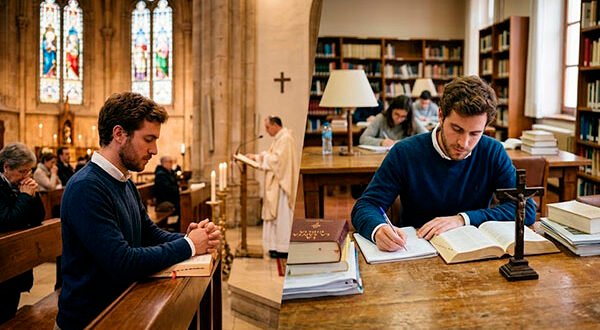
They are two gifts that God offers to humanity in order to lead us toward holiness.
Religion places us on our knees before God.
Theology helps us understand, through the light of reason enlightened by faith, the One whom we adore.
When both walk together, faith becomes stronger, prayer becomes deeper, hope becomes firmer, and charity bears richer fruit.
The history of the Church demonstrates that the great saints were, in one way or another, men and women who sought to know the Lord more deeply so that they might love Him more completely.
In an age marked by relativism, subjectivism, and superficiality, Catholics are called to rediscover the richness of a faith that is intelligently lived.
The goal is not to accumulate knowledge out of pride.
Rather, it is to allow revealed truth to transform the heart.
As Sacred Scripture teaches:
“Then you will know the truth, and the truth will set you free.” (John 8:32)
And that Truth has a name:
Jesus Christ.
Every authentic religion leads to Him.
Every true theology proceeds from Him and returns to Him.
When the believer unites humble adoration with the faithful study of Divine Revelation as handed down by the Church, he discovers that knowing God is not merely acquiring information.
It is entering ever more deeply into the mystery of the One who created us, redeemed us, and calls us to share eternally in His own divine life.
For this reason, religion and theology should never be separated.
Religion without theology easily falls into ignorance, sentimentalism, or superstition.
Theology without religion risks becoming a cold intellectual exercise, disconnected from prayer and conversion.
But when both flourish together, they produce mature Christians—men and women who know what they believe, why they believe it, and, above all, Whom they believe.
This harmonious union has always characterized the greatest saints, theologians, pastors, missionaries, and martyrs of the Church.
Their lives remind us that the highest purpose of all theological study is not simply to speak about God, but to know Him, love Him, worship Him, and one day contemplate Him face to face in the eternal glory of Heaven.
As Saint Paul beautifully expresses:
“For now we see through a glass, darkly; but then face to face. Now I know in part; then I shall know fully, even as I am fully known.” (1 Corinthians 13:12)
Until that blessed day, religion guides our hearts toward God, while theology illuminates our minds with His truth.
Together they become two wings by which the human soul rises toward the contemplation of the Eternal Truth, fulfilling the ultimate purpose for which every person was created:
To know God, to love God, to serve God in this life, and to enjoy Him forever in the next.