Related Articles



We live in an age where tattoos have gone from being something marginal to becoming a massive cultural expression. Young people, adults, athletes, artists, professionals, and even deeply believing people wear tattoos on their skin. Some consider them art. Others, a permanent memory. Some see them as fashion. Others, as a declaration of identity.
But for many Catholics, a sincere and profound question arises:
Is getting a tattoo a sin?
Is it wrong to modify the body?
Does the Bible forbid it?
Can a Christian get tattooed and still live an authentic life of faith?
The answer requires more than a simple “yes” or “no.” It requires understanding how the Catholic Church views the human body, freedom, the dignity of the person, and the true meaning of Christian morality.
And it is important to clarify something from the very beginning:
The Catholic Church does not teach that every tattoo is automatically sinful. But neither does it teach that every tattoo is morally indifferent. As with many moral questions, the Church invites us to discernment, prudence, and an examination of the deeper intentions of the heart.
The Body Is Not an Object: It Is a Gift from God
The Catholic vision of the human body is radically different from that of the modern world.
Today, many cultural currents present the body as:
- an accessory,
- an absolute personal possession,
- a tool for pleasure,
- or merely a means of self-expression.
But Christianity teaches something far greater:
The human body is not a biological accident.
It is not a prison for the soul.
It is not something without spiritual value.
The body is part of the person created by God.
Saint Paul writes:
“Do you not know that your body is a temple of the Holy Spirit?”
(1 Corinthians 6:19)
The Church has developed this idea deeply throughout the centuries: the human person glorifies God also through the body.
This completely changes the perspective.
Because the question is no longer simply:
“Can I get a tattoo?”
But rather:
“Does this honor the dignity of the body God gave me?”
So… Does the Bible Forbid Tattoos?
Many immediately quote this verse:
“Do not cut your bodies for the dead or put tattoo marks on yourselves.”
(Leviticus 19:28)
At first glance, it seems like an absolute prohibition. But the Church has always interpreted this passage within its historical and ceremonial context.
In the Old Testament, many laws were given specifically to the people of Israel:
- dietary restrictions,
- rules about fabrics,
- ceremonial norms,
- ritual purity laws.
Christians are not bound to observe those ceremonial Jewish laws in the same way ancient Israel was.
For this reason, the Church does not consider Leviticus 19:28 to be a universal and automatic condemnation of every tattoo.
However, it would be a mistake to conclude:
“Then I can tattoo anything I want in any way I want.”
Because Catholic morality is not based merely on lists of external prohibitions. The Church goes deeper:
- intention,
- meaning,
- scandal,
- dignity,
- prudence,
- charity,
- respect for the body,
- and spiritual consequences.
The Great Moral Question: Why Do You Want a Tattoo?
This is the true heart of Christian discernment.
It is not the same thing to:
- tattoo a satanic symbol,
- or a cross;
- tattoo oneself out of destructive rebellion,
- or for a family-related reason;
- tattoo oneself out of extreme vanity,
- or for a moderate artistic purpose.
Catholic morality examines three fundamental elements:
1. The Intention
What is really motivating you?
- A desire to belong?
- A need for attention?
- Inner emptiness?
- Fashion?
- Rebellion?
- Vanity?
- A memory of a loved one?
- A testimony of faith?
God looks at the heart.
Many times, a person does not get tattooed out of malice, but from emotional wounds, a need for approval, or impulsiveness.
The Church invites us to ask:
“Does this bring me closer to God, or does it feed my ego?”
2. The Content of the Tattoo
Here there is a much clearer moral line.
A tattoo can become gravely sinful if it promotes:
- hatred,
- obscenity,
- violence,
- anti-Christian ideologies,
- demonic symbols,
- blasphemy,
- degrading sexual content,
- or messages contrary to the faith.
Not every symbol is innocent.
Many young people today tattoo “aesthetic” images onto themselves without knowing their spiritual or esoteric origins. This can open dangerous doors morally and even spiritually.
This is not superstition: the Church has always warned against the trivialization of occult practices.
A Christian cannot willingly mark his or her body with symbols opposed to Christ and pretend that it is morally irrelevant.
3. The Consequences
Catholic morality also considers the real effects of our actions.
A tattoo may be objectively imprudent if it:
- seriously risks one’s health,
- harms family or professional opportunities,
- causes scandal,
- feeds a superficial lifestyle,
- or stems from self-destructive impulses.
Saint Paul teaches:
“Everything is permissible for me, but not everything is beneficial.”
(1 Corinthians 6:12)
That sentence perfectly summarizes the Catholic position on many modern issues… including tattoos.
Can a Tattoo Be an Expression of Faith?
Yes, it can.
In fact, historically some Christians used religious body markings as a sign of belonging or pilgrimage.
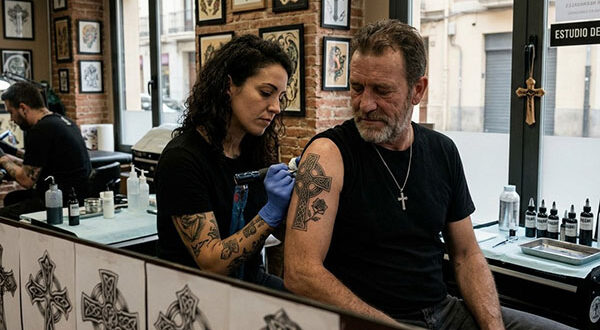
In certain regions of the Middle East, for example, some Coptic Christians wear small tattooed crosses as a testimony of faith and protection in the face of persecution.
For centuries, some pilgrims to the Holy Land even tattooed discreet Christian symbols onto themselves to remember their pilgrimage.
But here an important distinction must be made:
One thing is a humble sign of faith.
Another very different thing is turning religion into aesthetics, spectacle, or spiritual narcissism.
Today there is a risk of “consuming” religious symbols as visual fashion without true interior conversion.
And Christianity has never been about superficial appearances.
Christ did not ask us to appear holy.
He asked us to carry the cross.
The Modern Problem: The Cult of the Self
Perhaps the greatest danger related to tattoos today is not the ink itself.
It is the mentality that often lies behind them.
We live in the culture of:
- “do whatever you want,”
- “your body belongs to you,”
- “express yourself without limits,”
- “reinvent your identity.”
But Christianity teaches exactly the opposite:
We do not completely belong to ourselves.
We were created by God.
We were redeemed by Christ.
We are called to glorify God also through our bodies.
That does not mean despising art or bodily beauty. It means not turning one’s body into a permanent egocentric project.
There are people who begin with a small tattoo and end up trapped in a constant search for external identity. The problem is no longer the ink. It is the inner emptiness trying to be filled from the outside.
What If I Already Have Tattoos?
Here many people feel unnecessary guilt.
The Church does not automatically reject or condemn those who have tattoos.
There are saints who had far darker pasts than any mark on the skin.
The grace of God does not depend on perfect physical appearance.
A tattoo does not prevent someone from:
- going to confession,
- receiving Communion,
- becoming holy,
- loving God,
- or living the faith authentically.
What matters is a converted heart.
Many people come to Christ after years away from the faith, carrying tattoos from previous stages of their lives. The Church does not require them to erase their history in order to draw near to God.
The risen Christ retained His glorified wounds.
That also teaches us something profoundly beautiful: God can transform even our wounds into signs of redemption.
Should a Catholic Get a Tattoo?
Perhaps the right question is another one:
“Is it prudent for me?”
And that requires sincere discernment.
Before getting tattooed, a Catholic should ask:
- Why do I really want this?
- Am I acting impulsively?
- Does the content honor God?
- Will I be ashamed of this in ten years?
- Does this reflect maturity or a need for approval?
- Am I seeking identity in Christ or in an image?
- Is my decision born from freedom or social pressure?
The Church does not treat the faithful like children incapable of thinking. It invites them to form their conscience.
And a mature Christian conscience knows that not everything permitted is spiritually beneficial.
The True Mark of the Christian
In the end, Christianity has never placed the focus on external marks.
The first Christians did not change the world because of their tattoos, aesthetics, or appearance.
They changed it through:
- their purity,
- their charity,
- their courage,
- their fidelity,
- their capacity to love unto sacrifice.
The mark of the Christian is not first on the skin.
It is in the soul.
Saint Paul said:
“It is no longer I who live, but Christ who lives in me.”
(Galatians 2:20)
That is the true Christian identity.
And when someone discovers that deeply, many times they stop needing so many external affirmations.
So, Is It a Sin to Get a Tattoo?
The honest Catholic answer is:
Not necessarily.
There is no absolute prohibition against all tattoos in the Catholic Church.
But it can become sinful depending on:
- the intention,
- the content,
- the context,
- vanity,
- scandal,
- or contempt for the dignity of the body.
The Church does not answer with simplistic formulas because it understands something fundamental:
The deepest problem is never the ink.
It is the human heart.
And that is where Christ truly wants to act.