Related Articles

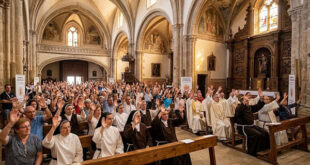

True renewal does not begin in Rome, nor with bishops, nor with priests… it begins in the heart of every baptized person.
We are living through turbulent times for the Church. It only takes opening any newspaper or spending a few minutes on social media to encounter news about the crisis of vocations, scandals, internal divisions, the decline in religious practice, secularization, indifference toward God, and a world that seems to be rushing ever more quickly toward a culture in which Christ occupies only a secondary place.
Many Catholics look upon this situation with sadness. Others with indignation. Some even with despair.
And then a question constantly echoes:
What does the Church need in order to flourish again?
The answers almost always point upward.
“We need better bishops.”
“We need better priests.”
“We need better catechesis.”
“We need better documents.”
“We need a liturgical reform.”
“We need to return to Tradition.”
All of that may contain part of the truth.
But there is a much deeper reality that we often forget.
The authentic reform of the Church has never begun with structures. It has always begun with the saints.
And that is an enormous difference.
Because it is much easier to try to change the Church… than to allow God to change us.
The Church Is Always in Need of Reform
There is a Latin expression that has been used for centuries:
Ecclesia semper reformanda.
It literally means:
“The Church must always be reformed.”
However, this phrase has often been misunderstood.
It does not mean that the Church must constantly reinvent her doctrine.
It does not mean adapting the Gospel to the world.
It does not mean altering revealed truth in order to make it more acceptable.
The Church cannot reform what Christ Himself instituted.
What is in constant need of reform is us.
The Church is holy because her Head is Christ.
Her sacraments are holy.
Revealed doctrine is holy.
The Eucharist is holy.
But the members of the Church remain sinners.
And there lies the constant need for conversion.
As the Second Vatican Council taught:
“The Church, embracing sinners in her own bosom, is at the same time holy and always in need of purification.”
This statement perfectly summarizes the entire history of Christianity.
The Great Mistake of Every Age
Every generation thinks the main problem lies outside itself.
The first Christians blamed the Roman Empire.
In the Middle Ages, many blamed the kings.
During the Protestant Reformation, some blamed the Pope.
Today, some blame the Second Vatican Council.
Others blame modernism.
Others blame traditionalism.
Others blame secularism.
Others blame the media.
But Christ never began by asking:
“What are others doing wrong?”
He always asked:
“And what about you?”
Because the Gospel does not begin by reforming institutions.
It begins by converting hearts.
The Silent Revolution of the Gospel
Jesus never organized a political revolution.
He never raised an army.
He never conquered Jerusalem.
He never took control of the Sanhedrin.
And yet He transformed the entire world.
How?
By changing people.
One by one.
Peter.
John.
Mary Magdalene.
Zacchaeus.
The Samaritan woman.
Nicodemus.
Matthew.
Twelve men transformed by grace eventually transformed history.
The Church continues to function in exactly the same way.
It does not first need buildings.
Nor money.
Nor influence.
It needs saints.
Reform Begins When I Stop Looking at Others
There is a very common temptation among committed Catholics.
To constantly observe the faults of others.
This priest celebrates Mass poorly.
That bishop speaks ambiguously.
That parishioner dresses improperly.
That community does this.
Another community does that.
Little by little, the spiritual life can become one long criticism.
But the examination of conscience disappears.
And then something dangerous happens.
One fights to defend the Church…
without allowing Christ to govern one’s own heart.
The Beam and the Speck
Jesus was extraordinarily clear.
“Why do you see the speck in your brother’s eye, but do not notice the beam in your own eye?” (Matthew 7:3)
This teaching remains revolutionary.
Christ does not tell us to ignore error.
He tells us that we must first be converted ourselves.
Because only a humble heart can truly help its neighbor.
**We All Want Reformers…
…but God Is Looking for Saints**
History demonstrates one constant truth.
Every time the Church has gone through a profound crisis, God has responded by raising up saints.
Not commissions.
Not strategies.
Not advertising campaigns.
Saints.
When Europe was sinking morally…
Saint Benedict appeared.
When the clergy was plagued by grave abuses…
Saint Gregory VII arose.
When the Church suffered the Protestant division…
Saint Ignatius of Loyola, Saint Philip Neri, Saint Teresa of Ávila, Saint John of the Cross, Saint Charles Borromeo, and many others appeared.
When the French Revolution sought to destroy Christianity…
new religious congregations emerged.
When the twentieth century seemed to be losing the faith…
God gave countless witnesses of holiness.
It always happens the same way.
God responds to crises by raising up transformed souls.
What Does True Conversion Really Mean?
Many people identify conversion only with abandoning grave sins.
But the spiritual tradition teaches something much deeper.
Conversion means directing one’s entire life toward God.
It means no longer living for oneself.
It means allowing Christ to occupy the center.
It means learning to think like Christ.
To speak like Christ.
To love like Christ.
To forgive like Christ.
To suffer like Christ.
To serve like Christ.
Conversion is not an isolated event.
It is a journey that lasts a lifetime.
The Danger of Religious Activism
There is another very modern danger.
To believe that working hard for the Church automatically means living united to God.
We can organize congresses.
Processions.
Conferences.
YouTube channels.
Associations.
Parish groups.
And yet…
neglect prayer.
Neglect Confession.
Neglect humility.
Neglect charity.
Saint Teresa of Ávila warned that a single soul truly united to God does more good for the Church than hundreds of activities carried out without an interior life.
Because apostolic fruitfulness is born from grace.
Not from activism.
The First Reform: Return to Prayer
Every authentic renewal begins here.
There is no reform without prayer.
There is no holiness without prayer.
There is no perseverance without prayer.
Jesus Himself devoted long hours to dialogue with the Father.
If the Son of God needed to pray…
how could we possibly do without that encounter?
A Church that prays remains alive.
A Christian who stops praying slowly begins to grow cold.
The Second Reform: Return to the Sacraments
The saints never built their spirituality upon emotions.
They built it upon the sacraments.
Frequent Confession.
The Eucharist.
Adoration.
Penance.
Sacramental grace is the invisible strength that sustains every interior reform.
It is not enough to admire holiness.
We must nourish it.
The Third Reform: Return to the Family
The crisis of the Church is inseparable from the crisis of the family.
The first Christian communities were born in homes.
The first evangelizers were fathers and mothers.
The first schools of holiness were households.
Today, many families need to recover simple practices:
pray together;
bless the table before meals;
read the Gospel;
attend Holy Mass faithfully;
teach the Catechism to their children;
live out daily forgiveness.
When one family is converted, an entire generation can be transformed.
The Fourth Reform: Live Charity
Sometimes we identify fidelity only with correctly defending doctrine.
But Christ always unites truth and charity.
Orthodoxy without love becomes harshness.
Love without truth eventually becomes empty.
Authentic reform requires both.
To speak with clarity.
And to love deeply.
Holiness Is Contagious
There is a fascinating reality.
Sin has the power to spread.
But holiness does as well.
A holy priest transforms a parish.
A holy mother transforms a family.
A holy young person transforms a university.
A holy businessman transforms a company.
A holy teacher transforms entire generations.
Holiness never remains confined.
It radiates.
Do Not Wait for Better Times
Many people think:
“When the Church improves…”
“When there are better priests…”
“When things change…”
Then I will fully live my faith.
It is exactly the opposite.
The Church will improve when we fully live our faith.
God will never hold us accountable for the sins of others.
But He will ask what we did with the grace we received.
The Example of the Saints
All the saints had reasons to complain about the situation of their own times.
Many lived in ages worse than ours.
Yet…
they did not dedicate their lives to complaining.
They dedicated themselves to loving more.
To praying more.
To serving more.
To sacrificing more.
And precisely because of that, they ended up changing history.
A Call for Our Time
We are living in an extraordinary age.
Not because it is easy.
But because it offers enormous opportunities for holiness.
In a world where noise reigns…
we can offer silence.
Where hatred reigns…
we can offer forgiveness.
Where selfishness reigns…
we can offer service.
Where despair reigns…
we can proclaim Christ.
Perhaps we will never hold great positions within the Church.
Perhaps we will never write famous books.
Perhaps no one will remember our name.
But if we live united to God…
we will truly have cooperated in the renewal of the Church.
Because history shows that the future of Christianity has never depended on majorities.
It has always depended on minorities deeply in love with Christ.
Pastoral Applications to Begin Today
The reform of the Church is not an abstract project; it can begin with concrete decisions made each day. Some simple practices can become the foundation of an authentic spiritual renewal:
- Dedicate a fixed time each day to personal prayer, even if it is only fifteen minutes.
- Read and meditate on the Gospel every day, asking yourself what Christ is asking of you today.
- Go frequently to the Sacrament of Reconciliation and prepare your examination of conscience well.
- Participate in Holy Mass with recollection, avoiding allowing it to become a routine.
- Pray for the Pope, the bishops, the priests, and for vocations, instead of limiting yourself to criticizing them.
- Practice one concrete work of mercy each week, whether corporal or spiritual.
- Examine your own attitudes before pointing out the faults of others.
- Seek unity in the truth, avoiding the promotion of unnecessary divisions among Catholics themselves.
- Make your home a small “domestic Church,” where prayer and charity are the center of family life.
Conclusion: The Change God Awaits
It is possible that we will never be able to solve all the visible problems of the Church. It is not within our power to put an end to every crisis, correct every error, or heal every wound. Yet it is within our power to respond to God’s grace.
The history of salvation shows that God is accustomed to beginning great transformations with people who seem insignificant, but who are completely available to Him. This is how He began with Abraham, with Moses, with the Blessed Virgin Mary, with the Apostles, and with so many saints throughout the centuries.
Therefore, before continually asking ourselves what should change in the Church, it is fitting to listen to the question the Lord addresses to the heart of every disciple:
“Will you allow Me to transform you?”
Saint Paul summarizes this call with words of timeless relevance:
“Do not be conformed to this world, but be transformed by the renewal of your mind, that you may discern what is the will of God, what is good and acceptable and perfect.” (Romans 12:2)
And the psalmist raises a plea that can also become our daily prayer:
“Create in me a clean heart, O God, and renew a steadfast spirit within me.” (Psalm 51:10)
The Church does indeed need reforms. But the most urgent and decisive reform begins when a man or a woman throws wide open the doors of his or her soul to Christ. Every well-made confession, every Holy Communion received with faith, every act of charity, every Rosary prayed with devotion, every sacrifice offered with love, and every step of sincere conversion are invisible bricks with which God continues to build His Church.
Perhaps the Lord is not asking you to change the whole world. Perhaps He is only asking you to change your heart. And when a heart allows itself to be conquered by Christ, it is never only one person who changes: a chain of grace begins that can reach a family, a parish, a city, and even entire generations.
The great reform the Church is waiting for does not begin tomorrow, nor does it depend solely on others. It begins today. It begins with you.