Related Articles

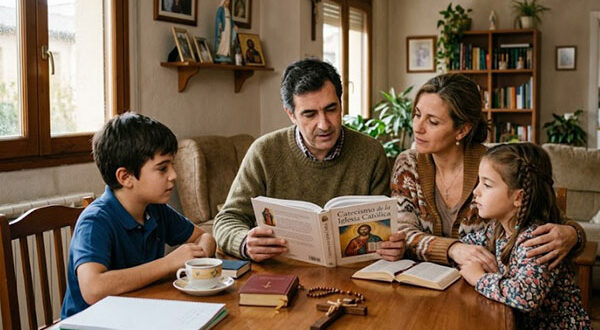
Educating in the faith is not about producing good religion students, but about forming disciples of Christ.
We live in a paradoxical age. Never before have there been so many resources available for teaching the faith: books, videos, apps, podcasts, courses, online catechesis, and materials for every age. Yet never has it been so common to find young people who, after years of religious instruction, abandon the Christian life as soon as they reach adolescence or young adulthood.
What has happened?
The answer is not simple. There are cultural, social, family, and even ecclesial factors involved. But it is also worth examining the way many parents pass on the greatest treasure they possess: faith in Jesus Christ.
Faith is not inherited through genetics. Nor is it transmitted merely through family tradition. It is communicated primarily through witness, experience, love, and an integral education in which the mind, the heart, and the will walk together.
As Scripture reminds us:
“These words that I command you today shall be on your heart. You shall teach them diligently to your children, and shall speak of them when you sit in your house, when you walk by the way, when you lie down, and when you rise.”
(Deuteronomy 6:6–7)
This passage reveals something fundamental: God does not ask that faith be taught only at certain moments, but that it permeate the whole of family life.
However, there are several common mistakes that, although born from the sincere desire to raise children in the Christian faith, end up making it harder for them to discover the beauty of the Gospel.
Let us look at three of them.
Mistake 1. Turning Religion into Just Another School Subject
When Faith Is Reduced to Memorizing Answers
Many parents want their children to learn the catechism.
And that is a good thing.
The problem arises when religious education is limited entirely to learning definitions, memorizing prayers, or giving the correct answers to questions.
The child ends up thinking that religion works just like history or mathematics:
study,
pass the test,
forget.
They know who Moses was.
They know how many sacraments there are.
They can recite the Creed.
But they have never personally encountered Christ.
There is an enormous difference between knowing about Jesus and knowing Jesus.
The Gospels repeatedly show how the scribes knew the Scriptures perfectly and yet were incapable of recognizing the Messiah when He stood before them.
Intellectual knowledge is necessary, but it is never sufficient.
The Christian faith is not simply about accepting certain doctrinal truths; it is about entering into a living relationship with God.
As Saint Paul says:
“The letter kills, but the Spirit gives life.”
(2 Corinthians 3:6)
This does not mean that doctrine is bad.
It means that doctrine without an encounter with Christ remains sterile.
The Pastoral Risk
Many young people abandon the faith because all they remember are years of classes.
They do not remember praying with their parents.
They do not remember having deep conversations about God.
They do not remember seeing their parents ask forgiveness.
They do not remember witnessing the example of a lived faith.
What remains in their memory is a subject.
Not an experience.
And no one gives his life for a school subject.
The Theology of Passing on the Faith
The Church has always understood that the family is the first domestic church.
Parents are not simply teachers.
They are the first witnesses.
The Catechism teaches that parents have the mission of proclaiming the Gospel primarily through the example of their lives.
Children learn far more by watching than by listening.
They discover whether God truly comes first.
They discover whether Sunday revolves around the Eucharist or around sports.
They discover whether forgiveness is actually practiced.
They discover whether prayer is part of everyday life.
Faith is contagious long before it is explained.
What Should You Do Instead?
Turn faith into a daily experience.
Speak naturally about God.
Pray with your children.
Thank God together before going to bed.
Teach them to discover His presence in creation.
Tell them how God has acted in your own life.
Explain why you go to Mass.
Share your doubts and how the Lord sustains you.
When the time for catechesis comes, its teachings will not fall upon dry ground, but upon a prepared heart.
Because before children learn the answers, they need to discover that God is Someone who is real.
Mistake 2. Presenting the Saints as Perfect People
Plaster Saints
Perhaps one of the most common mistakes is presenting the saints as though they had been born holy.
Children hear stories in which everything seems perfect.
They never doubted.
They were never afraid.
They never made mistakes.
They never cried.
They never failed.
The result is devastating.
The child thinks:
“I could never be like them.”
Because they are afraid.
They get angry.
They become distracted while praying.
They argue with their brothers and sisters.
They feel jealous.
They feel embarrassed.
And so they conclude that holiness is reserved for extraordinary people.
Nothing could be further from the Gospel.
God Calls Real People
The Bible is full of deeply imperfect men and women.
Abraham doubted.
Moses was afraid.
David fell into grave sin.
Jonah ran away.
Peter denied Jesus three times.
Thomas doubted.
Paul persecuted the Church.
Yet God wrote a story of holiness with every one of them.
Why?
Because holiness does not consist in never falling.
It consists in always getting back up through the grace of God.
The Humanity of the Saints
The saints cried.
They grew weary.
They experienced spiritual darkness.
They struggled against their own weaknesses.
Many endured depression, illness, persecution, or long interior nights.
Saint Thérèse of Lisieux endured an extremely painful trial of faith.
Saint Peter was impulsive.
Saint Augustine lived a disordered life before his conversion.
Saint Josephine Bakhita suffered the horrors of slavery.
Saint Ignatius of Loyola was proud.
Every one of them had a story.
And that is precisely why they can inspire us.
Not because they were unattainable.
But because they allowed God to work through their weakness.
As Saint Paul declares:
“My grace is sufficient for you, for My power is made perfect in weakness.”
(2 Corinthians 12:9)
The True Message
The saints are not superheroes.
They are people who allowed God to act in their lives.
Their greatness does not lie in being flawless.
It lies in the fact that they never stopped returning to Christ.
When children discover this, holiness no longer appears to be an impossible mountain to climb. Instead, it begins to look like a vocation within their reach.
What Should You Do Instead?
Tell the complete stories of the saints.
Talk about their struggles as well.
Talk about their sins, when they had them.
Their doubts.
Their conversions.
Explain to your children that God writes straight with crooked lines.
Help them understand that holiness does not consist in never making mistakes, but in loving a little more each day.
Then they will discover that they, too, can become saints.
Mistake 3. Failing to Speak Your Children’s Language
Children Do Not Learn Through Sermons
Too often, adults speak to children as though they were little theologians.
We give them long explanations.
Speeches.
Lectures.
Definitions.
But children learn differently.
Jesus knew this perfectly.
That is why He taught through parables.
He spoke about seeds.
Sheep.
Fishermen.
Vineyards.
Bread.
Banquets.
He used images that anyone could understand.
He did not simplify the message.
He made it accessible.
God’s Pedagogy
The entire history of salvation shows that God adapts His language to humanity.
The Incarnation is precisely that.
God speaks our language.
He becomes one of us.
If God chose to draw near to us through language we could understand, then we must do the same.
It is not enough merely to repeat concepts.
We must translate them into lived experiences.
A child understands forgiveness much better when he sees his parents reconcile.
He understands God’s love better when he experiences the love of his parents.
He understands divine providence better when he hears how God has helped the family through difficult times.
The Danger of Information Overload
We live in a society saturated with information.
Children receive thousands of stimuli every day.
Faith does not need to compete by offering more information.
It needs to offer meaning.
What changes a life is rarely a piece of information.
It is an experience.
A gesture.
A conversation.
An embrace.
A shared prayer.
What Should You Do Instead?
Speak less like a teacher and more like a father or mother.
Ask questions.
Listen.
Use everyday examples.
Connect the Gospel to what they experience at school.
Explain how God is also at work in the little things.
Read a parable together and ask them what they think it means.
Pray spontaneously.
Take advantage of a walk, a family meal, or a car ride to talk simply about God.
When a child asks a question, they usually are not looking for a lecture.
They are looking for a conversation.
The Greatest Catechism Is the Life of the Parents
There is a saying, attributed to various Christian authors, that beautifully summarizes the entire task of educating children in the faith:
“Your children may listen only a little to your advice, but they will never stop watching your example.”
The transmission of the faith begins long before opening a catechism.
It begins when a child sees his father kneel down to pray.
When he watches his mother forgive.
When he discovers that Sunday Mass is not an inconvenient obligation but the most important moment of the week.
When he learns that the cross is not merely a decoration but the sign of Christ’s love.
Parents are not called to be perfect.
They are called to be authentic.
Children do not need flawless heroes.
They need adults who love God, who ask forgiveness when they make mistakes, and who humbly show them the way to Christ.
Conclusion: Sowing Today for Eternity
Educating children in the faith has never been easy. It was not easy in the time of the first Christians, and it is no easier today. Yet it remains the most important mission that parents can receive.
The world will teach our children many things: how to succeed, how to consume, how to compete, and how to pursue success. But only the faith will teach them who they truly are, what the purpose of their existence is, and toward what end their lives are moving.
Let us not turn the Gospel into just another school subject.
Let us not present the saints as unreachable beings.
Let us not speak a language that their hearts are not yet able to understand.
Instead, let us make our homes into little domestic churches where people pray, engage in genuine dialogue, forgive one another, and love one another. Let our children discover that Jesus Christ is not a figure of the past or merely a lesson from catechism, but a living Person who walks with them every single day.
Then they will understand that faith is not about passing an exam, but about responding with love to the One who first loved us. And that will be the greatest inheritance we can leave them: not merely the knowledge of God, but a personal encounter with Him—an encounter capable of transforming an entire life and opening the gates of eternity.