Related Articles
The tragedy of a civilisation that has forgotten the Absolute Good, relativised the truth, and seeks to build a world without its Creator
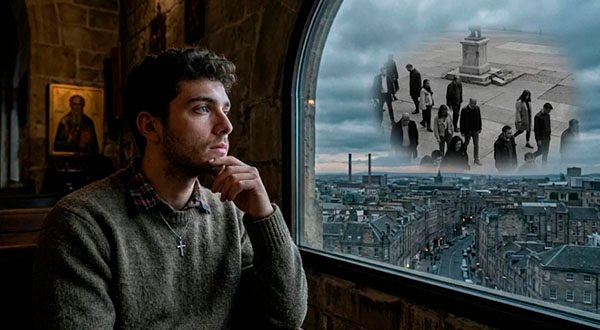
Let us imagine, for a moment, a world without God.
We are not necessarily talking about a world without churches, crucifixes, priests or people who pray. Let us imagine something much deeper: a world in which God had ceased to be the foundation of existence, the ultimate reference point for morality, the source of all truth and the final measure of justice. A world in which man no longer had to answer to anyone above himself.
What would happen then?
Who could tell the powerful that their decisions were unjust? Who could remind a ruler that his authority has limits? On what grounds could we affirm that an action is truly good or evil, even when an entire society accepts or rejects it? What value would human dignity have if it depended exclusively on a political decision, a social convention or the usefulness each person represents?
And, above all, what would become of man if he stopped looking towards Heaven?
This question is not merely philosophical. It is profoundly spiritual, moral and cultural. It affects the family, education, politics, justice, science, human relationships and the very meaning of our existence.
Catholic tradition has always taught that God is not an accessory element of human life, some kind of religious addition that we can incorporate whenever it suits us. God is the foundation of everything that exists. He is not a psychological need invented by man, but the Being from whom all reality proceeds and towards whom every creature is directed.
For this reason, a world that seeks to live without God does not merely dispense with a religious belief. It risks losing the ultimate foundation that enables us to understand who man is, why he possesses inviolable dignity, what goodness means and why truth deserves to be defended even when it is uncomfortable.
The fundamental question is this: can man make himself his own measure without eventually becoming his own judge, legislator and master?
1. God is not an addition to the world: He is its foundation
The first mistake when speaking about a world without God is to imagine that God is simply another reality among many, as though His presence could be removed without changing anything essential.
But the God of the Catholic faith is not a powerful creature dwelling somewhere in the universe. He is not another force within nature, nor a being competing with man for a place in existence.
God is the Creator. Everything that exists receives its being from Him.
The Book of Genesis begins with a fundamental affirmation: “In the beginning God created the heavens and the earth” (Genesis 1:1).
This sentence contains one of the most important truths of the Christian faith: the universe does not explain itself in its ultimate foundation. Creation is not God, but neither does it exist independently of Him.
Saint Paul expresses this radical dependence when he writes:
“For in him we live and move and have our being” (Acts 17:28).
This does not mean that God was merely present at the beginning of the universe and then withdrew, leaving everything to function by itself. Catholic doctrine also teaches that God preserves all things in being: He continually sustains everything He has created.
The Catechism of the Catholic Church, in paragraphs 301 and 302, explains that God does not abandon His creation, but preserves it and guides it towards its perfection.
This has enormous consequences.
If God is the foundation of our existence, man is not the absolute master of himself. He is a creature endowed with intelligence, freedom and dignity, but he is not his own creator.
His freedom is real, but not unlimited. His intelligence is extraordinary, but not omniscient. His authority may be legitimate, but it is never absolute.
Man is great precisely because he has been created by God, not because he has managed to become independent of Him.
A world without God, understood as a project of absolute autonomy, begins with an apparently attractive promise: man will be free because he will no longer have to answer to any transcendent authority.
But that promise contains a contradiction.
If man recognises no truth above his own will, he also has no ultimate foundation on which to limit that will. And when the will becomes the measure of all things, freedom runs the risk of being confused with the power to impose one’s own desires.
2. A world without God: who stands above the powerful?
This is perhaps one of the most important questions of our time.
What can stop the powerful when they no longer recognise any authority superior to themselves?
Human history is filled with examples of individuals and institutions that have used their power to subjugate, exploit or destroy other human beings.
For this reason, the great legal and moral traditions have sought to establish limits on authority. However, from the Christian perspective, there is a question that comes before any legislation: no human power is absolute because only God possesses absolute authority.
The king is not above God. The ruler is not above God. The judge is not above God. The rich, the influential, the powerful and the wise are not above Him either.
All are creatures. All are subject to the truth, and all will have to answer for their actions.
Scripture repeatedly presents this reality.
In the Book of Daniel, we find a warning addressed to Nebuchadnezzar, a powerful king who had forgotten that his authority was not independent of God:
“The Most High rules the kingdom of men and gives it to whom he will” (Daniel 4:32).
The message is unmistakable: political power is not absolute sovereignty.
The Gospel also offers a decisive teaching when Pilate questions Jesus Christ. Faced with the authority of the Roman governor, Jesus declares:
“You would have no power over me unless it had been given you from above” (John 19:11).
Christ is not denying the existence of civil authorities or claiming that all human authority is illegitimate. He is reminding us that even the power which presumes to judge Him remains subordinate to a higher reality.
This truth is extraordinarily important.
When a society recognises that there is a moral law that does not depend on the ruler, it has a criterion by which to judge unjust laws as well.
When it recognises that human dignity comes from God, it can affirm that no majority has the right to turn an innocent person into an instrument.
When it recognises that power must serve the common good, it can denounce its use for the private benefit of those who exercise it.
But what happens when power ceases to recognise any moral limit?
This does not mean that all rulers automatically become tyrants. Nor does it mean that a person who does not believe in God is incapable of acting justly.
It means something different and deeper: if every reference to a higher moral truth is removed, society must find other foundations on which to justify its limits, and it risks making those limits dependent on agreements, interests or power relationships.
And human agreements can change.
Laws can be amended. Majorities can be mistaken. Institutions can become corrupt.
What was considered unjust yesterday may become legal tomorrow. What one generation considered unacceptable may be presented by the next as a right.
Legality and justice are not necessarily the same thing.
For Christians, a law does not become just simply because it has been passed through a legal procedure. It must also respect the moral law.
That is why the Catechism of the Catholic Church, in paragraph 1902, teaches that authority does not derive its moral legitimacy from itself, but must be exercised within the moral order.
A world without God may retain laws, institutions and courts. What it needs to explain is where, ultimately, the moral obligation to obey a justice that cannot be reduced to the will of those in power comes from.
3. Without the Absolute Good, what does it really mean to be good?
We live in an age in which values are constantly discussed.
People speak of solidarity, tolerance, equality, respect, freedom, empathy and coexistence. These are important concepts, and many of them express genuine human goods.
However, there is a question that is rarely asked: what makes these values truly good?
Are they good because the majority accepts them? Because they are useful for social coexistence? Because they produce well-being? Because a particular culture considers them desirable?
If goodness depends exclusively on our preferences, then it ceases to be a reality that we must discover and respect and becomes something we can redefine according to our convenience.
The Catholic faith maintains something very different.
Goodness is not good because we have decided that it is. It is good because it participates in the order of truth and goodness whose ultimate foundation is God.
God is not simply someone who obeys a moral standard superior to Himself. Nor is He someone who arbitrarily invents what is good and evil. Christian theological tradition recognises in God the very fullness of Goodness.
Saint Thomas Aquinas develops this doctrine in his reflections on God as the supreme Good and the ultimate end of all creatures.
The Catechism, in paragraph 1950, explains that the moral law is the work of divine wisdom and can be defined as God’s fatherly instruction, prescribing for man the ways and rules of conduct that lead to blessedness.
This means that Christian morality is not a collection of prohibitions intended to restrict human happiness.
It is a path towards the true good.
God does not forbid evil because He wishes to deprive man of something good. He forbids it because evil destroys man, separates him from his true purpose and introduces him into a contradiction with the order for which he was created.
Sin promises freedom, but ultimately produces slavery.
Jesus Christ expresses this clearly:
“Everyone who commits sin is a slave to sin” (John 8:34).
In a world that has lost its reference to the Absolute Good, there is a danger that morality will eventually be reduced to personal preferences, social conventions or individual decisions.
What matters is no longer whether something is good or evil in itself, but whether someone considers it acceptable.
But a society cannot live indefinitely in this way without facing profound contradictions.
If everything depends on individual perception, with what authority can we condemn an injustice when the person committing it believes that he is acting correctly?
If every person defines his own good, what happens when one person’s good requires the destruction of another person’s good?
The Christian faith does not answer these questions by appealing to personal tastes, but to an objective truth about man and his destiny.
We are not the ones who create goodness. We are called to recognise it, love it and practise it.
4. Without Truth, man ends up living on opinions
Another consequence of imagining a world without God is the loss of a definitive reference point for understanding truth.
Contemporary society possesses an extraordinary amount of information. It has never been so easy to access knowledge, research, documents and opinions.
However, having information does not necessarily mean living in the truth.
Truth can be uncomfortable. It can challenge our decisions, expose our mistakes and demand that we change our lives.
For this reason, we sometimes prefer an opinion that reassures us to a truth that transforms us.
Christianity does not consider truth to be a construction of the human will.
Truth exists independently of whether we accept or reject it.
Jesus Christ did not present Himself merely as a teacher transmitting religious opinions. He made an extraordinary declaration:
“I am the way, and the truth, and the life” (John 14:6).
He did not merely say that He knew the truth or taught a path towards it. He personally identified Himself with the Truth.
This affirmation constitutes the very heart of the Christian faith.
Truth is not an abstract idea separated from God. It finds its fullness in Jesus Christ, the eternal Word made flesh.
For this reason, a world that rejects all reference to transcendent truth runs the risk of turning truth into something negotiable.
What is considered true today may be considered false tomorrow. Words can change their meanings. Facts can be interpreted according to particular interests. Convictions can become consumer products.
We must not confuse this reality with the legitimate diversity of opinions.
Human beings can disagree about economic, cultural, scientific or political matters without all opinions having equal value. Some interpretations are better supported than others.
The problem arises when the existence of a truth capable of judging our own opinions is denied.
Benedict XVI reflected on relativism and its consequences for contemporary culture on numerous occasions. His concern was not to deny the complexity of human questions, but to warn against a mentality that ultimately distrusts any objective and universal truth.
Because when truth ceases to be a point of reference, the most influential opinion can end up taking its place.
And when influence replaces truth, the person who controls the narrative acquires an extraordinary ability to shape what others consider real.
Truth, on the other hand, sets us free.
Jesus declares this in the Gospel:
“You will know the truth, and the truth will make you free” (John 8:32).
This is not freedom understood as the absence of every limit, but liberation from lies, error and the slavery of sin.
Man needs truth because he was created to live in it, not to manufacture a reality that conforms to his desires.
5. A world without God would not necessarily be a world without religion: man always seeks something to worship
There is an interesting paradox in human history.
Man can reject the existence of God, but he finds it extremely difficult to live without placing some reality at the centre of his existence.
He can turn money into his ultimate purpose. He can seek power as his supreme objective. He can absolutise pleasure, ideology, prestige, technology or his own image.
Not all these things are evil in themselves. Money can be used to help one’s neighbour, power can be exercised legitimately, and technology can contribute to human development.
The problem arises when a limited reality takes the place that belongs to God alone.
Scripture presents this temptation from its very first pages.
In the account of Genesis, the serpent promises our first parents:
“You will be like God, knowing good and evil” (Genesis 3:5).
Original sin contains a claim to autonomy: man wants to determine good and evil for himself, independently of the relationship of obedience and trust that unites him to his Creator.
The temptation does not simply consist in wanting to know. It consists in wanting to take God’s place.
This same logic can reappear in different forms throughout history.
Man can reject the worship of God and end up worshipping his own creations.
Saint Augustine, in his Confessions, expressed one of the most profound spiritual insights of Christian tradition:
“You have made us for yourself, O Lord, and our heart is restless until it rests in you.”
This celebrated statement summarises a fundamental truth: the human being possesses an orientation towards God that no created reality can fully satisfy.
We can achieve recognition and still feel empty. We can accumulate wealth and discover that we have not found happiness. We can attain positions of power and continue to experience fear, insecurity and loneliness.
Not because these things have no value, but because they cannot take the place of our ultimate end.
The Catechism, in paragraph 27, teaches that the desire for God is written in the human heart, because man has been created by God and for God.
A world without God, therefore, would not necessarily be a world without idols.
It could be a world in which the idols had simply changed their names.
6. Without God, where does the inviolable dignity of the human person come from?
This is one of the most delicate and far-reaching questions.
Why does a person have dignity?
Why does an elderly person who can no longer contribute economically retain the same human worth as when he was working? Why does a child who cannot yet contribute anything to society deserve protection? Why should a sick, disabled or dependent person be respected? Why does a poor human being possess exactly the same dignity as a rich one?
The Christian answer is profoundly simple and, at the same time, extraordinarily demanding:
Every human person has been created in the image and likeness of God.
Genesis expresses it this way:
“So God created man in his own image, in the image of God he created him; male and female he created them” (Genesis 1:27).
Human dignity does not come from intelligence, productivity, beauty, wealth, health, social position or a person’s usefulness.
It comes from what the person is.
Every human being possesses a dignity that cannot be lost because he or she has been loved and created by God.
This is one of the fundamental contributions of the Christian understanding of man.
The Catechism develops this teaching in paragraphs 1700 and following, explaining that the dignity of the human person is rooted in his creation in the image and likeness of God.
This has concrete consequences for the way we understand life.
The unborn child does not have less dignity because he cannot yet speak.
The elderly person does not have less dignity because he needs help.
The sick person does not have less dignity because his body has become weakened.
The poor person does not have less dignity because he lacks resources.
The prisoner does not cease to be a human person, even though he must answer for the crimes he has committed.
Nor does an enemy lose his status as a human being.
The Catholic faith does not maintain that societies without religion are incapable of defending these principles. It would be historically unjust and philosophically simplistic to claim anything of the sort.
Many people who do not profess a religious faith sincerely work for justice, protect the vulnerable and recognise the dignity of all human beings.
The question is different: what is the ultimate foundation of that dignity, and why must it remain inviolable even when protecting it is costly or unpopular?
The Christian understanding offers an answer that does not depend on circumstances.
Human dignity is not granted. It is recognised.
And what God has loved and created cannot become the absolute property of other human beings.
7. The danger of a society that turns man into his own god
Modernity has brought extraordinary advances.
Medicine has made it possible to treat diseases that were fatal for centuries. Science has expanded our knowledge of the universe. Technology has facilitated communication and access to information. Humanity has developed legal and social instruments to protect rights and limit abuses.
The Church has no reason to despise these achievements.
Christianity recognises the value of human reason, scientific research and man’s legitimate work upon creation.
Progress is not the problem.
The problem arises when progress becomes a kind of earthly salvation and man begins to believe that he can solve every problem while dispensing with any reference to his Creator.
Science can explain numerous natural processes, but it cannot by itself answer every question about the meaning of existence.
Medicine can prolong life, but it cannot make death cease to exist.
Technology can facilitate our relationships, but it cannot replace true love.
Economics can produce wealth, but it cannot guarantee moral justice.
Politics can organise social coexistence, but it cannot redeem the human heart.
When man considers himself the absolute master of reality, a very ancient temptation emerges: to use everything that exists as material available to satisfy his will.
Even other human beings can end up being viewed according to criteria of usefulness, efficiency or convenience.
The person ceases to be someone to love and respect and becomes something to use.
Christian teaching is radically opposed to this vision.
Man is lord of creation in a subordinate and responsible sense, not an absolute owner with the right to destroy it or manipulate it arbitrarily.
The Book of Genesis presents the command to exercise dominion over the earth (Genesis 1:28), but this responsibility must be understood within the wider context of creation as something willed by God.
Human dominion does not amount to permission to act without limits.
For this reason, a truly Christian culture does not reject progress, but asks where it leads and whose service it is intended to fulfil.
Not everything man is capable of doing is necessarily something he ought to do.
This distinction is especially important in an age of rapidly accelerating scientific and technological advances.
Technical ability needs moral direction.
Without it, progress can become an accumulation of power without a sufficient understanding of its responsibilities.
8. When freedom is separated from truth
One of the great confusions of our time consists in identifying freedom with the ability to do absolutely anything.
From this perspective, every limit seems like a threat, and every higher moral reference appears to be an imposition.
However, Catholic tradition understands freedom in a much deeper way.
Freedom is not simply the ability to choose. It is the capacity to choose the good.
A person who can choose between doing good and committing an injustice possesses freedom. But when that person repeatedly gives himself over to evil, his freedom is not perfected: it is weakened.
Consider someone dominated by an addiction. He may experience his behaviour as a personal choice, but that dependence progressively reduces his ability to act with genuine freedom.
The same happens with other forms of moral slavery.
Sin promises autonomy, but ultimately creates dependencies.
Saint Paul expresses it clearly:
“All things are lawful for me, but not all things are helpful” (1 Corinthians 6:12).
Freedom requires discernment.
The Catechism, in paragraph 1733, teaches that the more one does what is good, the freer one becomes. True freedom reaches its perfection when it is ordered towards God, the supreme Good and the blessedness of man.
Therefore, Christian morality is not the enemy of freedom.
It is its defence.
A world that rejects every reference to objective goodness may end up confusing freedom with the immediate satisfaction of desires.
But not every desire leads to happiness. Not every decision makes us better. Not every choice is an expression of authentic freedom.
Freedom without truth can become slavery disguised as autonomy.
9. A world without God would also be a world without transcendent hope
Perhaps the most profound consequence of an existence completely closed to God would be the loss of the hope that goes beyond the limits of this life.
Christianity does not regard death as a simple biological transition without meaning. Nor does it understand death as the absolute end of the human person.
The Catholic faith proclaims the resurrection of the dead and eternal life.
Christ has conquered death.
Saint Paul writes:
“If Christ has not been raised, then our preaching is in vain and your faith is in vain” (1 Corinthians 15:14).
The Resurrection constitutes the very heart of Christian hope.
Thanks to it, suffering does not have the final word. Injustice does not have the final word. Death does not have the final word.
This does not mean that Christians should remain indifferent to present suffering while simply waiting for a future reward.
Quite the opposite.
Precisely because Christians believe in eternal life, they understand that their decisions possess a value that transcends immediate circumstances.
Charity is not useless even when it produces no material benefits.
Sacrifice is not meaningless even when nobody acknowledges it.
Faithfulness is not a loss even when the world rewards betrayal.
Justice remains necessary even when the guilty manage to escape human courts.
God knows what human beings do not know. He sees what remains hidden. He knows the intentions that nobody can judge completely.
And the Christian faith proclaims that the moment will come when every person will stand before Him.
The Catechism, in paragraphs 1021 and 1022, explains the reality of the particular judgement after death.
This teaching is not intended to foster an unhealthy fear, but to remind us of the seriousness of our existence.
Our life has a purpose. Our actions matter. The love we offer and the evil we commit are not indifferent realities.
In a world that closes itself to eternity, there is a danger of measuring everything exclusively by its immediate results.
But what about the person who devotes his life to caring for a sick family member without receiving recognition? What about the person who gives up an unjust advantage in order to remain faithful to his conscience? What about the person who suffers for defending the truth?
From a purely utilitarian perspective, these sacrifices may seem incomprehensible.
From the perspective of Christian faith, they possess a value that is not exhausted in this life.
Christian hope does not eliminate suffering, but it prevents suffering from becoming the ultimate explanation of our existence.
10. History has already known societies that have attempted to live without God
The ambition to organise human existence while dispensing with God is not new.
Throughout history, there have been philosophical movements and political projects that have defended different forms of secularisation, materialism or atheism.
It is important to distinguish between them, because not all secularised societies are alike, nor do all non-confessional political systems pursue the same objectives.
It is also necessary to avoid historical simplification: not every society that loses religious influence automatically becomes a totalitarian society.
Nevertheless, the twentieth century offers particularly dramatic examples of what happens when a political ideology seeks to take the place of a higher moral authority and subject human beings to its own objectives.
The totalitarian regimes of Nazism and Soviet communism, although different in their ideological foundations, doctrines and forms of organisation, demonstrated how far political power can go when it destroys the limits imposed by human dignity and turns people into instruments of an ideological project.
In both cases, persecution, repression and grave violations of human rights took place.
It would not be correct to attribute all those crimes exclusively to atheism, or to claim that every non-believer shares the ideas of those regimes.
Historical analysis demands precision.
But we can draw one fundamental lesson: when an ideology, a State or a leader claims practically unlimited authority over the human person, individual dignity is exposed to extraordinary dangers.
The Church knows this reality well.
The Second Vatican Council, in Gaudium et spes, paragraph 36, affirms the legitimate autonomy of earthly realities, but warns against an understanding of autonomy that means independence from God.
Science, politics, culture and institutions have their own laws and methods, but this does not mean that they stand outside the moral order.
The same document, in paragraph 20, examines atheism and its various forms, recognising that, in certain cases, responsibility for its spread may be connected with critical reactions to the bad example of believers and deficiencies in religious education.
This observation is especially important.
The Church cannot limit itself to pointing out the errors of a society that is moving away from God. It must also examine its own witness.
If we speak of love but live selfishly, if we proclaim the truth but practise lies, if we defend human dignity but despise our neighbour, we are offering a distorted image of the Gospel.
It is not enough to affirm that God is necessary.
We must show through our lives that living with God truly transforms man.
11. Can a person without faith be good?
This question deserves a clear answer, because the seriousness of everything we are discussing depends on it.
Yes. A person who does not believe in God can perform good actions, practise justice, sacrifice himself for others, defend the weak and live with great moral integrity.
The Church has never taught that only believers are capable of recognising or practising goodness.
Human reason can know many moral truths. Natural law is inscribed in the heart of man and can be recognised by human intelligence.
In Romans 2:14-15, Saint Paul explains that Gentiles who do not have the Law may by nature do what the Law requires, showing that the moral demand is written in their hearts.
The Catechism develops this doctrine in paragraphs 1954-1960.
Therefore, we must not confuse the affirmation that God is the ultimate foundation of goodness with the claim that a person must explicitly profess a religious faith in order to perform good actions.
These are different questions.
A man may not know God and yet act in accordance with His moral law.
The opposite can also happen: a person may proclaim himself a believer and live with his back turned towards God’s commandments.
The Christian faith does not automatically confer virtue. It demands permanent conversion.
So, what difference does God make?
He introduces the ultimate foundation of moral reality and its fullness.
Christians do not consider goodness to depend exclusively on human convention, but recognise that goodness has its origin and perfection in God.
Furthermore, through Revelation, they know a truth that surpasses what reason can attain on its own: man is called to participate in divine life.
We are not destined merely to be honest citizens or socially respectable people.
We are called to holiness.
And this calling profoundly transforms our understanding of existence.
12. The world without God also begins in the human heart
It would be far too easy to speak of a world without God as though it were exclusively a political, cultural or institutional problem.
The absence of God often begins in a much more discreet way.
It begins when we stop praying because we believe we can solve everything by ourselves.
When we make decisions without asking whether they are pleasing to God.
When we choose what is convenient instead of what is just.
When we allow work, money, worries or entertainment to occupy all our time.
When we know the commandments but live as though they were unimportant.
When we turn to God only in moments of need and forget Him when things are going well.
It is possible to live surrounded by religious symbols while having a heart that is practically closed to God.
It is also possible for a society to preserve churches, celebrations and traditions while progressively losing the supernatural meaning of faith.
The question is not simply how many people declare themselves believers, but how much space God truly occupies in their decisions.
Jesus Christ spoke words that should make us reflect:
“No one can serve two masters” (Matthew 6:24).
We cannot place God in a corner of our existence and expect the rest of our lives to remain completely independent of Him.
Faith is not a separate compartment.
It must illuminate the way we work, educate, love, manage our possessions, treat others and face difficulties.
A world without God does not necessarily begin with a public declaration of atheism.
It may begin with an everyday decision: to live as though God did not exist.
13. How should a Catholic respond to a world that wants to dispense with God?
The Christian response cannot consist of despair, contempt towards those who think differently or sterile nostalgia for an idealised past.
Nor should it be reduced to permanent confrontation with society.
Catholics are called to bear witness to the truth with firmness, but also with charity.
Christ did not send us to hate the world, but to proclaim the Gospel and be a light within it.
“You are the light of the world” (Matthew 5:14).
This responsibility begins in our own lives.
Rediscover prayer
We cannot transmit a faith that we ourselves do not cultivate.
Prayer reminds us that we are not the centre of the universe and that we need God.
Daily prayer, the recitation of the Holy Rosary, the reading of Sacred Scripture and conscious participation in Holy Mass help us maintain our relationship with Him.
It is not a matter of accumulating religious practices mechanically, but of learning to live in the presence of God.
Educate our children in the truth
Children need more than information, entertainment and professional preparation.
They need to learn that life has meaning, that moral obligations exist, that goodness demands sacrifice and that not everything one desires should be done.
The Christian family has an irreplaceable responsibility in this formation.
Teaching children to pray, explaining the commandments to them, speaking to them about Jesus Christ, transmitting the history of the Church and teaching them to distinguish between good and evil are fundamental tasks.
We must not delegate this responsibility entirely to schools, institutions or the media.
Defend the truth with charity
Christian truth does not need lies, manipulation or insults in order to be proclaimed.
We must learn to argue, study, listen and respond with serenity.
Doctrinal firmness is not incompatible with charity.
On the contrary, authentic charity cannot be separated from truth.
Saint Paul teaches that we must live by “speaking the truth in love” (Ephesians 4:15).
This is an essential guideline for Catholics who participate in the cultural and social debates of our time.
Practise the works of mercy
A world without God may speak extensively about values, but Christians are called to turn charity into a concrete reality.
Visiting the sick, helping those in need, accompanying the elderly, feeding the hungry, consoling those who suffer and forgiving those who have offended us are real ways of showing God’s love.
Faith cannot remain mere words.
Saint James writes:
“Faith by itself, if it has no works, is dead” (James 2:17).
The way we treat our neighbour must demonstrate that God is not an abstract idea, but a presence that transforms life.
Do not be afraid of being different
Christians are not called to adapt automatically to every cultural trend.
There are moments when following Christ requires going against prevailing opinion.
Faithfulness can come at a price.
It may demand giving up an advantage, enduring misunderstanding or defending a conviction that others consider outdated.
But Christian conscience cannot change the truth in order to gain acceptance.
Faithfulness to God is worth more than the applause of the world.
14. The Church does not simply proclaim a better world: she proclaims Jesus Christ
There is a temptation within Christianity itself that must be avoided: reducing the mission of the Church to promoting certain human values.
Solidarity, justice, fraternity, peace and the defence of the vulnerable are important consequences of the Gospel.
But Christianity is much more than an ethical proposal.
If Christ were merely a teacher of good principles, He could be compared with other great thinkers in human history.
But the Church proclaims something incomparably greater: Jesus Christ is the eternal Son of God made man, who died and rose again for our salvation.
Christianity does not merely proclaim that we must become better people.
It proclaims that we need to be saved.
Sin is not simply a psychological imperfection or a difficulty in social coexistence. It is a rupture in our relationship with God.
And salvation does not consist exclusively in building a more just society, even though justice is part of the Christian vocation.
It consists in the reconciliation of man with God through Jesus Christ.
For this reason, the Church cannot replace the proclamation of Christ with a discourse limited to values that happen to be acceptable in each age.
If we stop speaking about grace, sin, conversion, the Cross, the Resurrection and eternal life, we will have reduced the Gospel to a human proposal.
The prologue of Saint John’s Gospel begins with an affirmation that contains all the greatness of the Christian faith:
“In the beginning was the Word, and the Word was with God, and the Word was God” (John 1:1).
And later it declares:
“And the Word became flesh and dwelt among us” (John 1:14).
God has not remained indifferent to humanity.
He has entered our history.
He has assumed our nature.
He has suffered and died for us.
And He has risen again.
That is why Christianity is not a philosophy of absence, but the proclamation of a Presence.
It is not an ideology constructed by men searching for meaning, but God’s answer as He comes to meet man.
15. The real problem of a world without God: forgetting what we were created for
After examining these questions, we can return to the initial one.
What would a world without God be like?
It would probably still have cities, universities, hospitals, governments, courts, families, scientists, artists and people capable of making great sacrifices.
We should not necessarily imagine a scenario of absolute chaos.
Man retains his intelligence, his moral conscience and his natural capacity to recognise many goods even when he does not recognise his Creator.
But it would be a world that had voluntarily closed its horizon to the deepest truth of existence.
A world that could build great buildings but forget why man lives.
That could multiply its knowledge but fail to find a definitive answer to the meaning of existence.
That could develop extraordinary instruments of power but would need constantly to justify why that power should respect human beings.
That could establish rules but would continue to face the question of what makes a rule truly just.
That could speak of love but would have lost the fullness of Love that comes from God.
That could prolong life but could not offer, by its own means, a definitive answer to death.
And, above all, it would be a world in which man would run the risk of forgetting that he is not God.
This is the central question.
It is not a matter of claiming that non-believers are necessarily worse people, nor of denying the good things that can exist in secularised societies.
It is a matter of understanding that man needs a truth that does not depend on him, a good that he cannot alter for his own convenience and a hope that does not end with the limits of his earthly existence.
He needs to recognise that there is Someone above the powerful, that there is a justice superior to the will of rulers, that there is a dignity no majority can grant or withdraw, and that truth does not depend on how many people are willing to accept it.
That Someone is God.
And His face has been revealed to us in Jesus Christ.
Conclusion: when man expels God, he does not become God; he is left without recognising who he is
A world without God may initially seem to be a world liberated from religious obligations, moral limits and transcendent authority.
But true freedom does not consist in living without any higher reference point.
It consists in living according to the truth of who we are.
Man does not become greater when he turns away from his Creator. He does not become freer when he rejects goodness. He does not become more powerful when he considers himself the absolute master of truth.
On the contrary, when he forgets God, he risks forgetting his own dignity, his limitations and his destiny.
We need God not because we are incapable of building hospitals, developing science, passing laws or practising solidarity without an explicitly religious motivation.
We need Him because none of these realities can take His place.
We need God because the powerful must answer to Someone. Because the innocent possess a dignity that nobody can take away. Because justice must stand above interests. Because truth cannot depend on majorities. Because goodness cannot be reduced to a preference. Because love finds its fullness in God. And because death does not have the final word.
Perhaps the most disturbing question is not what a world without God would look like.
Perhaps we should ask ourselves how much of that world we have already allowed into our own lives.
How many times do we make decisions without taking Him into account? How many times do we defend our opinions more passionately than the truth? How many times do we seek the recognition of men and forget to please God? How many times do we want the benefits of faith without accepting the demands of conversion?
The world does not need a Christianity that is ashamed to speak about God.
It needs Christians who know their faith, live by His commandments, love the truth, practise charity and are not afraid to proclaim Jesus Christ.
We are not called to be masters of the world, but witnesses of the One through whom the world exists.
For man may try to live without God, but he can never cease to depend on Him.
He may reject Him, forget Him or ignore Him, but he cannot replace Him.
And when all riches have disappeared, when power has come to an end, when ideologies have passed and when empires have been reduced to dust, the truth that runs through all of history will remain:
God is the beginning and the end. The Absolute Good. The Eternal Truth. The foundation of all justice and the source of all life.
And in the face of every attempt by man to take His place, the words of Jesus Christ will continue to resound:
“I am the Alpha and the Omega, the beginning and the end” (Revelation 21:6).
A world without God may continue to exist for a time. But a world that forgets God ultimately forgets the deepest reason why life is worth living.
Because when God ceases to be at the centre, anything else can attempt to occupy His throne. And no creature, however powerful, was created to take the place of its Creator.