Related Articles


There are words we repeat so often that we risk forgetting how profound they really are. Every Sunday, millions of Catholics stand during Holy Mass and begin to recite one of the most important formulas in the whole of Christian life: “I believe in one God, the Father almighty…”
We recite it almost from memory. We have heard it since childhood. Its expressions are familiar to us, and yet we may never have stopped to consider an apparently simple but deeply meaningful question: Why do we call the Creed a “Symbol”?
Why does the Church not simply call it a declaration of faith, a religious profession, or a summary of Christian doctrine? What exactly does this word mean? What connection does it have with the world of ancient Rome, with its soldiers, its recognition signs, and its ways of establishing a person’s identity? And what does all this have to do with us, Catholics in the twenty-first century?
The answer takes us back to the very roots of the Church, to the first Christian communities, to the catechumens preparing to receive Baptism, and to those martyrs who preferred to give their lives rather than renounce Jesus Christ.
Understanding why the Creed is called the Symbol is not merely an etymological curiosity. It helps us understand what it means to belong to the Church, what it entails to profess the faith publicly, and why Christianity does not consist simply of accepting certain ideas, but of adhering to a Person: Jesus Christ, true God and true man, who died and rose again for our salvation.
And it raises a decisive question: Are we truly aware of what we are saying when we recite the Creed?
1. What Does the Word “Symbol” Really Mean?
To understand the Christian meaning of this word, we must begin with its origin.
The term symbol comes from the Greek sýmbolon (σύμβολον), which is related to the verb symbállein, meaning to bring together, join, or place two things in correspondence.
In the ancient world, a symbol could be an object, a sign, or a token that made it possible to recognize a person, confirm a relationship, or establish that someone belonged to a particular group.
We should not necessarily imagine a symbol as an abstract image, a geometric figure, or a drawing loaded with secret meaning, as we often understand the word in modern language. Its ancient meaning was much more concrete: a symbol served to recognize, identify, and establish a correspondence between people or realities connected to one another.
This idea is fundamental to understanding why the Church called the Christian profession of faith the Symbol.
The Creed is not an arbitrary collection of religious phrases. It is a formula that allows us to recognize and express the faith that the Church has received from the Apostles, preserves throughout the centuries, and transmits to each new generation of the baptized.
When a Catholic recites the Creed, he is not inventing a personal religion or expressing only his private opinions about God. He is professing the faith of the Church, a faith that existed before him, that has been handed down by others, and that he himself is called to transmit.
The symbol therefore has both a personal and a communal dimension.
It is personal because each person must believe freely and respond to God with his own intelligence and will. No one can make the interior act of faith on our behalf.
But it is also communal because we do not construct the content of this faith individually. We receive it from Christ through the Church.
Saint Paul expresses this relationship between received faith and proclaimed faith in extraordinarily profound words:
“For I delivered to you as of first importance what I also received.”
— 1 Corinthians 15:3
The Apostle does not present the Gospel as a doctrine he invented himself. He recognizes that he is the custodian of something he has received and that he has a responsibility to transmit faithfully.
This is also the logic of the Creed: to receive, believe, profess, and transmit.
2. The Symbol in Antiquity: A Sign That Allowed People to Recognize One Another
To understand this question more fully, we should pause to consider the ancient world, especially Greek and Roman societies, in which signs of recognition, identity documents, and symbols of belonging played an important role.
We must make a historical clarification: the word symbolon is Greek, and the example of the two halves of a broken object belongs to the ancient world in a broad sense; it was not an exclusively Roman invention, nor was it a practice reserved for Roman soldiers. Nevertheless, Roman culture also knew various signs, passwords, and distinguishing marks used to identify people, establish their status, or transmit orders.
This distinction is important if we are to avoid confusing the history of the term with the Christian application it acquired later.
2.1. Two Halves That Could Recognize Each Other Again
Let us imagine a situation that might have occurred in antiquity.
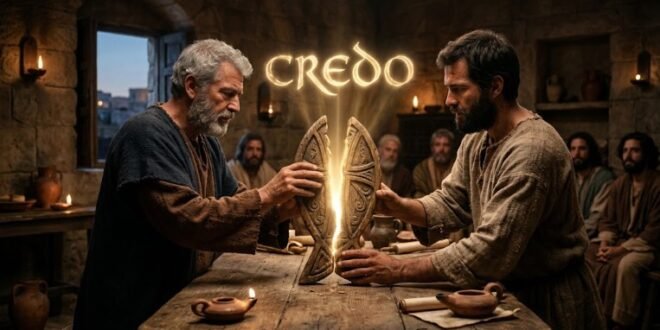
Two people establish a relationship of hospitality, friendship, or trust. To preserve evidence of this bond, they take a small object—for example, a piece of pottery—and divide it into two parts. Each person keeps one half.
Much later, when their descendants meet, they can produce the pieces. If the two parts fit together, they possess a material sign confirming the relationship between their families.
The object does not, by itself, create the friendship, nor does it necessarily constitute a legal contract in the modern sense. Its function is to make a relationship that already exists recognizable.
The essential idea is this: two separated parts can recognize one another because a prior correspondence exists between them.
A symbol is therefore more than an ornament. It has an identifying and relational function.
The Catechism of the Catholic Church explicitly recalls this explanation in paragraph 188, noting that the Greek term symbolon referred to half of a broken object that was presented as a sign of recognition. The pieces were brought together to verify the identity of the person carrying them.
This image helps us understand the deeper meaning of the Creed.
When two Catholics from different countries, different periods, or very different cultures profess the same faith, they recognize that they share the same fundamental profession: they believe in the same God, confess the same Jesus Christ, and receive the same apostolic faith.
They do not need to know one another personally, speak the same language, or belong to the same nation. Their profession of faith unites them in the same ecclesial communion.
2.2. What Was a Symbol in Ancient Rome?
In Roman society, we find practices that help us understand this function of recognition.
The Romans used seals, signet rings, tablets, credentials, and various types of distinguishing marks. In certain contexts, passwords and signals were also used to identify those authorized to perform an action or to recognize members of a particular group.
In the military sphere, for example, orders and passwords could help distinguish one’s own forces from outsiders or facilitate coordination among troops. Roman military tradition included the use of passwords, often associated with the military tessera.
However, the terms must be distinguished: symbolon is a Greek word; tessera is a Latin word that could designate, depending on the context, a tablet, token, or piece used for various purposes. They were not identical words, and not every object used for identification was called a symbol.
What matters here is the function these things shared: they enabled recognition, conveyed information, or established belonging.
The Christian symbol operates on a deeper level because it does not merely identify an individual outwardly. It expresses what the believer professes about God and the relationship that this faith establishes between the believer and the Church.
We can therefore distinguish three dimensions:
- Identification: it makes a particular profession of faith recognizable.
- Communion: it expresses that those who profess it share the same faith.
- Transmission: it preserves and communicates the essential content of that faith to subsequent generations.
These three dimensions are present in the Christian use of the term, although the faith cannot be reduced to a password, nor can membership in the Church be judged exclusively by the outward repetition of a formula.
2.3. From External Recognition to the Confession of the Heart
Here we encounter a decisive difference.
In an ancient society, a password might be sufficient for a guard to recognize someone as a member of an expedition or as a person authorized to pass through a gate. The password fulfilled its function if it was correct.
In Christian life, however, correctly pronouncing the Creed does not automatically mean living as a disciple of Jesus Christ.
A man may know all its words and, at the same time, live in opposition to the commandments. He may claim to believe in God while despising his neighbor. He may proclaim the Resurrection of Christ while living as though death had the final word.
The Church does not teach that outward pronunciation is sufficient. Rather, the faith must be genuinely professed and inwardly embraced.
Saint Paul writes:
“Because, if you confess with your mouth that Jesus is Lord and believe in your heart that God raised him from the dead, you will be saved.”
— Romans 10:9
Notice how the Apostle unites two realities: outward confession and inward faith.
They are not opposed to each other; rather, they must be united. The faith of the heart seeks expression in the confession of the mouth, and public confession calls for a life consistent with what is proclaimed.
The Creed is thus a sign of Christian identity, but it is not a magical password. It is a profession of truth that commits the whole person.
3. Why Did the Church Apply the Word “Symbol” to the Creed?
We now arrive at the heart of our question.
The early Church needed to transmit faithfully the teaching it had received from the Apostles. Christians did not gather simply to share religious feelings or express different opinions about the divine. They believed they had received a real revelation from God, brought to its culmination in Jesus Christ, and they had an obligation to safeguard it and proclaim it.
From its beginnings, the apostolic communities used brief formulas to express the essential elements of the faith. One of the oldest confessions we find in the New Testament is:
“Jesus is Lord.”
— Cf. Romans 10:9; 1 Corinthians 12:3
This apparently simple statement contained an extraordinary confession. Jesus, crucified under Roman power, was proclaimed Lord. For Christians, His death had not been a definitive defeat: God had raised Him from the dead and established Him as Lord and Messiah.
We also find in 1 Corinthians 15:3–5 a formula of faith transmitted by Saint Paul, proclaiming Christ’s death for our sins, His burial, His Resurrection on the third day, and His appearances.
In other words, long before the complete formulas of the Creed that we recite today existed, the Church was already transmitting summaries of its fundamental faith.
Over time, these confessions developed into more elaborate formulas, especially those associated with preparation for Baptism.
The Catechism explains that these summaries are known by several names:
- Professions of faith, because they express what Christians profess.
- Creeds, because the customary opening word in Latin is Credo, meaning “I believe.”
- Symbols of faith, because they identify the Christian confession, express communion among believers, and gather together the principal truths that must be believed.
Why, then, Symbol?
Because the Creed is a recognizable sign of the Christian faith and, at the same time, a synthesis of its content. It does not merely indicate that someone considers himself religious: it expresses what that Christian believes.
And here we must understand something essential: the Christian symbol is not a human invention intended to replace divine reality. The formula of the Creed serves the faith it professes; it does not invent God, produce revealed truth, or make something true that was previously false.
The Church expresses in human words the truths it has received from divine Revelation. For this reason, the authority of the Creed does not rest on the preferences of a generation or the personal tastes of an individual, but on its fidelity to the apostolic faith, safeguarded and transmitted by the Church.
3.1. The Symbol Is a Synthesis, Not a Reduction of the Faith
The word symbolon also acquired the meaning of a compilation, collection, or summary. This second meaning is equally important.
The Creed gathers together the fundamental truths of the Christian faith in a few sentences. It does not contain, word for word, the whole of Sacred Scripture, nor does it develop every subject in Catholic theology. Nevertheless, it presents the core of the faith around which Christian teaching is ordered.
Saint Cyril of Jerusalem, in his catechetical lectures addressed to those preparing for Baptism, compared the synthesis of the faith to a mustard seed: small in form, yet capable of containing great richness.
The comparison is illuminating.
A brief Creed can lead us to meditate for an entire lifetime. Each of its statements opens up an immense theological horizon.
When we say, “I believe in God the Father almighty, Creator of heaven and earth,” we enter into questions such as the existence of God, creation, divine providence, and the meaning of our own existence.
When we confess that Jesus Christ “for us men and for our salvation came down from heaven,” we proclaim the mystery of the Incarnation and God’s redeeming love.
When we affirm that He rose on the third day, we confess that death does not constitute man’s ultimate destiny.
When we say, “I believe in the Holy Spirit,” we enter into the mystery of the third Person of the Most Holy Trinity and the work of sanctification that God accomplishes within us.
And when we proclaim, “I believe in the Church, which is one, holy, catholic, and apostolic,” we confess that Christ has not left us a doctrine without a community, but a Church to which He has entrusted the mission of teaching, sanctifying, and leading mankind toward salvation.
The Creed is brief, but its content is inexhaustible.
That is why repeating it without understanding it impoverishes our spiritual life. By contrast, studying it, meditating on it, and living it enables us to discover that each of its words is a gateway into the Christian mystery.
4. The Creed in the Early Church: A Faith Received, Safeguarded, and Transmitted
To understand why the Symbol acquired such importance, we must travel back to the first centuries of Christianity.
The Church was born into a world in which numerous beliefs, cults, philosophies, and religious traditions coexisted. The Roman Empire encompassed highly diverse peoples and permitted a wide variety of religious practices, although relations between the imperial authorities and Christians were marked, in certain periods and places, by hostility and persecution.
Christians did not distinguish themselves merely by believing in one more deity. Their faith contained very specific claims that were sometimes deeply uncomfortable for the mentality of their time.
They believed in one God, rejected the worship of idols, proclaimed that Jesus Christ was Lord, and announced that God had bodily raised Jesus from the dead.
They also recognized in Christ an authority that stood above every political power.
All of this made the faithful transmission of doctrine necessary.
4.1. A Community That Did Not Invent Its Own Faith
The first Christians did not understand faith as a completely individual search in which each person could freely decide who Jesus was and what His teaching meant.
The Christian faith had a content received from the Apostles, witnesses to the life, death, and Resurrection of the Lord. The Christian community was required to preserve and transmit it without replacing it with doctrines contrary to the Gospel.
Saint Paul exhorted the faithful in Thessalonica:
“Stand firm and hold to the traditions that you were taught by us, either by word of mouth or by letter.”
— Cf. 2 Thessalonians 2:15
Apostolic Tradition does not mean indiscriminately clinging to every ancient custom. It means faithfully receiving and transmitting what comes from apostolic teaching and what the Church preserves under the assistance of the Holy Spirit.
This continuity explains the importance of the Creed.
The Symbol makes it possible to recognize the essential content of the faith that has been handed down and distinguish it from private interpretations that might contradict it.
In an age without printing presses, instant communications, or universal access to books, brief formulas served a particularly valuable catechetical purpose. They could be memorized, transmitted orally, and preserved in the life of the communities.
We should not, however, imagine that all Christians in the first centuries recited from the beginning exactly the same Creed, with identical wording and length. Various professions of faith existed in different local Churches, especially in connection with the celebration of Baptism.
The unity of the apostolic faith did not require every historical formula to be identical in every word. It required them to confess faithfully the same revealed truth.
4.2. The Symbol and Preparation for Baptism
One of the most important functions of the Creed in the ancient Church was its relationship with Christian initiation.
Anyone who wished to become a Christian had to receive appropriate instruction. It was not enough to express sympathy for Jesus or admiration for the Gospel.
The catechumen had to know the fundamental truths of the faith, understand the meaning of conversion, and prepare to receive the sacraments of Christian initiation.
The profession of faith was particularly connected with Baptism.
Christ had commanded the Apostles to baptize:
“In the name of the Father and of the Son and of the Holy Spirit.”
— Matthew 28:19
This Trinitarian formula provided the fundamental framework of baptismal faith. The Christian was incorporated into Christ and sacramentally entered the life of the Church.
For this reason, the Creed developed as a profession connected with that incorporation.
In different ancient Churches, there were catechetical practices known as traditio symboli and redditio symboli: the handing over of the Symbol to catechumens and their subsequent recitation of it.
The first expressed that the faith had to be received from the Church. The second manifested that the catechumen had learned and embraced that profession of faith.
It was not merely a memory test. It was a decisive stage in preparation for Baptism.
The person who received the Symbol learned that he was not inventing his own religion: he was entering a faith that had been transmitted from the Apostles and that he now had to profess personally.
4.3. Why Was Memorizing the Creed So Important?
Today, we can consult the text of the Creed in countless places. We find it in our missals, catechisms, prayer books, and electronic devices.
But throughout much of Christian history, memorization was even more important.
Learning the Symbol made it possible to preserve the essential truths of the faith in one’s memory. A Christian could recall them in prayer, pass them on to his children, and turn to them in moments of difficulty.
Memory was not an end in itself. It served intelligence, faith, and spiritual life.
We must remember that the Catholic faith does not despise reason. Grace does not destroy nature; it elevates and perfects it. Therefore, learning a formula of faith and understanding its meaning are complementary tasks.
A person may memorize the Creed without understanding it deeply. Another may know complex theological explanations and yet lack a living faith.
Christian formation requires both: knowing what we believe and personally adhering to God.
5. The Creed in Rome, Saint Peter, and the Apostles’ Creed
There is a particularly important historical relationship between the Creed and the Church of Rome.
The so-called Apostles’ Creed is considered by Catholic tradition a faithful summary of the apostolic faith and constitutes the ancient baptismal symbol of the Roman Church.
Its name does not mean that we can demonstrate that the twelve Apostles jointly wrote, word for word, the formula we know today.
Tradition associated the Creed with apostolic preaching and, on occasion, with the image of the twelve Apostles each contributing an article. This latter image symbolically expresses the integrity of the apostolic faith, but it must not be confused with a historically verified reconstruction of how the Creed was composed.
The Catechism of the Catholic Church explains that the Apostles’ Creed possesses particular authority because of its connection with the ancient baptismal profession of the Church of Rome, the see of Saint Peter.
5.1. Why Is the Church of Rome Important?
The Church of Rome occupies a unique place in Christian history because of its relationship with the holy Apostles Peter and Paul, who bore witness to Christ there unto martyrdom.
Saint Peter received a particular mission from the Lord:
“You are Peter, and on this rock I will build my Church.”
— Matthew 16:18
From the Catholic perspective, Peter’s ministry and that of his successors are connected with the unity of the Church and the safeguarding of the apostolic faith.
For this reason, the ancient Roman baptismal symbol has particular importance. Not because Christians in Rome invented a different faith, but because one of the oldest and most venerable professions of faith in Christianity was preserved and transmitted in that Church.
The word Symbol acquires its full ecclesial meaning here.
A Christian who recites the Apostles’ Creed is not merely recalling an ancient formula. He is professing a faith that the Church has received, preserved, and proclaimed through the generations.
5.2. The Apostles’ Creed and the Nicene-Constantinopolitan Creed
It is important to distinguish the two formulas we commonly encounter in Catholic liturgical life.
The Apostles’ Creed
This is an ancient formula from the Roman baptismal tradition, concise and especially suitable for catechesis and personal prayer. It begins, “I believe in God, the Father almighty…”
The Nicene-Constantinopolitan Creed
Its formulation is connected with the first two ecumenical councils: Nicaea in the year 325 and Constantinople in 381. It presents more fully central truths about Jesus Christ and the Holy Spirit.
Both professions express the same Catholic faith. They are not two different religions or two opposing creeds.
The Nicene-Constantinopolitan Creed emerged in a context in which it was necessary to express the Church’s faith precisely in response to doctrinal controversies, particularly those concerning the divinity of the Son and the Trinitarian confession.
That is why it proclaims that Jesus Christ is “true God from true God,” “begotten, not made, consubstantial with the Father.”
These words are not ornamental additions. They safeguard an essential truth: Jesus Christ is not simply an extraordinary man, a prophet, or a creature elevated to a higher dignity. He is the eternal Son of God, consubstantial with the Father, who truly became man for our salvation.
The Nicene-Constantinopolitan Creed retains extraordinary authority and importance in the life of the Church. With differences of wording in certain respects, it is shared by the great Christian traditions of East and West.
6. Why Is the Creed Divided into Articles?
When we study the Symbol, we see that it is not a disordered succession of statements. Its truths are arranged so that we can understand the unity of God’s plan.
The fundamental structure of the Creed revolves around the three Persons of the Most Holy Trinity: the Father, the Son, and the Holy Spirit.
The Catechism presents this organization in three major parts: creation, redemption, and sanctification.
6.1. The First Part: God the Father and Creation
The Creed begins with God.
It does not begin with man, his feelings, his needs, or his projects. It begins with the One who is the origin and end of all things.
“I believe in God, the Father almighty, Creator of heaven and earth.”
This first statement establishes the foundation of our understanding of the world.
Reality is not the product of absolute absurdity. The universe is not God, nor is God an impersonal force confused with nature. The Creator is distinct from what He has created and, at the same time, sustains everything that exists.
Faith in God the Father teaches us that existence is a gift and that human life possesses a dignity that does not depend exclusively on success, health, social position, or economic usefulness.
If God is our Creator, every person has a value that cannot be measured solely by productive capacity.
This truth is especially important in a society that frequently judges human beings by their performance, appearance, wealth, or influence.
The elderly person, the sick person, the unborn child, the person with a disability, and the person living in poverty do not lose their dignity because they find themselves in a condition of vulnerability.
To confess that God is the almighty Father means recognizing that our life depends on Him and that we are called to live as grateful and responsible creatures who trust in His providence.
6.2. The Second Part: Jesus Christ and Redemption
The second major part of the Creed focuses on Jesus Christ.
We confess His divinity, His Incarnation, His Passion, His death, His burial, His Resurrection, and His glorification.
Here we find the heart of Christianity.
God did not remain indifferent to human sin and suffering. The eternal Son assumed our nature, without ceasing to be God, in order to reconcile us with the Father.
Saint John writes:
“And the Word became flesh and dwelt among us.”
— John 1:14
The Incarnation does not mean that God was transformed into a man and ceased to be God. It means that the Son assumed a true human nature, uniting the divine and human natures in His one Person.
Jesus Christ experienced hunger, fatigue, suffering, and death. He lived our human condition without committing sin.
His Passion and death were not a meaningless accident. They constitute the redemptive sacrifice through which He reconciles us with God.
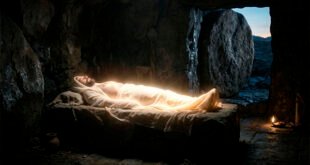
And His Resurrection is not merely a metaphor for hope or an affectionate memory preserved by His disciples. The Church confesses that Christ truly rose, conquered death, and lives in glory.
Therefore, reciting the Creed obliges us to ask ourselves a question: do we truly believe that our lives are called to share in Christ’s victory?
If the answer is yes, illness, failure, old age, and death must be viewed through a hope that does not eliminate suffering but prevents us from considering it the final word.
6.3. The Third Part: The Holy Spirit, the Church, and Eternal Life
The third part focuses on the Holy Spirit and the gifts God communicates to His Church.
We confess the existence of a Church that is one, holy, catholic, and apostolic; Baptism for the forgiveness of sins; the resurrection of the dead; and eternal life.
These statements are intimately connected.
The Holy Spirit sanctifies the faithful, leads them into truth, and incorporates them into the life of Christ. The Church is the sacramental and visible setting in which the faith is transmitted, Christian worship is celebrated, and the means of salvation entrusted by the Lord are proclaimed.
The Church is holy because of her divine origin, because of Christ, her Head, and because of the action of the Holy Spirit, even though her members may commit sins and continually need conversion.
She is one because she has one Lord, one faith, and one Baptism. She is catholic because she is called to embrace all peoples and possesses the fullness of the means of salvation entrusted by Christ. She is apostolic because she is founded upon the testimony and mission of the Apostles and preserves their teaching.
Finally, the Creed directs us toward eternal life.
The Christian does not live merely to achieve temporal well-being, accumulate possessions, or satisfy immediate desires. He lives oriented toward God and awaits the resurrection of the dead.
This hope transforms our present existence.
It reminds us that our decisions have eternal consequences, that sin is not inconsequential, and that holiness is not a hobby reserved for a few extraordinary people.
We are all called to conversion, charity, and union with God.
7. What Does It Mean to Say “I Believe”? The Personal Dimension of the Symbol
There is one detail we must not overlook: the Creed usually begins with the word “I believe.”
It does not simply say, “God exists,” “Jesus Christ was a historical figure,” or “The Church teaches certain doctrines.”
It says, “I believe.”
The act of faith personally commits the person who makes it.
Believing does not mean closing our eyes to reality or accepting any assertion without examination. The Catholic faith is a free response to God who reveals Himself, an adherence of the intellect and will to the truth He communicates.
Human reason can know many truths about God, but Revelation enables us to know mysteries that surpass our natural capacity, such as the mystery of the Most Holy Trinity and the Incarnation of the Word.
Faith does not eliminate reason. It elevates reason and leads it toward a truth that reason could not discover by its own powers.
For this reason, a Christian can study, ask questions, deepen his understanding of theology, and seek answers. He does not have to confuse faith with ignorance.
But he must also recognize that God is infinitely greater than our ability to understand Him. Human intelligence can truly know God without ever fully comprehending Him.
7.1. “I Believe” and “We Believe”: A Faith Received Within the Church
The Catechism of the Catholic Church, in paragraph 185, teaches that the person who says “I believe” adheres to what the Church believes. Communion in faith requires a common language that unites the faithful in one confession.
This statement helps us avoid two opposing errors.
The first is to think that faith is a purely individual experience in which each person can decide for himself which Catholic doctrines to accept and which to reject, as though the Church were an association of opinions.
The second is to imagine that faith is a collective act in which personal responsibility disappears.
Neither reflects Catholic teaching adequately.
Every baptized person must believe personally. But he believes within a community that has received Revelation and transmits the content of the faith to him.
When we recite the Creed at Holy Mass, we say “I believe,” even though we do so united with the entire assembly. Each of us must adhere to what we proclaim, and together we express the communion of the Church.
This has a very important pastoral consequence: we cannot treat Catholic doctrine as a catalogue from which we choose only what agrees with our preferences.
Faith requires intellectual humility and a willingness to allow ourselves to be taught by God through the Church.
This does not mean that we can never have difficulty understanding a truth or that all our questions must immediately disappear. It means that when we encounter a difficulty, we are called to study, pray, and seek a deeper understanding, rather than automatically turning our lack of understanding into a judgment against the truth revealed.
7.2. Can Someone Recite the Creed Without Having a Living Faith?
Yes. It is possible to pronounce the words of the Creed without paying attention, without understanding them, or even without living in accordance with them.
For this reason, mere outward repetition is not enough to describe the life of faith.
The Church distinguishes between the objective content of the faith and the believer’s personal response. The Creed expresses truths that do not depend on our passing feelings, but our adherence to those truths must be authentic.
Think of someone who proclaims belief in the forgiveness of sins but systematically refuses to acknowledge his own faults. Or someone who confesses the Resurrection of the dead but lives as though everything were reduced to material success.
The contradiction does not prove that the Creed is false. It shows that the person needs to convert his life so that it corresponds more closely to what he professes.
The Creed is not an automatic guarantee of holiness. It is a call to believe, understand, and live the truth.
8. The Symbol and the Unity of the Church: We Do Not Each Believe in a Different Religion
One of the most important consequences of the meaning of the Symbol is its relationship with ecclesial unity.
The Catholic Church is spread throughout the world. People of very different languages, cultures, ages, and circumstances belong to her.
A farmer from a small Spanish village, an African priest, a Brazilian mother, an elderly Italian, and a young Filipino can meet at the same liturgical celebration and profess the same faith.
This unity does not arise because they share identical political opinions, cultural preferences, or temperaments. It arises from their communion in Christ and in the faith the Church has received from the Apostles.
The Symbol expresses that unity.
Of course, Catholic unity does not mean that all believers understand every theological question with the same depth. Nor does it mean that legitimate differences do not exist regarding prudential questions, ecclesiastical disciplines, or liturgical traditions.
But it does mean that there are fundamental truths that the Church does not consider optional.
The divinity of Jesus Christ, His true Incarnation, His redemptive death, and His Resurrection are not private opinions that each generation may replace with others it finds more appealing.
If every individual could alter the content of the faith at will, the word “Symbol” would lose an essential part of its meaning. There would no longer be a common profession through which the same apostolic faith could be recognized.
8.1. Unity Does Not Require Cultural Uniformity
We must distinguish the unity of faith from the absolute uniformity of cultural expressions.
The Church has known different liturgical, spiritual, and theological traditions which, while remaining faithful to the Catholic faith, express the richness of the Christian mystery in diverse ways.
Legitimate diversity does not destroy unity. It can reveal that unity with particular beauty.
What diversity cannot do is contradict the content of Revelation.
This distinction is particularly important for those who wish to live a traditional spirituality. Preserving the liturgy, ancient prayers, Gregorian chant, Latin, or inherited devotions can be a valuable aid to deepening the faith.
But love for traditional forms must lead us to love Christ and the truth confessed by the Church even more.
It would make no sense to defend the outward form of a tradition while neglecting charity, feeding pride, or despising other members of the faithful.
Christian Tradition is not a museum piece. It is the living transmission of what the Church has received, and it must help us live the Gospel more faithfully.
9. Why Was the Symbol So Important in a World of Persecution?
The profession of faith acquired extraordinary force in the first centuries because, in certain circumstances, confessing Christ could have social, legal, and even fatal consequences.
We must avoid historical oversimplification: persecutions of Christians were neither constant nor identical in every province of the Roman Empire. There were periods of relative peace and others of persecution, with different circumstances and motivations.
Nevertheless, when authorities demanded religious acts incompatible with the Christian faith, some believers faced a decisive choice: renounce Christ or remain faithful to Him, even at the cost of their lives.
In that context, the Symbol was not an abstract declaration.
To confess Jesus Christ as Lord could mean rejecting the demand to offer religious worship to the emperor or to the traditional gods. The Christian affirmed that his ultimate obedience belonged to God.
This did not necessarily mean a political rebellion against Rome. Christians could respect civil authorities, fulfill their obligations, and contribute to the common good. But they could not recognize any human power as divine.
Faith established a moral limit to obedience.
9.1. The Witness of the Martyrs
Martyrdom is one of the most moving testimonies in Christian history.
The martyrs did not give their lives because they loved suffering for its own sake. They gave their lives because they considered fidelity to Christ more valuable than preserving earthly existence at the cost of denying the truth.
Their witness must not be used to justify violence or contempt toward those who do not share our religion. Christian martyrdom consists in suffering because of fidelity to Christ, not in imposing faith by force.
The martyrs’ blood reveals how profoundly faith could commit a person to his beliefs.
When we contemplate their example, we understand that the Creed is not a formula we pronounce only while everything is going well. It is a confession that must sustain us when believing becomes difficult, unpopular, or costly.
Today, in many places, Christians continue to suffer persecution because of their faith. In other contexts, the difficulties may be less dramatic, but they are not insignificant: ridicule, social isolation, family or professional pressure, and the temptation to conceal one’s convictions to avoid conflict.
The Christian response must not be aggression. It must be fortitude accompanied by charity.
The martyr does not confess Christ to prove that he is superior to others. He confesses Him because he recognizes that he has received a truth and a love that he cannot abandon.
9.2. Everyday Fidelity Is Also a Form of Witness
Not all of us are called to shed our blood for Christ. But every Christian is called to bear witness to Him.
For many, fidelity will be expressed in ordinary decisions:
- Rejecting a lie even when it would be advantageous.
- Defending the dignity of someone who is despised.
- Remaining faithful in marriage when difficulties arise.
- Fulfilling professional duties honestly.
- Forgiving an offense without abandoning justice.
- Not concealing one’s faith out of embarrassment, but also not using it to humiliate anyone.
- Remaining faithful to Christian doctrine when the dominant culture presents it as outdated.
The Symbol reminds us that believing in Christ is not simply identifying with a family tradition. It is accepting that His lordship must illuminate our decisions.
10. The Creed and Doctrinal Controversies: The Church Safeguards the Received Truth
Throughout history, the Church has faced interpretations that questioned fundamental truths about God and Jesus Christ.
Doctrinal controversies were not a marginal phenomenon. They obliged pastors and theologians to study Sacred Scripture rigorously, clarify the meaning of terms, and formulate more clearly what the Church had believed from her origins.
A decisive example was the Arian controversy of the fourth century.
Arius and his followers maintained an understanding of Christ that was incompatible with the confession of His full divinity. The Church’s response led to the Council of Nicaea, held in the year 325.
The Council affirmed that the Son is homoousios with the Father, a Greek term usually translated as “of the same substance” or “consubstantial” with the Father.
The issue was not a simple debate about words. If Jesus Christ were not truly God, we could not confess Him as the eternal Son who fully reveals the Father. The doctrine of salvation would be profoundly altered.
The Council of Constantinople, in the year 381, contributed to the Trinitarian formulation found in the Nicene-Constantinopolitan Creed.
10.1. Why Were Doctrinal Definitions Necessary?
Because words can be used in different ways, and sometimes an apparently Christian expression can conceal an interpretation incompatible with the apostolic faith.
It is not enough to say that Jesus Christ is the “Son of God” if each person attributes a radically different meaning to that expression.
The Church needed to clarify what it meant when it confessed that the Son is true God and true man.
For this reason, conciliar definitions did not seek to invent a new religion. They sought to safeguard the identity of the received faith and reject interpretations that distorted it.
The Creed thus became a fundamental doctrinal reference.
This does not mean that every theological question was resolved in a single formula. Catholic theology has continued to develop over the centuries, deepening its understanding of revealed truths and explaining their implications.
But that development must preserve continuity with the apostolic faith. It cannot consist of denying what the Church has received from Christ.
10.2. The Importance of Knowing the Creed Today
In a society characterized by an abundance of information, doctrinal confusion can arise from many different sources.
The internet provides access to excellent Catholic educational resources, but it also spreads erroneous interpretations, decontextualized excerpts from documents, and claims that confuse the Church’s doctrine with private opinions.
Sometimes a religious message may appear attractive because it uses Christian language while presenting an image of Jesus Christ that does not correspond to the Catholic faith.
Knowing the Creed provides a point of reference.
It does not replace the study of Sacred Scripture, the Catechism, or the teaching of the Church, but it offers a fundamental structure through which to understand them.
A person who knows the Symbol has a map that helps him situate the great questions of faith.
For this reason, catechesis should not be limited to teaching people to repeat the Creed. It must help them understand its statements, explain their biblical foundations, and show how they guide Christian life.
11. What Does the Symbol Mean for a Catholic in the Twenty-First Century?
We might think that the ancient meaning of the Symbol belongs to a vanished world.
We no longer live in the cities of antiquity. We do not need to present a broken piece of pottery so that another person can recognize our identity. We can communicate our beliefs through books, websites, and instant messages.
Nevertheless, the need to recognize what we believe remains fully relevant today.
Much is said about identity, belonging, authenticity, and individual freedom. At the same time, many people experience increasing difficulty finding stable reference points for the meaning of life, moral truth, and the destiny of the human being.
In this context, the Creed reminds us that the Christian faith is not an improvised construction.
We do not begin from scratch every morning to decide what God means, who Jesus Christ is, or what we should hope for after death.
We receive a faith that has a history, a content, and a community.
Receiving this faith does not eliminate our freedom. On the contrary, it invites us to exercise that freedom more deeply: by knowing the truth, examining our conscience, and ordering our lives toward the good.
11.1. Against Individualism: I Am Not the Author of My Own Faith
One of the contemporary temptations is to construct a tailor-made religion.
A person may claim to believe in God while rejecting any doctrine that challenges his decisions. He may accept Jesus’ teachings about mercy while rejecting those that demand conversion. He may desire spiritual comfort without accepting the moral consequences of faith.
The Creed reminds us that faith is not a selection of personal preferences.
When we say, “I believe in God the Father almighty,” we cannot reduce God to an idea that makes us comfortable.
When we confess, “I believe in Jesus Christ,” we cannot limit ourselves to those episodes of His life that match our expectations.
When we affirm, “I believe in the Church,” we must understand that the Christian faith has an ecclesial and sacramental dimension, not merely a private one.
This requires humility. We must accept that our ideas may need correction and that we are not the ultimate measure of truth.
11.2. Against Relativism: Truth Matters
Relativism, in its most radical forms, maintains that there is no objective truth that can be known and that all claims about fundamental questions are equally valid.
The Catholic faith does not share this vision.
The Church maintains that God is Truth and that, although our understanding is limited, we can truly know what He has revealed.
This does not authorize Christians to treat those who disagree with them contemptuously. Truth must be proposed clearly and defended through honest arguments, always united with respect for the dignity of persons.
But neither can we claim that all doctrines are equivalent.
The Creed proclaims specific truths about God, Christ, the Holy Spirit, the Church, and eternal life. Its content is not interchangeable with any other religious conception.
Christian charity requires us to love people; it does not require us to declare all their ideas true.
11.3. Against Materialism: Life Has an Eternal Destiny
The Creed concludes by directing our gaze toward the resurrection of the dead and the life of the world to come.
This transforms our understanding of existence.
If man were destined only to disappear, death would mark the absolute end of all his projects, relationships, and hopes.
The Christian faith, however, announces that God calls us to a life that surpasses death.
This does not mean despising this world or neglecting our present responsibilities. Precisely because we believe in God the Creator and hope for the Resurrection, we must care for our lives, love our neighbors, practice justice, and work for the common good.
But we cannot make temporal goods our ultimate end.
Money, health, social recognition, and professional success can be legitimate goods. They cannot take the place of God.
The Creed reminds us that our existence is called to a fullness that no temporal reality can provide by itself.
12. The Symbol as the Baptismal Seal: Belonging to Christ
There is another ancient image of great spiritual richness: the seal.
The Catechism recalls the testimony of Saint Ambrose, who describes the Symbol as a spiritual seal, a meditation of the heart, and a constant protection for the soul. It also connects the profession of faith with the baptismal seal.
What does this image mean?
A seal can identify something as belonging to a particular person or institution. In Christian life, the image evokes belonging to God and incorporation into Christ.
However, we must distinguish between the Symbol of faith and the sacramental character of Baptism. They are not identical realities.
Baptism imprints an indelible sacramental character. The Creed expresses the faith professed in connection with that sacrament and recalls the Christian identity we are called to live.
For this reason, the Symbol can be regarded as a kind of spiritual mirror: when we pronounce it, we must ask ourselves whether our lives correspond to the identity we confess.
12.1. To Whom Do We Truly Belong?
In a society that constantly invites us to define ourselves by our tastes, achievements, or position, the Creed reminds us of a deeper identity.
We are creatures of God. We have been called into existence by Him and invited to share in His life through grace.
The Christian does not belong to himself in an absolute sense, as though he could dispose of his existence without any reference to goodness, truth, or God.
Saint Paul writes:
“You were bought with a price. So glorify God in your body.”
— 1 Corinthians 6:20
The Apostle refers to the value of the redemption accomplished by Christ and to the dignity of the person called to live for God.
This truth must not be interpreted as an annulment of human freedom. Grace does not turn us into instruments without a will. It frees us from sin and enables us to love with a fuller freedom.
The baptized person is called to live as a child of God, reject sin, and order his actions according to the divine will.
The Creed reminds us of this vocation every time we recite it attentively.
12.2. Christian Identity Is Not Merely a Label
It is not enough to identify culturally as Catholic.
Belonging to the Church must be expressed through prayer, participation in the sacraments, obedience to the commandments, the practice of charity, and a willingness to convert.
This does not mean that we must be perfect before approaching God. Precisely because we are sinners, we need grace, forgiveness, and the help of the Church.
It means that we cannot be satisfied with a merely outward identity.
The Symbol should awaken within us the desire to become what we profess.
13. How to Pray the Creed More Consciously
After studying its history and theological meaning, we can ask how to make better use of this prayer in our daily lives.
The first recommendation is simple: let us not recite the Creed as though it were a mechanical obligation that we must finish as quickly as possible.
It is a profession of faith. Each of its statements deserves our attention.
13.1. Before Beginning, Make an Interior Act of Faith
We can pause for a few moments before reciting it and remember that we are in the presence of God.
There is no need for a complicated preparation. It is enough to recollect ourselves inwardly and ask the Lord to increase our faith.
We can say silently:
“Lord, I believe in You. Help me to understand more deeply the truths You have revealed and to live in accordance with them.”
This disposition helps us move from outward repetition to conscious prayer.
13.2. Meditate on One Statement Each Day
The Creed can become an excellent school of spiritual formation.
For a week, for example, we can devote a few minutes to meditating on different statements:
- God the Father and creation: give thanks for the gift of life and examine whether we live responsibly before God and others.
- Jesus Christ and the Incarnation: contemplate God’s love as He draws near to our human condition.
- The Passion and death of Christ: examine our relationship with sin, sacrifice, and conversion.
- The Resurrection: renew our hope in the face of difficulties and suffering.
- The Holy Spirit: ask for His help in growing in virtue and overcoming our faults.
- The Church: deepen our belonging to the Christian community and our responsibility to contribute to her holiness.
- Eternal life: order our priorities in the light of our ultimate destiny.
The point is not to add many new practices to an already busy life. It is to pray more deeply what the Church places before us.
13.3. Connect the Creed with Sacred Scripture
The Symbol summarizes truths that we find developed throughout the Bible.
When we confess creation, we can meditate on Genesis 1.
When we profess that Jesus Christ is the Son of God, we can read the prologue of Saint John’s Gospel.
When we affirm His death and Resurrection, we can turn to the Passion narratives and 1 Corinthians 15.
When we confess the Church and Baptism, we can study Matthew 28:19–20 and the Acts of the Apostles.
This practice helps us understand that the Creed is not a formula detached from Scripture. It is a synthesis of the faith that the Church receives from Revelation and transmits through her teaching.
13.4. Let Us Pray the Creed as a Family
In a Catholic family, the Creed can help transmit the faith between generations.
Parents can explain to their children what each statement means, answer their questions, and teach them that faith does not consist merely of repeating words.
Adults who are returning to religious practice after many years can also benefit from this exercise.
We should not be ashamed to study the foundations of the faith again. Christian formation does not end in childhood or with the reception of the sacraments of Christian initiation.
A Catholic may have attended Mass for decades and still discover new riches in the Creed.
Theology does not exhaust the mystery of God, but it helps us know Him more deeply and avoid mistaken interpretations.
14. The Creed at Holy Mass: A Profession of Faith Before God and the Church
In the celebration of the Eucharist, the profession of faith occupies a significant place after the homily on Sundays and solemnities when it is prescribed.
It is not a pause unrelated to the rest of the liturgy.
After hearing the biblical readings and the preaching, the faithful respond by proclaiming the faith of the Church.
The Word of God has been proclaimed; the assembly now confesses the fundamental truths it has received.
This profession prepares us spiritually to continue the celebration, in which the Church presents her petitions, offers the Eucharistic sacrifice, and participates sacramentally in the life of Christ.
14.1. Why Do We Stand to Recite It?
Our bodily posture also has a liturgical meaning.
In the Roman liturgy, the faithful ordinarily stand during the Creed. This posture expresses attention, reverence, and readiness to profess the faith.
We should not turn the gesture into a mere formality or attribute meanings to it that the Church does not establish. But we can recognize that the liturgy involves the whole human person: soul and body, intelligence and will.
Faith is not merely an interior feeling. It is expressed through words, gestures, postures, and actions.
Therefore, reciting the Creed at Holy Mass reminds us that we are not praying a private prayer in isolation from others. We are professing the faith together with the Church, within the context of the worship we offer to God.
14.2. Which Creed Should We Use?
At Holy Mass in the Roman Rite, the Nicene-Constantinopolitan Creed is the usual profession of faith. The Roman Missal also provides for the use of the Apostles’ Creed in the circumstances specified, particularly given its catechetical and baptismal use.
Specific liturgical norms must be followed in accordance with the books approved by the Church.
The important point is to understand that both formulas serve the same purpose: to profess the Catholic faith.
We must not confuse a spiritual preference for one formula with the idea that the other lacks value. Each has its own history and place in the Church’s tradition.
Liturgical fidelity includes understanding the meaning of the prayers, respecting the norms of the celebration, and participating with the proper interior disposition.
15. The Symbol and Catholic Tradition: Preserving the Faith Without Turning It into a Relic
For those who love the traditional liturgy, the history of the Symbol offers a particularly important lesson.
The Church has not preserved the Creed for centuries simply because it is a venerable formula or because it connects us emotionally with our ancestors.
She preserves it because it expresses the faith she has received from Christ through the Apostles.
Its antiquity is valuable, but its value does not depend exclusively on its age. It depends on the truth it proclaims and its fidelity to Revelation.
This enables us to understand better what Catholic Tradition really means.
Tradition does not consist in mechanically repeating everything that belongs to the past. Nor does it consist of continually adapting the faith to the preferences of each age.
It consists of faithfully receiving the deposit of faith, understanding it ever more deeply, and transmitting it intact to those who come after us.
The Creed is a privileged manifestation of this continuity.
15.1. The Faith Does Not Change Because Fashions Change
Societies change. Philosophical ideas come and go. Political systems rise and fall. Forms of communication are transformed.
But revealed truth does not depend on cultural fashions.
The Church can and must explain the faith in ways that people of every age can understand. She can also deepen her understanding of its implications and respond to new questions.
However, this task does not authorize her to replace the essential content of the faith with claims contrary to what Christ has revealed.
The Creed provides us with a stable reference point amid historical changes.
When we confess that Jesus Christ rose from the dead, we are not expressing a metaphor that can be adapted to any interpretation. We are professing a central event of the Christian faith.
When we proclaim that God is Father, Son, and Holy Spirit, we are not speaking of three gods or three temporary manifestations of one Person. We are confessing the one true God in three divine Persons.
When we affirm that the Church is one, holy, catholic, and apostolic, we are not describing a purely future ideal. We are confessing the marks of the Church founded by Christ, even though her members must continually work toward a holier life and fuller communion.
Fidelity to Tradition requires us to know these truths, not merely to defend outward symbols associated with them.
15.2. The Danger of Turning Tradition into a Source of Pride
There is a temptation we must honestly acknowledge: using religious knowledge as a reason to feel superior.
A person may know liturgical Latin, study the Fathers of the Church, appreciate the solemnity of ancient worship, and possess considerable doctrinal formation. All of this can be good and contribute to a fruitful spiritual life.
But such knowledge does not automatically make us saints.
If it feeds pride, impatience, contempt for the uninstructed, or a lack of charity, it needs to be purified.
The purpose of Christian doctrine is not to provide us with weapons to humiliate others. It is to lead us to the truth and, through it, to a deeper union with God.
True love for Tradition must produce the fruits of humility, reverence, obedience to the truth, and charity.
The Symbol reminds us that we all receive the faith. No one is its absolute owner. We are all disciples before we are teachers.
16. The Creed as an Examination of Spiritual Conscience
We can use the Symbol to examine our conscience in a way that goes beyond listing our sins.
Each article allows us to review our relationship with God and our neighbor.
“I believe in God the Father almighty.” Do I truly trust in divine providence, or am I dominated by anxiety, as though everything depended exclusively on my own strength?
“Creator of heaven and earth.” Am I grateful for the gift of life? Do I respect the dignity of others? Do I use responsibly the goods I have received?
“I believe in Jesus Christ.” Does Christ occupy the center of my existence? Do I know His Gospel? Do I try to follow His commandments, or do I turn to Him only when I need help?
“Who was crucified, died, and was buried.” Do I recognize the gravity of sin? Do I accept the need for conversion? Do I know how to unite my sufferings with those of Christ without falling into despair?
“And rose on the third day.” Do I live with hope? Do I allow myself to be dominated by fear of death, failure, or old age?
“I believe in the Holy Spirit.” Do I ask for His help? Do I strive to grow in virtue? Am I willing to abandon habits that distance me from God?
“I believe in the Church.” Do I participate in her sacramental life? Do I pray for her pastors and the faithful? Do I contribute to unity and avoid feeding unnecessary divisions?
“I believe in the forgiveness of sins.” Do I acknowledge my faults and approach the Sacrament of Penance when necessary? Am I willing to forgive those who have offended me?
“I look forward to the resurrection of the dead and the life of the world to come.” Do I order my decisions in the light of eternity, or do I live exclusively for passing goods?
This examination is not intended to replace the examination of conscience needed for a good sacramental confession. It is a complementary aid for discovering how the faith we proclaim must transform our lives.
17. A Practical Proposal: Rediscover the Creed Over Thirty Days
Anyone who wishes to deepen his understanding of the Symbol can devote a month to studying and praying it more attentively.
There is no need to spend many hours each day. A few minutes of reading, prayer, and personal examination are enough.
A Thirty-Day Spiritual Journey
A simple proposal for deepening your understanding of the profession of faith.
Week 1 — The Father and Creation
Meditate on God, His omnipotence, creation, and providence. Read Genesis 1 and the beginning of Saint John’s Gospel. Ask yourself whether you recognize God as the origin and end of your life.
Week 2 — Jesus Christ and Redemption
Study the Incarnation, the Passion, the death, and the Resurrection of the Lord. Read John 1:14 and 1 Corinthians 15:1–8. Spend time giving thanks for Christ’s redemptive work.
Week 3 — The Holy Spirit and the Church
Deepen your understanding of the Most Holy Trinity, sanctification, the Church, and the sacraments. Read Matthew 28:19–20 and Acts 2. Examine your participation in the life of the Church.
Week 4 — Forgiveness and Eternal Life
Meditate on the forgiveness of sins, the resurrection of the dead, and eternal life. Review your priorities and consider which aspects of your life need deeper conversion.
Days 29 and 30 — Profess and Live
Pray the entire Creed slowly. Choose the statements you most need to internalize and formulate a concrete resolution to live them during the following months.
Throughout this journey, it can be particularly helpful to consult paragraphs 185–197 of the Catechism of the Catholic Church, which are specifically devoted to the Symbols of Faith. There you will find a doctrinal explanation of their meaning, structure, and importance for Christian life.
The goal is not to turn prayer into another task on our schedule. It is to allow the faith gradually to illuminate our thoughts, decisions, and relationships.
18. The Questions We Should Ask Ourselves When We Profess the Symbol
After exploring its history and content, we can return to the original question: why is the Creed called the Symbol?
We can now answer more deeply.
It is called the Symbol because it is a profession of faith that gathers together the fundamental truths of Christianity and enables us to recognize the faith shared by believers. It also evokes the ancient function of objects broken into pieces, whose halves made it possible to verify a correspondence and identify those who were connected to one another.
In Christianity, that correspondence is not merely material. It is communion in the faith received from the Apostles and transmitted by the Church.
But the historical explanation leads us to a more demanding spiritual question.
When we pronounce the Creed, do we truly recognize the faith we are professing?
It is not enough for others to identify us as Catholics. We must ask ourselves whether we recognize Christ as Lord of our lives.
Do we believe in God the Creator when we must make decisions affecting our family, our work, or our conscience?
Do we believe in Jesus Christ crucified when the Gospel demands that we renounce our selfishness?
Do we believe in His Resurrection when we face illness, bereavement, or a situation that seems to offer no way out?
Do we believe in the Holy Spirit when we must struggle against a habitual sin?
Do we believe in the Church when her teachings contradict our personal preferences?
Do we believe in eternal life when we must choose between an immediate benefit and a morally upright decision?
These questions show that the Creed does not belong merely to the realm of ideas. It is a profession that must guide our entire existence.
We will not always live up to what we profess. We are weak and need God’s grace. But precisely for that reason, we must return again and again to the Symbol, not as someone repeating a password to prove that he belongs to a group, but as someone recalling the truth he wishes to love and live.
Faith is received, professed, celebrated, and practiced.
Conclusion: The Symbol That Unites Our Voice with the Faith of the Apostles
There is something profoundly moving about thinking that when a Catholic recites the Creed, his words unite him spiritually with countless generations of Christians who came before him.
Men and women from different periods and cultures have confessed the same God, recognized Jesus Christ as Lord, and hoped for the resurrection of the dead.
Some lived in the cities of the Roman Empire. Others lived through the Middle Ages, witnessed great historical changes, or transmitted the faith under difficult circumstances. Many remained unknown to the world, yet they were faithful in prayer, in family life, at work, and in suffering.
Others bore witness to Christ unto martyrdom.
Not everyone recited exactly the same formula in every time and place. Nevertheless, the Church has preserved and transmitted professions of faith that express the core of the same apostolic faith.
This continuity is one of the great treasures of Christianity.
The Symbol is neither a verbal relic nor a mere religious password. It is a synthesis of revealed truth, an expression of ecclesial communion, and a call to live according to what we believe.
When we say, “I believe in God,” we acknowledge that our existence has its origin and end in Him.
When we proclaim, “I believe in Jesus Christ,” we accept that our salvation does not come exclusively from our own strength, but from God’s redeeming love.
When we confess, “I believe in the Holy Spirit,” we recognize that we need His grace to grow in holiness.
When we affirm, “I believe in the Church,” we profess our belonging to a community entrusted with the mission of safeguarding and transmitting the faith.
And when we conclude by looking forward to eternal life, we lift our gaze beyond our immediate concerns and remember that we were created for God.
For this reason, the next time you stand during Holy Mass and begin to recite the Creed, try to do so differently.
Do not rush.
Pronounce each statement attentively. Remember the Apostles who transmitted the faith, the saints who lived it, and the martyrs who preferred to die rather than renounce Christ.
And ask yourself, humbly, whether you are willing to allow that faith to transform your life.
Because the true meaning of the Symbol does not consist merely in identifying what we believe.
It consists in recognizing the truth we have received, remaining united in the faith of the Church, and living in such a way that our actions do not contradict the words we pronounce.
The Creed is the voice of the Church reaching our lips. By God’s grace, may it also reach our hearts and transform our entire lives.