Related Articles

There are questions that seem simple until we try to answer them precisely.
One of them is this:
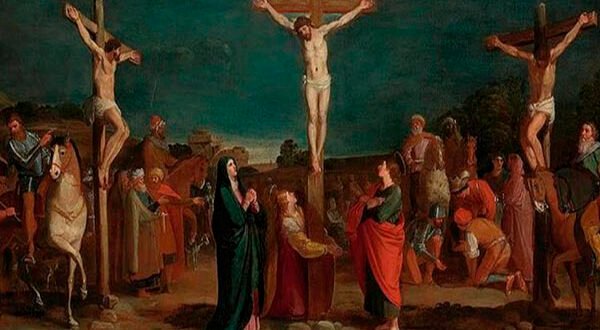
When Jesus Christ died on the Cross, did God die?
The question can even be bewildering. If Jesus is God, and if Jesus truly died on Calvary, does that mean that God died? Can God die? Did only the body of Jesus die? Did His humanity die? Did the Second Person of the Holy Trinity die? Or should we say that God remained completely removed from that death?
The Catholic answer is much deeper than a simple “yes” or “no.”
Because here we encounter the very heart of the Christian mystery: Jesus Christ is true God and true man; one divine Person with two natures, divine and human.
And precisely because this truth is so important, the Church has had to use carefully precise language for centuries in order to avoid two opposite errors: turning Christ into a mere extraordinary man, or imagining that in Him divinity and humanity were mixed together to form some kind of intermediate nature.
The Catholic faith affirms something infinitely greater:
The one who died on the Cross is truly God the Son. But He died according to His human nature, not according to His divine nature.
Divinity did not die.
The eternal Word did not cease to exist.
The Father did not die.
The Holy Spirit did not die.
And neither did the Person of the Son cease to exist for even a single instant.
But neither can we take refuge in an overly comfortable formula by simply saying: “The man Jesus died, but God had nothing to do with that death.”
That would also be false.
Because the man Jesus is not a human person independent of the Word.
The one who was born of Mary, the one who wept at the tomb of Lazarus, the one who sweated blood in Gethsemane, the one who was scourged, crowned with thorns and nailed to the Cross, is the same divine Person of the eternal Son.
And here the true mystery begins.
1. The First Assertion: Jesus Christ Is Truly God
To understand what happened on Calvary, we must begin long before the Cross.
We must begin in Bethlehem.
And, in reality, long before Bethlehem.
The Prologue of the Gospel of Saint John does not begin by simply saying that Jesus was born at a particular moment in history.
It begins in eternity:
“In the beginning was the Word, and the Word was with God, and the Word was God.”
(Jn 1:1)
And then comes one of the most extraordinary sentences in all of Scripture:
“And the Word became flesh and dwelt among us.”
(Jn 1:14)
Here the entire mystery of the Incarnation is condensed.
The one who was eternally with the Father assumed a true human nature.
He did not merely appear to be a man.
He did not disguise Himself as a man.
He did not use a human body as someone might use a tool.
He truly became man.
The Church teaches that Jesus Christ is perfect in His divinity and perfect in His humanity; true God and true man. He has a divine nature and a human nature, but not two persons. The two natures are united in the one divine Person of the Son. This is precisely the doctrine defined and safeguarded from the great Christological councils, especially Ephesus and Chalcedon.
Therefore:
Jesus is not two persons.
There is not a human person called Jesus alongside a divine person called the Son.
There is one Person:
the eternal Word of God.
And that Person possesses two natures:
- divine nature;
- human nature.
This distinction will be decisive for understanding the death of Christ.
2. What Exactly Do “Nature” and “Person” Mean?
Here we enter into a theological question that may seem complicated, but which can be explained simply.
Nature answers the question:
What is it?
Person answers:
Who is it?
In Christ:
What is Christ?
True God and true man.
Who is Christ?
The divine Person of the Son.
Therefore Christ has:
a divine nature.
a human nature.
But Christ does not have two persons.
He has one divine Person.
This is the doctrine of the hypostatic union.
Why is this so important?
Because if we say that there are two persons, we destroy the Incarnation.
And if we say that humanity disappears by being absorbed into divinity, we also destroy the Incarnation.
The Church simultaneously maintains both truths:
Christ is truly God.
Christ is truly man.
And He is one Person.
3. Then We Arrive at the Cross: Who Died?
Now we can formulate the question much more precisely.
We should not ask only:
“Did God die?”
We should ask:
“Who is the subject of Christ’s death?”
And the answer is:
The Person of the Son.
The one who dies on the Cross is the same eternal Son of God who exists from all eternity.
He is not someone else.
He is not a separate man.
He is not an independent humanity.
He is the Word made flesh.
That is why the Church can say something that, from a human perspective, seems paradoxical:
God the Son died.
But immediately we must add:
He died according to His human nature, not according to His divine nature.
This distinction is not a play on words.
It is the key to the Christian faith.
The Catechism teaches that everything belonging to Christ’s humanity—including His sufferings and His death—is attributed to the divine Person of the Word as its subject. Therefore, the one who was crucified in the flesh is truly the Son of God.
4. So, Can We Say “God Died”?
Yes, if we understand correctly what we are saying.
The expression can be used in a Christological sense, because the one who died is the divine Person of the Son.
But we must not understand it as though the divine nature had ceased to exist.
God, as God, is immortal.
Divinity cannot die.
The divine nature cannot experience death.
God is eternal, immutable, incorruptible and the source of all life.
Therefore, it would be theologically incorrect to say:
“Christ’s divinity died.”
No.
The divinity did not die.
But it would also be insufficient to say:
“Only a man called Jesus died.”
Nor is that correct.
The correct formula is:
The Son of God truly died according to the human nature He had assumed.
Or, expressed another way:
The divine Person of the Word truly experienced human death in the human nature He had assumed.
This is the extraordinary depth of Calvary.
5. What, Then, Does It Mean That Christ “Died”?
Here another fundamental point appears.
What is death?
From the human point of view, death consists in the separation of the soul and the body.
While we live, our body and soul are united.
When death comes, that union is broken.
This also happened in Jesus Christ.
Christ did not pretend to die.
He did not merely enter some kind of trance.
He did not simulate death only to recover afterward.
He truly died.
His human soul was separated from His human body.
The Catechism explicitly teaches that Christ “tasted death,” experiencing the state of death and the separation between His soul and His body from the moment of His death on the Cross until the Resurrection.
This is extremely important.
Because some modern interpretations tend to reduce the Passion to a symbolic experience.
But Christianity does not proclaim that Jesus “symbolically overcame” suffering.
It proclaims that:
He died.
Really.
Historically.
Bodily.
And afterward:
He rose bodily from the dead.
6. But Here We Encounter the Great Mystery of Holy Saturday
If Christ’s soul was separated from His body, what happened to the Person of the Son?
Here is one of the most extraordinary affirmations of Catholic theology.
The Person of the Word was not separated either from the soul or from the body.
Although Christ’s human soul and human body were separated by death, both continued to be united to the divine Person of the Son.
The Catechism explicitly expresses this doctrine: although Christ’s human soul was separated from His body, neither His soul nor His body was separated from the Person of the Word.
This means that during Holy Saturday we can speak of:
the human soul of Christ united to the Word;
and
the dead body of Christ united to the Word.
The body was in the tomb.
The soul was separated from the body.
But the Person of the Son was not divided.
Two Christs did not appear.
There was not one Christ in the soul and another Christ in the corpse.
He remained:
the one and only Jesus Christ.
7. The Dead Body of Jesus Was Still the Body of the Son of God
This truth is especially astonishing.
Let us imagine Christ’s body after His death.
The body that had been born of Mary.
The body that had walked through Galilee.
The body that had touched the sick.
The body that had embraced children.
The body that had been scourged.
The body that had been nailed to the Cross.
The body that had died.
That body was truly dead.
But it was still the human body of the Son of God.
The divine Person had not abandoned the body.
That is why the Catechism teaches that Christ’s death was a true death, but that His body did not undergo the corruption proper to ordinary corpses because of its union with the Person of the Son.
Here we can better understand a statement from the Psalmist applied by the Church to Christ:
“For you will not abandon my soul to Sheol, or let your holy one see corruption.”
(Ps 16:10)
And Saint Peter later proclaims:
“But God raised him up, loosing the pangs of death, because it was not possible for him to be held by it.”
(Acts 2:24)
Death truly entered into Christ.
But death could not hold Him.
8. Did Only the Second Person Die?
Here we must answer precisely.
Yes and no, depending on what we mean.
If by “the Second Person died” we mean:
“Was the divine Person of the Son the one who suffered and died?”
The answer is:
Yes.
If we mean:
“Did the divine nature of the Second Person cease to exist or die?”
The answer is:
No.
The Person of the Son is the subject of the death.
But death affects Christ according to His human nature.
We can express it schematically:
Person: the eternal Son.
Divine nature: does not die.
Human nature: can suffer and die.
Subject of the death: the divine Person of the Son.
This is one of the reasons why Catholic theology speaks of the communication of idioms (communicatio idiomatum).
The properties of a nature can be attributed to the personal subject.
Therefore we can say:
God was born of Mary.
God suffered.
God was crucified.
God died.
But these statements must always be understood in light of the Incarnation:
God did all these things according to the humanity assumed by the Word.
The divine nature itself does not suffer or die.
9. “God Died” Does Not Mean That the Trinity Ceased to Exist
This point is absolutely fundamental.
When Christ died on the Cross, the Father did not die.
The Holy Spirit did not die.
And the divinity of the Son did not cease to exist.
Therefore, the Holy Trinity never ceased to exist.
The Father remained the Father.
The Son remained the Son.
The Holy Spirit remained the Holy Spirit.
The divine nature remained one, eternal, infinite and immortal.
What happened was that the Person of the Son truly experienced human death in His human nature.
This allows us to avoid a completely mistaken image of the Cross.
We should not imagine that for several hours “God ceased to exist.”
That would be impossible.
If God ceased to exist, everything created would cease to exist.
Because God is not simply an extremely powerful being within the universe.
God is Being itself, the Creator and foundation of everything that exists.
Christ’s death is not the disappearance of God.
It is precisely the opposite:
it is God entering, in the humanity assumed by the Word, into the depths of our mortal condition.
10. The Paradox of Christianity: The Author of Life Enters into Death
Here one of the most beautiful contrasts in the whole Christian faith appears.
Saint Peter calls Christ:
“The author of life.”
(Acts 3:15)
And yet that same “Author of life” was led to death.
It seems like a contradiction.
But it is not.
Because Christ did not cease to be the Author of life.
Precisely because He is God, He was able freely to enter into human death and conquer it from within.
The Catechism uses this same paradox when speaking of Christ as the “Prince of life” who was put to death and who is simultaneously the risen Living One.
Here we find one of the great differences between Christianity and any merely moral philosophy.
Christianity does not say:
“God teaches us to accept death.”
It says something infinitely greater:
God has entered into our death in order to destroy its power from within.
11. The Cross Was Not an Accident
From a superficial perspective, the death of Jesus may seem like the result of a political tragedy.
An innocent man was condemned.
He was betrayed.
He was abandoned.
He was tortured.
He was executed.
But the Christian faith sees something much deeper.
Christ repeatedly announced His Passion.
“The Son of Man is going to be delivered into the hands of men, and they will kill him, and he will be raised on the third day.”
(Mt 17:22-23)
The Cross forms part of God’s redemptive plan.
This does not mean that God the Father enjoyed the suffering of His Son.
Nor does it mean that the Father is a bloodthirsty executioner.
It means that the Son, in loving obedience to the Father and out of love for humanity, freely gave Himself.
Saint Paul expresses it in a deeply moving sentence:
“The Son of God loved me and gave himself for me.”
(Gal 2:20)
He does not simply say:
“Jesus suffered.”
He says:
“He gave himself for me.”
Here the personal dimension of sacrifice appears.
The Cross is not merely a tragedy that happened two thousand years ago.
It is an act of love.
12. Why Did Christ Have to Die?
This question leads us to the heart of Redemption.
Sin had introduced a rupture between God and man.
Humanity, unable to save itself, needed a Savior.
And the Savior had to be truly human, because it was humanity that needed to be redeemed.
But He also had to be truly God, because salvation could not come merely from a creature.
Therefore the Mediator is simultaneously:
true God and true man.
As man, He can represent us.
As God, He can save us.
As man, He can suffer and die.
As God, His self-offering possesses infinite dignity and efficacy.
Here we find one of the profound reasons why the Incarnation is indispensable for understanding the Cross.
The one who dies is truly man.
The one who gives Himself is truly God.
And both realities belong to one Person.
13. The Blood of Christ Is Not the Blood of a Mere Martyr
Throughout history there have been countless martyrs.
Men and women have died defending the truth.
But Christ’s death is unique.
Why?
Because the one who gives Himself is the eternal Son.
That is why Saint Paul can say:
“In him we have redemption through his blood, the forgiveness of our trespasses.”
(Eph 1:7)
The blood poured out on Calvary is not simply the blood of a good man unjustly killed.
It is the blood of Christ, true God and true man.
That is why the sacrifice possesses incomparable depth.
The Cross simultaneously reveals:
the gravity of sin,
the justice of God,
the mercy of God,
the obedience of Christ,
and the love of God for man.
14. “My God, My God, Why Have You Forsaken Me?”
There is another scene that many people find puzzling.
Jesus cries out from the Cross:
“My God, my God, why have you forsaken me?”
(Mt 27:46)
Does this mean that the Father truly abandoned the Son?
Was the Trinity broken?
Did divinity disappear from Christ?
No.
The Trinity is not broken.
The Father and the Son remain eternally united in the one divine nature.
So what does this cry mean?
Jesus is pronouncing the beginning of Psalm 22, a psalm that begins with a cry of abandonment and ends in a proclamation of trust and victory.
But, in addition, Christ truly experiences in His humanity the depth of the suffering and desolation that accompanies wounded human existence.
We must not imagine that divinity disappeared from Christ.
The Catechism teaches precisely the opposite: throughout the Passion, the Son remains united to the Father.
The human experience of abandonment does not mean an ontological rupture within the Trinity.
It means that Christ carries the experience of human suffering to its extreme without ceasing to be the beloved Son.
15. Christ’s Death Did Not Destroy His Divinity; It Revealed How Far His Love Goes
This point has enormous pastoral importance.
If Christ had avoided every experience of suffering, we could wonder whether He truly assumed our condition.
But Christ entered all the way in.
He experienced:
weariness,
hunger,
thirst,
loneliness,
betrayal,
abandonment,
injustice,
physical pain,
anguish,
and finally death.
Except for sin.
Saint Paul says:
“He emptied himself, by taking the form of a servant, being born in the likeness of men. And being found in human form, he humbled himself by becoming obedient to the point of death, even death on a cross.”
(Phil 2:7-8)
Christianity does not teach that God remained distant from our suffering.
God entered into it.
Not as divinity suffering, because the divine nature is impassible.
But as the divine Person who assumed a true human nature capable of suffering.
16. Does This Mean That God Can Suffer?
Another delicate question.
The correct answer once again requires a distinction.
God, according to His divine nature, does not suffer.
God is immutable and perfect.
He is not subject to the alterations, deficiencies or limitations proper to creatures.
But the Son of God truly suffered in His human nature.
We must not think that Christ’s humanity was some kind of external shell that suffered while God remained indifferent.
The Person who suffers is the divine Person of the Son.
Therefore Christ’s suffering is truly the suffering of the Son, although experienced through His human nature.
This precision simultaneously protects two truths:
God does not change and does not cease to be God.
And:
Christ truly suffered.
17. The Danger of Saying That “Only the Humanity Died”
The phrase may seem correct, but it can be misleading.
If we mean:
“The human nature of Christ was the one that experienced death,”
then it is correct.
But if we mean:
“A human person died who was distinct from the Word,”
then it is false.
There is no human person separate from the Word.
Christ’s humanity does not have an independent human person of its own, separate from the Word.
The humanity belongs to the Person of the Son.
Therefore we can say:
The Son died according to His humanity.
This is a much more precise formula than:
“Only the man Jesus died.”
Because the latter expression can eventually separate Jesus from the Word.
And that is precisely what the Church has always rejected.
18. The Opposite Error: Saying That Divinity Died
But we must also avoid the opposite extreme.
To say:
“The divinity died”
as though the divine essence had ceased to exist would likewise be impossible.
Divinity cannot die.
God cannot cease to be God.
The divine nature does not experience separation, corruption or disappearance.
Therefore we cannot say that during Good Friday:
“God was dead.”
In an absolute sense, that would be false.
We must say:
The Son of God was dead according to His humanity.
This small expression—“according to His humanity”—contains an extraordinary theological depth.
19. The Mystery of Holy Saturday
Perhaps the moment that best allows us to understand this is precisely Holy Saturday.
The Church contemplates the body of Christ in the tomb that day.
The world seems to fall silent.
The visible triumph of the Resurrection has not yet arrived.
Christ has died.
But He has not ceased to be God.
His soul is separated from His body.
But both remain united to the Person of the Word.
The body rests in the tomb.
And the divine Person of the Son remains equally united to that body.
This is one of the reasons why Holy Saturday constitutes one of the deepest mysteries of the entire Christian liturgy.
It is the day of silence.
The day when it seems that God has been defeated.
The day when the tomb appears to have the final word.
But it does not.
Because the one who lies in the tomb is precisely:
the Lord of life.
20. “I Was Dead, and Behold I Am Alive”
The Book of Revelation contains one of Christ’s most extraordinary statements:
“I died, and behold I am alive forevermore.”
(Rev 1:18)
Let us notice the precision.
Christ does not say:
“I only appeared to be dead.”
He says:
“I was dead.”
The death was real.
But He does not say:
“I ceased to exist.”
He says:
“I am alive.”
The Person remains.
Death does not destroy Christ’s identity.
The one who died is the same one who rose.
The same Jesus who was crucified is the one who appears glorified.
There are not two Christs.
It is the same Lord.
21. The Resurrection Proves That the Cross Was Not a Defeat
If we look only at Good Friday, everything seems lost.
The disciple betrayed Him.
The apostles fled.
Christ was condemned.
His body was placed in a tomb.
But the story does not end there.
The Resurrection manifests that death had no definitive power over Christ.
Saint Paul expresses it clearly:
“We know that Christ, being raised from the dead, will never die again; death no longer has dominion over him.”
(Rom 6:9)
The Resurrection does not mean that Christ simply returned to His previous life.
It is a glorious transformation.
His humanity enters into a new condition.
And death, which had separated His soul from His body, is definitively conquered.
22. What Exactly Happened Between Death and Resurrection?
This question leads us to what is called Christ’s descent into hell.
It does not mean that Jesus descended to the place of damnation to suffer the punishments of hell.
The term “hell” in the Creed refers to the state or abode of the dead.
Christ enters into the condition of the dead.
The one who has truly died descends there.
And there He proclaims the victory of Redemption.
The Church sees in this mystery the radical nature of the Incarnation:
Christ does not merely touch our life.
He enters into our death as well.
And from there begins the victory that will culminate in the Resurrection.
23. The Cross Teaches Us That God Does Not Love from a Distance
This truth has enormous pastoral power.
Many people ask:
“If God exists, why does He allow suffering?”
Christianity does not answer merely with a philosophical theory.
It points to a Cross.
And says:
Look at Christ.
God did not remain a distant spectator of human suffering.
The eternal Son assumed a human nature capable of suffering.
And He suffered.
And He died.
This does not automatically answer every question we may have about evil.
But it radically transforms the Christian’s relationship with suffering.
When a Christian suffers, he cannot say:
“God does not know what this means.”
Because God the Son has chosen to know, in His humanity, pain, anguish and death.
24. Christ Did Not Come Merely to Teach Us Values
This question is particularly relevant today.
In an age when Christianity can easily be reduced to:
“being good,”
“helping others,”
“being tolerant,”
“respecting one another,”
“loving,”
we must remember that Christianity is infinitely greater.
Christ did not come merely to teach us an ethic.
He came to save us.
He did not simply come to say:
“Love one another.”
He came to give His life.
He did not merely come to teach forgiveness.
He came to obtain forgiveness for us through His sacrifice.
He did not merely come to speak about life.
He entered into death to give us eternal life.
The Cross demonstrates that Christianity is not simply a system of human values.
It is an encounter with the living God who became man to save man.
25. Why Does It Matter Today to Know Whether God Died?
It might seem like a question exclusively for academics.
It is not.
It has enormous consequences.
If Christ is not truly God, the Cross loses its supernatural dimension.
If Christ is not truly man, then He did not truly experience our condition.
If Christ were two persons, the Incarnation would be destroyed.
If divinity could die, our understanding of God would be mistaken.
And if Christ’s death were not real, neither would the Resurrection truly be real.
Therefore Christological doctrine is not a discussion reserved for specialists.
It is the heart of the Gospel.
26. The Cross Also Teaches Us Who God Is
Paradoxically, to understand who God is, we must look at the Crucified One.
Not because God is suffering.
God is not suffering.
Not because God is death.
God is not death.
But because in Christ we see how far divine love reaches.
Saint John says:
“For God so loved the world, that he gave his only Son.”
(Jn 3:16)
The Christian God is not a distant god.
He is the God who gives.
The Father gives the Son.
The Son freely gives Himself.
The Holy Spirit works in the mystery of the Incarnation and Redemption.
The Cross manifests Trinitarian love.
27. Mary Was There: The Mother of God Before the Death of God the Son
Here we also encounter a Marian mystery of extraordinary depth.
Mary was at the foot of the Cross.
The woman who had received the Word into her womb now contemplates her Son nailed to the wood.
The same one she had carried in her arms.
The same one who had been born in Bethlehem.
The same one who had lived in Nazareth.
The same one who had proclaimed the Kingdom.
Now He is dying.
And Mary is not simply contemplating the death of a human son.
She is contemplating the Passion of the one who is truly her Son according to the flesh and truly the eternal Son of God according to His Person.
That is why Catholic tradition can call Mary Mother of God (Theotokos).
It does not mean that Mary is the origin of divinity.
It means that the one who was born from her is truly God made man.
The motherhood refers to the Person of the Son, not to the eternal origin of His divine nature.
This precision also helps us understand the Cross.
28. “He Truly Died”: An Affirmation That Protects the Reality of the Incarnation
Sometimes we think that a highly precise theological statement loses spiritual power.
Here the opposite happens.
The more deeply we understand the doctrine, the more astonishing the mystery becomes.
Christ truly died.
His heart stopped beating.
His soul was separated from His body.
His body was placed in a tomb.
And yet:
the eternal Word did not abandon either His soul or His body.
The Church does not need to diminish the mystery.
It can affirm both things simultaneously.
True death.
True divinity.
They do not contradict each other because they belong to different aspects of Christ’s reality.
29. The Error of Thinking That Divinity “Withdrew” from Jesus
There is an image we must avoid.
We might imagine that, during the Passion, God gradually abandoned Jesus and that on the Cross only a man remained.
That would be contrary to the Catholic faith.
Divinity did not separate itself from Christ.
The Word did not abandon His humanity.
Even in death, Christ’s body and soul remained united to the divine Person.
The Catechism insists precisely on this continuity: during death, although soul and body are separated, both remain united to the same Person of the Word.
Therefore the Cross is not the moment when Christ ceases to be God.
It is precisely the moment when the God incarnate takes His love to the extreme.
30. So, What Is the Most Precise Answer to the Question?
We can answer briefly:
Did Jesus Christ die?
Yes.
Truly.
Did His body die?
Yes.
His body experienced a real death.
Was His soul separated from His body?
Yes.
That constitutes the reality of His human death.
Did the Son of God cease to exist?
No.
The divine Person of the Son is eternal.
Did the divine nature die?
No.
Divinity cannot die.
Did the divine Person of the Son remain united to His humanity during death?
Yes.
He remained united both to the soul separated from the body and to the body laid in the tomb.
Then can we say “God died”?
Yes, if it is understood correctly: the Son of God died according to His human nature.
But it would be incorrect to understand this as meaning that the divine nature ceased to exist or that the divine nature died.
31. The Formula We Must Keep
If we wanted to condense the entire mystery into a single sentence, we could say:
Jesus Christ, true God and true man, truly died according to His human nature; but His divine Person, the eternal Word, did not cease to exist or separate Himself from His soul and His body.
This sentence contains practically the whole answer.
And it allows us to understand why the Church can proclaim:
“Jesus Christ is God.”
And simultaneously:
“Jesus Christ died.”
There is no contradiction.
Because the same Christ is:
true God and true man.
32. And Here the Greatness of the Cross Appears
The Cross is not simply the place where a man died.
It is the place where God made man gave His life for us.
Not because divinity could die.
But because the eternal Son chose to assume a truly mortal humanity.
The immortal entered into mortality.
The impassible according to divinity chose to suffer truly according to humanity.
The One who is Life entered into death.
The eternal One entered into time.
The One who needs nothing chose to become dependent, as a child, upon a Mother.
The One who sustains the universe chose to be held in human arms.
And the One who gives life to all allowed His human heart to be pierced by a lance.
Here is the scandal and glory of Christianity.
God did not cease to be God in order to save us.
He became man in order to save us.
33. The Cross and Our Own Lives
This truth cannot remain merely a theological discussion.
It has to reach our lives.
When we suffer, Christ is near.
When we are treated unjustly, Christ knows injustice.
When we feel abandoned, Christ knows desolation.
When we weep, Christ has wept.
When we are afraid, Christ knew the anguish of Gethsemane.
When we face death, Christ has already entered into death.
But there is something even greater:
Christ has come out of death.
That is why the Christian does not contemplate the Cross separately from the Resurrection.
The Cross leads to the tomb.
The tomb leads to the Resurrection.
And the Resurrection opens the doors of eternal life.
34. The Christian Response to the Contemporary World
We live in an age that constantly tries to avoid death.
Contemporary society can speak of it through euphemisms, hide it, medicalize it, turn it into an exclusively technical problem, or simply remove it from consciousness.
But Christianity looks directly at death.
It does not glorify it.
It does not seek it.
It does not consider it good.
It calls it an enemy.
Saint Paul even calls it:
“The last enemy to be destroyed is death.”
(1 Cor 15:26)
But precisely because Christ entered into it and emerged victorious, the Christian can look at death differently.
Not as a door leading into nothingness.
But as an enemy defeated by Christ and destined to be definitively conquered in the resurrection of the dead.
35. We Do Not Worship a Corpse: We Worship the Risen Lord
The image of the Crucified One is central to Catholic spirituality.
But the Catholic faith does not end with a corpse.
The Church does not worship a dead body as though Christ had remained eternally in the tomb.
She worships the same Christ who died and rose again.
The Crucified One is the Risen One.
The body of Christ that we contemplate on the Cross is the body that will be glorified.
That is why the Catholic Cross is not a symbol of defeat.
It is the throne from which Christ reigns.
The King does not reign from a palace of marble.
He reigns from the wood.
And precisely for that reason Christian tradition can proclaim:
Ave Crux, spes unica.
“Hail, O Cross, our only hope.”
36. One Final Precision: Let Us Not Simplify the Mystery
When faced with this subject, there are two temptations.
The first is to say:
“God died.”
And leave it there.
That can lead to an incorrect understanding of the divine nature.
The second is to say:
“Only the man Jesus died.”
And leave it there.
That can artificially separate Christ from the eternal Word.
The Catholic truth is more demanding and more beautiful:
The one who died is truly God the Son, but He died according to the human nature He had assumed.
The Person is divine.
The nature that experiences death is human.
And the two natures remain united in one Person.
This is the mystery that the Church has guarded for centuries.
Conclusion: The Immortal God Who Chose to Die for Us
So, when we contemplate the Crucified One, what are we contemplating?
Not simply a good man.
Not merely a prophet.
Not only a martyr.
We are contemplating the eternal Son of God made man.
And yes:
He truly died.
But He died according to His humanity.
His soul was separated from His body.
His body was placed in the tomb.
But the Person of the Word did not cease to exist.
Divinity did not die.
The Trinity was not broken.
The Father did not cease to be God.
The Holy Spirit did not cease to be God.
And the Son did not cease to be God either.
On the contrary.
Precisely because the Son is God, His death acquires a meaning that no other death can possess.
The immortal entered into death.
Life entered into our mortality.
The Creator assumed a created nature.
The Lord of glory allowed Himself to be nailed to a Cross.
And the One who has power over death willingly accepted death.
That is why Saint Paul is not afraid to proclaim:
“We preach Christ crucified, a stumbling block to Jews and folly to Gentiles, but to those who are called, both Jews and Greeks, Christ the power of God and the wisdom of God.”
(1 Cor 1:23-24)
Here is the center of our faith.
Divinity did not die.
The Father did not die.
The Holy Spirit did not die.
The Son did not cease to exist.
But the eternal Son of God truly experienced death in His humanity.
And precisely because of this, we can look at the Cross and say, with awe and adoration:
The one who is nailed to that wood is truly God.
Not because divinity can die.
But because the eternal God chose to become man and, being man, chose to die for us.
That is the mystery.
That is the scandal.
That is the love.
And that is the very heart of Christianity:
God did not die in His divinity; God the Son truly died in the flesh so that we, who die in the flesh, might live eternally in God.