Related Articles

Between Physical Exercise and Spiritual Danger
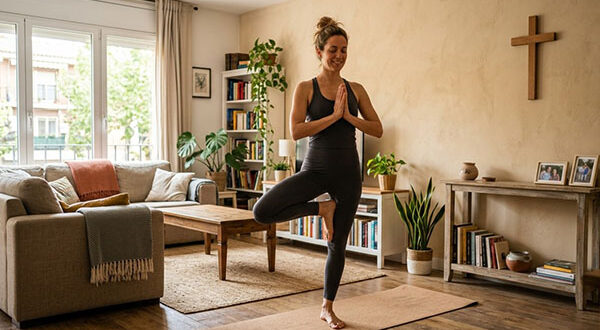
We live in an age marked by stress, anxiety, mental exhaustion, and the constant search for well-being. In the midst of this reality, millions of people turn to practices that promise inner balance, relaxation, and physical health. Among them, yoga occupies a privileged place. It is offered in gyms, schools, companies, mobile apps, and even in environments that seem compatible with Christian spirituality.
Many Catholics sincerely ask themselves:
Is practicing yoga a sin?
Can a Christian practice yoga simply as physical exercise?
Is there a real spiritual danger, or are these merely exaggerations?
Where is the line between bodily stretching and openness to practices incompatible with the Catholic faith?
This is not a superficial issue. We are not merely talking about gymnastics. We are speaking about a practice with deep religious and philosophical roots. Precisely for this reason, discernment must be carried out with serenity, knowledge, and fidelity to the truth.
This article does not seek to fuel irrational fears or simplistic condemnations. Nor does it aim to downplay the real dangers involved. Its purpose is to offer a clear, profound, and pastorally useful guide for Catholics who wish to live their faith fully in a world that is becoming increasingly spiritually confused.
What Is Yoga Really?
The word “yoga” comes from the Sanskrit yuj, meaning “union.” But originally this was not about muscular or psychological union, but spiritual union.
Yoga arose within the religious context of ancient India, especially linked to Hinduism, although it later also influenced certain Buddhist and esoteric currents. Its traditional purpose was not fitness or relaxation, but the attainment of altered states of consciousness and spiritual liberation (moksha) through bodily, breathing, and meditative techniques.
In the West, yoga is often presented as a neutral practice reduced to:
- stretching,
- breathing,
- relaxation,
- posture improvement,
- stress management.
However, historically, yoga cannot be completely separated from its original religious worldview. The postures (asanas), breathing techniques (pranayama), and certain forms of meditation were integrated into a spiritual path directed toward an understanding of God, the soul, and the universe that is very different from the Christian faith.
And here the first fundamental point emerges.
The Central Problem: Not Every Spirituality Leads to God
We live in a culture where people constantly repeat that “all spiritualities are the same” or that “what matters is feeling good.” But Christianity has never taught this.
The Catholic faith proclaims that Jesus Christ is not “just another spiritual teacher,” but the Son of God made man, the only Savior of the world.
Our Lord said clearly:
“I am the way, and the truth, and the life; no one comes to the Father except through Me.”
— John 14:6
The problem with yoga is not merely physical. The true discernment revolves around its spiritual and anthropological dimension.
Many forms of yoga are based on ideas incompatible with the Christian faith, such as:
- pantheism (“everything is god”),
- the dissolution of the person into the absolute,
- reincarnation,
- self-salvation,
- the divinization of the self,
- the search for enlightenment apart from Christ.
These ideas deeply contradict Christian revelation.
The Body in Christianity: A Different Vision
The Church does not despise the body. Quite the contrary.
Christianity affirms the immense dignity of the human body because:
- it was created by God,
- the Son of God assumed a human body,
- Christ rose bodily from the dead,
- we too shall rise bodily.
Saint Paul teaches:
“Do you not know that your body is a temple of the Holy Spirit?”
— 1 Corinthians 6:19
For this reason, caring for physical health is good and legitimate. Physical exercise can even be a form of Christian responsibility.
The Church does not condemn stretching, conscious breathing, or postural exercises in themselves. The problem arises when these practices become vehicles for spiritualities foreign to the Gospel.
Here it is important to avoid two extremes.
1. Naive Relativism
This consists in thinking:
- “Everything is the same.”
- “It doesn’t matter.”
- “All religions teach the same thing.”
This approach ignores spiritual reality.
2. Irrational Fear
This consists in thinking that any bodily stretching is automatically demonic.
That is not correct either.
The Church calls for prudent discernment, not paranoia.
Can Yoga Be Separated from Its Spiritual Dimension?
Here we find the heart of the debate.
Some argue that it can: that certain postures may be practiced purely as gymnastics.
Others believe that the postures and techniques are so closely tied to a specific spirituality that they should not be used at all.
Pastoral reality requires a nuanced response.
There Are Different Types of Yoga
Not everything today called “yoga” contains the same content.
There are forms that are clearly religious and spiritual, including:
- mantras,
- invocations,
- Eastern meditation,
- “chakra” opening,
- spiritual energies,
- mental emptying techniques.
These practices are incompatible with Catholic spirituality.
But there are also highly secularized classes consisting almost entirely of:
- mobility,
- flexibility,
- athletic breathing,
- muscular relaxation.
Here discernment must consider:
- intention,
- context,
- the actual content,
- spiritual impact,
- the person’s doctrinal formation.
The Real Spiritual Risks
Although many people enter yoga simply seeking relaxation, it should not be ignored that some practices can open the door to profound spiritual confusion.
1. Mental Emptying
Some forms of yoga teach people to “empty the mind” or dissolve thought.
Christian prayer does not consist in annihilating consciousness, but in entering into a loving relationship with God.
Christian spirituality seeks:
- contemplation,
- listening,
- adoration,
- union with Christ,
but never the disappearance of the self or impersonal absorption.
The Congregation for the Doctrine of the Faith warned against certain forms of meditation that can lead Christians toward ambiguous experiences detached from the faith.
2. The Cult of Energy
Many yoga environments constantly speak about:
- universal energies,
- vibrations,
- spiritual awakening,
- chakras,
- kundalini.
These ideas belong to religious and esoteric systems foreign to Christianity.
The Christian does not seek to manipulate “cosmic energies.” He seeks to live in the grace of God.
The Holy Spirit is not an impersonal energy. He is the Third Person of the Holy Trinity.
3. The Risk of Syncretism
Syncretism means mixing religions as though they were compatible.
Today many Catholics say:
- “I believe in Jesus, but also in chakras.”
- “I’m Catholic and I practice reiki.”
- “I go to Mass, but I also follow Eastern spiritualities.”
This creates enormous spiritual confusion.
Saint Paul warns:
“What fellowship has light with darkness?”
— 2 Corinthians 6:14
Christianity cannot be indiscriminately mixed with incompatible doctrines.
What Does the Catholic Church Say?
The Church has not issued a universal and absolute condemnation of every form of physical yoga. However, it has seriously warned about the doctrinal and spiritual dangers of certain Eastern practices.
An important document is:
“Letter to the Bishops of the Catholic Church on Some Aspects of Christian Meditation” (1989)
Published by the Congregation for the Doctrine of the Faith under Cardinal Joseph Ratzinger (the future Benedict XVI).
The document warns against methods of meditation that:
- reduce prayer to techniques,
- confuse psychological states with mystical experiences,
- seek mental emptiness,
- dilute the personal relationship with God.
The Church recognizes that certain bodily disciplines may contain useful elements, but insists that Christians must always preserve the centrality of Christ.
So… What Should a Catholic Do?
The answer requires spiritual honesty.
A Catholic should ask:
Why do I want to practice yoga?
- For health?
- Because it is fashionable?
- For spiritual searching?
- Because of anxiety?
- Because of inner emptiness?
What does the practice actually include?
- Are there mantras?
- Eastern meditation?
- Invocations?
- Talk about energies?
- Hindu religious symbolism?
- Promotion of alternative spirituality?
Is it affecting my faith?
- Does it distance me from Christian prayer?
- Does it create doctrinal confusion?
- Am I relativizing Christ?
- Am I beginning to believe ideas incompatible with the Gospel?
Healthy Alternatives for Catholics
Many people seek yoga because they need peace, rest, and balance. The problem is that the modern world has forgotten Christianity’s spiritual treasures.
The Church possesses an immense tradition of contemplation and inner harmony:
- Eucharistic adoration,
- silent prayer,
- lectio divina,
- the Rosary,
- Carmelite spirituality,
- peaceful breathing during prayer,
- pilgrimages,
- fasting,
- sacramental life.
There are also neutral physical alternatives:
- Pilates,
- stretching,
- functional mobility,
- physiotherapy,
- postural gymnastics.
Not all well-being needs to be wrapped in Eastern spirituality.
The Spiritual Emptiness of Our Age
The rise of yoga in the West reveals something profound: modern man is hungry for transcendence.
Technological society has produced:
- emotional exhaustion,
- individualism,
- anxiety,
- existential emptiness.
Many seek in yoga what is actually a thirst for God.
Saint Augustine wrote:
“You have made us for Yourself, O Lord, and our hearts are restless until they rest in You.”
No technique can replace grace.
No bodily posture can fill the human heart as Christ does.
Pastoral Discernment: Neither Naivety nor Fanaticism
Good pastoral guidance must avoid both exaggerated alarmism and superficial relativism.
Not everyone who practices yoga is engaging in occultism. Many simply seek relief from physical tension.
But it is also true that spiritual relativism can slowly lead to the loss of Christian identity.
That is why discernment is essential.
Christ Did Not Come to Teach a Technique, but to Save Us
This is the great difference.
Christianity is not a relaxation method.
It is not a technique for inner balance.
It is not spiritual self-help.
It is a real encounter with the living Jesus Christ.
The center of Christian life is not achieving a special mental state, but living in friendship with God.
Holiness is not born from controlling energies, but from opening the heart to grace.
A Decisive Question for Our Time
Perhaps the most important question is not merely:
“Can a Catholic practice yoga?”
But rather:
Are we seeking in human techniques what only God can give?
Because many times the deeper problem is not yoga itself, but the immense spiritual thirst of a society that has lost its sense of God.
And when the human heart stops worshipping the Creator, it inevitably searches for substitutes.
Conclusion: Prudence, Discernment, and Fidelity to Christ
A Catholic must act with prudence and proper formation.
If a yoga practice includes:
- Eastern spirituality,
- religious relativism,
- mantras,
- energies,
- mental emptying,
- doctrines incompatible with the faith,
it should be avoided.
If it is simply a matter of physical exercises stripped of spiritual content, discernment may be more open, provided there is no doctrinal confusion or harm to one’s faith.
But Christians must never forget one fundamental truth:
Christ is enough.
The deepest peace does not come from a bodily posture, but from communion with God.
Jesus said:
“Peace I leave with you; My peace I give to you. Not as the world gives do I give to you.”
— John 14:27
That peace cannot be bought, cannot be learned in a course, and does not depend on secret techniques.
It is the fruit of the Holy Spirit in a soul that lives close to God.
And that remains, today as two thousand years ago, the true answer to the weariness of the human heart.