
Related Articles


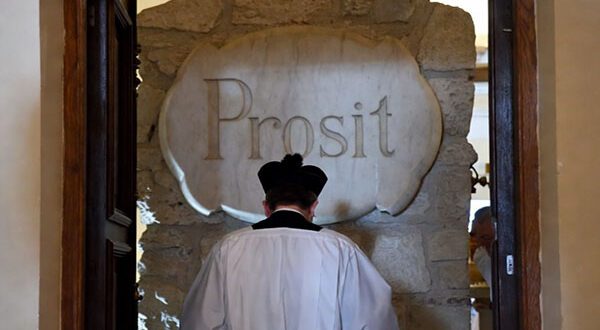
In the quiet silence of the sacristy, when the bustle of the celebration has faded and the priest slowly removes the sacred vestments, there is a brief word—almost whispered—that has echoed through the centuries: “Prosit.”
It may seem like a simple formality, a ritual expression without much importance. Yet, as so often happens in the Church’s liturgy, what is small conceals something immense, and what is simple reveals the eternal. This word, spoken at the end of Holy Mass, opens a window into a deep spirituality, rich with theological meaning and filled with lessons for everyday Christian life.
1. What does “Prosit” really mean?
“Prosit” is a Latin word that literally means: “may it be beneficial,” “may it do good,” “may it bear fruit.”
It is not just a farewell. It is not a simple “see you later” or a polite expression. At its core, it is an implicit blessing, a prayer condensed into a single word.
When the priest pronounces it—traditionally while removing his vestments after Mass—he is expressing something far deeper:
May the sacrifice offered be fruitful.
May the grace received transform life.
May what has been celebrated not remain at the altar, but continue in the soul.
It is a word directed first of all to himself or to other priests present. But its spiritual resonance extends to all the faithful.
2. Historical roots: a tradition born from the heart of the liturgy
To understand “Prosit,” we must place it within the context of the Church’s traditional liturgy. For centuries, Mass did not simply end with the “Ite, missa est,” but continued in a moment of recollection in the sacristy.
There, the priest—aware that he had acted in persona Christi—did not consider himself the author of the mystery, but a humble instrument. For this reason, as he removed his vestments, he recited prayers of thanksgiving.
It is in this context that “Prosit” appears—not as a superficial addition, but as a natural expression of priestly spirituality:
- The Mass is not an isolated act, but a source of ongoing grace.
- What has been celebrated must produce fruit.
- The life of both priest and faithful must be transformed by the Eucharistic sacrifice.
Thus, “Prosit” becomes a kind of final echo of the sacrifice, a seed planted in the soul after the celebration.
3. Theological depth: the fruit of the Sacrifice
From a theological perspective, this small word is filled with meaning.
The Holy Mass is not merely a remembrance, but the actualization of Christ’s sacrifice. And like every true sacrifice, it bears fruits:
- General fruit: for the whole Church.
- Special fruit: for those who participate with faith.
- Ministerial fruit: for the priest.
- Particular fruit: for the specific intention offered.
When the priest says “Prosit,” he is, in a certain sense, invoking that these fruits may be fully realized.
It is an implicit affirmation of a fundamental truth:
grace must be received in order to bear fruit.
It is not enough to attend Mass. It is not enough to fulfill an obligation. Grace must penetrate, transform, and make fruitful.
4. A word that challenges us: does Mass “benefit” me?
Here is where “Prosit” ceases to be merely a priestly formula and becomes an existential question.
After every Mass, we might ask ourselves:
- Has the Eucharist borne fruit in me?
- Have I come away transformed, or merely satisfied?
- Have I allowed Christ to act in my life?
Because there is a real danger in the Christian life: becoming accustomed to the sacred.
One can attend Mass every Sunday… and remain unchanged.
One can receive Communion frequently… and not convert one’s heart.
One can hear the Word… and not allow it to challenge us.
“Prosit” breaks that spiritual routine. It reminds us that Mass is not something that ends, but a mission that begins.
5. Practical applications: living “Prosit” every day
This word can become a true spiritual guide for daily life. How?
1. Prolong the Mass in daily life
The Eucharist does not end in the church. It continues in:
- our work,
- our family life,
- our daily decisions.
To live “Prosit” is to ask:
How do I bring Christ into the concrete realities of my life?
2. Make an examination after Mass
A simple habit can transform one’s spiritual life:
- What has God said to me today?
- What must I change?
- What grace have I received?
In this way, Mass ceases to be routine and becomes a transforming encounter.
3. Offer concrete fruits
Each Mass can produce visible fruit:
- forgiving someone,
- renouncing a sin,
- helping someone in need,
- living with greater charity.
“Prosit” becomes real when grace turns into action.
4. Recover the sense of the sacred
In a fast-paced world where everything is trivialized, this word invites us to rediscover the mystery:
- Mass is not a social event,
- it is not a spectacle,
- it is the greatest act that takes place on earth.
And therefore it deserves recollection, silence, and gratitude.
6. A lesson for our time
We live in an age marked by haste, superficiality, and a lack of interior life. Everything passes quickly, everything is consumed, everything is forgotten.
Against this, “Prosit” proposes a radically different spirituality:
- interior rather than superficial,
- fruitful rather than sterile,
- transformative rather than routine.
It is an invitation not to live the faith as a habit, but as a living encounter with Christ.
7. Conclusion: a small word, an immense mission
“Prosit” is brief, almost invisible. Yet it contains one of the most important truths of the Christian life:
God’s grace is not meant merely to be received… but to bear fruit.
Each Mass is a divine seed planted in the soul.
Each Communion is Christ who desires to live within us.
Each celebration is an opportunity for conversion.
The next time you think about the end of Mass, remember this word.
Let it echo within you as a prayer:
“Lord, may what I have received today… bear fruit in my life.”
That is the true meaning of “Prosit.”
And, in the end, it is also the meaning of the entire Christian life.