Related Articles

Christ Already Won Your Salvation… But You Must Receive It.
There is a fundamental truth of Christianity that many people know in a superficial way, but few understand in all its depth: Christ has already redeemed the world.
Yes, salvation has already been obtained.
However — and here lies one of the most important mysteries of Christian theology — not everyone is saved automatically.
Why?
Because salvation has two inseparable dimensions that Catholic theology distinguishes with great precision:
- Objective Redemption
- Subjective Redemption
This distinction, developed in soteriology (the branch of theology that studies salvation), allows us to understand something essential:
Christ obtained salvation for all, but each person must freely receive it.
This article is a deep guide to understanding this mystery:
what it means, where it comes from, how the Church explains it, and above all how to live it today in your spiritual life.
1. The Great Drama of Humanity: Sin and the Need for Redemption
To understand redemption, we must first understand what we are redeemed from.
Human history begins with a spiritual tragedy: the fall of man.
In the account of Genesis, the disobedience of Adam and Eve introduces into the world:
- sin
- death
- separation from God
- the corruption of human nature
From that moment on, man cannot save himself.
Saint Paul explains this clearly:
“All have sinned and fall short of the glory of God.”
(Romans 3:23)
Humanity as a whole becomes trapped in an impossible situation:
- God is holy
- man is sinful
- divine justice demands reparation
- man does not have the capacity to offer it
A divine intervention was necessary.
And that intervention has a name:
Jesus Christ.
2. Christ: The Redeemer of the World
Christianity is not simply a moral doctrine or a spiritual philosophy.
It is the story of a real redemption.
God does not send only teachings.
God sends His Son.
In the Incarnation something radical happens:
God enters human history.
The eternal Son becomes man in order to fulfill a mission:
to save humanity through His sacrifice.
Jesus Himself affirms it:
“For the Son of Man came not to be served but to serve, and to give his life as a ransom for many.”
(Mark 10:45)
This redemptive sacrifice culminates in three inseparable events:
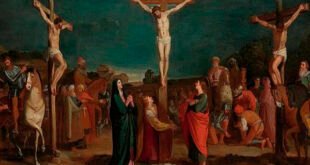
- the Passion
- the Death
- the Resurrection
Here begins what theology calls objective redemption.
3. Objective Redemption: Salvation Has Already Been Accomplished
Objective redemption is the saving work that Christ accomplished once and for all.
It is the historical and supernatural event through which humanity was reconciled with God.
It includes primarily:
- the Passion of Christ
- His death on the cross
- His redemptive sacrifice
- His glorious resurrection
On the cross, Christ offers the Father a perfect sacrifice.
Saint Peter describes it this way:
“You were ransomed… not with perishable things such as silver or gold, but with the precious blood of Christ.”
(1 Peter 1:18–19)
Redemption is objective because it exists independently of us.
Christ has already accomplished the work.
It does not depend on whether someone believes or not.
The cross remains the center of the history of the universe.
That is why the liturgy proclaims:
“Mysterium fidei.”
The mystery of faith.
Humanity has been redeemed objectively.
But a decisive question still remains:
If Christ already redeemed the world…
why are not all saved?
4. Subjective Redemption: When Salvation Reaches Your Soul
Here the second dimension of the mystery appears:
subjective redemption.
If objective redemption is the work of Christ,
subjective redemption is the application of that work to each concrete person.
In other words:
Christ opened the fountain of salvation,
but each soul must drink from that fountain.
Saint Augustine expressed this idea with a famous phrase:
“God who created you without you will not save you without you.”
God radically respects human freedom.
For that reason salvation is offered, but it must be received.
Subjective redemption occurs mainly through:
- faith
- the sacraments
- the life of grace
- personal conversion
5. The Sacraments: Channels of Redemption
The Church teaches that Christ’s redemption reaches each person through the sacraments.
The sacraments are not merely symbols.
They are real instruments of grace.
Christ willed that His saving work would continue in time through them.
For example:
Baptism
It applies redemption to the person by removing original sin.
Saint Paul explains it this way:
“We were buried therefore with him by baptism into death, so that as Christ was raised from the dead… we too might walk in newness of life.”
(Romans 6:4)
Confession
When a Christian falls into sin, redemption is applied again through the sacrament of reconciliation.
The Eucharist
It is the sacrifice of Christ made sacramentally present.
In every Mass the redemptive sacrifice is made present.
For this reason the Church teaches that the Eucharist is:
“the source and summit of the Christian life.”
6. Faith: Opening the Heart to Salvation
Subjective redemption also requires faith.
It is not enough that Christ died for us.
It is necessary to believe in Him.
The Gospel expresses this clearly:
“He who believes in the Son has eternal life.”
(John 3:36)
Faith is not only an idea.
It is:
- trusting in Christ
- accepting His salvation
- following His path
Without faith, redemption remains like a treasure not received.
7. The Life of Grace: Remaining in Redemption
Salvation is not only a moment.
It is a path.
The Christian life consists of remaining in the grace of Christ.
This implies:
- avoiding mortal sin
- living in friendship with God
- growing in holiness
Jesus explains it with a powerful image:
“I am the vine, you are the branches; he who abides in me bears much fruit.”
(John 15:5)
Separated from Christ, the branch dries up.
United to Him, it produces life.
8. A Modern Error: Believing That Everyone Is Automatically Saved
One of the great spiritual errors of our time is to think that:
“God is good, so everyone will be saved.”
This thought ignores the distinction between objective and subjective redemption.
Christ died for all.
But salvation must be received.
Jesus Himself warns:
“Enter by the narrow gate.”
(Matthew 7:13)
Grace is offered to all,
but not everyone accepts it.
Human freedom remains real.
9. The Mission of the Church: Applying Redemption
The Church exists precisely to extend subjective redemption to the world.
Christ obtained salvation.
The Church distributes it.
She does this through:
- the preaching of the Gospel
- the sacraments
- the life of holiness
- the missionary mission
That is why Christ sent the apostles saying:
“Go into all the world and preach the Gospel.”
(Mark 16:15)
Evangelization is not proselytism.
It is inviting souls to receive the salvation already obtained by Christ.
10. Practical Applications: Living Redemption Today
Understanding this distinction profoundly changes spiritual life.
Because it reveals something astonishing:
Christ has already won your salvation.
But you must live in it.
Some concrete practices help us do this.
1. Live in a state of grace
Avoid grave sin and go to confession when you fall.
2. Participate in the Eucharist
The Mass is the place where redemption becomes present.
3. Cultivate faith
Prayer, reading the Gospel, and Christian formation.
4. Cooperate with grace
Holiness is cooperation between God and man.
11. A Simple Image to Understand Everything
Imagine that a doctor discovers the cure for a deadly disease.
The medicine exists.
It is available.
But a person is only healed if he takes it.
The cross is the medicine.
The sacraments are the way to receive it.
Faith is opening the hand.
The life of grace is allowing that medicine to transform the entire spiritual organism.
12. The Greatest Mystery in History
Redemption is the heart of Christianity.
Christ died and rose again.
The universe changed forever.
But the spiritual drama of each person remains open:
Will you accept that salvation?
The cross has already been raised.
The fountain of grace remains open.
The final question is not whether Christ saved the world.
The question is far more personal.
Are you living in that salvation?
Because redemption is not only a doctrine.
It is a new life.
And it begins each day when a soul decides to respond to the love of the Redeemer.