Related Articles
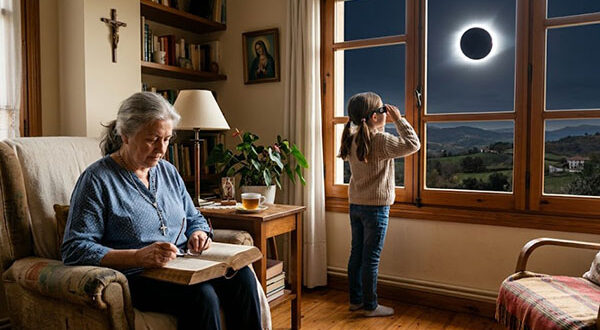
There are natural phenomena that, even when science can explain exactly how they work, continue to awaken a profound sense of wonder within us. An eclipse is one of them. For a few moments, something that seemed unchanging before our eyes suddenly changes: daylight takes on a strange darkness, the Sun seems to disappear, and the landscape becomes enveloped in an unusual light.
It is therefore not surprising that since ancient times human beings have looked upon eclipses with fear, wonder, and religious meaning.
Sacred Scripture also speaks of the darkness of the Sun, of the Moon losing its brightness, and of celestial signs accompanying certain decisive moments in salvation history.
But here we must make an important clarification from the very beginning: the Bible does not teach that every eclipse is a portent, an immediate divine punishment, or a direct sign of the end of the world.
The biblical perspective is much deeper.
For the Catholic faith, the stars are creatures of God. An eclipse is not a coded message that we must decipher superstitiously, but an event within creation that, in the light of Revelation, can become a privileged opportunity to contemplate God’s power, remember our own littleness, and lift our hearts toward Christ.
And precisely today, when eclipses once again occupy headlines, social media, and conversations—including the total solar eclipse of August 12, 2026, whose path reaches certain areas of the Northern Hemisphere—it is worth asking ourselves: What does the Bible really say about eclipses?
1. The Sun, the Moon, and the Stars Belong to God
The first key to understanding any biblical reference to celestial phenomena is found in Genesis.
“God made the two great lights: the greater light to rule the day, and the lesser light to rule the night; and the stars.”
(Genesis 1:16)
This statement is extraordinarily important.
In many ancient religions, the Sun, Moon, and stars were associated with deities. The heavenly bodies could be worshipped, feared, or regarded as supernatural powers.
The Bible radically breaks with that mentality.
The Sun is not God.
The Moon is not a goddess.
The stars are not divine powers that govern our destiny.
They are creatures.
“God created.” That is the fundamental affirmation.
Therefore, a Christian can contemplate an eclipse with enormous admiration without falling into superstition. Precisely because he knows that what he is contemplating is not a divinity, but a creature that indirectly manifests the greatness of its Creator.
An eclipse can thus become a small cosmic catechesis: creation is great, but the Creator is infinitely greater.
Science explains how an eclipse occurs: during a solar eclipse, the Moon passes between the Sun and the Earth; during a lunar eclipse, the Earth comes between the Sun and the Moon. The extraordinary precision with which these phenomena can be predicted demonstrates precisely that the universe possesses an intelligible order. (NASA Science)
The scientific explanation, therefore, does not necessarily eliminate religious wonder.
It can increase it.
2. Do Eclipses Really Appear in the Bible?
Here we must distinguish between eclipses in the strict astronomical sense and the biblical language of cosmic darkness.
The Bible frequently uses images associated with the darkening of the Sun, Moon, and stars.
One of the best-known passages appears in the prophet Amos:
“And on that day, declares the Lord God, I will make the sun go down at noon and darken the earth in broad daylight.”
(Amos 8:9)
At first sight, we might immediately think of a solar eclipse.
However, we must be careful.
Prophetic language does not function like a modern astronomy textbook. The prophets use cosmic imagery to express God’s intervention in history, especially His judgment upon sin.
The darkening of the Sun represents the arrival of a moment of profound upheaval.
The message is not: “When you see an eclipse, know that God is punishing someone.”
The message is much more serious:
man may live as though God does not exist, but the moment will come when he must confront the truth.
3. Joel: The Sun Will Be Darkened and the Moon Will Turn to Blood
Another fundamental text appears in the prophet Joel:
“The sun shall be turned to darkness, and the moon to blood, before the coming of the day of the Lord, the great and terrible day.”
(Joel 3:4)
This expression is especially interesting because it reappears in the New Testament.
Saint Peter quotes it in his speech at Pentecost:
“The sun shall be turned to darkness and the moon to blood, before the day of the Lord comes, the great and glorious day.”
(Acts 2:20)
And the Book of Revelation uses similar imagery:
“The sun became black as sackcloth, and the full moon became like blood.”
(Revelation 6:12)
Here we encounter a fundamental question for the modern reader.
Is the Bible literally talking about eclipses?
The Catholic answer requires prudence.
Sacred Scripture frequently uses cosmic language to describe eschatological events and extraordinary manifestations of God’s power. The darkened Sun, the blood-red Moon, and falling stars belong to a powerful symbolic language.
We should not turn every eclipse that appears on our astronomical calendar into a fulfilled prophecy.
That would mean abandoning the Christian interpretation of Scripture and entering the realm of superstition.
4. And What Happened at the Death of Jesus Christ?
Here we find the most striking passage of all.
The Synoptic Gospels describe an extraordinary darkness during the Crucifixion.
Saint Matthew writes:
“Now from the sixth hour there was darkness over all the land until the ninth hour.”
(Matthew 27:45)
Saint Mark likewise refers to the three hours of darkness.
And Saint Luke says:
“It was now about the sixth hour, and there was darkness over the whole land until the ninth hour, while the sun’s light failed.”
(Luke 23:44-45)
We are confronted here with one of the most fascinating biblical passages related to astronomy.
But precisely here we must avoid a very common confusion.
Was It an Ordinary Solar Eclipse?
We cannot simply identify the darkness of the Crucifixion with a conventional solar eclipse.
The reason is both astronomical and liturgical.
Jesus died during the Jewish Passover celebration, which took place around the time of the full Moon. A solar eclipse can occur only around the new Moon, when the Moon is positioned between the Earth and the Sun. (NASA Science)
Therefore, three hours of darkness during the Crucifixion cannot simply be explained as an ordinary solar eclipse.
This is important.
The Christian faith does not need to distort astronomy in order to defend the Gospel.
On the contrary: it can fully acknowledge the scientific reality while at the same time affirming the extraordinary character of what the Gospels narrate.
5. Then What Does the Darkness of the Crucifixion Mean?
Here we enter the heart of theology.
The darkness surrounding Calvary is not merely a meteorological phenomenon.
The Gospels present Christ’s death as a cosmic event.
The Creator is being rejected by His creature.
The Author of life is nailed to a Cross.
The One who said:
“Let there be light”
at the beginning of creation now appears surrounded by darkness.
We are not dealing with a mere literary coincidence.
Christian tradition has always contemplated the darkness of Calvary as a profoundly theological sign.
The universe seems to fall silent before the death of the Son of God.
The earth trembles.
The rocks split.
The veil of the Temple is torn.
And darkness covers the scene of the Crucifixion.
All creation seems to respond to the drama of its Creator.
6. And What About the “Moon Turned to Blood”?
Here we encounter another point that in recent years has generated enormous interest.
Astronomical calculations indicate that a lunar eclipse may have been visible from Jerusalem on April 3 in the year 33, one of the dates proposed for the Crucifixion. NASA notes that Christian references to the Moon becoming “like blood” could be related to a lunar eclipse, since during such phenomena the Moon can take on a reddish hue. (NASA Science)
This is interesting, but it must be stated correctly.
It does not mean that NASA has demonstrated that Jesus Christ died precisely on April 3, AD 33.
Astronomical calculations can help us study possible historical dates, but they do not automatically turn a chronological hypothesis into a dogma of faith.
And, above all, we must not confuse a lunar eclipse with the darkness described during the central hours of the Crucifixion.
A lunar eclipse occurs when the Earth casts its shadow upon the Moon and can occur only at full Moon. A solar eclipse occurs during a new Moon. (NASA Science)
Therefore, a possible reddish Moon at sunset and the darkness lasting several hours during the Crucifixion are two different matters.
Astronomy can illuminate certain historical aspects.
But the ultimate meaning of the Crucifixion belongs to theology.
7. Joshua and the Sun That “Stood Still”
There is another biblical passage frequently associated with eclipses.
In Joshua 10:12-13 we read:
“Sun, stand still at Gibeon, and moon, in the Valley of Aijalon.”
The text continues by saying that the Sun stood still and the Moon remained.
Throughout the centuries, various interpretations have been proposed, and attempts have also been made to connect this episode with particular historical eclipses. Some modern astronomical studies have proposed specific candidates, but these identifications remain debated and do not constitute a binding interpretation of the biblical text. (arXiv)
Here again, we must begin with theology.
The principal purpose of the account is not to teach celestial mechanics.
Its purpose is to show God’s extraordinary intervention on behalf of His people.
The Bible was not written to answer the questions found in a modern astronomy textbook.
It was written to reveal who God is and what His relationship with man is.
8. Eclipses Are Not Christian Horoscopes
This point is especially necessary in our own time.
Whenever an eclipse approaches, all kinds of interpretations appear on the internet:
“It is a sign of the Apocalypse.”
“God is announcing a punishment.”
“This eclipse proves that we are living in the last days.”
“The Bible predicted this exact event.”
The problem is that many of these claims combine biblical fragments, numerology, astrology, conspiracy theories, and personal speculation.
That is not Catholicism.
The Church teaches us to avoid superstition and every form of divination.
The Christian does not consult the stars to discover his destiny.
He looks to Christ.
This distinction is fundamental.
Astrology asks:
“What do the stars tell me about my future?”
The Christian faith asks:
“What is God asking of me today?”
These are two radically different attitudes.
9. Christ Is the True Light
And here we find the most beautiful spiritual key.
The Bible begins with the creation of light:
“And God said, ‘Let there be light,’ and there was light.”
(Genesis 1:3)
And Saint John’s Gospel presents Christ as the true Light:
“The true light that gives light to everyone was coming into the world.”
(John 1:9)
For this reason, it is deeply meaningful to contemplate an eclipse from a Christian perspective.
For a few moments, the Sun seems to disappear.
But Christ does not disappear.
Circumstances may become dark.
Society may pass through crises.
Culture may move away from God.
We may experience doubts, suffering, losses, and moments of spiritual darkness.
But the absence of light in our experience does not mean that God has ceased to be the Light.
There is a difference between our inability to see and God having ceased to exist.
The eclipse can thus become a spiritual parable.
Sometimes the light is temporarily hidden.
But the light continues to exist.
10. An Eclipse as a Call to Humility
We live in an age extraordinarily confident in its own abilities.
Modern man can predict eclipses with impressive precision. He can calculate their paths, determine their times, and know with remarkable accuracy where they will be visible.
And all of this is admirable.
But precisely because of this, it should lead us to humility.
For the more we understand the universe, the more impressive its greatness becomes.
Scientific knowledge does not necessarily have to lead us to atheism.
It can also lead us to a much deeper question:
Why is there an ordered universe that we are capable of understanding?
Contemplating the cosmos can become an invitation to pray with the Psalm:
“The heavens declare the glory of God, and the sky above proclaims his handiwork.”
(Psalm 19:1)
The eclipse is not God.
But it can remind us of God.
11. What Should We Do Spiritually When Faced with an Eclipse?
A Catholic can take advantage of an event such as this to stop for a few minutes and recover an attitude that our society has largely lost: contemplation.
Instead of merely taking photographs for social media, we can ask ourselves:
Who created all of this?
What place does God truly occupy in my life?
Am I living as though God really exists?
What things are eclipsing Christ in my soul?
This last question can be especially fruitful.
Because there is an eclipse much more dangerous than any astronomical phenomenon: the spiritual eclipse of God within the human heart.
Not because God ceases to exist.
But because we allow other things to occupy the place that belongs to Him alone.
Money can eclipse God.
Success can eclipse God.
Politics can eclipse God.
Social media can eclipse God.
Comfort can eclipse God.
Even our own worries can eclipse God.
And then we need to hear Christ’s words again:
“Seek first the kingdom of God and his righteousness.”
(Matthew 6:33)
12. An Eclipse Can Also Teach Us to Wait
There is something particularly beautiful about an eclipse.
We know that the darkness has a limit.
We know that the light will return.
This reality can become a beautiful image of Christian life.
There are moments when God allows us to pass through periods of trial, silence, or suffering.
Saint Teresa of Ávila, Saint John of the Cross, and so many other saints knew the experience of spiritual darkness.
But the night does not have the final word.
For the Christian, the final word belongs to the risen Christ.
The history of salvation passes through the Cross, but it does not end at the Cross.
After Good Friday comes Easter Sunday.
After darkness comes light.
And this has enormous pastoral importance for anyone who is currently going through a difficult time.
Perhaps today you do not understand what God is permitting.
Perhaps you feel that the heavens have grown dark.
Perhaps you cannot find answers.
But remember:
the fact that you cannot see the Sun does not mean that the Sun has disappeared.
And, spiritually speaking, the fact that you do not immediately perceive God’s action does not mean that God is absent.
13. We Should Not Be Afraid of the Heavens: Let Us Contemplate Their Creator
Catholic tradition has never needed to fear creation.
The Church has contemplated the heavens, studied the stars, and cultivated the sciences.
Astronomy and faith do not have to be enemies.
The problem arises when we turn creation into a substitute for the Creator.
An eclipse can be studied scientifically and, at the same time, contemplated spiritually.
We can understand its physical cause and simultaneously lift our hearts toward God.
We can know exactly when it will begin and end and, at the same time, remember that our existence rests in the hands of Providence.
Science explains how an eclipse occurs.
Faith helps us ask what spiritual good can come from contemplating it.
14. The Great Question Is Not When the Next Eclipse Will Be
Ultimately, the Bible leads us far beyond the astronomical phenomenon.
The prophets speak of darkened heavens to remind us that human history is subject to God’s judgment.
The Gospels describe the darkness of Calvary to reveal the mystery of Christ’s redeeming death.
Revelation uses cosmic images to announce that history has an end and that Christ is Lord of history.
And Genesis reminds us that everything began because God said:
“Let there be light.”
Therefore, the truly Christian question is not:
“What does this eclipse mean for my future?”
The question is:
“What does Christ mean for my life?”
The eclipse will pass.
The shadow will pass.
The astronomical event will remain recorded in books, photographs, and scientific archives.
But Christ remains.
As the Letter to the Hebrews says:
“Jesus Christ is the same yesterday and today and forever.”
(Hebrews 13:8)
Conclusion: When the Heavens Grow Dark, Let Us Lift Our Eyes Toward God
Eclipses can impress us because for a few moments they seem to alter the ordinary order of the world.
But the true Christian lesson does not consist in searching for hidden messages or feeding fear of the end of the world.
It consists in lifting our eyes toward God.
Giving thanks for creation.
Rejecting superstition.
Remembering the Passion of Our Lord.
And asking for the grace that no creature—neither power, nor money, nor fame, nor technology, nor our worries—may succeed in eclipsing in our souls the One who said:
“I am the light of the world. Whoever follows me will not walk in darkness, but will have the light of life.”
(John 8:12)
Because every eclipse ends.
But the Light of Christ never goes out.