Related Articles


We live in an age in which speed has often replaced contemplation, where screens have displaced books, and where beauty is frequently reduced to a matter of personal taste. Yet the Church has always understood that authentic beauty has a far higher mission: to lead the soul to God. It is not a luxury but a spiritual language.
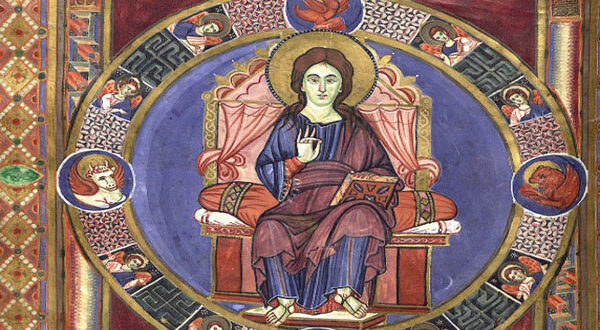
Among the most extraordinary works that bear witness to this truth is the Lorsch Codex Aureus, one of the most magnificent manuscripts in all of medieval Christendom. It is not merely an ancient book or an artistic treasure reserved for museums. It is a silent sermon that continues to proclaim, more than twelve hundred years later, that the Gospel deserves the very best that humanity can offer.
Its very existence confronts us with a profoundly relevant question:
What place does God occupy in our hierarchy of values?
If our forefathers clothed the Word of God in gold, how do we clothe it today?
What Is the Lorsch Codex Aureus?
The Latin name Codex Aureus literally means “Golden Book.”
It is a magnificent Gospel Book produced toward the end of the eighth century or the beginning of the ninth century, during the Carolingian Renaissance, most likely under the patronage of Charlemagne or within the cultural environment fostered by his court.
It bears the name “of Lorsch” because it belonged for centuries to the renowned Benedictine Abbey of Lorsch in Germany, one of the great spiritual and intellectual centers of medieval Europe.
Although its various parts are now preserved in different institutions, the manuscript is still regarded as one of the greatest masterpieces of Western Christian art.
Yet to reduce it merely to an artistic achievement would be to remain only on the surface.
In reality, the Codex Aureus is an act of worship.
A Time When Copying a Book Was a Form of Prayer
Today, all it takes is pressing a button to obtain thousands of books.
In the eighth century, reality was entirely different.
Every manuscript required years of labor.
The parchment had to be carefully prepared.
The inks had to be made.
Every letter had to be copied by hand.
Mistakes had to be corrected.
The pages had to be illuminated.
Gold leaf had to be applied.
Precious stones had to be worked.
Ivory covers had to be carved.
All of this was accomplished without printing presses.
Without electricity.
Without computers.
The monks carried out this work convinced that copying Sacred Scripture was itself a form of prayer.
They were not merely scribes.
They were servants of the Word of God.
Every stroke of the pen was an act of love.
Every decorated initial was a profession of faith.
Every page sought to glorify Christ.
That is why many medieval manuscripts conclude with humble petitions:
“Pray for the sinner who wrote this book.”
They sought neither fame nor recognition.
They sought salvation.
The Carolingian Renaissance: Rebuilding Europe Through the Gospel
After the fall of the Roman Empire, Europe passed through difficult centuries.
The invasions had destroyed schools.
Libraries.
Centers of learning.
Much of classical knowledge was disappearing.
Then an extraordinary renewal emerged under the leadership of Charlemagne.
Far from merely strengthening political power, he understood that a true civilization could only be built upon truth.
To achieve this, priests had to be educated.
Schools had to be founded.
Books had to be copied.
The Bible had to be preserved.
The liturgy had to be spread.
The Church became the great cultural engine of Europe.
The monasteries became universities before universities even existed.
Within their walls, both classical culture and divine Revelation were preserved.
The Codex Aureus was born precisely within this immense effort to place Christ once again at the center of civilization.
Gold Was Not Luxury: It Was Theology
Many modern observers ask:
“Why so much gold?”
The answer reveals a profound understanding of the faith.
Gold possesses unique qualities.
It does not rust.
It never loses its brilliance.
It withstands the passage of time.
For this reason, since antiquity it has symbolized eternity.
When medieval artists used gold to decorate a Gospel Book, they were not trying to impress anyone.
They were proclaiming a truth:
The Word of God possesses infinite value.
No material is precious enough to express its dignity.
The same principle appears repeatedly throughout the Old Testament.
The Ark of the Covenant was overlaid with gold.
The Temple of Jerusalem used immense quantities of gold.
The sacred vessels were made of precious materials.
Not because God needed riches.
But because man needed to express outwardly the honor due to his Creator.
Beauty as a Means of Evangelization
Saint Augustine wrote:
“Late have I loved You, Beauty ever ancient, ever new.”
This is no coincidence.
Beauty touches dimensions of the soul that reasoning alone often cannot reach.
For centuries, millions of illiterate people learned the faith by contemplating images.
The stained-glass windows.
The frescoes.
The sculptures.
The illuminated manuscripts.
Everything taught.
Everything spoke.
Everything catechized.
The Codex Aureus belongs precisely to this great tradition.
Its miniatures were not merely illustrations.
They were genuine visual catechesis.
Every color.
Every symbol.
Every figure.
Every gesture.
Everything pointed toward Christ.
The Gospel Deserves the Very Best
There is a profoundly important lesson that has largely been forgotten.
When Mary of Bethany poured costly nard upon the feet of Our Lord, some protested.
It seemed like a waste.
Yet Christ replied:
“She has done a beautiful thing to Me.” (Matthew 26:10)
The logic of love always appears excessive to those who think only in economic terms.
The same principle applies to the great churches.
The cathedrals.
The chalices.
The reliquaries.
The illuminated manuscripts.
These were not material investments.
They were acts of worship.
The Codex Aureus proclaims precisely this truth.
When it comes to God, the heart does not calculate.
It loves.
The Written Word as a Sacred Presence
For Christian tradition, the Bible is not merely another book.
We do not adore the paper.
But we deeply venerate Sacred Scripture because it contains divine Revelation.
Saint Jerome declared:
“Ignorance of Scripture is ignorance of Christ.”
Every time the Gospel is proclaimed during the Holy Mass, Christ Himself speaks to His Church.
For this reason, the Book of the Gospels occupies a privileged place upon the altar.
It is incensed.
It is kissed.
It is carried solemnly in procession.
All of this finds its historical continuation in works such as the Codex Aureus.
Its external beauty expresses the interior holiness of what it contains.
The Incarnation Also Sanctified Art
One of the deepest consequences of the Incarnation is that God assumed matter.
The eternal Son took on flesh.
He entered history.
He used human words.
Human hands.
A human voice.
For this reason, Christianity has never despised material beauty when it is directed toward God.
Christian art is born precisely from this mystery.
Wood can become a crucifix.
Stone can become a cathedral.
Ink can become the Gospel.
Gold can become praise.
All creation can become an instrument for glorifying its Creator.
The Spiritual Symbolism of the Covers
The extraordinary covers of the Codex Aureus possess a profoundly spiritual meaning.
Ivory represents purity.
Gold symbolizes heavenly glory.
The precious stones evoke the Heavenly Jerusalem described in the Book of Revelation.
Nothing was placed there by chance.
Everything serves a catechetical purpose.
The faithful understood that this book was not merely an object.
It was the visible proclamation of the Kingdom of God.
The Importance of Silence and Contemplation
It is significant that this manuscript was born within a monastery.
Silence was indispensable for its creation.
It could not have been produced amid noise.
Only a contemplative heart can create a contemplative work.
Our own age desperately needs to rediscover this truth.
We live saturated with information.
Yet poor in contemplation.
We know countless news stories.
But we meditate little on the Gospel.
We constantly consume images.
But we scarcely contemplate the face of Christ.
The Codex Aureus reminds us that beauty requires patience.
And so does holiness.
A Call for Our Own Time
Perhaps we will never possess a manuscript covered in gold.
But all of us can ask ourselves:
How lovingly do I treat my Bible?
Do I leave it forgotten on a shelf?
Do I read it only when I have problems?
Do I allow it to transform my life?
Many Christians own several Bibles.
Yet they know very little of what is written in them.
Paradoxically, we have greater access to Sacred Scripture than any previous generation, and yet we often read it less.
The Codex Aureus silently exposes this contradiction.
Beauty Will Save Man… If It Leads to Christ
The famous phrase often attributed to Dostoevsky is frequently quoted:
“Beauty will save the world.”
From a Christian perspective, however, the statement must be completed.
Not just any beauty.
Only the beauty that leads to God.
There is a superficial beauty that feeds pride.
But there is also sacred beauty that lifts the soul.
The Codex Aureus clearly belongs to this second category.
It does not seek admirers.
It seeks worshippers.
It does not aim to entertain.
It seeks conversion.
It does not glorify the artist.
It glorifies the Author of all beauty.
A Lesson for Families
Parents can learn a great deal from the Codex Aureus.
Children discover the value of faith by observing the place it occupies within the home.
A well-cared-for Bible.
A prayer corner.
A dignified crucifix.
An image of the Blessed Virgin.
Everything teaches.
Everything transmits.
Everything evangelizes.
Beauty within the home can also lead souls to God.
A Lesson for Priests and Communities
Parishes likewise receive an invitation.
The liturgy deserves dignity.
The vestments.
The sacred vessels.
The music.
The proclamation of the Gospel.
The silence.
The reverence.
This is not about luxury.
It is about expressing outwardly the greatness of the mystery being celebrated.
As Catholic tradition has always taught, the liturgy is a foretaste of Heaven.
And Heaven is never mediocre.
Sacred Scripture as Daily Nourishment
The Lord Himself reminds us:
“Man shall not live by bread alone, but by every word that proceeds from the mouth of God.” (Matthew 4:4)
And the Psalmist proclaims:
“Oh, how I love Your law! It is my meditation all the day.” (Psalm 119:97)
These words perfectly summarize the spirit of the Codex Aureus.
It is not enough to admire the Gospel.
We must live it.
It is not enough to preserve it.
We must obey it.
It is not enough to kiss it during the liturgy.
It must transform our daily decisions.
The True “Golden Book”
There is, finally, a profoundly spiritual lesson.
The true Golden Book is not merely the medieval manuscript.
The authentic Codex Aureus should be the heart of every Christian.
When sanctifying grace dwells within the soul, God writes His law there.
Saint Paul expresses this beautifully:
“You are a letter from Christ… written not with ink but with the Spirit of the living God, not on tablets of stone but on tablets of human hearts.” (2 Corinthians 3:3)
This statement sheds light on the entire meaning of the Codex Aureus. Magnificent though the manuscript may be, it points toward an even deeper reality: God does not merely desire that we preserve a sacred book, but that we allow His Word to be engraved upon our very lives.
Every page illuminated with gold reminds us of the light of Christ that seeks to dispel the darkness of sin. Every carefully copied letter speaks of the faithfulness with which the Lord has transmitted His Revelation throughout the centuries. Every precious stone set into its cover evokes the virtues that the Holy Spirit desires to make shine forth in the soul of every believer. And every sacred image invites us to contemplate the face of Him who is “the image of the invisible God” (Colossians 1:15).
In a world that produces millions of fleeting words every day, the Lorsch Codex Aureus continues to proclaim, through the silent splendor of gold and parchment, that there is one Word that never passes away. Fashions change, cultures evolve, and civilizations rise and fall, but the Gospel remains forever unchanged because it comes from God Himself.
We may never have the opportunity to behold this masterpiece of Christian art in person, but we can all embrace its message. Every time we open Sacred Scripture with faith, every time we listen attentively to the Gospel at Holy Mass, and every time we strive to live according to the will of God, we continue the work begun by those monks who, more than twelve centuries ago, patiently and lovingly copied the words of Christ.
The greatest tribute we can pay to the Lorsch Codex Aureus is not merely to admire its artistic beauty, but to allow the Word of God—more precious than the finest gold (cf. Psalm 19:10)—to enlighten our minds, strengthen our wills, purify our hearts, and lead us, step by step, toward holiness. Only then will we truly understand that the Church’s greatest treasure is not books covered in gold, but men and women who make the Gospel the rule of their lives and reflect, through their deeds, the glory of Him who is the Alpha and the Omega, the beginning and the end of all authentic beauty.