
Related Articles



There are few words in all of Sacred Scripture that move the human heart as deeply as these:
“My God, my God, why have you forsaken me?”
(Matthew 27:46)
Many Christians have read these words with confusion. Some wonder whether Jesus lost faith. Others believe that the Father truly abandoned His Son. There are even those who use this verse to claim that Christ experienced despair or that the Trinity was somehow broken during the Passion.
But is that really what happened?
Did God the Father abandon Jesus Christ?
Was Jesus expressing despair?
Or was He proclaiming something far deeper?
Understanding this passage correctly is not merely an academic matter. It is a fundamental teaching for every Christian who has ever felt alone, betrayed, misunderstood, or abandoned by God.
Because, in reality, this cry from the Cross speaks not only about Christ but also about us.
And it contains one of the most extraordinary revelations in the entire history of salvation.
The Most Dramatic Moment of the Passion
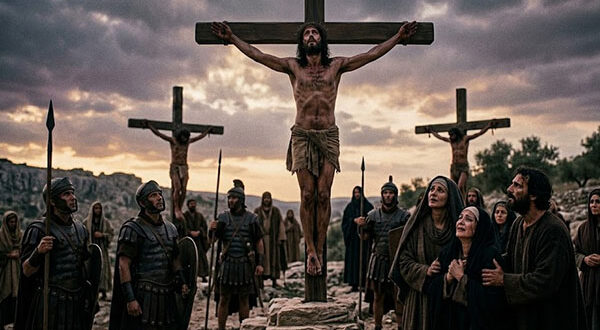
We find ourselves on Calvary.
After being betrayed, arrested, beaten, spat upon, scourged, and crowned with thorns, Jesus hangs nailed to the Cross.
The physical agony is indescribable.
Every breath requires an unbearable effort.
Blood pours from His wounds.
His muscles tear.
His heart is pushed to its limits.
But Christ’s suffering is not merely physical.
He has been abandoned by almost everyone.
Judas betrayed Him.
Peter denied Him.
The Apostles fled.
The priests mock Him.
The soldiers ridicule Him.
The crowd demands His death.
And in the midst of that darkness, Jesus utters these words:
“Eli, Eli, lema sabachthani.”
“My God, my God, why have you forsaken me?”
(Matthew 27:46)
At first glance, it appears to be a cry of despair.
But the Church has always taught that there is much more behind these words.
Jesus Is Quoting Psalm 22
Here we find the primary key to understanding this passage.
When Jesus pronounces these words, He is not improvising a complaint.
He is deliberately quoting the opening line of Psalm 22.
In Christ’s time, Jews identified the Psalms by their opening words, much as we identify a song by its first line.
By saying:
“My God, my God, why have you forsaken me?”
Jesus is pointing to the entirety of Psalm 22.
And when we read that Psalm in full, we discover something astonishing.
An Extraordinary Prophecy of the Passion
Psalm 22 was written approximately one thousand years before Christ.
Yet it describes with remarkable precision what would happen on Calvary.
For example:
“All who see me mock me.”
(Psalm 22:7)
That is exactly what happened at the Cross.
“They shake their heads and say:
He trusts in the Lord; let Him deliver him.”
(Psalm 22:8)
The enemies of Jesus repeated almost the exact same words.
“They have pierced my hands and my feet.”
(Psalm 22:16)
A striking description of crucifixion centuries before the Romans developed that method of execution.
“They divide my garments among them and cast lots for my clothing.”
(Psalm 22:18)
Exactly what the Roman soldiers did.
Jesus is not proclaiming defeat.
He is pointing to the fulfillment of a Messianic prophecy.
He is saying:
“What you are witnessing right now was foretold centuries ago.”
So Did God Abandon Christ?
The theological answer is clear:
No.
The Father never abandoned the Son.
The Holy Trinity cannot be divided.
The Father, the Son, and the Holy Spirit possess one divine nature.
The union among the Divine Persons is eternal and indestructible.
If the Father had truly abandoned the Son, the Trinity itself would have ceased to exist.
That is impossible.
For this reason, the Church has always rejected any interpretation suggesting a real rupture within the Trinity.
Then What Did Jesus Mean?
Here we enter one of the deepest mysteries of Christian theology.
Jesus is not saying that the Father stopped loving Him.
What He is expressing is the human experience of suffering carried to its absolute extreme.
Let us remember a fundamental truth:
Christ possesses two natures:
- True divine nature.
- True human nature.
As man, He genuinely experienced:
- hunger,
- fatigue,
- pain,
- sadness,
- anguish,
- suffering.
The Letter to the Hebrews teaches:
“He was tested in every way that we are, yet without sin.”
(Hebrews 4:15)
Therefore, Jesus chose to experience even that which so many of us experience:
the feeling of abandonment.
The Difference Between Feeling Abandoned and Being Abandoned
This distinction is crucial.
One thing is to feel abandoned.
Another thing entirely is actually to be abandoned.
Many saints experienced profound spiritual darkness.
It seemed that God had disappeared.
It seemed that Heaven was closed.
It seemed that their prayers were unheard.
Yet God remained present.
More present than ever.
The same is true on Calvary.
Jesus experiences in His humanity the deepest darkness imaginable.
Yet the Father remains united with Him.
The Trinitarian love remains intact.
Christ Bore the Weight of the World’s Sin
There is another dimension that is even deeper.
Saint Paul writes:
“For our sake He made Him to be sin who knew no sin.”
(2 Corinthians 5:21)
Of course, Christ never sinned.
What this means is that He took upon Himself the consequences of human sin.
All the misery of humanity.
All rebellion.
All injustice.
All violence.
All corruption.
All evil accumulated from Adam to the last human being.
Christ assumes that burden in order to redeem us.
And precisely because of this, He experiences an anguish that no human being can fully comprehend.
The New Adam Enters Where We Could Not Go
Since original sin, humanity has lived separated from God.
Human beings know spiritual exile.
They know distance.
They know the wound of sin.
Jesus descends into the very depths of that human condition.
Not because He is a sinner.
But because He came to rescue sinners.
As many of the Church Fathers taught:
Christ enters into our night in order to open the path to light.
He enters into our death in order to destroy it from within.
He enters into our abandonment so that we may never truly be abandoned.
The End of Psalm 22 Completely Changes the Meaning of the Passage
Many people know the first verse of Psalm 22.
Few know how it ends.
And there lies one of the most important keys.
The Psalm begins with suffering.
But it ends with victory.
It begins with anguish.
But it ends with hope.
It begins with apparent abandonment.
But it concludes with absolute trust.
The Psalmist proclaims:
“For He has not despised or scorned the suffering of the afflicted one;
He has not hidden His face from him
but has listened to his cry for help.”
(Psalm 22:24)
Notice the power of these words.
“He has not hidden His face from him.”
This is precisely the opposite of abandonment.
When Jesus quotes the beginning of the Psalm, He is also evoking its glorious conclusion.
The Cross points toward the Resurrection.
Suffering points toward victory.
Death points toward eternal life.
The Lesson for Those Who Believe God Has Abandoned Them
This passage is profoundly relevant today.
We live in an age of anxiety.
Depression.
Loneliness.
Family crises.
Economic uncertainty.
Spiritual emptiness.
Many people pray and feel that God does not answer.
They attend Mass and feel nothing.
They seek God and He seems distant.
In those moments, Christ’s words take on extraordinary power.
Because Jesus understands that experience perfectly.
He lived it from within.
But He also teaches us an essential truth:
our emotions do not always reflect spiritual reality.
You can feel alone without being alone.
You can feel abandoned without being abandoned.
You can experience darkness while God is silently at work in your soul.
The Dark Night of the Saints
Great saints experienced this reality.
Among them:
- Saint John of the Cross
- Saint Teresa of Calcutta
- Saint Teresa of Ávila
All of them went through periods of profound spiritual dryness.
They felt no consolation.
They felt no religious emotions.
They felt no sense of God’s closeness.
Yet it was precisely then that they were growing in holiness.
Authentic faith does not consist in feeling God.
It consists in remaining faithful when we do not feel Him.
The Cry That Saved the World
The words:
“My God, my God, why have you forsaken me?”
are not a cry of defeat.
They are a cry of redemption.
They do not express despair.
They express the fulfillment of Scripture.
They do not reveal a rupture between the Father and the Son.
They reveal how far God’s love was willing to go for humanity.
At that moment, Christ took upon Himself the entire tragedy of the human condition.
Every loneliness.
Every anguish.
Every feeling of abandonment.
And He carried it with Him to the Cross.
So that no human being could ever say:
“God does not know what I am suffering.”
Christ does know.
He knows it from within.
He experienced it personally.
And for that very reason, He is able to accompany us in our darkest nights.
Conclusion: When God Seems Silent
Perhaps today you are going through a trial.
Perhaps you have spent months praying without finding answers.
Perhaps you feel that God is far away.
Perhaps you identify with that cry from Calvary.
Then remember this:
Christ spoke those words before you did.
But the story did not end on Good Friday.
Easter Sunday came.
The tomb was found empty.
Death was conquered.
Darkness did not have the final word.
And that is the great lesson of this passage.
When everything seems lost, God is still at work.
When He seems absent, He is still present.
When He seems silent, He is still loving.
And when the soul cries out:
“Why have you forsaken me?”
God’s definitive answer arrives three days later, with an empty tomb and an eternal promise:
“I am with you always, even to the end of the age.”
(Matthew 28:20)
Christ was not abandoned by the Father. And those who remain united to Christ are never abandoned either. The Cross teaches us that even in the darkest night, Divine Providence continues to guide history toward the Resurrection.


