Related Articles

A Catholic Reflection on Rest, the Sunday Obligation, and Human Dignity in the Light of the Church’s Social Doctrine
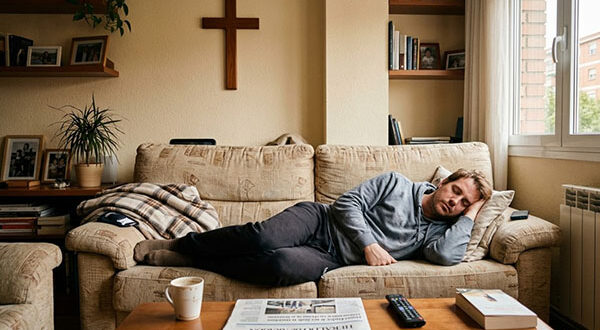
We live in an age marked by exhaustion. Many people arrive at Sunday completely worn out after entire weeks of work, stress, endless shifts, family problems, financial worries, and a routine that never seems to stop. In the midst of this reality, a question frequently arises in the conscience of many Catholics:
Is it a sin to miss Mass because of tiredness or work?
This is not a superficial question. It touches the very heart of Christian life: our relationship with God, the meaning of rest, the dignity of human labor, the sanctification of time, and the balance between our earthly responsibilities and our eternal vocation.
Furthermore, in a world where performance often seems more valuable than the person, the Church offers a profoundly human and spiritual vision. It is not simply about “fulfilling a rule,” but about understanding what the Christian Sunday truly means and why the Eucharist is essential for the life of the soul.
This article seeks to address this issue in a deep, approachable, and pastoral way, illuminating it through Sacred Scripture, the Tradition of the Church, moral theology, and the Social Doctrine of the Church.
Sunday Mass: Much More Than an Obligation
To understand whether missing Mass can be sinful, we must first understand what the Mass truly is.
The Holy Mass is not merely a community gathering or a cultural tradition. For Catholics, the Eucharist is the very sacrifice of Christ made present sacramentally. In every Mass, the sacrifice of Calvary becomes present again in an unbloody manner.
The Church teaches that the Eucharist is:
- the source and summit of Christian life;
- spiritual nourishment for the soul;
- the living memorial of Christ’s Passion, Death, and Resurrection;
- a foretaste of Heaven.
This is why Sunday occupies such a central place in Catholic life. From the earliest centuries, Christians gathered on the “Day of the Lord” to break bread and celebrate the Resurrection.
In the Book of Acts we read:
“On the first day of the week, when we were gathered together to break bread…”
— Acts 20:7
And the Third Commandment itself points toward the sanctification of time dedicated to God:
“Remember the sabbath day, to keep it holy.”
— Exodus 20:8
The Church, heir to this apostolic tradition, establishes the grave obligation to participate in Sunday Mass and certain holy days of obligation.
The Catechism of the Catholic Church teaches:
“The faithful are obliged to participate in the Eucharist on days of obligation.”
— CCC 2180
However, an essential point must be understood: the Church also recognizes that there are situations which can legitimately excuse a person from this obligation.
When Is Missing Mass a Sin?
According to Catholic moral theology, for a mortal sin to exist, three conditions must be present:
- grave matter;
- full knowledge;
- deliberate consent.
Deliberately missing Sunday Mass without a serious reason has traditionally been considered grave matter. But this does not mean that every absence automatically constitutes mortal sin.
The Church carefully distinguishes between:
- voluntary negligence;
- real impossibility;
- serious or proportionate causes.
This is where extreme tiredness, unavoidable work obligations, and other human circumstances come into play.
Can Tiredness Justify Missing Mass?
The answer requires prudence and honesty of conscience.
Ordinary Tiredness Usually Does Not Excuse
Very often, tiredness is simply part of ordinary daily life. Waking up early, making an effort, or reorganizing one’s schedule can be part of Christian sacrifice.
Sometimes a person simply “doesn’t feel like going,” feels somewhat tired, or prefers extra rest. In such cases, missing Mass out of comfort can indeed reveal spiritual lukewarmness.
Christ Himself reminds us:
“If anyone would come after me, let him deny himself and take up his cross daily and follow me.”
— Luke 9:23
Christian life is not based merely on feelings or comfort. True love involves sacrifice.
Many saints walked miles on foot in order to attend Mass. The Martyrs of Abitinae, in the fourth century, risked their lives to gather for the Eucharist during Roman persecutions. Their famous statement still echoes today:
“Without Sunday, we cannot live.”
But There Is Also Real and Extreme Exhaustion
At the same time, the Church recognizes human reality. Some people endure truly severe physical and psychological exhaustion:
- night-shift workers;
- healthcare workers;
- caregivers;
- overwhelmed parents;
- people working multiple jobs;
- exploited laborers;
- chronically ill persons;
- those suffering from extreme anxiety or profound mental exhaustion.
In such cases, there may indeed be a proportionately grave reason.
God is not a tyrant who ignores human frailty. Christ Himself showed compassion toward the weary:
“Come to me, all who labor and are heavy laden, and I will give you rest.”
— Matthew 11:28
The issue is not simply “being tired,” but honestly discerning:
- could I realistically attend?
- is there negligence involved?
- have I done everything reasonably possible?
- am I prioritizing God or continually pushing Him aside?
Catholic morality should never be interpreted as a cold list of rules detached from human reality.
And What About Work?
Here we enter into a profoundly relevant modern issue.
We live in societies where millions of people work on Sundays and holy days:
- healthcare workers;
- police officers;
- transport workers;
- hospitality employees;
- retail workers;
- emergency services;
- logistics workers;
- industrial laborers;
- essential service providers.
The Church clearly distinguishes between:
1. Necessary Work
Some forms of labor are indispensable for the common good. Jesus Himself taught that charity and necessity can justify certain actions even on holy days.
When the Pharisees criticized actions performed on the Sabbath, Christ responded:
“The sabbath was made for man, not man for the sabbath.”
— Mark 2:27
Therefore, someone who must legitimately work because of personal, family, or social necessity may be excused from the Sunday obligation if attending Mass is truly not reasonably possible.
2. Work Imposed Unjustly
Here the Social Doctrine of the Church offers a very profound critique of modern economic systems.
Many workers do not miss Mass because they want to, but because they are trapped in labor structures that:
- destroy family life;
- prevent proper rest;
- reduce the person to a tool of production;
- absolutize consumerism;
- eliminate Sunday as a sacred day.
The Church has repeatedly denounced this dehumanization.
Sunday and Human Dignity
The Social Doctrine of the Church teaches that work exists for the person, not the person for work.
This is fundamental.
Saint John Paul II and the Meaning of Work
In the encyclical Laborem Exercens, John Paul II teaches that work possesses dignity because it participates in God’s creative activity, yet he warns against systems that reduce workers to mere economic instruments.
Sunday rest is not a luxury: it is a human and spiritual necessity.
Human beings need:
- prayer;
- family;
- community;
- silence;
- contemplation;
- physical and mental restoration.
When a society eliminates these things, it ultimately destroys the human person.
Does It Support Human Dignity or Weaken Social Participation and Personal Effort?
This is an extremely important question from the perspective of the Church’s Social Doctrine.
A Society Without Rest Destroys Human Dignity
Modern consumerist capitalism often promotes a dangerous logic:
- produce more;
- consume more;
- work more;
- rest less.
Sunday ceases to be “the Lord’s Day” and becomes just another commercial day.
This has very serious consequences:
- weakening of family life;
- social isolation;
- loss of community life;
- psychological exhaustion;
- secularization;
- disappearance of spiritual life.
The Church teaches that this weakens authentic social participation because the human person ends up living solely to produce and consume.
A society without time for God eventually becomes a society without time for neighbor.
But There Is Also the Risk of the Opposite Extreme
The Social Doctrine of the Church also does not defend a culture of laziness or irresponsibility.
Work possesses moral and sanctifying value.
Saint Paul writes:
“If anyone will not work, let him not eat.”
— 2 Thessalonians 3:10
Christianity has never glorified passivity. Personal effort, sacrifice, and responsibility are part of the human vocation.
This is why it is important to avoid two errors:
Modern Error #1:
turning work into an absolute idol.
Modern Error #2:
using tiredness as a permanent excuse to neglect spiritual life.
The Catholic vision seeks balance and truth.
The Christian Sunday: A Spiritual Resistance
In a certain sense, going to Mass on Sunday has become countercultural today.
It means telling the world:
- my value does not depend solely on productivity;
- I do not live only to work;
- my soul needs God;
- family and community matter;
- rest is also sacred.
The Christian Sunday protects the human person against the modern slavery of constant performance.
What If You Truly Cannot Attend?
If a person honestly cannot attend Mass for serious reasons, the Church recommends:
- dedicating time to prayer;
- reading the daily Scripture readings;
- making a spiritual communion;
- following the Mass through digital media if possible;
- seeking another reasonable Mass time;
- avoiding religious indifference.
It is important to understand that watching Mass online does not normally fulfill the obligation of physical attendance, but it can spiritually help when genuine impossibility exists.
The Danger of Routine and Spiritual Lukewarmness
It is also important to examine one’s conscience.
Sometimes tiredness is real. But other times the soul slowly grows cold.
The modern world exhausts us so deeply that we end up pushing God into last place. Little by little:
- we abandon prayer;
- we neglect the sacraments;
- we live only to survive;
- we lose inner peace.
At that point, the problem is no longer merely physical, but spiritual.
The devil rarely begins by radically separating a person from God. Often, it is enough simply to establish indifference.
Christ Also Rested… But Never Abandoned the Father
The Gospel shows that Jesus knew human exhaustion.
- He slept;
- He withdrew to pray;
- He sought solitary places;
- He understood human weakness.
But He never broke His communion with the Father.
This teaches something essential: true rest does not consist merely in “disconnecting,” but in rediscovering the deepest meaning of life.
And there the Eucharist occupies a central place.
A Pastoral Question: Accompanying Without Relativizing
The Church must avoid two pastoral extremes:
1. Rigorism
Treating every absence as automatically mortal sin without listening to real circumstances.
This can crush consciences and drive away wounded or exhausted people.
2. Relativism
Acting as though Mass were optional or unimportant.
This slowly empties the faith and destroys the sacred meaning of Sunday.
Authentic Catholic pastoral care unites:
- truth;
- mercy;
- moral seriousness;
- understanding;
- accompaniment.
Christian Rest Is Not Escapism
The modern world constantly sells forms of “rest” that often leave people even emptier:
- compulsive entertainment;
- limitless consumerism;
- digital hyperconnection;
- individualism;
- constant escapism.
Christian rest is different.
It is:
- encounter with God;
- interior renewal;
- family communion;
- silence;
- gratitude;
- worship;
- hope.
This is why Sunday is not merely “a day off,” but a foretaste of eternal rest in God.
Practical Discernment for Daily Life
A good question for examination of conscience might be:
“Am I missing Mass because I truly cannot go, or because spiritually I am becoming comfortable?”
It is also worth asking:
- do I organize my life leaving room for God?
- have I normalized an inhuman lifestyle?
- is my work destroying my spiritual life?
- do I need pastoral guidance?
- can I seek another Mass schedule?
- am I prioritizing what truly matters?
The Eucharist as Medicine for Modern Exhaustion
Paradoxically, many times we approach Mass thinking we “have no strength,” when in reality that is precisely where spiritual strength is found.
Christ said:
“I am the bread of life.”
— John 6:35
The Eucharist is not an additional burden placed upon an exhausted person. It is nourishment for the weary pilgrim.
Conclusion: Between Obligation and Love
Is it a sin to miss Mass because of tiredness or work?
The Catholic answer cannot be reduced to a simple “yes” or “no.”
It depends on:
- the real seriousness of the obstacle;
- the person’s freedom;
- honesty of conscience;
- the existence of genuine necessity;
- the interior attitude toward God.
The Church teaches that deliberately missing Mass without a serious reason is a grave matter. But she also recognizes that there are human circumstances that can legitimately excuse a person.
Yet beyond obligation, the Christian is called to discover something deeper: the Mass is not merely a commandment, but an encounter with Christ.
And in a society that is exhausted, anxious, and spiritually empty, perhaps it has never been more necessary to remember that the human person was not created merely to work, produce, and run endlessly without rest.
He was created for God.
Because when man loses Sunday, he often ends up losing himself as well.