Related Articles

When the faith was defended with pen, prayer, and holiness
The history of Christianity is not a calm or linear story. From its earliest centuries, the Church had to defend the heart of its faith against errors, misunderstandings, and profound theological disputes. Far from weakening the Christian faith, these controversies helped purify, deepen, and express more clearly the mystery of Christ.
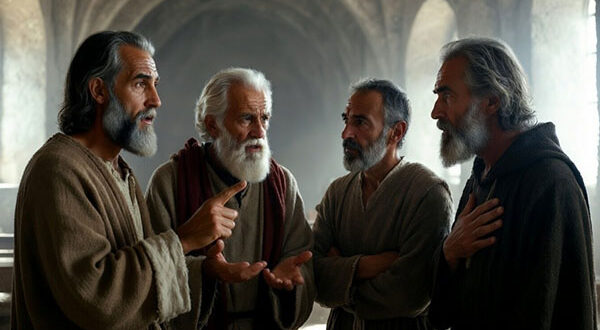
The great protagonists of these debates were the Fathers of the Church, men of profound spiritual life and extraordinary theological intelligence, such as Saint Augustine of Hippo, Saint Jerome, Saint Athanasius of Alexandria, Saint Basil the Great, or Saint John Chrysostom. Their discussions, letters, and treatises were not merely intellectual disputes: they were spiritual battles for the truth of the Gospel.
As the Apostle reminds us:
“Stand firm and hold fast to the traditions you were taught.”
— (2 Thessalonians 2:15)
Understanding these controversies is not only a historical exercise. It helps us understand why we believe what we believe and how to live today a solid faith amid cultural confusion.
1. The great battle for the divinity of Christ: Arianism
One of the most decisive controversies in the entire history of Christianity was provoked by a priest named Arius in the fourth century.
Arius taught something apparently simple but theologically devastating:
Christ was not truly God, but the first creature created by God.
In other words, Jesus would be a superior being, but not the eternal God.
Why was this so serious?
If Christ is not God:
- He cannot fully save humanity
- The Incarnation loses its meaning
- Redemption becomes incomplete
As Christian theology would later affirm:
Only God can save man.
The great defender of the faith against Arianism was Saint Athanasius of Alexandria. For decades he endured persecution, exile, and political pressure for defending that Christ is “of the same substance as the Father.”
This truth was solemnly defined at the First Council of Nicaea.
There the famous formula was proclaimed:
Christ is “God from God, Light from Light, true God from true God, begotten not made.”
Spiritual application today
Today Arianism does not exist in its classical form, but it appears in many modern ways:
- reducing Jesus to a simple moral teacher
- seeing Him only as a prophet or spiritual leader
- ignoring His divinity
The Fathers remind us that Christ is not merely an inspirer: He is the Savior.
2. The controversy about grace: Augustine against Pelagius
Another of the deepest debates occurred around the mystery of grace.
The central figure was the British monk Pelagius.
Pelagius taught that human beings can fulfill the commandments by their own strength, without the need for an interior transforming grace.
According to him:
- original sin barely affects humanity
- the human will can achieve holiness by itself
This vision seemed optimistic, but in reality it empties Christianity of its core.
The great defender of the doctrine of grace was Saint Augustine of Hippo.
For Augustine, Scripture was clear:
“Apart from me you can do nothing.”
— (John 15:5)
Human beings need grace in order to:
- believe
- love
- persevere in goodness
It is not about denying human freedom, but recognizing that God acts first.
The great pastoral lesson
This controversy touches on a very current issue:
Christianity is not spiritual self-help.
It is not about improving ourselves by sheer willpower, but about allowing God’s grace to transform the heart.
3. The identity of Mary: the Nestorian controversy
In the fifth century another key dispute arose: the identity of the Virgin Mary in relation to Christ.
The patriarch of Constantinople Nestorius rejected calling Mary Mother of God.
He preferred to call her only Mother of Christ.
At first glance this seemed like a matter of language, but in reality it touched a central point:
Is Christ one person or two?
The great defender of Catholic doctrine was Saint Cyril of Alexandria.
The Church finally defined at the Council of Ephesus that Mary is truly:
Theotokos — Mother of God
Not because she is the origin of the divinity, but because the Son born from her is truly God made man.
Spiritual application
This teaching has a beautiful consequence:
If Mary is Mother of God, then she is also the spiritual mother of Christians.
For this reason Marian devotion is not sentimentalism but a profound theological reality.
4. The great discussion about the Trinity
The first centuries were also filled with debates about how to understand the central mystery of the faith:
God is one and triune.
Three great theologians defended this doctrine with extraordinary depth:
- Saint Basil the Great
- Saint Gregory of Nyssa
- Saint Gregory of Nazianzus
They are known as the Cappadocian Fathers.
They developed the theological language that made it possible to express the mystery:
- one divine nature
- three distinct persons
Father, Son, and Holy Spirit.
Thanks to their reflection, Christianity avoided two errors:
- thinking of three gods
- thinking that God is one person with three masks
Application for our spiritual life
The Trinity is not an abstraction.
It is the model of Christian love.
God Himself is communion, relationship, and mutual self-giving.
Therefore the Christian life is called to reflect that mystery:
- in the family
- in the Church
- in the community
5. The controversy about the nature of Christ
Another of the most important discussions revolved around how the divinity and humanity of Christ relate to each other.
Some thought that the humanity was absorbed by the divinity.
This position is known as Monophysitism.
The Church defined the correct doctrine at the Council of Chalcedon:
Christ is true God and true man, with two natures united in one person.
This definition is one of the jewels of Christian theology.
Spiritual consequence
Christ can fully understand humanity because He truly became man.
As the Letter to the Hebrews says:
“We do not have a high priest unable to sympathize with our weaknesses.”
— (Hebrews 4:15)
6. Controversies were also paths of holiness
It is important to remember something:
These disputes were not mere academic debates.
Many Fathers of the Church:
- were persecuted
- were exiled
- were misunderstood
for defending the truth of the Gospel.
Saint Athanasius of Alexandria was exiled five times.
Saint John Chrysostom died in exile after denouncing abuses of power.
Saint Maximus the Confessor suffered torture for defending the doctrine of Christ.
Theological truth always has a cost.
7. Why these controversies are still relevant today
Today we live in an age of great doctrinal and spiritual confusion.
Ancient heresies reappear with new names:
- religious relativism
- spirituality without Christ
- morality without grace
- faith without the Church
The Fathers of the Church teach us three fundamental attitudes.
1. Love the truth
The Christian faith is not an opinion.
It is divine revelation.
2. Seek depth
The Fathers dedicated their lives to understanding the faith.
Today we need to rediscover the richness of theology.
3. Unite doctrine and holiness
True theology is born from prayer.
8. What Christians today can learn from the Fathers
The controversies of the early centuries teach us several very current spiritual lessons.
1. Faith requires formation
It is not enough to believe in a superficial way.
We must know the faith in order to live it and defend it.
2. Truth requires courage
The Fathers did not seek popularity, but fidelity to Christ.
3. Theology must lead to God
The ultimate goal is not to win debates.
It is to know God more deeply.
Conclusion: disputes that built the faith
Sometimes we think that conflicts in the Church are signs of weakness.
But history shows the opposite.
Thanks to these controversies:
- we understand better who Christ is
- we understand the action of grace
- we deepen the mystery of the Trinity
The Fathers of the Church teach us that truth is sought with intelligence, humility, and prayer.
And in the end, everything leads to the center of the Christian faith:
Jesus Christ, true God and true man, Savior of the world.
As Saint Augustine of Hippo wrote:
“You have made us for Yourself, O Lord, and our heart is restless until it rests in You.”