Related Articles


There are images that are worth more than a thousand documents. And there are gestures that, even if presented as simple acts of courtesy or dialogue, carry such great symbolic force that they end up provoking confusion, debate, and deep concern among the faithful.
That is precisely what has happened recently in Rome, when during an ecumenical pilgrimage, the Anglican leader There are images that are worth more than a thousand documents. And there are gestures that, even if presented as simple acts of courtesy or dialogue, carry such great symbolic force that they end up provoking confusion, debate, and deep concern among the faithful.
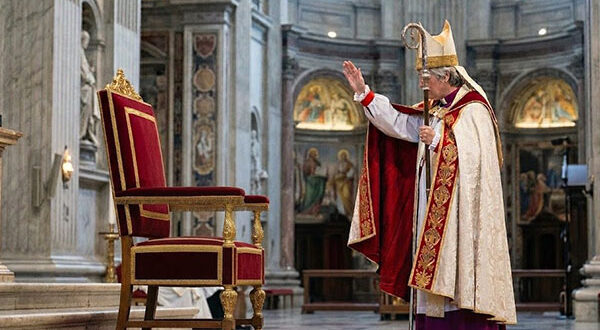
That is precisely what has happened recently in Rome, when during an ecumenical pilgrimage, the Anglican leader Sarah Mullally—presented as a “bishop” within the Anglican Communion—appeared praying at the tombs of the Apostles and, according to the circulated images, giving a blessing near the tomb of Saint Peter, in the very heart of the Vatican.
For many, it was simply a gesture of ecumenical cordiality.
For others, especially from a traditional Catholic perspective, the scene has been profoundly scandalous.
Not because of a lack of charity.
Not because of personal rejection.
Not because of contempt toward Anglicans.
But because the issue is not emotional, but doctrinal.
The question is not whether we should engage in dialogue.
The question is whether that dialogue can be expressed in a way that obscures Catholic truth.
And when it comes to the tomb of Saint Peter—the visible symbol of the unity of the Church and of apostolic primacy—prudence is not optional: it is an obligation.
This episode forces us to reflect seriously on the true meaning of ecumenism, on Catholic doctrine regarding Anglican orders, and on the real danger of turning symbolic gestures into sources of confusion for the faithful.
Because not every kind gesture builds up.
And not every visible closeness helps the clarity of faith.
Who Is Sarah Mullally and Why Has This Gesture Caused So Much Controversy?
Sarah Mullally is one of the most relevant figures within contemporary Anglicanism. As a high-ranking authority of the Anglican Communion, she represents an ecclesial structure separated from Rome since the 16th century, when Henry VIII broke with the Catholic Church and gave rise to the Anglican schism.
That was not a simple administrative difference.
It was an ecclesiological, sacramental, and doctrinal rupture of enormous depth.
Since then, the Catholic Church has maintained a clear position regarding the validity of Anglican orders.
And here lies the core of the problem.
In 1896, Pope Leo XIII published the bull Apostolicae Curae, in which he solemnly declared that Anglican orders were:
“absolutely null and utterly void”
Not ambiguously.
Not partially.
Not “in the process of recognition.”
But invalid.
This means that, according to Catholic doctrine, Anglican priesthood and episcopacy do not possess sacramental validity in the Catholic sense.
Therefore, from the Catholic faith, there is not truly an “Anglican bishop” in the sacramental sense.
And even less a female “bishop,” given that the Catholic Church definitively teaches that it has no authority to confer priestly ordination on women.
That is why seeing a female Anglican figure giving a blessing beside the tomb of Saint Peter inevitably raises a serious question:
What message does the ordinary faithful person receive when seeing that image?
Because theology can make distinctions.
But images catechize.
And sometimes they confuse more than they explain.
The Tomb of Saint Peter Is Not Just Any Place
Here we are not speaking of a protocol meeting in a diplomatic room.
We are not speaking of an academic conversation.
We are speaking of the tomb of the Apostle Peter.
Of the place where Christian tradition recognizes the martyrdom and burial of the first Pope.
Of the symbolic heart of Roman primacy.
Of the place where millions of Catholics make pilgrimage to renew their communion with the Church founded upon the apostolic rock.
Saint Peter does not simply represent a historical figure.
He represents the visible authority entrusted by Christ:
“You are Peter, and on this rock I will build my Church” (Mt 16:18).
That is why everything that happens there carries immense weight.
It is not a neutral space.
It is a profoundly catechetical place.
A blessing given beside that tomb is not perceived as just any gesture.
It carries a doctrinal weight, whether intended or not.
And precisely for that reason many faithful felt disturbed.
Because when symbolism surpasses official explanation, public perception can be devastating.
The Problem Is Not Dialogue, but Ambiguity
It is important to say it clearly: the Church does not reject dialogue.
Authentic ecumenism does not consist in hostility, contempt, or arrogance.
Christ Himself asked for unity.
And the Church sincerely desires visible reconciliation among Christians.
But that unity cannot be built upon doctrinal confusion.
Unity does not consist in pretending differences do not exist.
Charity does not consist in silencing truth.
Ecumenism cannot become symbolic theater where everyone appears equal even when doctrinally they are not.
Because then it would no longer be unity.
It would be liturgical and pastoral relativism.
Saint John Paul II insisted that true ecumenism requires doctrinal clarity.
Benedict XVI repeatedly warned against a false irenicism that dilutes truth in order to avoid tensions.
And Catholic Tradition has always maintained that charity without truth ends in religious sentimentalism.
It is not about humiliating anyone.
It is about not confusing everyone.
Apostolicae Curae: A Teaching That Cannot Be Ignored
Many today seem to act as though Leo XIII’s declaration were an uncomfortable relic of the past.
But it is not.
Apostolicae Curae remains a fundamental doctrinal reference.
The reason was not merely disciplinary.
Leo XIII explained that the problem affected the sacramental form and the intention with which the Anglican rite of ordination had been reformed.
That is to say: it was not a political matter.
It was sacramental.
For that reason, the Church concluded that valid apostolic succession had been interrupted.
Without valid apostolic succession, there is no valid sacramental priesthood.
Without valid priesthood, there is no valid Eucharist in the Catholic sense.
And without that reality, one cannot speak of sacramental equivalence.
This point is not an extreme traditionalist opinion.
It is formal Catholic doctrine.
That is why many faithful feel that certain public gestures seem to visually contradict what the Church still teaches doctrinally.
And that tension causes wounds.
The Female Question: An Even Greater Rupture
In addition, there is another even more delicate point.
Sarah Mullally is not simply an Anglican authority.
She is a woman presented as a “bishop.”
And here the doctrinal problem becomes even more evident.
Saint John Paul II, in Ordinatio Sacerdotalis (1994), affirmed that the Church has no authority to confer priestly ordination on women.
He did not say that it was still under study.
He did not say that it depended on culture.
He did not say that it was a revisable disciplinary issue.
He said that it must be definitively held by all the faithful.
Therefore, female ordination is not simply an administrative difference with Anglicanism.
It is a direct rupture with the sacramental and apostolic understanding of the priesthood.
That is why allowing an image of a female episcopal blessing in such a central place of Catholicism cannot be read as a neutral gesture.
It has pedagogical consequences.
And pedagogical consequences, in the Church, matter greatly.
The Ordinary Faithful and the Silent Scandal
Many times those who organize these gestures think in diplomatic terms.
But the faithful think in terms of concrete faith.
A grandmother praying the Rosary.
A young man struggling to defend doctrine.
A priest trying to teach clearly.
A family seeking fidelity in the midst of modern chaos.
All of them look at those images and ask themselves:
“So… does everything mean the same now?”
“Does apostolic succession no longer matter?”
“Is it the same to be Catholic as to be Anglican?”
“What was once invalid—is it now no longer so?”
And even if officially the answer is no, the visual impact has already planted doubt.
That is the real problem.
Scandal does not always consist of explicit heresies.
Sometimes it consists of public ambiguities.
And prolonged ambiguity erodes more than a clear confrontation.
How Should True Ecumenism Be Lived?
With respect.
With charity.
With prayer.
With a sincere desire for unity.
But also with truth.
With clear Catholic identity.
With doctrinal fidelity.
With carefully guarded symbols.
Not everything should be done in every place.
Not every courtesy needs liturgical expression.
Not every friendship requires gestures that can be interpreted as sacramental recognition.
True ecumenism does not seek to make everyone appear the same.
It seeks that everyone walk toward the fullness of truth.
And for a Catholic, that fullness is not an abstract idea.
It has a visible name: the Church founded by Christ upon Peter.
Authentic charity does not consist in hiding that.
It consists in inviting, with humility and clarity, toward that fullness.
Saint Peter Continues to Ask
Perhaps the most eloquent place of this whole episode is precisely the tomb of Peter.
Because Peter was not called to negotiate truth.
He was called to confirm it.
Christ said to him:
“Strengthen your brethren” (Lk 22:32).
Do not confuse them.
Do not reassure them in error.
Do not dilute the faith to avoid conflicts.
Strengthen them.
Today that word continues to resound.
Especially in Rome.
Especially in times when confusion is often presented as mercy.
The Church must love everyone.
But loving does not mean erasing doctrinal boundaries.
It means extending the hand without letting go of the truth.
And perhaps that is the great lesson of this episode.
It is not enough to ask whether the gesture was kind.
We must ask whether it was clear.
Because in the Church, clarity is also charity.
And beside the tomb of Saint Peter, that clarity should never be lacking.—presented as a “bishop” within the Anglican Communion—appeared praying at the tombs of the Apostles and, according to the circulated images, giving a blessing near the tomb of Saint Peter, in the very heart of the Vatican.
For many, it was simply a gesture of ecumenical cordiality.
For others, especially from a traditional Catholic perspective, the scene has been profoundly scandalous.
Not because of a lack of charity.
Not because of personal rejection.
Not because of contempt toward Anglicans.
But because the issue is not emotional, but doctrinal.
The question is not whether we should engage in dialogue.
The question is whether that dialogue can be expressed in a way that obscures Catholic truth.
And when it comes to the tomb of Saint Peter—the visible symbol of the unity of the Church and of apostolic primacy—prudence is not optional: it is an obligation.
This episode forces us to reflect seriously on the true meaning of ecumenism, on Catholic doctrine regarding Anglican orders, and on the real danger of turning symbolic gestures into sources of confusion for the faithful.
Because not every kind gesture builds up.
And not every visible closeness helps the clarity of faith.
Who Is Sarah Mullally and Why Has This Gesture Caused So Much Controversy?
Sarah Mullally is one of the most relevant figures within contemporary Anglicanism. As a high-ranking authority of the Anglican Communion, she represents an ecclesial structure separated from Rome since the 16th century, when Henry VIII broke with the Catholic Church and gave rise to the Anglican schism.
That was not a simple administrative difference.
It was an ecclesiological, sacramental, and doctrinal rupture of enormous depth.
Since then, the Catholic Church has maintained a clear position regarding the validity of Anglican orders.
And here lies the core of the problem.
In 1896, Pope Leo XIII published the bull Apostolicae Curae, in which he solemnly declared that Anglican orders were:
“absolutely null and utterly void”
Not ambiguously.
Not partially.
Not “in the process of recognition.”
But invalid.
This means that, according to Catholic doctrine, Anglican priesthood and episcopacy do not possess sacramental validity in the Catholic sense.
Therefore, from the Catholic faith, there is not truly an “Anglican bishop” in the sacramental sense.
And even less a female “bishop,” given that the Catholic Church definitively teaches that it has no authority to confer priestly ordination on women.
That is why seeing a female Anglican figure giving a blessing beside the tomb of Saint Peter inevitably raises a serious question:
What message does the ordinary faithful person receive when seeing that image?
Because theology can make distinctions.
But images catechize.
And sometimes they confuse more than they explain.
The Tomb of Saint Peter Is Not Just Any Place
Here we are not speaking of a protocol meeting in a diplomatic room.
We are not speaking of an academic conversation.
We are speaking of the tomb of the Apostle Peter.
Of the place where Christian tradition recognizes the martyrdom and burial of the first Pope.
Of the symbolic heart of Roman primacy.
Of the place where millions of Catholics make pilgrimage to renew their communion with the Church founded upon the apostolic rock.
Saint Peter does not simply represent a historical figure.
He represents the visible authority entrusted by Christ:
“You are Peter, and on this rock I will build my Church” (Mt 16:18).
That is why everything that happens there carries immense weight.
It is not a neutral space.
It is a profoundly catechetical place.
A blessing given beside that tomb is not perceived as just any gesture.
It carries a doctrinal weight, whether intended or not.
And precisely for that reason many faithful felt disturbed.
Because when symbolism surpasses official explanation, public perception can be devastating.
The Problem Is Not Dialogue, but Ambiguity
It is important to say it clearly: the Church does not reject dialogue.
Authentic ecumenism does not consist in hostility, contempt, or arrogance.
Christ Himself asked for unity.
And the Church sincerely desires visible reconciliation among Christians.
But that unity cannot be built upon doctrinal confusion.
Unity does not consist in pretending differences do not exist.
Charity does not consist in silencing truth.
Ecumenism cannot become symbolic theater where everyone appears equal even when doctrinally they are not.
Because then it would no longer be unity.
It would be liturgical and pastoral relativism.
Saint John Paul II insisted that true ecumenism requires doctrinal clarity.
Benedict XVI repeatedly warned against a false irenicism that dilutes truth in order to avoid tensions.
And Catholic Tradition has always maintained that charity without truth ends in religious sentimentalism.
It is not about humiliating anyone.
It is about not confusing everyone.
Apostolicae Curae: A Teaching That Cannot Be Ignored
Many today seem to act as though Leo XIII’s declaration were an uncomfortable relic of the past.
But it is not.
Apostolicae Curae remains a fundamental doctrinal reference.
The reason was not merely disciplinary.
Leo XIII explained that the problem affected the sacramental form and the intention with which the Anglican rite of ordination had been reformed.
That is to say: it was not a political matter.
It was sacramental.
For that reason, the Church concluded that valid apostolic succession had been interrupted.
Without valid apostolic succession, there is no valid sacramental priesthood.
Without valid priesthood, there is no valid Eucharist in the Catholic sense.
And without that reality, one cannot speak of sacramental equivalence.
This point is not an extreme traditionalist opinion.
It is formal Catholic doctrine.
That is why many faithful feel that certain public gestures seem to visually contradict what the Church still teaches doctrinally.
And that tension causes wounds.
The Female Question: An Even Greater Rupture
In addition, there is another even more delicate point.
Sarah Mullally is not simply an Anglican authority.
She is a woman presented as a “bishop.”
And here the doctrinal problem becomes even more evident.
Saint John Paul II, in Ordinatio Sacerdotalis (1994), affirmed that the Church has no authority to confer priestly ordination on women.
He did not say that it was still under study.
He did not say that it depended on culture.
He did not say that it was a revisable disciplinary issue.
He said that it must be definitively held by all the faithful.
Therefore, female ordination is not simply an administrative difference with Anglicanism.
It is a direct rupture with the sacramental and apostolic understanding of the priesthood.
That is why allowing an image of a female episcopal blessing in such a central place of Catholicism cannot be read as a neutral gesture.
It has pedagogical consequences.
And pedagogical consequences, in the Church, matter greatly.
The Ordinary Faithful and the Silent Scandal
Many times those who organize these gestures think in diplomatic terms.
But the faithful think in terms of concrete faith.
A grandmother praying the Rosary.
A young man struggling to defend doctrine.
A priest trying to teach clearly.
A family seeking fidelity in the midst of modern chaos.
All of them look at those images and ask themselves:
“So… does everything mean the same now?”
“Does apostolic succession no longer matter?”
“Is it the same to be Catholic as to be Anglican?”
“What was once invalid—is it now no longer so?”
And even if officially the answer is no, the visual impact has already planted doubt.
That is the real problem.
Scandal does not always consist of explicit heresies.
Sometimes it consists of public ambiguities.
And prolonged ambiguity erodes more than a clear confrontation.
How Should True Ecumenism Be Lived?
With respect.
With charity.
With prayer.
With a sincere desire for unity.
But also with truth.
With clear Catholic identity.
With doctrinal fidelity.
With carefully guarded symbols.
Not everything should be done in every place.
Not every courtesy needs liturgical expression.
Not every friendship requires gestures that can be interpreted as sacramental recognition.
True ecumenism does not seek to make everyone appear the same.
It seeks that everyone walk toward the fullness of truth.
And for a Catholic, that fullness is not an abstract idea.
It has a visible name: the Church founded by Christ upon Peter.
Authentic charity does not consist in hiding that.
It consists in inviting, with humility and clarity, toward that fullness.
Saint Peter Continues to Ask
Perhaps the most eloquent place of this whole episode is precisely the tomb of Peter.
Because Peter was not called to negotiate truth.
He was called to confirm it.
Christ said to him:
“Strengthen your brethren” (Lk 22:32).
Do not confuse them.
Do not reassure them in error.
Do not dilute the faith to avoid conflicts.
Strengthen them.
Today that word continues to resound.
Especially in Rome.
Especially in times when confusion is often presented as mercy.
The Church must love everyone.
But loving does not mean erasing doctrinal boundaries.
It means extending the hand without letting go of the truth.
And perhaps that is the great lesson of this episode.
It is not enough to ask whether the gesture was kind.
We must ask whether it was clear.
Because in the Church, clarity is also charity.
And beside the tomb of Saint Peter, that clarity should never be lacking.