Related Articles

At every Holy Mass, a mystery takes place that surpasses all human understanding: the very Sacrifice of Calvary becomes present in an unbloody manner upon the altar. Everything surrounding this mystery possesses an extraordinary dignity. Not only the priest, but also those who assist in the sacred liturgy are called to carry out their service with profound reverence, a supernatural spirit, and an authentic interior life.
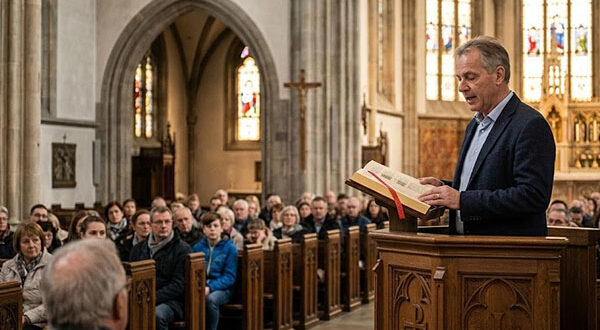
Among them, the lector occupies a particular place: the one who proclaims the Word of God before the assembled faithful. Yet there is a danger especially characteristic of our own time: reducing this ministry to a merely technical function. Great attention is often given to good diction, a pleasant voice, correct pronunciation, or confidence at the ambo, while what is truly essential is forgotten: before becoming a good lector, one must first become a soul deeply united to God.
For in the liturgy, it is not enough to pronounce the inspired words correctly. Those very words must first have transformed the heart of the one who proclaims them.
The Church has always understood that every liturgical ministry requires proper spiritual preparation. No ministry should ever be lived as a form of personal prominence. Every authentic service is born of humility, prayer, and the sincere desire to glorify God alone.
This article seeks to explore precisely this often-forgotten dimension: the spiritual preparation of the lector, especially in light of the rich liturgical and spiritual tradition of the Church.
The Lector: A Voice at the Service of God
When we hear a reading during Holy Mass, we might think that someone is simply reading an ancient text.
But the reality is infinitely deeper.
Sacred Scripture is not just another book.
Saint Paul teaches:
“All Scripture is inspired by God and profitable for teaching, for reproof, for correction, and for instruction in righteousness.” (2 Timothy 3:16)
Every word of Sacred Scripture has God as its principal author.
Therefore, when the lector proclaims the reading, he or she quite literally lends a human voice so that the inspired Word of God may resound.
The lector does not speak in his own name.
He does not express personal opinions.
He does not improvise reflections.
He does not seek to persuade through merely human eloquence.
He simply steps aside so that Christ may speak.
It is a mission of tremendous responsibility.
The Church’s Tradition Concerning the Lector
During the early centuries of Christianity, there existed what were known as the minor orders, among which was the office of lector.
Not everyone could exercise this function.
The lector received specific spiritual formation and was regarded as a true servant of divine worship.
Many of the Fathers of the Church insisted that whoever proclaimed the Scriptures should live according to what he announced.
Saint Jerome famously wrote:
“Ignorance of the Scriptures is ignorance of Christ.”
But one could also add:
To read the Scriptures without living them is to deprive them of much of their witness-bearing power.
For centuries, the lector was regarded as someone especially formed both doctrinally and spiritually.
Tradition never understood this service as merely another form of community participation.
It was a ministry directed entirely toward the worship of God.
Before Opening the Bible, Open Your Heart
There is a common temptation.
To think that preparation consists merely in practicing pronunciation.
Certainly, reading well is important.
But that is only the external aspect.
True preparation begins much earlier.
It begins in prayer.
A lector should ask himself:
- Am I living in the state of grace?
- Have I prayed before proclaiming the Word?
- Have I meditated beforehand on the text?
- Am I willing to disappear so that only Christ may be heard?
These questions are far more important than any reading technique.
Because God does not need perfect voices.
He seeks willing hearts.
The Interior Life of the Lector
Every person who serves in the liturgy should cultivate a deep spiritual life.
This includes:
- daily prayer;
- spiritual reading;
- examination of conscience;
- frequent confession;
- devout participation at Holy Mass;
- Eucharistic adoration;
- devotion to the Blessed Virgin Mary.
These are not optional practices.
They are the nourishment of the soul.
It would be contradictory to proclaim the Gospel while living a life completely detached from it.
No one demands perfect holiness.
But there must be a sincere desire for continual conversion.
The Importance of the State of Grace
The spiritual tradition of the Church has always emphasized the importance of living in the state of grace.
Not because God ceases to act through a sinner.
The objective efficacy of the Word does not depend upon the lector.
But the spiritual fruit borne in the one who serves depends greatly upon his interior disposition.
Our Lord says:
“Abide in me, and I in you. As the branch cannot bear fruit of itself unless it abides in the vine, neither can you unless you abide in me.” (John 15:4)
The lector should strive to receive the Sacrament of Confession frequently.
Not out of scrupulosity.
But out of love.
Serving at the altar deserves offering the Lord the very best of ourselves.
Preparing the Reading Throughout the Week
The proclamation begins several days before the Mass itself.
A lector should not open the lectionary five minutes before the celebration.
Ideally, the assigned reading should be read during the week.
Then read again slowly.
Its context should be studied.
One should ask:
What is God saying here?
Why has the Church chosen this reading for this particular day?
How does it relate to the Gospel?
How does it shed light upon our lives today?
When the moment comes to proclaim it, those words will already have become part of the lector’s own heart.
Lectio Divina: The Best Formation for a Lector
For centuries the Church has recommended the practice of Lectio Divina.
It consists of four principal stages:
Reading.
Listening attentively to the sacred text.
Meditation.
Reflecting upon its meaning.
Prayer.
Responding to God.
Contemplation.
Remaining in silent openness, allowing oneself to be transformed.
Whoever regularly practices this method develops a profound familiarity with Sacred Scripture.
Then the proclamation ceases to be merely a reading and becomes a genuine witness.
Humility: The Most Important Virtue
We live in a culture obsessed with appearances.
Social media has accustomed many people to seek constant recognition.
This danger can also infiltrate the liturgy.
Some may find themselves thinking:
“Today it’s my turn to read.”
“I hope I do it perfectly.”
“Everyone will be listening to me.”
Authentic spirituality completely changes that perspective.
The lector should instead think:
“Today Christ will use my voice.”
Nothing more.
Nothing less.
Saint John the Baptist expressed this spirit in unforgettable words:
“He must increase, but I must decrease.” (John 3:30)
This should become the interior motto of every lector.
Reverence for the Word of God
The Bible is not simply a religious book.
It is the inspired Word of the Holy Spirit.
For this reason, it deserves profound veneration.
The Church’s liturgical tradition has always taken great care regarding the manner in which it is proclaimed.
The silences.
The posture.
The dignity.
The sobriety.
Everything should help make clear that we are not dealing with an ordinary text.
Even the manner of walking toward the ambo can become a silent prayer.
The Lector Also Evangelizes
Even though the lector does not preach the homily, he nevertheless evangelizes.
How?
Through personal example.
Through recollection.
Through reverent behavior.
Through the way he enters the church.
Through the manner in which he kneels.
Through his reverence before the Blessed Sacrament.
Many people notice these seemingly small details.
And these gestures often speak even more eloquently than words.
Human Preparation Also Matters
Spirituality never excludes technical preparation.
On the contrary.
Love inspires us to do things well.
Therefore, it is important to:
- practice pronunciation;
- learn difficult names correctly;
- control the pace;
- respect meaningful pauses;
- articulate clearly;
- avoid theatrical dramatization;
- speak naturally.
The goal is not to perform.
The goal is to serve.
The Danger of Routine
Those who have served as lectors for many years can easily fall into routine.
The same readings.
The same gestures.
The same schedules.
Eventually, the sense of wonder can disappear.
The best remedy is to remember one fundamental truth:
Every Mass is unique.
Every proclamation may touch someone’s heart.
Perhaps a person is hearing that reading for the very first time.
Perhaps it will be the last Mass they ever attend.
Perhaps God intends to convert a soul precisely through that particular passage.
We never know how grace will act.
Mary: The Perfect Model for Every Lector
The Blessed Virgin Mary never publicly proclaimed the Scriptures in the liturgy.
Yet no one ever listened to the Word of God more perfectly than she did.
She is the perfect model.
She listened.
She meditated.
She treasured.
She lived.
Saint Luke tells us:
“Mary kept all these things, pondering them in her heart.” (Luke 2:19)
Before announcing the Word, one must first learn from Mary how to treasure it.
Every lector should entrust himself to Our Lady before serving.
Saint Jerome and Love for Sacred Scripture
Saint Jerome devoted his entire life to the study of the Bible.
His passion for the Word sprang from his love for Christ.
His well-known statement remains just as relevant today:
“Ignorance of the Scriptures is ignorance of Christ.”
Yet the lector is called to something even deeper.
Not merely to know the Scriptures.
But to allow himself to be known by them.
To permit the Word to reveal his shortcomings, enlighten his decisions, and guide his entire life.
Silence as Preparation
We live surrounded by noise.
Notifications.
Screens.
Constant music.
Endless conversations.
Yet God often speaks in silence.
Before Holy Mass, it is highly recommended to avoid unnecessary conversations.
Remain recollected for a few moments.
Pray.
Adore.
Ask for the assistance of the Holy Spirit.
In this way, the proclamation is born from an encounter with God.
The Holy Spirit: The True Protagonist
Every form of spiritual preparation would be incomplete without invoking the Holy Spirit.
It was He who inspired the Scriptures.
It is He who enlightens the mind.
It is He who moves hearts.
It is He who makes the proclamation fruitful.
Before approaching the ambo, the lector may pray interiorly:
“Come, Holy Spirit. Enlighten my mind, purify my heart, and grant that Your Word may be proclaimed with fidelity, humility, and love, for the glory of God and the salvation of souls. May my own voice disappear so that Christ alone may speak. Amen.”
A Practical Spiritual Preparation Plan Before Proclaiming the Word
The lector’s preparation can be organized as a small spiritual journey.
Throughout the Week:
- Read the assigned readings several times.
- Study their biblical context.
- Meditate upon them through Lectio Divina.
- Ask the Holy Spirit for light and understanding.
The Day Before:
- Review the pronunciation of names and places.
- Offer this service to the Lord.
- If possible, get sufficient rest in order to carry out the ministry with attentiveness and serenity.
Before Leaving Home:
- Make a brief prayer of offering.
- If possible, read the passage one more time in an atmosphere of recollection.
Upon Arriving at Church:
- Keep silence.
- Make a visit to the Blessed Sacrament.
- Entrust yourself to the Blessed Virgin Mary and to the saint of the day.
- Ask for the grace to serve with humility.
Moments Before Approaching the Ambo:
- Breathe calmly.
- Make the Sign of the Cross interiorly.
- Remember that you are not simply “doing a reading,” but allowing God to speak to His people through you.
The Mission of the Lector in a World That Has Forgotten How to Listen
We live in an age saturated with words. Every day we are exposed to thousands of messages coming from social media, news outlets, advertising, and countless conversations. Paradoxically, the more people speak, the less they truly listen. Amid this constant noise, the proclamation of Sacred Scripture takes on a prophetic significance.
The lector is not communicating just another opinion among many voices. He proclaims a Word that never grows old, that is not subject to changing fashions, and that possesses the power to penetrate the deepest recesses of the human heart. As the Letter to the Hebrews teaches:
“For the word of God is living and active, sharper than any two-edged sword, piercing even to the division of soul and spirit, of joints and marrow, and discerning the thoughts and intentions of the heart.” (Hebrews 4:12)
This certainty should fill every liturgical minister with confidence. The fruitfulness of the ministry depends not primarily upon natural talents, but upon God’s action, who humbly chooses to use a human voice to communicate His grace.
Conclusion: Before Proclaiming with the Lips, Listen with the Heart
Being a lector in the liturgy does not simply mean reading well. It means allowing the Word of God to transform one’s own life before proclaiming it to others. Spiritual preparation is not an optional addition; it is the very foundation of every authentic liturgical ministry. Whoever approaches the ambo carries not only a lectionary, but also the witness of his faith, his prayer, and his sincere desire to serve.
The ideal lector is not the one who receives compliments for his diction or his voice, but the one whose presence almost goes unnoticed because all attention is directed toward Christ and His Word. His greatest success will be that, when the proclamation has ended, no one remembers the lector, but many remember what God has spoken to them.
In a Church that is in great need of credible witnesses, the liturgical minister is called to become a man or woman of silence, prayer, humility, and profound communion with the Lord. Only then can his voice become a humble instrument of that eternal Word which continues to call, console, correct, and sanctify souls until the end of time.