
Related Articles

Introduction: A Phrase of Christ That Resounds Today More Powerfully Than Ever
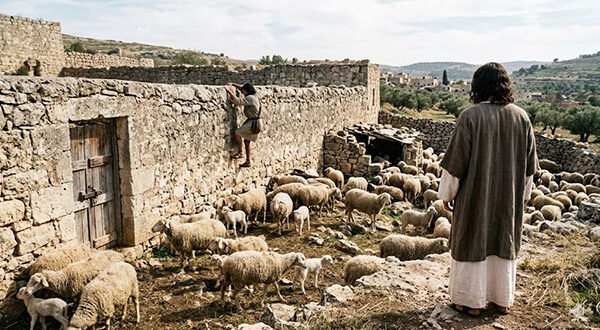
“Truly, truly, I say to you, he who does not enter the sheepfold by the door, but climbs in by another way, that man is a thief and a robber” (John 10:1).
These words of Our Lord Jesus Christ are not an empty metaphor nor merely a pastoral image from the agricultural world of Judea. They are a divine warning, a spiritual key, and a theological compass for discerning who truly comes in the name of God… and who uses religion, authority, or even pious language to steal, scatter, and destroy.
We live in times of doctrinal confusion, moral relativism, and a profound crisis of authority. Never has it been more urgent to return to this teaching of the Good Shepherd. For Christ not only spoke of Himself as the Door; He also revealed that there are intruders, impostors, mercenaries, and wolves disguised as sheep.
This passage is, in many ways, a spiritual X-ray of salvation history… and also of our present age.
I. Biblical Context: The Discourse of the Good Shepherd in the Gospel of John
Chapter 10 of the Gospel of John contains one of the deepest Christological revelations in all of Scripture. Jesus presents Himself through two inseparable images:
1. Christ Is the Door
“I am the door; if anyone enters by me, he will be saved and will go in and out and find pasture” (John 10:9).
2. Christ Is the Good Shepherd
“I am the good shepherd. The good shepherd lays down his life for the sheep” (John 10:11).
This means there is no legitimate access to God’s flock outside of Christ. There is no true spiritual authority, true doctrine, or true salvation that ignores, replaces, or manipulates Jesus Christ.
The “door” in biblical tradition
In biblical symbolism, the door represents:
- Legitimate access to truth.
- Entrance into salvation.
- Obedience to the divine plan.
- Authentic authority.
Therefore, whoever tries to “enter by another way” represents the usurper: one who seeks spiritual power without divine mission, authority without truth, influence without the Cross.
II. Who Are the Thieves and Bandits?
Christ uses extraordinarily strong language. He does not merely speak of “confused people,” but of “thieves” and “robbers.”
From a theological point of view, these may include:
1. False prophets
Those who adulterate the Word of God to accommodate it to the spirit of the world.
“Beware of false prophets, who come to you in sheep’s clothing but inwardly are ravenous wolves” (Matthew 7:15).
2. Heretics
Those who select certain parts of truth while rejecting others, constructing a false religion.
3. Unfaithful shepherds
Ministers who seek human approval before fidelity to Christ.
4. Infiltrated ideologies
When political, cultural, or philosophical systems attempt to redefine the Gospel.
III. The History of “Thieves” in the Economy of Salvation
From the beginning, sacred history has been marked by attempts to reach man without passing through God.
In Eden
The serpent promises knowledge without obedience.
In Israel
False gods offered prosperity without covenant.
In the time of Christ
The Pharisees imposed burdens without interior conversion.
In the Church
Heresies have continually attempted to offer “alternative Christianities”:
- Gnosticism
- Arianism
- Modernism
- Moral relativism
Saint Pius X warned about this
He called modernism “the synthesis of all heresies,” because it seeks to reinterpret the faith according to human criteria rather than Revelation.
IV. The Narrow Door: Christ Not Only Includes, He Also Excludes
One of the great problems of our age is its allergy to doctrinal exclusivity. Yet Jesus was absolutely clear:
“I am the way, and the truth, and the life; no one comes to the Father except through me” (John 14:6).
This scandalizes the modern world because it implies that:
- Not every spirituality leads to God.
- Not every religious teaching is true.
- Not every spiritual leader serves the Kingdom.
Charity without truth becomes deception
Accepting every doctrine out of fear of seeming intolerant is not love; it can become pastoral abandonment.
V. Pastoral Application: How to Recognize Today Who Enters Through the Door
1. Fidelity to the deposit of faith
Whoever comes from Christ teaches what Christ taught, not an adapted version.
2. Humility and the Cross
The true shepherd does not seek applause, but the salvation of souls.
3. Moral clarity
He does not call evil good or good evil.
4. Sacramental life
He leads toward:
- Confession
- Eucharist
- Conversion
- Holiness
VI. The Mercenary: An Especially Relevant Figure Today
Jesus distinguishes between the thief and the hired hand.
“He who is a hired hand and not a shepherd… sees the wolf coming and leaves the sheep and flees” (John 10:12).
The mercenary does not always deny Christ; he is simply unwilling to suffer for Him.
Today this appears when:
- Truth is silenced for political correctness.
- Preaching about sin is avoided.
- Conversion is replaced with self-help.
- The sacred is trivialized.
VII. The Church as the Visible Sheepfold
Christ did not found an abstract spirituality, but a Church.
This is essential
The sheepfold has structure, doctrine, and sacraments.
Saint Cyprian said:
“He cannot have God for his Father who has not the Church for his Mother.”
To enter through the door means to enter into communion with Christ according to the order He Himself established.
VIII. Personal Spiritual Dimension: You Too Can Try to “Enter Another Way”
This teaching not only denounces false leaders; it also challenges the believer.
How often do we want salvation without the Cross?
Truth without obedience?
Religion without conversion?
Every time we seek:
- Morality on our own terms,
- Faith without sacrifice,
- Forgiveness without repentance,
we are trying to climb the wall.
IX. Mary: The Door Through Which the Thief Never Enters
Catholic tradition has seen in the Blessed Virgin Mary the “Porta Coeli” (Gate of Heaven), not as a substitute for Christ, but as the one who always leads perfectly to Him.
Mary never offers an alternative access, but total obedience:
“Do whatever he tells you” (John 2:5).
X. Present Urgency: Discernment in Times of Confusion
In the digital age, religious voices abound:
- Spiritual influencers
- Preachers without mission
- Diluted theologies
- Syncretisms
Never has it been so easy to hear thousands… and so difficult to recognize the Voice of the Shepherd.
Christ gives the definitive criterion
“My sheep hear my voice, and I know them, and they follow me” (John 10:27).
The question is not who speaks the loudest, but who speaks with the voice of Christ.
XI. Practical Guide to Protect Your Soul
Ask yourself these questions:
Does this draw me closer to the Cross?
Does this call me to conversion?
Is this in continuity with the Catholic faith of all time?
Does this lead me to the sacraments and holiness?
If it does not pass through Christ, through His Church, and through His truth… be careful.
Conclusion: The Door Is Still Open… But Not Every Entrance Leads to Life
The great modern tragedy is not merely that thieves exist, but that many no longer distinguish between the door and the wall.
Christ did not come to offer one option among many. He came to be the only secure entrance to eternal life.
Today, more than ever, this phrase must be engraved in the Catholic heart:
“He who does not enter through the door is a thief or a bandit.”
Not everything that appears spiritual comes from God.
Not everything that speaks of love preaches truth.
Not every shepherd leads to Heaven.
Therefore, return to Christ.
Enter through the Door.
Remain in the Sheepfold.
Listen to the Good Shepherd.
For only there are salvation, truth, and life.
Final Prayer
Lord Jesus, Good Shepherd, deliver us from false guides, from strange voices, and from the deception of the world. Grant us discernment to recognize Your voice, courage to follow You, and fidelity always to enter through You, for You are the eternal Door. Amen.