Related Articles



The hidden face of the enemy: a reality that is not symbolic
In a world that trivializes evil—reducing it to metaphor, psychology, or mere “negative energy”—the Catholic faith maintains with clarity a truth that is uncomfortable yet liberating: the devil exists, he is real, personal, and active.
But here arises a question that many faithful—even practicing Catholics—do not know how to answer precisely:
Are Devil, Satan, and Lucifer the same… or are we speaking about different realities?
The answer, far from being a simple “yes” or “no,” opens up a profound theological universe that directly touches our spiritual life.
1. Who is the devil according to the Church?
The Church teaches that the devil is a created angel, originally good, who through a free act of pride rebelled against God.
Sacred Scripture presents him clearly as a personal spiritual being:
“The great dragon was thrown down, that ancient serpent, who is called the Devil and Satan, the deceiver of the whole world” (Rev 12:9).
This gives us a first important key:
👉 “Devil” and “Satan” are not originally proper names, but titles that describe his activity.
2. Devil, Satan, Lucifer… what does each name mean?
🜂 2.1. “Satan”: the adversary
The word “Satan” comes from the Hebrew śāṭān, meaning:
👉 “the adversary,” “the accuser”
In the Book of Job, he appears as the one who accuses man before God. His role is clear:
- To point out sin
- To accuse human weakness
- To sow doubt about man’s fidelity
💡 In today’s spiritual terms:
Satan is the one who constantly whispers:
“You are not worthy,” “God will not forgive you,” “it’s not worth trying.”
🜂 2.2. “Devil”: the one who divides
“Devil” comes from the Greek diábolos, meaning:
👉 “the one who divides,” “the slanderer,” “the accuser”
This name perfectly describes his strategy:
- He separates man from God
- He divides families
- He divides communities
- He divides the human heart
💡 Wherever there is confusion, rupture, and moral chaos… there the diábolos is at work.
🜂 2.3. “Lucifer”: the fallen angel
“Lucifer” means in Latin:
👉 “light-bearer” (lux + ferre)
This term appears in Isaiah 14:12:
“How you are fallen from heaven, O morning star!”
Originally referring to the king of Babylon, Christian Tradition has also interpreted it as a symbol of the fall of the most beautiful and exalted angel.
⚠️ Here is a key distinction:
- Lucifer → the name describing his original state (an angel of light)
- Satan / Devil → what he became after his fall
👉 Therefore: yes, we are speaking of the same being, but from different perspectives.
3. Other names of the devil in Scripture (and what they reveal)
The Bible is surprisingly rich in names for the enemy. Each one reveals a facet of his activity:
🔥 Main names
- Beelzebul → “lord of the flies” (Mt 12:24)
- Prince of this world → (Jn 12:31)
- Father of lies → (Jn 8:44)
- Dragon → (Rev 12)
- Ancient serpent → (Gen 3; Rev 12)
- Tempter → (Mt 4:3)
- The Evil One → (Mt 13:19)
👉 Each name is not decorative: it is a spiritual X-ray of how he acts.
4. The hierarchy of evil: demons and fallen angels
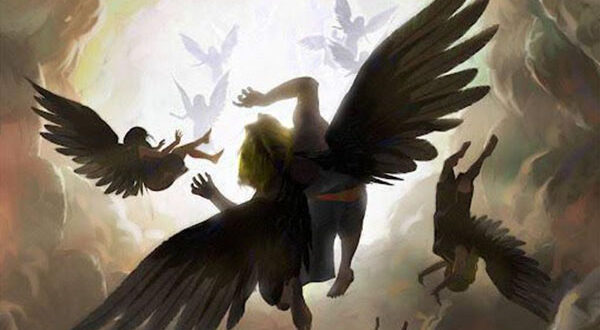
Tradition teaches that he did not fall alone.
When Lucifer rebelled, he dragged with him a multitude of angels:
“His tail swept down a third of the stars of heaven” (Rev 12:4).
📉 What does this imply?
- There exist different levels of demons
- They maintain a hierarchical structure (imitating the heavenly order)
- Each has specific roles
Saint Paul expresses it this way:
“Our struggle is not against flesh and blood, but against principalities, powers, the rulers of this present darkness” (Eph 6:12).
🜂 Demonic hierarchies (according to tradition)
Although not a defined dogma, classical theology speaks of:
- Demonic princes
- Powers
- Lesser evil spirits
Some well-known names in tradition:
- Asmodeus → associated with lust
- Mammon → wealth turned into idolatry
- Leviathan → pride
- Belial → moral corruption
⚠️ Important:
The Church does not promote morbid curiosity about these names, but rather spiritual vigilance.
5. The sin of Lucifer: the root of all evil
🜂 What sin did he commit?
Tradition agrees on one word:
👉 Pride
Lucifer did not want to serve. He wanted to be like God.
“I will not serve” (Non serviam) —an expression attributed to his rebellion.
This total rejection of God explains something essential:
👉 The devil cannot love. He can only distort love.
6. What does the devil do today? (very relevant)
🧠 He does not act like in the movies
Forget the cliché of spectacular possessions. His ordinary action is far more subtle:
- He normalizes sin
- He ridicules faith
- He promotes relativism
- He disguises evil as good
👉 His main weapon today is not fear… but indifference.
🎯 His three main strategies
- Temptation → suggesting evil
- Accusation → crushing you after you fall
- Deception → confusing truth and error
7. Can the devil harm you?
Yes… but with limits.
👉 He is not omnipotent
👉 He cannot force you to sin
👉 He is subject to God
As the Church teaches:
The devil is powerful, but he is not God.
8. Christ has already conquered: the key that changes everything
Here is the central point every Catholic must engrave in their heart:
👉 The devil is already defeated.
“The Son of God appeared to destroy the works of the devil” (1 Jn 3:8).
The battle continues… but the victory is assured in Christ.
9. Practical application: how to defend yourself today
Knowing is not enough. You must live it.
🛡️ Concrete spiritual weapons
- Frequent confession → breaks his power
- The Eucharist → real union with Christ
- Daily prayer → strengthens the soul
- The Rosary → a powerful weapon (feared by the demon)
- Life in grace → the greatest protection
🧭 Key discernment
Always ask yourself:
👉 Does this bring me closer to God or lead me away?
Because everything is decided there.
10. Conclusion: do not be afraid, but do not be naïve
The modern error is twofold:
- ❌ Denying the devil
- ❌ Obsessing over him
The Catholic position is clear:
👉 Realism + trust in God
The devil exists.
He acts.
He deceives.
But:
👉 Christ reigns.
And whoever lives in grace has nothing to fear.
✨ Final reflection
It is not about living in fear…
but in vigilance.
It is not about obsessing over evil…
but about clinging to the Good.
Because in the end, history is not written by Satan…
👉 It is written by God.