Related Articles

There is a reality that our age speaks about less and less, yet which occupies an important place in the preaching of Jesus Christ, in Sacred Scripture, and in the traditional teaching of the Church: Hell.
It is not a symbolic image invented to inspire fear, nor merely a medieval metaphor intended to control consciences. The Church teaches that Hell exists, that it is eternal, and that it consists fundamentally in definitive separation from God, as a consequence of dying in mortal sin without repentance and without accepting His mercy.
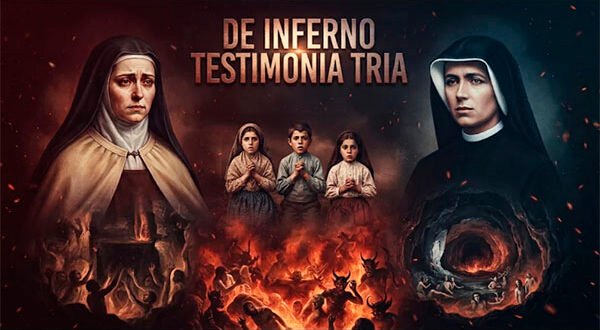
Throughout history, certain people who claimed to have received extraordinary mystical experiences have described Hell through particularly terrifying images. Among them, three testimonies stand out, separated by centuries and belonging to very different contexts:
- Saint Teresa of Ávila, a sixteenth-century Carmelite nun and one of the great Doctors of the Church.
- The three shepherd children of Fatima, Lucia, Francisco, and Jacinta, who claimed to have witnessed Hell during the apparition of 13 July 1917.
- Saint Faustina Kowalska, a Polish religious sister of the twentieth century, known for her Diary on Divine Mercy.
What is truly interesting is that their accounts present certain common elements: darkness, fire, suffering, despair, separation from God, and an experience of damnation that surpasses what we can normally imagine.
But there is an even more important question: Are we dealing with three independent testimonies describing the same spiritual reality? To what extent do they agree? What value does the Church attribute to these experiences?
We must study their words rigorously, without turning private revelations into dogmas or attributing details to them that do not appear in their writings.
1. What Does the Church Really Teach About Hell?
Before comparing the three experiences, it is necessary to establish a fundamental distinction: the existence of Hell is a truth of the Catholic faith; the particular details described by mystics belong to the realm of private revelations.
We do not believe in Hell because Saint Teresa described it, because the children of Fatima saw it, or because Saint Faustina narrated it in her Diary. We believe in it because Jesus Christ Himself spoke about it and because the Church has maintained this teaching since its beginnings.
In the Gospel of Saint Matthew, we find particularly forceful words:
“Depart from me, you cursed, into the eternal fire prepared for the devil and his angels” (Matthew 25:41).
Likewise, in Mark 9:43–48, Jesus warns about Gehenna and the fire that is not quenched. He does not use these warnings as mere literary devices to provoke a passing emotion, but as a serious call to conversion.
The Catechism of the Catholic Church develops this teaching in paragraphs 1033–1037.
In particular, paragraph 1033 defines Hell as the state of definitive self-exclusion from communion with God and the blessed. This separation occurs when a person dies in mortal sin, without repenting and without accepting God’s merciful love.
Paragraph 1035 affirms two essential truths:
- Hell exists.
- Its punishment is eternal.
It adds a decisive clarification: the chief punishment of Hell is eternal separation from God, who is the only source of life and happiness for which we have been created.
For its part, paragraph 1037 teaches that God predestines no one to Hell. To be condemned, a person must turn away from God voluntarily and persist in that rejection until the end.
Therefore, Catholic doctrine does not present God as a being who takes pleasure in punishing His creatures. It presents a much deeper and more terrible reality: the human being was created for God, but his freedom can definitively reject the love for which he was created.
This truth will be fundamental to understanding the three experiences we are about to examine.
2. Saint Teresa of Ávila: Hell as a Prison of Darkness, Confinement, and Despair
SIXTEENTH CENTURY · ÁVILA · THE BOOK OF HER LIFE, CHAPTER 32
Saint Teresa of Ávila (1515–1582), a Carmelite nun, reformer of the Carmelite Order, and Doctor of the Church, left one of the best-known mystical testimonies concerning Hell.
Her account appears in chapter 32 of her spiritual autobiography, known as The Book of Her Life.
The saint explains that, while she was praying, she experienced something that she interpreted as a vision of the place she would have deserved because of her sins.
Her opening words are very revealing:
“One day, while I was at prayer, I found myself, without knowing how, plunged into Hell.”
Teresa does not describe a distant contemplation, like someone observing a landscape from the outside. She speaks of an experience that made an extraordinarily profound impression on her.
A Narrow, Dark, and Foul-Smelling Place
The first image that appears in her description is an entrance resembling a long, narrow, low, and dark passage, comparable to an oven.
The floor seemed to be covered with a liquid resembling filthy, foul-smelling mud, in which unpleasant creatures could be found.
At the end of that passage was a kind of hollow excavated in a wall, resembling a small niche, into which she saw herself placed and imprisoned.
There is one particularly important detail: for Saint Teresa, what she saw externally was far less terrible than what she experienced internally.
The physical description of the place, however horrifying, could not express the suffering she was experiencing.
Inner Fire and the Suffering of the Soul
Saint Teresa compares the pains she felt with the worst physical sufferings she had endured during her life.
Nevertheless, she states that those bodily pains were nothing compared with what she experienced in the vision.
She describes an inner fire, a suffering that affected the soul, and a sensation of anguish, suffocation, and despair for which she could find no words adequate to explain it.
One of the most overwhelming aspects is her perception that this suffering would never end.
The eternity of punishment appears as one of the most terrifying dimensions of her experience.
She also insists on the absolute absence of consolation: there was no rest, relief, or possibility of escaping that situation.
The darkness was complete.
The Spiritual Lesson She Drew from the Vision
What is truly interesting about chapter 32 is that Saint Teresa does not conclude by dwelling on the terrifying details.
She explains the spiritual consequences that the experience produced in her.
She states that the vision greatly increased her love for God, her gratitude for having been delivered from such a fate, and her concern for the salvation of souls.
She also connects that experience with her desire to work for the Church and for the salvation of others.
The vision helped awaken in her a much deeper awareness of spiritual responsibility.
Her practical conclusion is clear: no sacrifice in this life should seem excessive if it helps us remain united to God.
In Saint Teresa, we find three particularly prominent elements: confinement, inner suffering, and the despair of a separation without end.
3. The Shepherd Children of Fatima: A Sea of Fire and Souls Like Human Embers
13 JULY 1917 · FATIMA · PORTUGAL
The second testimony comes from three Portuguese children: Lucia dos Santos, Francisco Marto, and Jacinta Marto.
According to Sister Lucia’s account, on 13 July 1917, during the third apparition of Our Lady at Cova da Iria, the three shepherd children received a vision of Hell.
This experience constitutes the first part of what is known as the Secret of Fatima.
Unlike Saint Teresa, who describes a personal and interior experience during prayer, at Fatima we find a vision shared by three people.
The best-known description appears in Sister Lucia’s memoirs, particularly the Fourth Memoir, written in 1941.
An Immense Sea of Fire
Lucia describes what the children witnessed:
“Our Lady showed us a great sea of fire which seemed to be under the earth.”
In that fire appeared the souls and the demons.
The souls had human forms and seemed like transparent embers, black or bronze-coloured, suspended and carried about by the flames.
The description includes clouds of smoke, chaotic movements, and cries of pain and despair.
The demons appeared in horrible and repulsive forms, resembling terrifying and unknown animals.
The scene was so frightening that the children experienced extraordinary fear.
Lucia explains that the vision lasted only an instant, although the impression it made on them was profound.
Hell as the Destiny of Souls Who Are Lost
There is a particularly important aspect of the message of Fatima.
According to Lucia’s testimony, Our Lady explained that they had seen Hell, where the souls of sinners go, and that God wished to establish devotion to the Immaculate Heart of Mary throughout the world in order to obtain their salvation.
The vision was not presented as a curiosity about the afterlife, but as a warning and an urgent call to conversion.
Indeed, after this experience, the children developed an extraordinary concern for the salvation of sinners.
Francisco and Jacinta, especially, embraced sacrifices and prayers for this intention.
Jacinta showed profound concern for the souls that could be condemned. This concern appears in the testimonies collected about her life.
An Important Particularity: The Children Saw Hell Together
This aspect profoundly distinguishes the account of Fatima from the other two.
Saint Teresa speaks of a personal experience.
Saint Faustina also speaks of an individual experience.
At Fatima, by contrast, Lucia states that the three children witnessed that vision.
This does not mean that all three subsequently described it in the same degree of detail. The written account we possess comes fundamentally from Lucia.
It is therefore important to distinguish between the shared experience she describes and the written documentation that has come down to us.
The Shrine of Fatima explicitly presents the vision of Hell as the first scene of the secret revealed on 13 July 1917.
And here we find a fundamental pastoral lesson: the contemplation of Hell did not lead the shepherd children to despair, but to prayer, sacrifice, and offering themselves for the salvation of others.
4. Saint Faustina Kowalska: The Seven Torments of Hell and the Particular Suffering of Each Soul
TWENTIETH CENTURY · POLAND · DIARY, PARAGRAPH 741
The third testimony belongs to Saint Faustina Kowalska (1905–1938), a Polish religious sister of the Congregation of the Sisters of Our Lady of Mercy and an apostle of Divine Mercy.
Her experience is found in paragraph 741 of her Diary: Divine Mercy in My Soul.
The text begins with a direct statement:
“Today I was led by an Angel to the chasms of hell.”
Faustina explains that she contemplated a place of torment whose vastness seemed immense to her.
She then lists seven sufferings which, according to her account, the condemned experience together.
Her description is particularly interesting because it does not limit itself to presenting images of fire and darkness. It organises the torments into a kind of spiritual classification.
The Seven Torments Described by Saint Faustina
1. The Loss of God
This is the first torment and the most important from a theological point of view.
The condemned soul has definitively lost the possibility of attaining God and enjoying His presence.
This description directly corresponds to the doctrine of the Catechism: eternal separation from God constitutes the chief punishment of Hell.
2. The Constant Remorse of Conscience
The second suffering is permanent remorse.
The condemned person experiences the awareness of having rejected goodness and having definitively lost the possibility of changing their situation.
This is not the hopeful repentance that can still lead to conversion during earthly life, but a painful awareness of one’s irreversible condition.
3. The Certainty That Their Destiny Will Never Change
Faustina describes as the third torment the awareness that this state will never end.
There is no second opportunity after death to escape damnation.
Eternity constitutes a fundamental dimension of her description.
4. The Fire That Torments the Soul
The fourth torment is a fire which, according to her account, penetrates the soul without destroying it.
Faustina describes it as a terrible spiritual fire.
It is important to remember that the Church teaches the reality of the punishment of eternal fire, but has not defined all the physical or metaphysical mechanisms of that fire. The particular explanations given by mystics must not be confused with a dogmatic definition of its nature.
5. Permanent Darkness and a Suffocating Smell
The fifth torment includes constant darkness and a horrible, suffocating smell.
Faustina adds a striking detail: despite the darkness, the condemned souls and the demons can see one another, as well as contemplate the evil of others and their own.
This image recalls certain elements found in the accounts of Teresa and Fatima.
6. The Constant Company of Satan
The sixth torment consists of the permanent company of Satan.
The presence of the devil, far from representing a pleasant authority for the condemned, appears as another dimension of their suffering.
7. Despair, Hatred, and Blasphemy
The seventh torment brings together despair, hatred of God, curses, and blasphemies.
This is a particularly profound description because it shows that Hell is not characterised solely by suffering imposed from outside.
It also appears as a state of inner disorder, opposition to God, and rejection of goodness.
Particular Torments According to Each Soul’s Sins
After listing these seven torments, Faustina adds an extraordinarily important clarification.
She states that there are also particular torments for certain souls, related to their senses and to the things in which they sinned.
In other words, each soul would be tormented in a particular way in relation to the evil it committed.
This detail introduces a dimension of personal justice: sin is not something indifferent, and moral decisions have consequences.
Faustina ends by acknowledging that, although she had tried to describe what she had witnessed, she could not find sufficient words to express its magnitude.
Her testimony concludes with a statement worth remembering: she would rather have suffered the greatest torments until the end of the world than commit the smallest sin.
The spiritual purpose of her experience, therefore, was not to satisfy curiosity about Hell, but to awaken a deeper awareness of the gravity of sin and the need for Divine Mercy.
5. Comparison: The Similarities Between the Three Visions
We now arrive at the most interesting question in this article.
Saint Teresa of Ávila, the three shepherd children of Fatima, and Saint Faustina Kowalska belong to different historical periods, lived under different circumstances, and described their experiences from very particular personal perspectives.
Nevertheless, we find similarities that deserve to be examined.
It is important to point out that not all the elements appear in all three accounts with the same degree of detail. The comparison must distinguish between direct similarities and general resemblances.
Comparative Table of the Three Experiences
| Element | Saint Teresa | Fatima | Saint Faustina |
|---|---|---|---|
| Fire | Inner fire and intense suffering | Great sea of fire | Fire that torments the soul |
| Darkness | Extremely dark surroundings | Scene of fire and smoke | Permanent darkness |
| Suffering | Agony of the soul and bodily pain | Cries and groans of pain | Spiritual and particular torments |
| Despair | Anguish and absence of consolation | Cries of despair | Permanent despair |
| Demons | Presence and reference to the place prepared by them | Horrible and monstrous forms | Constant company of Satan |
| Unpleasant smell | Foul-smelling mud | Smoke and fire | Horrible and suffocating smell |
| Eternity | Endless suffering | Destiny of damnation | A state that will never change |
| Separation from God | Implied in the anguish and absence of consolation | Not explicitly developed in the visual description | The first of all the torments |
First Similarity: Fire
This is probably the best-known similarity.
All three experiences present fire as one of the fundamental elements of Hell.
However, there are interesting differences:
- Teresa speaks of an inner fire that produces indescribable suffering.
- The shepherd children contemplate a sea of fire in which souls and demons appear.
- Faustina distinguishes a spiritual fire that penetrates the soul without destroying it.
The similarity is remarkable, although the descriptions are not identical.
It is also important to remember that fire appears repeatedly in Jesus Christ’s own teaching, particularly in Matthew 25:41 and Mark 9:43–48.
Therefore, this is not an image that depends exclusively on these mystical experiences.
Second Similarity: Darkness
All three descriptions present an environment associated with darkness.
Teresa speaks of absolutely dark surroundings.
Faustina mentions permanent darkness.
At Fatima, Lucia describes a scene of fire, smoke, and figures appearing as dark embers.
This similarity connects with another Gospel expression: the “outer darkness” of Matthew 8:12, where Jesus speaks of weeping and gnashing of teeth.
Darkness also has a spiritual meaning: it represents the absence of divine light and the loss of communion with God.
Third Similarity: The Suffering of the Soul
Perhaps this is one of the deepest similarities.
In Saint Teresa, inner suffering surpasses every physical pain she had ever known.
At Fatima, the souls appear amid cries and groans of despair.
In Faustina, spiritual suffering acquires a more detailed structure: loss of God, remorse, despair, hatred, and awareness of an irreversible situation.
All three experiences point towards a reality that goes beyond simple bodily pain.
Hell does not appear as a place where people merely suffer flames, but as a condition of integral suffering.
Fourth Similarity: The Demons
In all three testimonies, demons appear as elements associated with Hell.
Saint Teresa mentions the place that the demons had prepared for her and describes the horror of that experience.
At Fatima, the demons appear in monstrous and repulsive forms, resembling unknown animals.
In Faustina, Satan appears as the permanent companion of the condemned.
This similarity is particularly interesting because all three descriptions show the devil as a creature associated with suffering and damnation, never as a glorious sovereign ruling an independent kingdom.
This is entirely consistent with Catholic doctrine: Satan is a creature who rebelled against God, not a divinity opposed to Him.
Fifth Similarity: Eternity and the Impossibility of Escape
This is another fundamental point.
Teresa insists on the idea of suffering that never ends.
Faustina explicitly states that this destiny will never change.
At Fatima, although the visual description does not explicitly develop this question, the message presents Hell as a destiny of damnation and warns of the need to save sinners.
Here we find a particularly important correspondence with the teaching of the Catechism, which affirms the eternity of Hell in paragraph 1035.
Sixth Similarity: The Olfactory Dimension and Repulsiveness
This detail often goes unnoticed.
Saint Teresa speaks of a floor resembling foul-smelling mud.
Saint Faustina mentions a horrible and suffocating smell.
Lucia describes smoke, fire, and repulsive figures, but does not explicitly attribute an unpleasant smell to the vision.
Therefore, we can speak of a partial similarity between Teresa and Faustina, rather than a characteristic shared by all three accounts.
This is an interesting detail because it shows that the experiences are not exact copies of one another.
6. How Is It Possible That They Describe Such Similar Experiences Without Knowing One Another?
This is probably the question that attracts the most attention.
We are talking about three testimonies originating in very different historical contexts:
Saint Teresa of Ávila
1515–1582
Spain · Sixteenth century.
She records her experience in The Book of Her Life, chapter 32.
The Shepherd Children of Fatima
1917
Portugal · Twentieth century.
The vision takes place on 13 July, during the third apparition.
Saint Faustina Kowalska
1905–1938
Poland · Twentieth century.
She records her experience in the Diary, paragraph 741.
Several centuries separate Saint Teresa from Fatima. Between Fatima and Saint Faustina, only a few years passed.
Nevertheless, their descriptions contain similarities that cannot simply be ignored.
There is an important historical clarification to make here: we do not have sufficient documentation to claim that none of the protagonists knew the accounts of the others before their respective experiences.
In Saint Teresa’s case, her experience occurred long before the other two.
As for the shepherd children, we have no documentary evidence that they knew chapter 32 of The Book of Her Life. Nor can we categorically prove that they never had any contact with its contents.
Regarding Faustina, there is an even more delicate issue: the apparitions of Fatima had taken place when she was twelve years old, and their message was already known in the Catholic world. Therefore, it would not be rigorous to claim that she necessarily knew nothing about Fatima.
We also lack sufficient evidence to establish that she knew the specific experience of Saint Teresa.
Consequently, the historically correct formulation is that these are testimonies from different people, belonging to different periods and circumstances, with no direct relationship of dependence between their respective descriptions having been demonstrated.
This allows us to study their similarities, but it does not by itself prove that all the images are literal reproductions of a supernatural reality.
What Explanation Can We Offer from a Catholic Perspective?
There are several considerations that help us understand this question.
1. The three testimonies refer to the same doctrinal reality.
All three speak about Hell, whose existence does not depend on the particular experiences of these people.
The Church had already been teaching the reality of eternal fire and separation from God many centuries before Saint Teresa wrote her autobiography.
2. Sacred Scripture provides a common language.
Fire, darkness, suffering, and damnation appear in different biblical passages.
For this reason, the similarities do not necessarily have to be interpreted as the result of information being transmitted between the protagonists.
All of them belong to a Christian tradition familiar with the warnings of Jesus Christ concerning eternal destiny.
3. Mystical experiences can use different images to express the same reality.
Catholic theology recognises that supernatural experiences can be described through images, symbols, and representations adapted to the human capacity for understanding.
We must not confuse the image contemplated with a scientific or anatomical description of the afterlife.
This is particularly important when speaking about fire, the dimensions of Hell, or the forms of demons.
4. Similarity does not constitute scientific proof.
The fact that three people describe similar elements may be striking and spiritually significant, but it does not in itself demonstrate the supernatural authenticity of each experience.
The Catholic faith does not need to turn these similarities into scientific proof in order to maintain its doctrine concerning Hell.
7. A Fundamental Difference: Three Perspectives, Three Spiritual Messages
Although the similarities are interesting, the differences between the testimonies are also of enormous value.
Each experience seems to emphasise a particular dimension of the mystery of damnation.
| Testimony | Most prominent aspect | Spiritual consequence |
|---|---|---|
| Saint Teresa | Anguish, confinement, and inner suffering | Gratitude to God and desire for holiness |
| Fatima | The damnation of souls and the need to save them | Prayer, sacrifice, and reparation |
| Saint Faustina | The loss of God and the different torments | Conversion, rejection of sin, and trust in Divine Mercy |
Saint Teresa: Understanding the Gravity of Sin
Saint Teresa’s experience led her to take eternal salvation much more seriously.
Her account contains a lesson that is particularly necessary in our time: sin is not a superficial matter or a mere psychological imperfection.
Mortal sin breaks our friendship with God and, if there is no repentance before death, can lead to eternal damnation.
But Teresa does not end her reflection with fear. Her response is to love God more, serve Him, and seek to ensure that other souls are not lost.
Fatima: Understanding Our Responsibility for the Salvation of Others
In the shepherd children, we find a particularly moving dimension.
After contemplating Hell, they did not limit themselves to worrying about their own destiny.
Their concern extended to sinners.
They offered sacrifices, prayed the Rosary, and accepted sufferings for the conversion of souls.
The vision thus becomes a call to supernatural charity.
It is not enough to seek our own salvation: we must also be concerned about the salvation of our relatives, friends, and those who still live far from God.
Saint Faustina: Understanding That Mercy Does Not Eliminate Justice
Faustina’s experience has a particularly interesting relationship with the central message of her spirituality: Divine Mercy.
It might seem contradictory that a religious sister dedicated to spreading trust in God’s mercy should describe Hell so harshly.
However, there is no contradiction.
Divine Mercy does not mean that sin has no consequences.
God offers His forgiveness, continually calls us to conversion, and desires the salvation of all people. But He does not force anyone to love Him.
Faustina’s message is not that everyone will be saved regardless of their decisions, but that we must trust in God, repent, and not reject His grace.
Mercy is an invitation to return to God, not permission to live separated from Him.
8. What Does the Bible Say About the Characteristics That Appear in the Three Visions?
One of the most interesting checks we can make is to compare the testimonies with the texts of Sacred Scripture.
We find several parallels.
Eternal Fire
Jesus Christ speaks of eternal fire in Matthew 25:41:
“Depart from me, you cursed, into the eternal fire prepared for the devil and his angels.”
This text has an evident connection with the descriptions of fire given by Fatima, Teresa, and Faustina.
The Outer Darkness
In Matthew 8:12, we find these words:
“While the children of the kingdom will be thrown into the outer darkness; there men will weep and gnash their teeth.”
The image of darkness is particularly developed in Saint Teresa and Saint Faustina.
Suffering and Despair
In Luke 16:19–31, Jesus Christ presents the parable of the rich man and Lazarus.
After dying, the rich man finds himself in a place of torment and asks for someone to go and warn his brothers so that they do not end up in the same situation.
This passage is particularly significant for understanding concern for the salvation of others.
It also recalls the message of Fatima: warning about damnation and calling people to conversion.
Definitive Separation
Perhaps the most important parallel is found in Matthew 25:46:
“And they will go away into eternal punishment, but the righteous into eternal life.”
The eternity of each destiny appears explicitly in the words of Jesus Christ.
It is not an invention of mystics or a particular interpretation belonging to a historical period.
It is a teaching that belongs to the very heart of Christian eschatology.
9. Must We Believe Literally Every Detail of These Three Experiences?
This question is fundamental if we are to avoid mistakes.
The Church distinguishes between Public Revelation and private revelations.
Public Revelation was completed with Jesus Christ and the apostolic witness. No subsequent revelation can add a new truth necessary to complete the deposit of faith.
The Catechism explains this in paragraph 67:
“Throughout the ages, there have been so-called ‘private’ revelations.”
Some of them have been recognised by the authority of the Church, but none belongs to the deposit of faith.
Their purpose is to help people live more fully the definitive Revelation of Christ in a particular historical period.
This has important consequences for our study.
First: we must believe in the existence of Hell because it is a truth taught by Jesus Christ and confirmed by the Magisterium, not because Saint Teresa or Faustina had a vision.
Second: the particular descriptions are not dogmas. The Church does not require us to believe that Hell has exactly the shape of a narrow passage, a sea of fire, or any particular dimensions.
Third: even when a private revelation has received ecclesiastical recognition, its details do not automatically acquire the authority of Public Revelation.
At Fatima, the message received ecclesiastical recognition and has been the subject of profound study by the Church. In 2000, the Congregation for the Doctrine of the Faith published the document The Message of Fatima, which expressly recalls the nature of private revelations.
The process of recognising a supernatural experience does not turn all its images into doctrinal definitions either.
In the case of Saint Faustina, her canonisation does not mean that every detail of her Diary has become a truth of faith.
We must apply the same prudence to Saint Teresa.
The holiness of a person does not mean that all their personal experiences have the same degree of authority as Sacred Scripture or the Magisterium.
10. The Great Lesson for Catholics Today: Hell Must Not Become a Forgotten Subject
There is a pastoral question that deserves particular reflection.
In many contemporary religious conversations, people speak extensively about God’s love, His mercy, His forgiveness, and His closeness to us.
All of this is true and fundamental.
However, sometimes speaking about Hell, mortal sin, particular judgment, or eternal damnation seems uncomfortable.
As a consequence, many Catholics know these truths only superficially or even come to think that Hell is merely a metaphor.
But Jesus Christ did not avoid speaking about it.
Traditional Catholic preaching has always considered meditation on the Four Last Things — death, judgment, Hell, and Heaven — an important part of spiritual formation.
Not so that we live obsessed with fear, but so that we understand the importance of our decisions.
Sin Is Not a Game
Contemporary society tends to relativise many forms of moral behaviour.
Freedom is frequently presented as the possibility of doing whatever we want without consequences.
But Christian freedom is much deeper.
We are free to choose, but our choices have spiritual and moral consequences.
The Catechism reminds us that three conditions must be present for a sin to be mortal:
- Grave matter.
- Full knowledge.
- Deliberate consent.
This is explained in paragraph 1857.
This means that not every sin has the same gravity, and that not every mistake automatically leads to damnation.
The Church teaches the seriousness of mortal sin, but also reminds us that we must avoid judging the interior state of other people.
Only God fully knows a person’s conscience and responsibility.
The Importance of Confession
The existence of Hell should encourage us to value the Sacrament of Penance.
Christ has entrusted His Church with the means by which we receive forgiveness for our sins.
We must not become accustomed to living in mortal sin or indefinitely postpone our conversion.
Sacramental Confession is an immense gift of Divine Mercy.
A Catholic who acknowledges their sins, sincerely repents, and approaches the sacrament to receive God’s forgiveness does not need to live in despair over their past.
They must live with humility, trust, and a firm purpose of amendment.
Praying for the Conversion of Sinners
Here we find one of the most beautiful teachings of Fatima.
The shepherd children did not contemplate Hell in order to condemn others, but to become concerned for their salvation.
This attitude should inspire our Christian lives.
We can pray for our relatives who have drifted away from the faith, offer small sacrifices for the conversion of sinners, participate in Holy Mass, and practise the works of mercy.
Concern for the eternal salvation of others must not become an attitude of superiority, but an expression of charity.
Living with Trust in Divine Mercy
Finally, the testimony of Saint Faustina reminds us of something essential: no one should despair of God’s mercy while they are alive.
The Lord desires our salvation.
Saint Paul expresses this in his First Letter to Timothy:
“God desires all men to be saved and to come to the knowledge of the truth” (1 Timothy 2:4).
Therefore, meditation on Hell must always be accompanied by trust in divine grace.
We are not called to live terrified, but to live in the grace of God.
11. One Final Reflection: Three Testimonies, One and the Same Warning
Saint Teresa of Ávila, the shepherd children of Fatima, and Saint Faustina Kowalska lived in different periods, came from different countries, and left personal testimonies with their own particular characteristics.
Their descriptions coincide in several particularly striking elements:
- Fire as an image of suffering.
- Darkness and the absence of light.
- Anguish and despair.
- The presence of demons.
- The impossibility of escaping damnation.
- The gravity of definitively losing communion with God.
We cannot demonstrate that these similarities originated from supernatural communication between the protagonists, nor can we claim that their experiences were entirely independent of every cultural or religious influence.
Nor should we turn every detail of their accounts into a literal and dogmatic description of the afterlife.
But we can recognise that the three testimonies offer an extraordinarily profound spiritual reflection that is consistent with the great truths of the Catholic faith.
There is, moreover, one detail that deserves to be highlighted.
None of these testimonies has as its main purpose satisfying our curiosity about what Hell looks like.
Saint Teresa emerged from that experience with a deeper desire to love and serve God.
The shepherd children of Fatima began offering sacrifices and prayers for the conversion of sinners.
Saint Faustina insisted on the need to reject sin and trust in Divine Mercy.
Three experiences, three circumstances, and three spiritual responses that lead to the same warning: our life has an eternal destiny, and we cannot treat our salvation as a secondary matter.
The Church does not invite us to look at Hell with morbid curiosity, but to contemplate the greatness of the salvation that Jesus Christ has offered us through His Passion and Resurrection.
Because, if there is one truth that must always accompany Christian meditation on Hell, it is this:
God does not desire the damnation of any human being. He wants everyone to be saved. But He has created us free and calls us to respond to His love.
And while we are alive, the door of mercy remains open.
Sources and References for Further Reading
Primary Sources
- Saint Teresa of Ávila, The Book of Her Life, chapter 32. Account of her mystical experience concerning Hell.
- Sister Lucia of Fatima, Memoirs, Fourth Memoir, account of the vision of Hell on 13 July 1917.
- Saint Faustina Kowalska, Diary: Divine Mercy in My Soul, paragraph 741.
Doctrinal and Ecclesiastical Sources
- Catechism of the Catholic Church, paragraphs 67 and 1033–1037, concerning private revelations and the doctrine of Hell.
- Congregation for the Doctrine of the Faith, The Message of Fatima, 26 June 2000.
- Shrine of Fatima, chronology of the apparitions and documentation concerning 13 July 1917.