Related Articles


Introduction: A Question We Have All Asked
Why does God allow evil people to exist? Why does evil often seem to prosper while so many righteous people suffer? Why do we find scandals, divisions, and even grave sins within the Church itself? Shouldn’t God immediately eliminate evil?
These questions have accompanied humanity since the beginning of history. They also troubled the disciples of Jesus Christ, and the Lord answered them through one of the deepest and most prophetic parables in the Gospel: the Parable of the Wheat and the Weeds.
It is found in the Gospel according to Saint Matthew (Matthew 13:24–30), and a few verses later Jesus Himself provides its interpretation (Matthew 13:36–43), something rather exceptional, since He did not always explain His parables personally.
Although it may seem like a simple story about farming, this parable is actually a profound summary of salvation history. Within it we find teachings about the origin of evil, God’s patience, human freedom, the Last Judgment, the nature of the Church, divine mercy, and Christian hope.
In a society marked by moral confusion, relativism, and the tendency to judge others hastily, this parable is more relevant than ever.
The Text of the Parable
Jesus said:
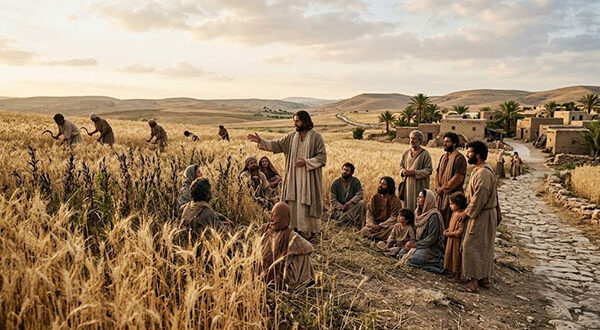
“The Kingdom of Heaven is like a man who sowed good seed in his field. But while everyone was sleeping, his enemy came and sowed weeds among the wheat and went away.
When the wheat sprouted and formed heads, then the weeds also appeared.
The owner’s servants came to him and said,
‘Sir, didn’t you sow good seed in your field? Where then did the weeds come from?’
‘An enemy did this,’ he replied.
The servants asked him,
‘Do you want us to go and pull them up?’
‘No,’ he answered, ‘because while you are pulling up the weeds, you may uproot the wheat with them.
Let both grow together until the harvest. At that time I will tell the harvesters: First collect the weeds and tie them into bundles to be burned; then gather the wheat and bring it into my barn.'”
(Matthew 13:24–30)
The Context of the Teaching
Jesus tells this parable beside the Sea of Galilee.
The crowds were expecting a Messiah who would immediately destroy sinners and establish a political kingdom.
Instead, Christ presents a completely different vision.
The Kingdom of God does not advance through violence or by instantly eliminating the wicked. It grows slowly, silently, and amid contradictions.
This teaching completely overturned the religious expectations of His time.
What Does Each Element Represent?
Jesus Himself explains the meaning.
The Sower
It is Christ.
He is the One who sows the good seed.
Everything God creates is good.
Sin never comes from God.
The Field
Jesus clearly says:
“The field is the world.”
Not merely the Church.
The whole of humanity is the stage upon which the battle between good and evil unfolds.
The Good Seed
These are the children of the Kingdom.
This does not mean perfect people.
They are those who accept God’s grace and strive to live according to His will.
The Weeds
These are the children of the Evil One.
Here an important clarification must be made.
Jesus does not say that some people are created evil.
Every human being has been created in the image and likeness of God.
The expression refers to those who freely choose to live under the influence of sin and reject God’s grace.
The Enemy
It is Satan.
Christ states something revolutionary.
Evil does not originate with God.
It has a spiritual author.
The devil acts by sowing confusion, division, lies, and sin.
This parable confirms the real existence of the devil, a truth of the faith that is often forgotten in our own time.
The Harvest
It represents the end of the world.
Good and evil will not remain mixed forever.
History has an ending.
There will be a judgment.
The Harvesters
They are the angels.
God will entrust them with the final separation of the righteous from the wicked.
What Exactly Are the Weeds?
The weed referred to in the parable was a plant well known in Palestine.
Its scientific name is Lolium temulentum.
During the early stages of growth, it looks almost identical to wheat.
Only when it matures can the difference be clearly seen.
That is precisely the heart of the message.
Very often evil presents itself with the appearance of good.
Not everything that seems good truly is.
Sin frequently disguises itself.
A lie rarely announces itself by saying,
“I am a lie.”
More often it adopts the language of love, freedom, or progress.
This teaching is extraordinarily relevant today.
The Great Mystery: Why Doesn’t God Immediately Destroy Evil?
This is the great question.
The servants offer what seems like the obvious solution.
“Let’s pull up the weeds now.”
We often think the same way.
Why doesn’t God immediately eliminate evil people?
Why doesn’t He instantly punish every injustice?
Why does He allow wars, corruption, and scandals?
Christ’s answer is astonishing.
“No.”
Why?
Because you might uproot the wheat as well.
The Patience of God
Here we encounter one of God’s most wonderful attributes:
His patience.
Saint Peter writes:
“The Lord is not slow in keeping His promise… Instead He is patient with you, not wanting anyone to perish.”
(2 Peter 3:9)
God’s patience does not mean indifference.
It means mercy.
God grants time for conversion.
Many saints were once great sinners.
Had God acted immediately with justice, they would never have had the opportunity to convert.
Saint Paul persecuted Christians.
Saint Augustine spent many years far from God.
Saint Mary Magdalene experienced a radical conversion.
Saint Ignatius of Loyola sought worldly glory before his conversion.
The wheat of today may have looked like weeds yesterday.
Only God knows the future of every soul.
A Lesson Against Rash Judgment
The servants want to separate the good from the bad immediately.
Jesus tells them not to do so.
Why?
Because human beings cannot see the heart.
Only God knows:
- people’s intentions
- their conscience
- their personal history
- their interior wounds
- their circumstances
- the opportunities they have received
- the degree of their moral responsibility
That is why Jesus said:
“Do not judge, and you will not be judged.”
This does not mean abandoning moral discernment.
It means avoiding the temptation to condemn people inwardly.
We may judge actions.
We cannot definitively judge souls.
The Parable and the Church
One of the most important applications of this parable concerns the Church herself.
From her very beginning, there have existed together:
- saints
- sinners
- heroes of the faith
- traitors
Among the Twelve Apostles was Judas.
The earliest Christian communities experienced divisions.
Saint Paul had to correct numerous abuses.
The Church has never been a community made up exclusively of perfect people.
She is the hospital where Christ heals sinners.
Those who abandon the Church because they find sinners within her forget that Christ Himself foretold this reality.
The presence of weeds within the field does not prove that the Gospel has failed.
It proves that Jesus was right.
The Danger of Believing We Are Always the Wheat
There is a superficial way of reading this parable.
To think:
“The bad people are everyone else.”
But the parable first invites us to look into our own hearts.
Each of us carries an interior struggle.
As Saint Paul said:
“For I do not do the good I want, but the evil I do not want is what I keep on doing.”
Every human heart is a field where seeds of holiness grow, but where sin also tries to sow its weeds.
Conversion begins by allowing Christ to purify our hearts.
The Spiritual Battle
The weeds continue to be sown every single day.
Today the enemy uses many different means:
- lies presented as truth
- moral relativism
- the trivialisation of sin
- religious indifference
- hatred disguised as justice
- selfishness turned into a way of life
- consumerism
- hopelessness
- the loss of the sense of sin
The spiritual battle continues.
The Good News is that Christ has already won the victory.
Human Freedom
This parable also teaches us about the importance of freedom.
God forces no one to love Him.
True love requires freedom.
For that reason, He allows every person to respond freely to His grace or to reject it.
Without freedom, there could be neither merit nor holiness.
But neither could there be sin.
The Last Judgment
Many people forget this dimension.
God’s patience has a limit.
The harvest will come.
There will be a judgment.
Christ speaks with remarkable clarity.
The weeds will be separated.
The wheat will be gathered.
This is not a threat.
It is a promise of justice.
The victims of history need to know that evil will not have the final word.
God will establish perfect justice.
Christian Hope
Although evil often appears to prevail, the parable ends with hope.
The wheat will be gathered.
The Kingdom will triumph.
Christ will reign victorious.
The saints will shine “like the sun in the Kingdom of their Father.”
This expression recalls the glory of the Resurrection.
The Christian’s final destiny is not an endless struggle.
It is perfect communion with God.
The Teaching of the Church Fathers
The earliest Christian writers reflected deeply on this parable.
Saint John Chrysostom
He explains that Christ forbids the servants from pulling up the weeds because many sinners may later become saints. If they were removed too soon, future conversions—known only to God—would be lost.
Saint Augustine
He insists that no one should presume to belong definitively to the wheat while still living in this world. Every Christian must persevere in humility, for only God’s judgment will fully reveal the heart of each person.
Saint Gregory the Great
He emphasises that the coexistence of the good and the wicked also serves to purify the righteous. Trials, contradictions, and scandals can become paths to holiness when lived with faith.
Saint Thomas Aquinas
Following the patristic tradition, he teaches that God’s patience is not weakness but an expression of His wisdom and providence. He knows how to draw greater good even from situations in which evil seems to prevail.
Pastoral Applications for Our Lives
The parable was not given merely to be studied but to be lived.
1. Do Not Lose Hope Because of the Evil in the World
Wars, corruption, religious persecution, and injustice do not mean that God has abandoned history. He remains the Lord of the field and is leading everything towards its ultimate fulfilment.
2. Examine Your Own Heart
Before pointing to the weeds growing in others, ask yourself which weeds may be taking root within your own soul: pride, resentment, lukewarmness, envy, or a lack of charity.
3. Trust in God’s Mercy
As long as there is life, there is the possibility of conversion. We must never consider anyone beyond God’s saving grace—not even ourselves.
4. Do Not Be Scandalised by Sin Within the Church
The sins of Christians are real and deeply painful, but they do not invalidate the holiness of the Church, whose Head is Christ. He Himself foretold that wheat and weeds would grow together until the end.
5. Persevere with Patience
The wheat grows slowly.
Holiness is not achieved overnight.
God works quietly, like a seed that matures without making any noise.
6. Live with Your Eyes Fixed on Eternity
History does not end with the injustices of the present.
God’s judgment will render to each person according to his or her deeds and will fully reveal both His justice and His mercy.
The Relevance of the Parable in the Twenty-First Century
We live in an age in which good and evil are often confused.
What contradicts the natural moral law is frequently presented as progress.
Truth is relativised.
Success appears to matter more than virtue.
Social media encourages quick judgments and public condemnation without mercy.
The Parable of the Wheat and the Weeds invites us to embrace a profoundly Christian attitude: to discern without falling into relativism, to defend the truth without losing charity, to fight against sin without hating the sinner, and to trust that God continues to guide history even when evil appears to prevail.
It also challenges every baptised believer to become “wheat” in the midst of the world: a humble, fruitful, and quiet presence that bears fruit for the glory of God and the good of others.
The Christian is called to sow peace where there is hatred, truth where there is confusion, hope where discouragement reigns, and holiness in a culture that has often forgotten God.
Conclusion: What Kind of Seed Are We Allowing to Grow?
The Parable of the Wheat and the Weeds is not merely an explanation of the origin of evil.
Above all, it is an invitation to hope and conversion.
Christ reminds us that God has not lost control of history.
The enemy may sow weeds, but he can never ultimately destroy the Lord’s field.
God’s patience is an opportunity to change our lives, grow in holiness, and cooperate with His saving work.
Every day, through our decisions, words, and actions, we either allow the wheat of grace to flourish within us or make room for the weeds of sin.
The Lord continues to sow good seed through the power of His Word, the Sacraments, and the action of the Holy Spirit.
Our free response will determine the fruit we bear.
In the end, the harvest will come.
Then appearances, masks, and confusion will disappear forever.
Only what has been sown in the love of God will remain.
Therefore, the great question this parable asks every believer is not who the weeds around us are, but whether we are allowing Christ to bring to maturity within us the good wheat that will one day shine, according to the promise of the Gospel, like the sun in the Kingdom of the Father.