Related Articles
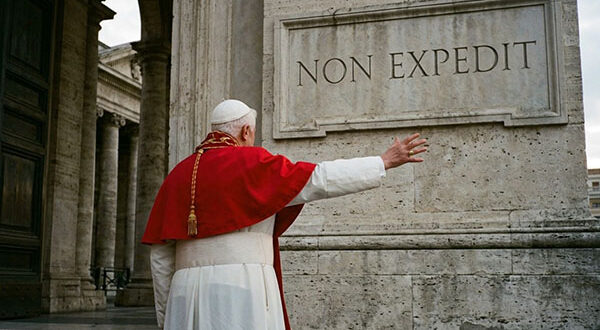
There was a time when the Catholic Church clearly told the faithful that they should not participate in the political life of the modern Italian state. It was not a mild recommendation nor a simple prudential opinion. It was a serious directive, deeply tied to the defense of the faith, the spiritual authority of the Church, and the survival of the Christian order in a revolutionary age.
That Latin expression was brief, yet explosive:
“Non Expedit”
“It is not expedient.”
Two words that contained a tremendous spiritual battle between the Church and the modern world.
Today, in an era marked by political confusion, aggressive secularization, laws against natural law, and the loss of the Christian sense of society, many Catholics are once again asking:
- Should a Catholic participate in political systems hostile to God?
- Is there a moral limit to cooperation with the State?
- Can a Catholic support parties that promote grave evils?
- What does the Non Expedit teach us today?
The story of this papal decision belongs not only to the past. It is a prophetic mirror for our own time.
What exactly was the Non Expedit?
The Non Expedit was a policy officially adopted by the Holy See during the nineteenth century that discouraged—and in certain contexts practically prohibited—the participation of Italian Catholics in the political life of the new Kingdom of Italy.
The expression comes from the Latin formula:
“Non expedit”
“It is not expedient.”
Concretely, it meant that Catholics were not to:
- vote in national elections,
- run as political candidates,
- actively collaborate with the new liberal Italian State.
The measure arose in a dramatic context: the unification of Italy had violently taken the Papal States from the Pope, reducing his temporal sovereignty and leaving the Church in a situation of political and cultural persecution.
To understand the Non Expedit, one must realize that it was not simply a political matter. It was a profoundly spiritual and theological issue.
The historical context: Revolution against the Christian order
For centuries, the Pope had exercised not only spiritual authority but also temporal sovereignty over the Papal States. This guaranteed a minimum political independence from civil powers.
However, the nineteenth century was marked by:
- anti-Catholic liberalism,
- revolutionary nationalism,
- Freemasonry,
- secularism,
- and the desire to build modern states detached from Christ and the Church.
Many leaders of the Italian Risorgimento saw the Papacy as an obstacle to the new unified Italy.
In 1870, Italian troops took Rome. The Pope lost the Papal States. The Pontiff declared himself a “prisoner in the Vatican.”
This was not merely a political defeat.
It was the symbol of something far deeper:
the attempt of the modern world to expel Christ from the social order.
The theological issue behind the conflict
The Church has always taught that Christ must reign not only in individual souls, but also over societies.
The social kingship of Christ means that:
- human laws must respect natural law,
- politics must serve the true common good,
- civil authority is subordinate to God,
- nations have duties toward religious truth.
That is why the clash between the Church and modern liberal states was so intense.
Nineteenth-century liberalism asserted:
- that religion should be relegated to the private sphere,
- that all religions should be considered equal before the State,
- that sovereignty resides exclusively in the people,
- that politics can be organized without reference to God.
The Church saw in this a doctrinal rebellion against the order willed by God.
The Non Expedit as an act of spiritual resistance
Many today interpret the Non Expedit as merely a political strategy. In reality, it was a form of spiritual resistance.
Participating in that political system could be interpreted as:
- legitimizing the dispossession of the Church,
- tacitly accepting the anti-Christian liberal order,
- cooperating with structures hostile to the faith.
The Holy See wanted to prevent Catholics from helping consolidate a system built, in large part, against the Church.
At its heart, the question was:
can a Catholic collaborate with a system that actively fights against God?
And that question remains profoundly relevant today.
“You cannot serve God and mammon”
Christ said:
“No one can serve two masters.”
— Matthew 6:24
And also:
“Seek first the kingdom of God and His righteousness.”
— Matthew 6:33
These words have political consequences.
The Gospel is not merely a private spirituality. It has social, cultural, and moral implications.
When a political system:
- destroys the family,
- legalizes abortion,
- corrupts children,
- fights against truth,
- mocks the faith,
- promotes ideologies against nature,
the Catholic cannot act as though politics were morally neutral.
The Non Expedit reminded the faithful precisely of this:
there are historical moments when neutrality becomes complicity.
Does this mean Catholics should never participate in politics?
No.
And here it is important to avoid simplifications.
The Church does not condemn political participation in itself. In fact, she teaches that the laity have an essential mission in the Christian transformation of society.
The problem arises when:
- the system demands compromises incompatible with the faith,
- participation implies cooperation with evil,
- politics becomes idolatry,
- power replaces God.
Over time, the Holy See relaxed the Non Expedit because new historical circumstances emerged. The socialist and anti-Christian threat made a more active Catholic presence in public life necessary.
Eventually, Pope Pius X allowed certain forms of Catholic political participation.
But the underlying moral principle never disappeared:
the Catholic must never sacrifice truth for political convenience.
The great modern danger: turning politics into religion
Today many Catholics live absorbed by political ideologies.
Some believe salvation will come:
- from a political party,
- from a leader,
- from a cultural revolution,
- from a national ideology,
- or from economic programs.
But Christianity teaches something radical:
no political structure can replace the Kingdom of God.
Politics can be important.
It can be necessary.
It can be a moral duty.
But it can never become an absolute.
When politics takes the place of God:
- fanaticism is born,
- charity is destroyed,
- evil is justified,
- and the soul loses its peace.
The Non Expedit was also a warning against political idolatry.
The current crisis: are we living a new implicit Non Expedit?
Many traditional Catholics today feel a tension similar to that of the nineteenth century.
They see political systems where:
- almost every party supports abortion,
- euthanasia is normalized,
- gender ideology is imposed,
- Christian education is attacked,
- natural morality is persecuted.
Then a painful question arises:
how can one participate without becoming contaminated?
The Catholic answer has never been absolute escapism, but neither is it naive submission.
The Christian must:
- discern,
- resist evil,
- support what is compatible with moral law,
- and reject every form of formal cooperation with sin.
Catholic doctrine on cooperation with evil
Here we enter a fundamental moral issue.
Catholic theology distinguishes between:
- formal cooperation with evil,
- material cooperation,
- proximate or remote cooperation.
A Catholic may never directly support an intrinsic evil.
For example:
- abortion,
- euthanasia,
- religious persecution,
- corruption of minors,
- deliberate destruction of the family.
No political benefit can justify such things.
Saint Paul writes:
“Do not be overcome by evil, but overcome evil with good.”
— Romans 12:21
The modern problem is that many Catholics end up justifying anything “for strategy,” “for pragmatism,” or “because the other party is worse.”
But Catholic morality does not function solely through calculations of political effectiveness.
Truth remains truth even when it is costly.
The social kingship of Christ: a forgotten doctrine
One of the great contemporary tragedies is that many Catholics have forgotten the doctrine of the social kingship of Christ.
Pope Pius XI taught in the encyclical Quas Primas that Christ must reign:
- in hearts,
- in families,
- in culture,
- and also in nations.
This does not mean imposing forced conversions.
It means recognizing that objective moral truth exists and that societies cannot flourish by denying God.
When a civilization completely breaks with the moral order:
- relativism appears,
- human dignity is destroyed,
- power replaces truth,
- and man ultimately becomes spiritually lost.
The Non Expedit was born precisely in an age when the State sought to emancipate itself entirely from God.
And today we see similar consequences on a global scale.
The Catholic before the modern world
The great temptation today is twofold:
1. Absolute isolation
Some conclude:
“Everything is corrupt; we should do nothing.”
But Christ said:
“You are the salt of the earth.”
— Matthew 5:13
The Christian cannot completely abandon the world.
2. Total adaptation
Others think:
“We must accept anything in order to remain relevant.”
But Saint Paul warns:
“Do not be conformed to this world.”
— Romans 12:2
The Christian’s mission is not to blend into the spirit of the age.
It is to transform the world through truth.
What does the Non Expedit teach us today?
A great deal.
It teaches us that:
- faith has political consequences,
- not every system deserves automatic support,
- the Church must resist when the State fights against God,
- Catholics must morally discern their public participation,
- truth cannot be sold for power,
- and politics must never become an idol.
It also reminds us of something uncomfortable:
there may come a time when being truly Catholic means going against the dominant current.
And that requires spiritual courage.
The real battle is not political, but spiritual
Behind every political crisis lies a deeper crisis:
the loss of God.
Without interior conversion:
- no political party will save civilization,
- no law will be enough,
- no strategy will suffice.
Authentic renewal begins:
- in prayer,
- in holiness,
- in the family,
- in the sacraments,
- in daily fidelity.
Christ did not come merely to reform governments.
He came to save souls.
A prophetic lesson for our time
The Non Expedit remains uncomfortable because it challenges many modern certainties.
It forces us to ask:
- Whom do we truly serve?
- How far are we willing to compromise?
- Can a just society exist without God?
- Are we cooperating with structures contrary to the Gospel?
- Have we turned politics into a new religion?
History shows that when a civilization expels Christ:
- it eventually loses man as well.
That is why the challenge for Catholics today is not simply to choose between left or right, between progressivism or conservatism.
The true challenge is far deeper:
to remain faithful to Christ in the midst of a world that often no longer wants Him to reign.
And that fidelity may require sacrifice, misunderstanding, and resistance.
But it is also the path to true freedom.
For as Our Lord said:
“You will know the truth, and the truth will set you free.”
— John 8:32