Related Articles

(A theological and pastoral meditation from the Second Sunday of Easter)
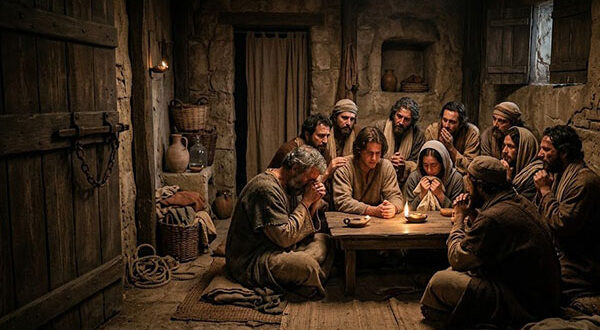
There are scenes in the Gospel which, though brief, contain an inexhaustible spiritual depth. One of them—especially radiant in the Easter context—is that of the apostles gathered “with the doors closed for fear.” It is not merely a historical detail: it is a mirror of the human soul.
1. The scene: a nascent Church paralyzed by fear
The passage we contemplate is found in the Gospel according to the Gospel of John (Jn 20:19–23). The context could not be more dramatic: Christ has been crucified, the disciples are disoriented, and they fear suffering the same fate.
“On the evening of that first day of the week, when the disciples were together, with the doors locked for fear of the Jews, Jesus came and stood among them and said, ‘Peace be with you’” (Jn 20:19).
Let us pause here. There are three key elements:
- Physical enclosure: closed doors.
- Emotional motivation: fear.
- Apparent absence of Christ… until He breaks in.
This is the state of the apostles: they have not completely lost faith, but they are paralyzed. They have not betrayed (like Judas), but neither do they act (as they will at Pentecost). They are in an immature, wounded, insecure faith.
2. Fear: a deeply human reality
Fear is not foreign to the Christian life. From a theological standpoint, it is a passion of the soul that can play a positive role (protection from danger) or a negative one (spiritual paralysis).
In this case, the apostles’ fear is understandable:
- They have seen their Master die.
- They feel watched and persecuted.
- They do not yet understand the mystery of the Resurrection.
But that fear has consequences: it shuts them in.
Here emerges a key teaching:
👉 Fear is not only felt; it also builds “closed doors” in our lives.
What are those doors today?
- Fear of rejection → prevents us from bearing witness to our faith.
- Fear of suffering → distances us from the Cross.
- Fear of change → keeps us in a mediocre spiritual life.
- Fear of radical conversion → makes us negotiate with sin.
Ultimately, fear leads us to a defensive life, not a missionary one.
3. The Risen Christ passes through closed doors
The most astonishing detail of the passage is not the fear… but what Christ does in the face of it.
“Jesus came and stood among them…”
The doors were closed, yet this does not stop Christ.
Here we find a truth of immense theological depth:
👉 Nothing can prevent Christ’s action in the soul, not even our resistances.
Neither sin, nor fear, nor doubt are absolute obstacles for God. He does not require perfectly opened doors: He enters even into our fragility.
This reveals something essential about the Risen Christ:
- He is not a memory → He is a living presence.
- He does not wait for ideal conditions → He breaks into the midst of chaos.
- He does not reproach → He offers peace.
4. “Peace be with you”: the first Easter gift
Christ’s first words are not of judgment, but of mercy:
“Peace be with you.”
In Greek: eirēnē. In Hebrew: shalom. It is not merely the absence of conflict, but fullness, reconciliation, and inner restoration.
From a theological point of view, this peace is:
- Fruit of Redemption: Christ has conquered sin.
- Gift of the Holy Spirit: it is not psychological, but supernatural.
- Foundation of mission: without inner peace, there is no evangelization.
Here another pastoral key is revealed:
👉 Christ does not first eliminate the external problem (persecution), but the internal one (fear).
5. From locked-in disciples to sent apostles
The passage does not end in consolation. It continues with a radical transformation:
“As the Father has sent me, I am sending you” (Jn 20:21).
And He breathes on them the Holy Spirit.
This gesture recalls Genesis: God breathing life into Adam. Here, Christ inaugurates a new creation.
The change is total:
| Before | After |
|---|---|
| Closed doors | Open mission |
| Fear | Courage |
| Confusion | Clarity |
| Enclosure | Sending |
This teaches us:
👉 A real encounter with Christ always leads to mission.
There is no authentic Easter experience that does not translate into apostolic life.
6. Saint Thomas: doubt also has doors
In the same passage appears Saint Thomas the Apostle, who was not present at first.
His reaction is well known:
“Unless I see… I will not believe” (Jn 20:25).
Thomas represents another kind of “closed door”: the need for control, the difficulty of trusting.
Christ does not reject him. He appears again—once more passing through closed doors—and invites him to touch His wounds.
Here we find a profound pastoral lesson:
👉 Christ does not destroy our doubts with violence; He passes through them with mercy.
And Thomas responds with one of the highest confessions in the Gospel:
“My Lord and my God” (Jn 20:28).
7. Contemporary relevance: we live in a culture of closed doors
Today, more than ever, this passage is relevant.
We live in a society marked by:
- Insecurity (economic, social, existential)
- Relativism (which weakens truth)
- Isolation (individualism, screens, real disconnection)
All of this generates a culture of fear:
- Fear of commitment
- Fear of truth
- Fear of total self-giving
And like the apostles, many Christians live locked in, even if outwardly everything seems normal.
8. Practical applications: opening (or allowing to be opened) the doors
1. Identify your “closed doors”
Make a sincere examination:
- What paralyzes me?
- Where am I avoiding trust in God?
2. Allow Christ to enter
Do not wait to be “perfect.” Grace acts in the midst of weakness.
3. Seek the peace that comes from God
Through:
- Prayer
- The sacraments (especially confession)
- Eucharistic adoration
4. Live as one sent
Faith is not meant to be hidden:
- Witness in the family
- Integrity at work
- Courage in public life
5. Accept the process
The apostles did not change instantly. Transformation is gradual, but real.
9. A final spiritual key: Christ is always “in the midst”
The text says that Jesus “stood among them.”
This is not accidental. Theologically, it means:
👉 Christ wants to be the center.
- Center of the community
- Center of the heart
- Center of life
When He occupies that place, doors cease to be prisons… and become thresholds of mission.
Conclusion: from fear to mission
Closed doors are not the end of the story. They are the starting point of Easter in every soul.
Christ continues to enter today:
- Into wounded hearts
- Into paralyzed lives
- Into stories marked by fear
And He continues to say:
“Peace be with you.”
The question is not whether He can enter…
👉 The question is whether we are willing to be transformed.
Because when Christ enters, nothing remains the same.
Doors open.
Fear retreats.
And the disciple… becomes an apostle.