
Related Articles
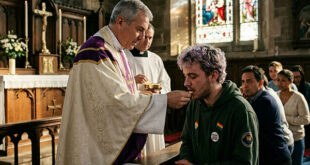

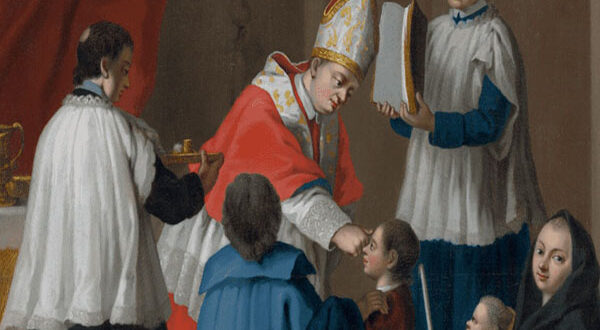
In a world where everything seems fleeting, where identities shift and certainties fade, there are words that endure. Words that are not merely spoken, but leave a permanent mark. One of them, deeply rooted in the tradition of the Church, is this Latin formula: “Signo te signo crucis, et confirmo te chrismate salutis.”
This is no ordinary phrase. It is a declaration, an act, a spiritual seal. It is the echo of a truth that spans the centuries: the Christian is not merely someone who believes, but someone who has been marked by God.
1. What does this phrase really mean?
Translated into English, the expression means:
“I sign you with the sign of the cross and I confirm you with the chrism of salvation.”
Here two fundamental gestures are brought together:
- The sign of the cross: a visible mark of belonging to Christ.
- The anointing with chrism: an invisible sign of a profound grace, the gift of the Holy Spirit.
This is not just a symbolic blessing. In Catholic tradition, these words are especially linked to the sacrament of Confirmation, though they also echo Baptism. They are words that seal the soul with an indelible character, that is, a spiritual mark that can never be erased.
2. Historical roots: a tradition from the earliest centuries
From the earliest Christians, the gesture of tracing the cross upon the body was a way of identifying oneself as a disciple of Christ. In times of persecution, this sign was not decoration, but a courageous profession of faith.
The Church Fathers already spoke of this gesture as a spiritual shield. Tertullian, in the second century, wrote that Christians made the sign of the cross at the beginning of every activity. The cross was their identity.
On the other hand, anointing with oil has even older roots in the Old Testament. Kings, priests, and prophets were anointed as a sign of divine election. In Christianity, this gesture reaches its fullness:
no longer are only a few chosen anointed, but every baptized and confirmed person.
Chrism—made of olive oil and balsam, consecrated by the bishop—thus becomes a sign of the action of the Holy Spirit.
3. The theological depth: the “character” that cannot be erased
One of the most fascinating aspects of this formula is what it implies theologically. When these words are spoken within the sacramental context, something invisible yet real takes place:
👉 The soul is marked forever.
Catholic theology calls this the “sacramental character.” The sacraments of Baptism, Confirmation, and Holy Orders imprint this permanent mark.
But what does this mean in practice?
- That your Christian identity does not depend on your emotions.
- That even if you drift away, that mark remains.
- That God has left an indelible imprint upon your being.
It is, in a certain sense, like a seal of divine ownership:
you belong to Christ, not only by choice, but by inner transformation.
4. The cross: more than a symbol, a way of life
When we hear “signo te signo crucis,” we may think of the routine gesture of making the sign of the cross. But the cross is not merely a movement of the hand.
The cross is:
- Self-giving
- Sacrifice
- Radical love
- Redemption
To be marked with the cross means accepting that the Christian life is not comfortable, but deeply transformative. It means learning to love even when it is difficult, to forgive when it hurts, to stand firm when everything invites compromise.
In a culture that flees from suffering, the cross appears as a paradox:
it is precisely in self-giving that true life is found.
5. The chrism: the fragrance of the Holy Spirit
The second part of the formula—“et confirmo te chrismate salutis”—introduces an element full of beauty: chrism.
This perfumed oil does not merely symbolize grace; it communicates it. In Confirmation, the Holy Spirit strengthens the Christian to live the faith with maturity.
The aroma of chrism carries a deep meaning:
👉 the Christian is called to “smell like Christ” in the world.
That is to say:
- To be a visible witness of faith.
- To radiate charity.
- To transform one’s surroundings with the presence of God.
This is not a faith confined to the private sphere, but a faith that expands, that is noticeable, that leaves a trace.
6. Relevance in today’s world: identity in the face of confusion
We live in an age marked by a crisis of identity. Many people do not know who they are or where they are going.
In this context, the formula “Signo te signo crucis…” offers a clear and firm answer:
your identity is not built solely from within; it has been given by God.
This has enormous practical consequences:
- You do not need to constantly reinvent yourself.
- You do not depend on social approval.
- Your worth is not in what you do, but in who you are.
You are someone marked by God. And that changes everything.
7. Practical applications: living as someone marked by God
How can we bring this truth into daily life? Here are some concrete keys:
1. Recover the meaning of the sign of the cross
Make it slowly, with awareness. Not as an automatic gesture, but as a declaration of faith.
2. Live with coherence
If you are marked by Christ, your life should reflect it—in your decisions, words, and relationships.
3. Invoke the Holy Spirit
Remember that you have been confirmed with chrism. Ask for His help in every important moment.
4. Embrace the daily cross
Difficulties are not a punishment, but an opportunity for union with Christ.
5. Be a witness in the world
Do not hide your faith. The world needs authentic Christians, not those who fade into invisibility.
8. A final call: rediscover what we already are
Many Christians live as if they had never been marked—as if their faith were something superficial, optional, interchangeable.
But the reality is different:
you carry within your soul an eternal seal.
“Signo te signo crucis, et confirmo te chrismate salutis” is not merely a liturgical formula. It is a truth that defines your existence.
Perhaps today is a good moment to ask yourself:
- Do I live as someone marked by Christ?
- Am I aware of the gift I have received?
- Am I allowing that grace to transform my life?
Because in the end, faith is not only about believing in God…
it is about living as someone who has been touched, marked, and sent by Him.
Conclusion
Amid the noise of the world, this ancient formula resounds with renewed strength. It reminds us who we are, where we come from, and where we are going.
The cross marks us.
Chrism strengthens us.
The Spirit sends us.
And everything begins with those eternal words:
“Signo te signo crucis, et confirmo te chrismate salutis.”