Related Articles



To speak of the sorrows of the Blessed Virgin is not merely to dwell on suffering, but to enter into the deepest mystery of love that accompanies, sustains, and redeems. The life of the Virgin Mary was not a path free from pain; on the contrary, it was a pilgrimage marked by intense trials, always lived in union with God.
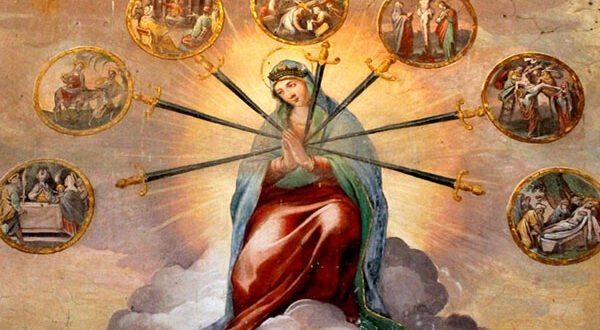
The so-called Seven Sorrows of the Virgin Mary invite us to contemplate the heart of a Mother who suffers, yet never loses faith. They are a spiritual school for our time, so marked by uncertainty, suffering, and the search for meaning.
What are the Seven Sorrows of the Virgin Mary?
The Seven Sorrows are seven key moments in Mary’s life in which her heart was pierced by suffering, always in relation to the life and mission of her Son, Jesus Christ.
This devotion has ancient roots in the Church, especially developed in the Middle Ages and promoted by the Order of the Servants of Mary (Servites). Its purpose is not to dwell on pain, but to discover how suffering, united to God, becomes a path of redemption.
The seven sorrows, one by one
1. The prophecy of Simeon
When Mary presents Jesus in the Temple, the elderly Simeon announces to her:
“And a sword will pierce your own soul too” (Luke 2:35)
This first sorrow is a warning: Mary’s motherhood will be marked by suffering. She accepts without fully understanding, but with complete trust.
👉 Practical application:
In our lives, we often do not understand the pain that comes. Mary teaches us to trust even when we do not see the meaning.
2. The flight into Egypt
Faced with the threat of Herod the Great, the Holy Family flees:
An uncertain, dangerous journey, full of fear and uprooting.
👉 Practical application:
Today, many families experience displacement, crisis, or insecurity. Mary teaches us to sustain our faith even in the midst of instability.
3. The Child Jesus lost in the Temple
For three days, Mary and Joseph search anxiously for Jesus:
“Son, why have you treated us like this?” (Luke 2:48)
It is the sorrow of misunderstanding, of God’s silence.
👉 Practical application:
How often do we feel that we have “lost” God? Mary teaches us to keep searching without giving up.
4. Mary meets Jesus on the way to Calvary
On the Way of the Cross, their eyes meet. No words are needed.
👉 Practical application:
Accompanying the suffering of others is one of the purest forms of love. Mary teaches us to be present, simply to be there.
5. The crucifixion and death of Jesus
The most heartbreaking moment: Mary at the foot of the cross, watching her Son die.
“Near the cross of Jesus stood his mother” (John 19:25)
She does not flee, she does not rebel, she does not lose faith.
👉 Practical application:
In the hardest moments, we can choose to flee or to remain. Mary teaches us fidelity in suffering.
6. Jesus is taken down from the cross
Mary receives the lifeless body of her Son. It is the sorrow of apparent failure.
👉 Practical application:
When something in our lives seems lost, Mary reminds us that God is still at work even in darkness.
7. The burial of Jesus
The silence of the tomb. The waiting. Hope against all hope.
👉 Practical application:
In moments of emptiness, when everything seems finished, Mary teaches us to wait in God.
The theological meaning of Mary’s sorrows
Mary’s sorrows are not merely human sufferings: they have a profound redemptive value.
She participates in a unique way in the work of salvation. Not as the Redeemer (Christ alone is), but as a co-redeemer in a participatory sense: her constant “yes” accompanies the entire mission of her Son.
Her suffering is united to that of Christ. For this reason, the Church also calls her Our Lady of Sorrows.
A deeply relevant spirituality today
We live in a time that flees from suffering. People seek to avoid it, numb it, or ignore it. But the reality is that pain is part of life.
Mary offers us another perspective:
- Not to deny suffering
- Not to despair before it
- Not to live it in isolation
But rather to offer it, unite it to God, and transform it into love
How to live the Seven Sorrows today
This is where the devotion becomes deeply practical:
1. Pray the Rosary of the Seven Sorrows
A simple yet powerful prayer to meditate on these mysteries.
2. Offer daily suffering
Small setbacks, illness, worries… everything can be united to Christ.
3. Accompany the suffering of others
As Mary accompanied Jesus, we are called to accompany others.
4. Learn to wait
Mary’s Holy Saturday teaches us that God’s silence is not His absence.
Mary, teacher of redemptive suffering
The Virgin does not remove suffering from our lives, but she teaches us how to live it differently.
In a world that often loses the meaning of suffering, she reminds us that:
- Pain can have a purpose
- Suffering can be fruitful
- The cross is not the end
Because after Good Friday… Resurrection always comes.
Conclusion: a path for today’s heart
The Seven Sorrows of the Virgin Mary are not just an ancient devotion. They are a deeply relevant path for anyone who suffers, doubts, or seeks meaning.
Mary is not a distant figure. She is a Mother who understands.
And in each of our sorrows, she whispers to the heart:
“You are not alone. I have been there too. And God never abandons.”