Related Articles

History, theology, and spiritual guidance from one of the most relevant books of the Bible
Among the many books of the Old Testament, few are as surprisingly relevant today as the Book of Nehemiah. Within its pages we find a story of ruins and reconstruction, of leadership and prayer, of social crisis and spiritual renewal. It is a deeply human narrative and, at the same time, a powerful theological lesson about how God acts within history.
The story of Nehemiah is not merely about rebuilding a destroyed city; above all, it is about rebuilding a people and their spiritual identity. For this reason, the book remains today an extraordinary guide for those who wish to rebuild their lives, their families, their communities, or even their faith.
Throughout this article we will explore:
- The historical context of the book
- The figure of Nehemiah as a leader and a man of prayer
- The profound theology that runs through the narrative
- The spiritual meaning of the rebuilding of Jerusalem
- Concrete applications for Christian life today
Because in truth, we all have walls that need rebuilding.
1. Historical Context: Jerusalem in Ruins
To understand the book, we must place ourselves in one of the most difficult moments in the history of Israel.
In 586 BC, Jerusalem was destroyed by the Babylonian Empire. The Temple was razed and a large portion of the population was deported into exile. It was a national and religious catastrophe.
Decades later, the Persian Empire conquered Babylon and allowed some Jews to return to their homeland. However, the return did not mean immediate restoration.
Jerusalem remained devastated.
The city’s walls were still broken down, which meant three fundamental things:
- Military vulnerability
- Political humiliation
- Spiritual crisis
In the ancient world, a city without walls was a city that was defenseless and dishonored.
It is in this context that Nehemiah appears, a Jew living far from Jerusalem, in the court of the Persian king.
2. Who Was Nehemiah?
Nehemiah held a very important position: he was the cupbearer to King Artaxerxes.
This was not simply a servant who poured wine. The cupbearer was a highly trusted official. He had direct access to the king and often participated in political decisions.
Yet Nehemiah possessed something even more important than his position: a heart deeply united to his people and to God.
When he hears news about Jerusalem, his reaction is immediate.
The Bible tells us:
“When I heard these words, I sat down and wept, and mourned for days; and I fasted and prayed before the God of heaven.”
(Nehemiah 1:4)
This verse reveals the spiritual heart of the man.
Before acting, he:
- prays
- fasts
- weeps for his people
Nehemiah is an example of something essential in Christian life:
every true renewal begins with an interior conversion.
3. A Prayer That Changes History
The first chapter of the book contains one of the most profound prayers in the Old Testament.
Nehemiah recognizes three fundamental theological truths:
1. God Is Faithful to His Covenant
God never abandons His people.
2. Sin Has Historical Consequences
The destruction of Jerusalem was not merely a political disaster; it was also the result of turning away from God.
3. Restoration Is Always Possible
Divine mercy opens the path toward rebuilding.
Nehemiah’s prayer reveals something central in biblical theology:
human history and the history of salvation are deeply intertwined.
4. Leadership According to God
After months of prayer, Nehemiah finally dares to speak with the king.
And something remarkable happens: the king not only authorizes his journey to Jerusalem but also finances the reconstruction.
This moment reveals a very deep theological idea:
God can use even the powerful of this world to accomplish His plans.
Nehemiah does not act impulsively.
First, he:
- analyzes the situation
- studies the walls
- organizes the work
- distributes responsibilities
He is a spiritual leader, but also an excellent organizer.
This balance is profoundly biblical:
spiritual life does not exclude intelligent and concrete action.
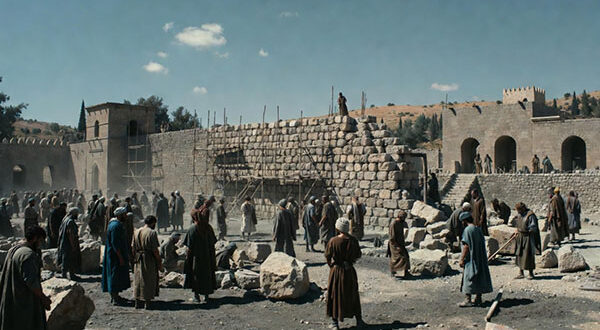
5. The Rebuilding of the Walls
One of the most fascinating aspects of the book is the detailed description of the reconstruction.
Each family receives a section of the wall.
Priests, merchants, artisans—everyone works together.
This detail carries an important theological meaning:
the restoration of God’s people is a communal task.
No one rebuilds Jerusalem alone.
The Bible says:
“Those who built the wall and those who carried burdens worked with one hand and held a weapon with the other.”
(Nehemiah 4:17)
This scene reflects a very profound spiritual truth:
the Christian life is both construction and battle at the same time.
Construction of holiness.
Battle against sin.
6. Opposition: When Good Encounters Resistance
The rebuilding was not easy.
The enemies of the people tried to:
- ridicule the project
- provoke fear
- create division
- carry out physical attacks
This also happens today in spiritual life.
Every time someone tries to rebuild his or her life with God, obstacles appear:
- fatigue
- criticism
- doubts
- temptations
Nehemiah responds with a combination of prayer and action.
One of his most famous statements summarizes his attitude:
“Our God will fight for us.”
(Nehemiah 4:20)
Here we find an essential spiritual teaching:
the work is ours, but the victory belongs to God.
7. Social Reform and Justice
The book is not only about physical walls.
Nehemiah discovers a serious problem: some wealthy people are exploiting the poor through abusive lending.
It is a social crisis within the people themselves.
Nehemiah reacts firmly and demands that lands and properties be returned.
This episode reminds us that biblical faith is never merely spiritual.
Authentic fidelity to God includes:
- justice
- solidarity
- defense of the poor
Religion that ignores those in need is not the faith of the Bible.
8. Spiritual Renewal of the People
After the walls are rebuilt, something even more important happens.
The priest Ezra publicly proclaims the Law of God.
The people listen for hours.
Their reaction is moving:
- they weep
- they repent
- they renew their covenant with God
Scripture describes this moment with great beauty.
“Do not be grieved, for the joy of the Lord is your strength.”
(Nehemiah 8:10)
This verse contains one of the most profound spiritual statements in the entire Bible.
The true strength of the believer is not human power, but the joy that comes from God.
9. Theological Meaning of the Book
The Book of Nehemiah contains several great theological themes.
1. God Acts in History
The reconstruction is not merely a human project.
It is part of the plan of salvation.
2. Conversion Is Necessary for Restoration
External renewal requires interior renewal.
3. Community Is Essential
The people of God are built together.
4. Fidelity to God’s Law Is a Source of Life
True freedom is found in living according to the will of God.
10. Nehemiah as a Spiritual Figure
In Christian tradition, Nehemiah has been seen as a figure that foreshadows several spiritual realities.
He can be viewed as:
- a spiritual reformer
- an intercessor for his people
- a leader who unites prayer and action
In a certain sense, Nehemiah also foreshadows the mission of Christ.
Just as Nehemiah rebuilt Jerusalem, Christ came to rebuild humanity fallen through sin.
11. What Does Rebuilding the Walls Mean Today?
The Book of Nehemiah is extraordinarily relevant today.
We also live in a world where many spiritual walls have collapsed:
- broken families
- weakened faith
- moral confusion
- loss of Christian identity
Nehemiah’s message is clear:
reconstruction is possible.
But it requires several things.
12. Five Spiritual Lessons from Nehemiah
1. Weep for the Ruins
Conversion begins when we stop ignoring evil.
Nehemiah weeps for Jerusalem.
Today we must ask ourselves:
- Do we grieve over the distance from God?
- Do we grieve over the spiritual crisis of our society?
2. Pray Before Acting
Nehemiah spends months in prayer.
In a culture that values immediate action, the Bible reminds us:
without prayer there is no true renewal.
3. Build with Perseverance
Walls are not raised in a single day.
Spiritual life also requires patience.
Holiness is built stone by stone.
4. Defend the Good in the Face of Opposition
Every good work encounters resistance.
Nehemiah teaches us not to lose courage.
5. Return to the Word of God
The climax of the book is not the finished wall.
It is the people listening to Scripture.
True renewal begins when the Word returns to the center of life.
13. Practical Applications for Christian Life
Every person has his or her own “Jerusalem in ruins.”
It may be:
- a broken family relationship
- weakened faith
- a neglected spiritual life
- wounds from the past
The path of Nehemiah can inspire us:
- Recognize reality without denying it
- Pray with humility
- Act with courage
- Work together with others
- Trust in God
Conclusion: God Still Rebuilds
The Book of Nehemiah reminds us of something profoundly hopeful:
God does not abandon what seems lost.
When Jerusalem was destroyed, God raised up a man willing to rebuild it.
He continues to do the same today.
Every generation needs new “Nehemiahs.”
People who:
- love God
- love His people
- work for spiritual renewal
Because, in the end, the story of Nehemiah is also our story.
We all have ruins.
We all need rebuilding.
And God continues to repeat throughout history:
“Let us rise up and build.”
An invitation that does not belong only to the biblical past, but also to our lives today.