Related Articles
In an age marked by speed, constant noise, and superficial communication, the liturgical tradition of the Catholic Church preserves a form of dialogue that is profoundly spiritual and, although brief in words, filled with centuries of faith: the “Versiculus” and the “Responsum.”
Many Catholics have probably heard these expressions in the liturgy without pausing to reflect on their meaning. They appear in the Liturgy of the Hours, in the Traditional Holy Mass, in the Rosary, in Eucharistic adoration, and in many popular devotions. They are short phrases, almost like a heartbeat of prayer between the priest and the people.
But behind these brief formulas lies something far deeper: a form of dialogued prayer that reflects the communion between God and His people, between Christ and His Church.
In this article we will explore what Versiculus and Responsum mean, their historical origin, their profound theological significance, and how this form of prayer can become a very concrete spiritual tool for our daily life.
1. What do “Versiculus” and “Responsum” mean?
The words come from liturgical Latin.
- Versiculus literally means “little verse” or “short phrase.”
- Responsum means “response.”
In the liturgy, the Versiculus is a brief invocation generally pronounced by the priest, the deacon, or the cantor. The Responsum is the answer given by the people or the choir.
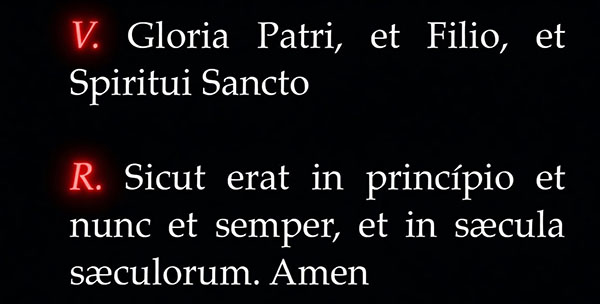
For example, one of the most well-known exchanges is:
V. Dominus vobiscum
R. Et cum spiritu tuo
In English:
V. The Lord be with you
R. And with your spirit
This brief exchange occurs many times in the liturgy, but it is not a simple formality. It is a spiritual dialogue that expresses the unity of the Body of Christ in prayer.
2. An origin that goes back to the Bible
The format of invocation and response is not a medieval invention nor merely a liturgical convention.
In fact, it is born in Sacred Scripture itself.
In the Psalms we find numerous examples of responsorial prayer, where the people respond to a proclamation.
A very clear example appears in Psalm 136, where the people continually respond:
“For His mercy endures forever.”
(Psalm 136)
Each proclaimed verse is followed by the same response of the people. This style of prayer creates a collective spiritual rhythm, in which the entire community participates in praise.
In the New Testament we also find examples of communal responses in apostolic preaching.
When Saint Paul explains the faith, the people respond with affirmations of faith, showing that the Christian faith is not only individual, but communal.
3. The early Church and dialogued prayer
The first Christians inherited this form of prayer from the Jewish tradition.
In the earliest Christian liturgies — especially in Jerusalem and Antioch — responsorial acclamations already existed.
Among the most ancient we find:
- Kyrie eleison (Lord, have mercy)
- Amen
- Alleluia
These responses were not merely liturgical ornaments. They represented the active participation of the people in worship.
Saint Augustine described the liturgical response as:
“The voice of the whole Church responding to the Lord.”
In other words, the community becomes one single body responding to God.
4. The Versiculus in the Liturgy of the Hours
One of the places where Versiculus and Responsum appear most frequently is in the Liturgy of the Hours, also called the Divine Office.
This daily prayer of the Church structures the day into different moments:
- Lauds
- Vespers
- Compline
- Office of Readings
In each of them we find small verses such as:
V. Deus, in adiutorium meum intende
R. Domine, ad adiuvandum me festina
In English:
V. O God, come to my assistance
R. O Lord, make haste to help me
This prayer has extremely ancient roots. According to monastic tradition, Saint Benedict placed it at the beginning of every liturgical hour in the 6th century.
However, its true origin lies in Psalm 70:
“O God, come to my assistance; O Lord, make haste to help me.”
(Psalm 70:2)
Thus, every prayer begins by recalling something fundamental: the absolute dependence of man on God.
5. A profound theological meaning
Although they may seem like simple phrases, Versiculus and Responsum express a very deep theological truth.
1. The Church is communion
The Christian faith is not individualistic. The liturgical dialogue shows that the Church prays as one body.
The priest proclaims, but the people respond.
In this way we see reflected what Saint Paul teaches:
“You are the body of Christ.”
(1 Corinthians 12:27)
The liturgy is not a spectacle: it is an action of the whole People of God.
2. God speaks first
In the structure of verse and response there is also a spiritual dimension.
First the word is proclaimed (verse). Then comes the response.
This reminds us of a fundamental truth: God always takes the initiative.
As Saint John says:
“We love because He first loved us.”
(1 John 4:19)
All Christian prayer is, in reality, a response to the prior love of God.
3. Christ and the Church in dialogue
Many theologians interpret the liturgical exchange as a symbol of the dialogue between Christ and His Church.
Christ speaks through the liturgy.
The Church responds with faith.
For this reason, the Responsum is not merely a ritual formula: it is the voice of the Bride responding to the Bridegroom.
6. The spiritual power of brief responses
In our time, when many people find it difficult to pray for long periods, the liturgical wisdom of the Church offers a very simple solution:
short prayers repeated throughout the day.
Liturgical responses function like ejaculatory prayers (short invocations).
For example:
- “Amen”
- “Lord, have mercy”
- “And with your spirit”
These phrases, though brief, contain immense spiritual truths.
Saint John Chrysostom taught that even a single word spoken with faith can raise the soul to God.
7. Practical applications for daily life
This is where Versiculus and Responsum stop being a liturgical detail and become a very concrete spiritual guide.
1. Short prayers during the day
We can adopt the style of the liturgy with small spiritual responses.
For example:
At the beginning of the day:
V. Lord, open my lips
R. And my mouth shall proclaim your praise
When difficulties arise:
Lord, come to my help.
This form of prayer is especially useful in the middle of work, studies, or family responsibilities.
2. Prayer in the family
Christian families can recover dialogued prayer.
For example:
Father or mother:
V. Let us bless the Lord
Children:
R. Thanks be to God
This transforms the home into a small domestic church.
3. Recovering participation in the liturgy
Versiculus and Responsum remind us that the liturgy is not something we merely “listen to.” It is something we participate in.
Responding with attention, faith, and awareness is a real spiritual act.
8. An antidote to modern individualism
We live in a deeply individualistic culture.
Responsorial liturgy teaches something different:
faith is lived together.
When the community responds in unity, something very profound happens: the Church becomes visible.
We are not isolated believers.
We are a people who respond to God.
9. The eternal echo of the Church’s prayer
Perhaps the most beautiful aspect of the Versiculus and Responsum is that they unite us with centuries of Christian prayer.
The same responses we pronounce today:
- were prayed by medieval monks
- by the first Christians
- by saints such as Saint Benedict, Saint Thomas Aquinas, and Saint Teresa
Every time we respond in the liturgy, we enter into a chain of prayer that crosses the centuries.
It is the voice of the pilgrim Church united with the heavenly Church.
Conclusion: learning to respond to God
In the end, the entire Christian life can be summarized in a response.
God calls.
God speaks.
God loves first.
Our life becomes the Responsum.
Every decision, every prayer, every act of charity is a response to the verse that God pronounces over our life.
As the Virgin Mary responded at the Annunciation:
“Behold the handmaid of the Lord; let it be done to me according to your word.”
(Luke 1:38)
Perhaps the great spiritual lesson of the Versiculus and Responsum is precisely this:
to learn to respond to God with our whole life.
Because in the end, the liturgy does not end when Mass finishes.
It continues in every moment of our existence.
And God continues to pronounce His verse.
The question is always the same:
What will our response be?