Related Articles

There are questions that seem to belong exclusively to the administrative sphere of cemeteries, but which, when viewed through the lens of faith, acquire an unexpected depth.
What happens when a cemetery runs out of space? Is it permissible to open an old grave in order to move the remains of one person and use that place to bury another? Does this constitute a lack of respect toward the deceased? Is it a sin to exhume a body? What does the Catholic Church actually think about this practice? Is there some kind of “sacred right” for a person to remain forever in the same grave?
The Catholic answer requires us to carefully distinguish between the respect owed to the bodies of the deceased, the need to preserve cemeteries, civil and canonical regulations, and faith in the resurrection of the flesh.
Because one thing must be clear from the outset: for the Church, exhuming human remains does not necessarily mean desecrating the deceased or denying the dignity of the body. The moral question depends on the circumstances, the intention behind the exhumation, the respect with which it is carried out, and the legitimate regulations governing cemeteries.
Christian faith does not teach that a body must remain forever in the same physical location. It teaches something far greater: that the human person was created for eternity and that God will raise the body on the last day.
“And many of those who sleep in the dust of the earth shall awake: some to everlasting life, and others to shame and everlasting contempt.”
Daniel 12:2
This truth completely changes the way we look at a grave.
1. A Grave Is Not Simply a Space in the Ground
To understand this question correctly, we must begin with a fundamental issue.
From a Christian perspective, a cemetery is not simply a storage place for corpses.
It is a place of remembrance, respect, prayer, and hope.
The Church has traditionally regarded the burial of the dead as a corporal work of mercy. Burying the dead means recognizing that even after death, the human body deserves respect.
Not because the body is still the living person in the full sense—for at death the soul is separated from the body—but because that body belonged to a human person and is destined for resurrection.
Catholic doctrine affirms that the human being is not simply a soul accidentally enclosed within a body.
We are a unity of body and soul.
That is why the body possesses a particular dignity.
The Congregation for the Doctrine of the Faith explained in Ad resurgendum cum Christo that the Church strongly recommends the burial of bodies in cemeteries or other sacred places because burial expresses in a particularly appropriate way faith and hope in bodily resurrection.
This is why a Christian grave silently says:
“Here rest the remains of a person whom we hope will live again by the power of God.”
But precisely here an important distinction appears.
The grave is not eternity.
2. Does a Person Have the Right to Remain Forever in Their Grave?
From an emotional perspective, it is perfectly understandable that a family would want their grandfather, mother, husband, or child to remain forever in the place where they were buried.
The grave becomes a point of reference.
We go there.
We bring flowers.
We pray.
We remember.
We speak about our dead.
We commemorate anniversaries.
And, above all, we have the feeling that this place belongs to that person.
But from a theological perspective, we must make an important clarification.
Indefinite physical permanence in a particular cemetery plot is not part of Catholic doctrine concerning death.
The Church does not teach that a body must remain forever in the same geographical location.
The Christian promise is not:
“Your body will remain forever in this grave.”
The promise is:
“Your body will rise again.”
These are two completely different things.
God does not need to preserve a body in precisely the same physical condition or geographical location in order to raise it.
In fact, millions of Christians died centuries ago and their bodies were destroyed by time, wars, fires, natural disasters, animals, floods, landslides, or simply the natural process of decomposition.
And this does not constitute any problem for Catholic faith.
3. The Body Decays: And the Church Has Always Known This
There is sometimes an excessively romanticized view of burial.
People imagine that the body remains intact for generations.
But biological reality is different.
After death, the natural process of decomposition begins.
That is why Christian tradition uses expressions such as:
“For you are dust, and to dust you shall return.”
Genesis 3:19
The Church has never confused physical preservation of the corpse with Christian hope.
The human body undergoes transformations.
The coffin eventually deteriorates.
The bones decay.
The body progressively returns to the earth.
And yet hope remains intact.
Why?
Because the resurrection is not simply a chemical reconstruction of the corpse.
It is a supernatural act of God.
Saint Paul explains this beautifully:
“It is sown a perishable body, it is raised an imperishable body.”
1 Corinthians 15:42
And he continues:
“It is sown a natural body, it is raised a spiritual body.”
1 Corinthians 15:44
Therefore, Christian faith does not depend upon a body remaining physically preserved forever in its present state.
4. So, Is Exhuming a Body a Sin?
Here we must be very precise.
No. Exhumation, considered in itself, is not necessarily a sin.
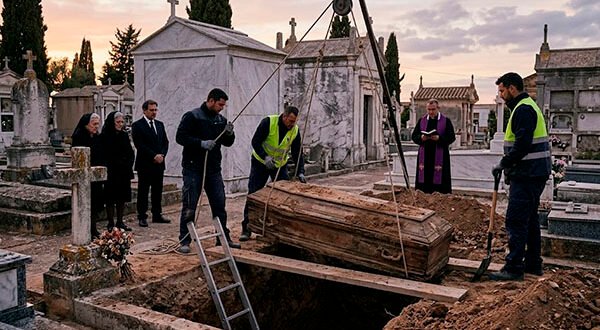
A legitimate exhumation may take place, carried out respectfully and for a reasonable purpose.
For example:
- when the legal burial period has ended;
- when the cemetery needs to reorganize its available space;
- when the remains need to be transferred elsewhere;
- when a family decides to move them to a family mausoleum;
- when a cemetery is being expanded or remodeled;
- when legitimate health or administrative reasons exist;
- when a historical or judicial investigation requires it;
- when the remains of a person are transferred for public veneration;
- when ecclesiastical authorities request a transfer connected with a cause of beatification or canonization.
In all these cases, exhumation does not automatically constitute desecration.
What matters is how it is carried out.
5. Exhumation Is Not the Same as Desecration
This distinction is fundamental.
To exhume means to remove human remains from a grave.
To desecrate means to treat those remains in a seriously disrespectful or offensive manner, contrary to the dignity they deserve.
We must not confuse the two.
Opening a grave according to an established procedure, carefully collecting the remains, and transferring them to an ossuary or another grave is not morally equivalent to simply throwing a corpse away, abandoning it, or treating it as garbage.
The moral problem is not necessarily moving the remains.
It is how and why they are moved.
The Church insists that the remains of the deceased must be treated with respect.
Therefore, a properly conducted exhumation should preserve this attitude of reverence.
Even when circumstances require the remains to be transferred, there should never be an attitude of:
“This is no longer useful; we can throw it away.”
Because we are not dealing with an ordinary object.
We are dealing with the mortal remains of a human person.
6. What Happens When Someone Is Exhumed So That Another Person Can Be Buried?
Here we reach the heart of the question.
Suppose a family has a temporary grave.
After a certain number of years, according to the applicable legislation and the conditions of the cemetery, the remains are exhumed.
They are then transferred to an ossuary, another grave, or a space specifically designated for their preservation.
The plot is subsequently used to bury another person.
Is this contrary to the Catholic faith?
Not necessarily.
The practice can be compatible with Christian faith provided that the applicable laws, cemetery regulations, and, above all, the dignity of the human remains are respected.
The issue is not that one person “loses” their place because another person later occupies the same grave.
The earth does not belong eternally to the corpse.
The deceased person is not spiritually bound to that particular square of ground.
Their eternal destiny rests in the hands of God.
7. The Earth Is Not Man’s Final Destination
This issue is particularly important in an age in which society tends to turn certain objects, places, and memories into substitutes for faith.
A grave has enormous emotional value.
But it is not a sacrament.
It is not a place where the deceased person “lives.”
We should not think that the soul remains inside the grave.
According to Catholic faith, after death comes the particular judgment, and the soul stands before God.
The body remains in the earth.
The soul is not locked inside the grave.
Therefore, when a Christian visits a cemetery, they should not simply think:
“My mother is here.”
In a strictly bodily sense, her remains are there.
But the person is not reduced to those remains.
And precisely because of this, Christian prayer for the dead makes sense.
We pray for the person.
We ask God for mercy.
We hope for the resurrection.
8. Christian Hope Is in Christ, Not in a Cemetery Plot
Saint Paul expresses the heart of the whole matter:
“But Christ has indeed been raised from the dead, the firstfruits of those who have fallen asleep.”
1 Corinthians 15:20
Christ did not promise His disciples a particular grave.
He promised the resurrection.
Christ’s empty tomb is precisely the decisive point.
Christianity does not end in a grave.
It begins after victory over the grave.
The Christian grave, therefore, should be understood as a provisional reality.
It has an extremely important function while we wait.
But it is not definitive.
That is why the first Christians could use expressions referring to the dead as those who “sleep.”
The dead rest.
But they wait.
9. The Christian Cemetery: A School of Eternity
This vision also allows us to recover something that our society is losing.
The cemetery should not be merely a place of sadness.
Paradoxically, it is one of the places where Christian hope can be proclaimed most powerfully.
When we walk among the graves, we find names.
Dates.
Photographs.
Crosses.
Images of saints.
Rosaries.
Flowers.
And behind all of this there appears a truth:
we will all die.
Death equalizes rich and poor.
Famous and unknown.
Powerful and humble.
Those who lived long lives and those who barely began to live.
The cemetery preaches a truth that our culture tries to hide.
But Christianity adds something extraordinary:
death does not have the last word.
10. “Here Lies”: An Expression That Should Make Us Think
For centuries Christian tombstones have used expressions such as:
Here lies.
They do not necessarily say:
Here remains forever.
They say:
Here lies.
The verb matters.
To lie means to rest.
The grave is a place of waiting.
That is why many old Christian tombstones contain expressions such as:
“Pray for his soul.”
Not simply:
“Remember him.”
The difference is enormous.
Modern culture tends to turn memory into a substitute for religion:
“As long as we remember them, they will remain alive.”
But Christianity says something infinitely deeper:
They will not live simply because we remember them; they will live because God is capable of raising them.
Human memory can disappear.
God does not forget.
11. Why Does the Church Give So Much Importance to Burial?
Precisely because the body matters.
The Church does not consider the corpse something worthless.
The human body participated in the life of the person.
With those eyes we saw.
With those hands we worked.
With that mouth we prayed.
With those feet we walked.
With that body we received Baptism.
With that body we received the Eucharist.
With that body we performed works of charity.
That is why the Church speaks of a genuine dignity of the human body.
The instruction Ad resurgendum cum Christo recalls that the body is an integral part of the person and that burial expresses faith in bodily resurrection.
This is also why the Church considers burying the dead a corporal work of mercy.
12. And What Happens If Only Bones Remain?
This question may be uncomfortable, but it is extremely common.
After a certain number of years, depending on the conditions of the soil and the coffin, only skeletal remains may be left.
What is done then?
From a Christian perspective, those remains still deserve respect.
Not because God needs every bone in order to raise the deceased, but because they belonged to a person.
Therefore, they may be respectfully transferred to an ossuary or another place designated for human remains.
This does not mean that the Church considers those remains to have lost their value.
It means that the way in which they are preserved may change with the passage of time.
13. Can a Family Emotionally Object to an Exhumation?
From a human perspective, this is perfectly understandable.
For many families, opening a grave means reliving their grief.
Sadness, fear, anguish, or even the feeling that the deceased is being “disturbed” may arise.
This is where a genuine pastoral care of the bereaved is needed.
It is not enough to say:
“It is the regulation.”
People also need to be accompanied.
A family may need an explanation.
It may need to pray.
It may need to say goodbye once again.
It may need to know where the remains will be placed.
It may need to preserve a reference to the new location.
All of this forms part of Christian respect.
The Church should not treat the suffering of families as merely an administrative problem.
14. The Importance of Praying When the Remains Are Transferred
Whenever pastorally possible, the transfer of remains can even become an occasion for prayer.
Why not pray a prayer for the dead?
Why not pray an Our Father?
Why not entrust that soul to God once again?
Why not take the opportunity to remember the hope of the resurrection?
An exhumation can thus become a deeply Christian moment.
It is not simply:
“Moving a corpse.”
It is accompanying reverently the mortal remains of a person who belonged to a family, a community, and, if baptized, to the Church.
15. “Eternal Rest Grant Unto Them, O Lord”
The traditional prayer for the dead expresses this attitude perfectly:
“Eternal rest grant unto them, O Lord.”
And the response is:
“And let perpetual light shine upon them.”
It is a simple prayer, but it contains extraordinary theology.
We ask for rest.
We ask for light.
We ask for mercy.
And we hope for eternal life.
The Church does not teach that death is simply disappearance.
Death is a painful separation caused by the mortal condition of humanity, but Christ has conquered death.
That is why a Christian can grieve and hope at the same time.
16. What Does the Bible Say About Burying the Dead?
Sacred Scripture repeatedly shows the importance of giving burial to the dead.
One of the most beautiful examples appears in the Book of Tobit.
Tobit is distinguished precisely by his concern for burying the dead.
The biblical account shows that this was regarded as an act of justice and mercy.
Christian tradition embraced this sensitivity and incorporated it among the corporal works of mercy:
to bury the dead.
But Scripture also gives us something even more important: the promise of resurrection.
Job proclaims:
“I know that my Redeemer lives.”
Job 19:25
And in the Gospel, Christ says to Martha:
“I am the resurrection and the life; whoever believes in me, though he die, yet shall he live.”
John 11:25
This is the true Christian response when standing in any cemetery.
17. Christ’s Tomb Illuminates All Other Graves
There is one detail we must never forget.
Jesus Christ Himself was buried.
Joseph of Arimathea asked for the Lord’s body and placed it in a tomb.
This is extraordinarily important.
God Himself chose to enter into the human experience of death.
Christ had a real body.
He truly died.
He was truly buried.
And He truly rose again.
Therefore, when the Church accompanies a deceased person to the cemetery, it is following Christ Himself.
The Christian funeral liturgy is not simply a ceremony designed to provide psychological comfort to the relatives.
It is a proclamation of faith:
Christ died.
Christ was buried.
Christ rose again.
And those who belong to Christ also await the resurrection.
18. What Happens to the Remains After an Exhumation?
Here we must distinguish between the universal doctrine of the Church and the specific regulations of each country, diocese, and cemetery.
The practical regulation of exhumations may depend on civil law, municipal authorities, health regulations, and the regulations of the cemetery itself.
Therefore, there is no single administrative answer that applies everywhere.
But from a Catholic perspective, the principle is clear:
the remains must be treated with respect.
They may be transferred.
They may be placed in an ossuary.
They may be buried again.
They may be moved to another cemetery.
And, when appropriate, they may be preserved in places specifically designated for that purpose.
What matters is that we never lose awareness that we are dealing with human remains.
19. What If the Same Grave Is Reused for Another Person?
This is probably the part that causes the greatest concern.
Imagine:
A person died in 1950.
They were buried in a grave.
Decades later, their remains were exhumed and transferred to an ossuary.
The former grave is subsequently used for another person.
Does this mean that the first deceased person has been “erased”?
No.
Does it mean that the second deceased person is occupying a place that “belonged” to the first for all eternity?
Neither.
A grave is a physical and temporary place.
The relationship between a person and God does not depend on a plot of land.
Nor does the communion between the living and the dead depend exclusively on the fact that the deceased’s name remains written on precisely the same stone.
20. The Real Danger: Turning the Grave into a Substitute for Faith
Here an important pastoral issue arises.
We can fall into two extremes.
The first would be to treat the deceased as though they no longer mattered at all:
“They are dead; we can do whatever we want with their remains.”
That is contrary to Christian respect.
But there is another extreme:
“If the remains are moved, we have destroyed something essential to their eternal existence.”
That is not Catholic either.
Christianity avoids both extremes.
It deeply respects the body without turning it into a magical object.
The grave deserves respect.
But it is not sacred in the sense that God has promised to preserve every corpse forever in the place where it was buried.
Hope is in Christ.
21. The Earthly Grave Is Not the Christian’s Final Destination
The Christian understanding of burial ultimately points beyond the cemetery.
The body is buried.
The soul awaits the fulfillment of God’s plan.
The Christian awaits resurrection.
This means that even if a grave is eventually opened, even if the remains are transferred, even if the place is later occupied by another person, none of this destroys the promise of God.
The Christian’s final destination is not a particular cemetery.
It is the Kingdom of God.
22. The Resurrection Is Greater Than the Grave
This is perhaps the central theological point.
If the resurrection depended upon the physical preservation of the corpse, Christianity would have a serious problem.
Think of the martyrs.
Many were burned.
Others were killed in ways that destroyed their bodies.
Some disappeared without a known grave.
Some were buried in unknown locations.
Others were never recovered.
And yet the Church has never taught that they therefore cannot rise.
Why?
Because the resurrection depends upon God’s power, not upon human preservation of remains.
The God who created man from the dust can certainly raise him from the dead.
23. The Christian Does Not Worship the Grave
This distinction is also important.
Catholics honor graves.
They decorate them.
They pray there.
They bless them.
They visit them.
But they do not worship them.
The cemetery points beyond itself.
The grave is not God.
The tomb is not heaven.
The remains are not the soul.
The stone is not eternal life.
Everything points toward something greater:
Christ.
24. A Culture That Tries to Hide Death
Our contemporary society has a complicated relationship with death.
In many environments, people try to hide it.
The dead disappear rapidly from homes.
Funerals become shorter.
Death becomes professionalized.
Corpses are removed from ordinary experience.
And cemeteries can become places we barely visit.
Christian tradition offers an alternative.
It does not consist in becoming obsessed with death.
It consists in looking at death in the light of Christ.
The cemetery reminds us:
“You too will die.”
But the Cross adds:
“Christ has conquered death.”
And the empty tomb proclaims:
“Death will not have the final word.”
25. Exhumation Can Become an Opportunity to Recover the Doctrine of the Resurrection
Paradoxically, an exhumation can become an occasion for catechesis.
It can help us explain to our children something that we often forget:
Christian life does not end with death.
We can explain:
“This body belonged to a person whom we loved. Its remains are now being transferred. But our faith does not depend on their remaining here. We believe that God will raise the dead.”
This conversation can be far more educational than trying to protect children from every reference to death.
Children need to learn that death exists.
But they also need to hear that Christ has risen.
26. The Church Does Not Teach a Spirituality of the Corpse, but a Spirituality of the Resurrection
This distinction deserves to be remembered.
Christianity is not a religion centered on preserving corpses.
It is a religion centered on Christ dead and risen.
The veneration of the relics of the saints, when practiced, does not contradict this.
Precisely because we believe in the dignity of the body and in God’s action, relics may be venerated.
But even the most venerated relics continue to await the resurrection.
The Church does not teach:
“This body must remain eternally in this condition.”
It teaches:
“This body is destined to be glorified.”
27. What Should a Catholic Family Do When Faced With an Exhumation?
When faced with a concrete situation, a family can follow some simple principles.
First: Get Proper Information
Do not rely on rumors.
Ask the cemetery what procedure will be followed.
Second: Find Out Where the Remains Will Be Placed
The family should know whether they will be transferred to an ossuary, another grave, or another authorized location.
Third: Maintain an Attitude of Respect
Even if the exhumation is an administrative procedure, for the family it can be an important spiritual moment.
Fourth: Pray
A simple:
“Eternal rest grant unto him, O Lord.”
can transform a painful administrative procedure into an act of faith.
Fifth: Avoid Superstition
Do not think that moving the remains will bring misfortune.
There is no Catholic doctrine teaching that a deceased person can supernaturally “become angry” because their remains are transferred according to the law and with respect.
Sixth: Preserve Christian Memory
The best way to honor the deceased is not merely to preserve an intact grave.
It is also to pray for them.
28. The Best “Grave” of a Christian Is the Memory of God
There is a phrase that summarizes all of this profoundly:
We forget; God does not forget.
A tombstone can deteriorate.
An inscription can disappear.
A grave can be reused.
A cemetery can be relocated.
A family can die out.
But God knows each person.
Christ said:
“So do not be afraid; you are worth more than many sparrows.”
Matthew 10:31
If God knows even what we consider insignificant, how could He not know those whom we have loved?
Christian hope does not rest on a stone.
It rests on a Person:
Jesus Christ.
29. What Does It Mean, Then, to Respect Our Dead?
To respect them means much more than preserving a physical location.
It means:
- treating them with dignity;
- carrying out burial respectfully;
- avoiding all desecration;
- preserving their remains with dignity;
- praying for them;
- offering Mass for their eternal rest;
- maintaining their memory;
- teaching future generations who they were;
- living in such a way that one day we may meet them again in God.
Because a grave can preserve the remains.
But prayer keeps alive the spiritual communion of the Church.
The Church teaches that the faithful departed remain members of the communion of the Church and that prayer for them is a fundamental expression of this communion.
30. Death Does Not Turn the Deceased into an Object
This is perhaps the simplest moral criterion.
When we see a corpse, we should remember:
“Here lived a person.”
Not:
“Here is an object that is no longer useful.”
This difference completely changes our attitude.
Even when the body has decomposed and only skeletal remains are left, it remains right to act with reverence.
And precisely for this reason, a respectful exhumation does not contradict the faith.
31. The Church Looks Farther Than We Do
We look at a grave.
The Church looks toward the resurrection.
We see dust.
The faith proclaims:
“I believe in the resurrection of the body and life everlasting.”
We see separation.
Faith sees waiting.
We see the end of a life.
Christ proclaims:
“I am the resurrection and the life.”
That is why a Christian can accept even the painful reality of an exhumation without falling into despair.
They can weep.
They can feel sadness.
They can keep photographs.
They can remember.
They can visit the new place where the remains rest.
But they know that the eternal destiny of that person is not determined by the cemetery plot.
32. A Message for Those Who Have Had to Exhume a Loved One
If you have ever had to face the exhumation of the remains of a father, mother, husband, wife, child, or friend, it is important to remember this:
You have not lost that person again because their remains have been moved.
Love does not disappear because a grave is moved.
Memory does not disappear because remains are transferred.
And above all, Christian hope does not disappear because a grave is reused.
You can pray:
“Lord, you know the person I loved. You know their life, their sufferings, their sins, their virtues, and everything we do not know. Receive them into your mercy and grant them eternal life. And give us the hope that one day we may meet again in your presence.”
This prayer contains more Christian truth than any superstition connected with a grave.
33. The True Destiny of the Body Is Glory
Catholic teaching about the dead ultimately looks forward.
Not toward the cemetery.
Not toward the ossuary.
Not toward the grave.
Toward the resurrection.
Saint Paul expresses it extraordinarily:
“For this perishable body must put on the imperishable, and this mortal body must put on immortality.”
1 Corinthians 15:53
That is the destiny announced by Christ.
The body we bury today will not remain forever in the earth.
It will be transformed.
It will be glorified.
It will be reunited with the soul.
And then death will have been definitively defeated.
Conclusion: We Can Move a Grave, but We Cannot Move the Promise of God
The question of exhuming a body so that the same grave can later be used for another person can cause enormous anxiety, especially when it involves someone we love.
But from a Catholic perspective, two truths must be held together.
First: the remains of the dead deserve profound respect. The Church recommends the burial of bodies, considers burying the dead a work of mercy, and sees the grave as a place of remembrance, prayer, and hope.
Second: Christian hope does not depend upon the indefinite preservation of a particular grave. Resurrection is the work of God’s power. The Church even teaches that, for legitimate reasons, cremation does not prevent the resurrection of the body.
Therefore, an exhumation carried out lawfully, respectfully, and in accordance with the applicable regulations is not in itself a denial of the Catholic faith or a lack of respect for the deceased.
What truly matters is that the human body is never treated as garbage, that the remains are treated with dignity, and that the family receives appropriate pastoral care.
But above all, we must remember something that our society needs to hear much more often:
the Christian does not place their hope in a grave.
They place it in Christ.
Gravestones may be changed.
Remains may be transferred.
Graves may be reused.
The cemetery itself may disappear.
But the promise of Jesus Christ remains:
“I am the resurrection and the life; whoever believes in me, though he die, yet shall he live.”
John 11:25
Therefore, when one day we walk through a cemetery and see an old grave that no longer contains the remains of the person once buried there, we should not think that this person has been forgotten by God.
We can think something much greater:
the grave was provisional.
The body was waiting.
Memory remains.
The Church continues to pray.
And the final word does not belong to the earth.
The final word belongs to Christ.
And that word is:
Resurrection.