Related Articles



The Great Unknown for many… and yet the fire without which the soul dies
There are truths of the faith that many Catholics recite… but few truly meditate upon.
Every Sunday we say: “I believe in the Holy Spirit,” yet far too often those words pass through our lips without setting our hearts ablaze.
We believe in the Father because we recognize Him as Creator.
We believe in the Son because we contemplate His Cross.
But when it comes to the Holy Spirit… many reduce Him to a “force,” an “energy,” or an “inspiration.”
And there begins one of the great spiritual tragedies of our time.
Because the Holy Spirit is not a religious emotion.
He is not a wave of enthusiasm.
He is not a poetic metaphor.
He is God.
True God.
Third Person of the Most Holy Trinity.
Lord and giver of life.
The eternal fire of love between the Father and the Son.
To understand the eighth article of the Creed is not a secondary matter: it is to discover who sanctifies your soul, who fights your lukewarmness, who strengthens you in spiritual battle, and who can transform a coward into a martyr.
1. “I Believe in the Holy Spirit”: A Revolutionary Declaration
The catechism teaches:
“The eighth article of the Creed teaches us that there is a Holy Spirit, the third Person of the Most Holy Trinity, who is eternal God, infinite, omnipotent, Creator and Lord of all things, like the Father and the Son.”
This means something immense:
The Holy Spirit is not inferior to the Father or the Son.
He was not created.
He did not appear later.
He is not “less God.”
He is consubstantial: He possesses the same divine nature.
He is eternal
He never began to exist.
He is infinite
He has no limits.
He is omnipotent
All divine power belongs to Him.
He is Lord
He governs all creation with the Father and the Son.
Here the Church destroys centuries of error: the Holy Spirit is not an angelic creature, nor a mere manifestation of God, nor an impersonal presence.
He is a Person.
He loves.
He sanctifies.
He speaks.
He guides.
He sends.
He consoles.
That is why to lie to the Holy Spirit, as Ananias and Sapphira did, was to lie to God Himself (Acts 5).
2. From Whom Does the Holy Spirit Proceed?
The catechism answers:
“The Holy Spirit proceeds from the Father and the Son, by way of will and love, as from one single principle.”
Here we enter one of the deepest mysteries of the Trinity.
The Father begets the Son
By way of eternal intellect.
The Holy Spirit proceeds from the Father and the Son
By way of eternal love.
Put simply:
The Father knows the Son perfectly.
The Son knows the Father perfectly.
And from that infinite Love proceeds the Holy Spirit.
Not as something separate.
But as a divine Person.
3. The Mystery of the “Filioque”: Why It Matters
When the Latin Church professes that the Holy Spirit proceeds “from the Father and the Son” (Filioque), it is not adding a theological curiosity, but defending a fundamental truth about Trinitarian communion.
Because the Spirit is the subsisting Love between both.
To deny this is not a minor issue; it affects the understanding of God’s inner life.
And though the mystery surpasses human reason, the Church guards it because Christ promised that the Spirit would lead His Church into all truth.
4. Is the Holy Spirit “Later” Than the Father and the Son?
A classic question:
If He proceeds from the Father and the Son, did He come afterward?
Answer: No.
God does not live in time.
In God there is no “before” or “after.”
The Father eternally begets.
The Son is eternally begotten.
The Spirit eternally proceeds.
There was never a “moment” when the Holy Spirit did not exist.
This shatters our human categories, because we think chronologically. But divine eternity does not function like a clock.
5. Why Is He Called “Holy Spirit”?
Because He proceeds by way of aspiration and love.
“Spirit” expresses that immaterial and divine procession.
“Holy” because He is subsisting holiness, absolute purity, divine fire that purifies.
He does not merely possess holiness.
He is Holiness.
That is why wherever the Holy Spirit enters:
- The intellect is illuminated
- The will is strengthened
- The heart is purified
- Sin is destroyed if the soul cooperates
6. The Great Work of the Holy Spirit: Sanctifying Souls
The catechism says:
“To the Holy Spirit is especially attributed the sanctification of souls.”
Although the whole Trinity acts unitedly, sanctification is especially attributed to the Holy Spirit because sanctification is a work of love.
And here is an urgently needed truth:
Without the Holy Spirit there is no holiness.
You may have religious structure… but not life.
You may have rules… but not fire.
You may have external tradition… but not interior transformation.
The Holy Spirit:
- Infuses sanctifying grace
- Communicates gifts
- Produces virtues
- Inspires good works
- Sustains in trial
- Gives final perseverance
7. Pentecost: When Fear Became Fire
Before Pentecost:
The Apostles were hiding.
After Pentecost:
They preached publicly.
They converted nations.
They embraced martyrdom.
What changed?
The Holy Spirit.
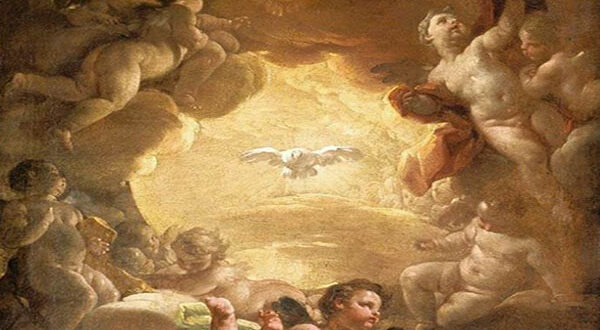
Fifty days after the Resurrection, ten days after the Ascension, He descended upon them like a mighty wind and tongues of fire.
It was not empty symbolism.
It was a real transformation.
Peter, who had denied Christ before a servant girl, now defies religious authorities.
That is what the Holy Spirit does:
He transforms fragility into supernatural fortitude.
8. The Cenacle: School of Waiting, Silence, and Mary
The Apostles did not receive the Spirit haphazardly.
They waited in prayer.
With perseverance.
With Our Lady.
This matters profoundly today.
Many want gifts… without prayer.
They want charisms… without conversion.
They want inspiration… without recollection.
But Pentecost was born in the Cenacle.
Where Mary is, the Holy Spirit finds docility.
Because no one was ever more docile to the Spirit than the Blessed Virgin.
9. The Gifts of the Holy Spirit: Weapons for Times of Confusion
The Spirit does not merely “accompany”; He equips.
His seven gifts:
Wisdom, understanding, counsel, fortitude, knowledge, piety, and fear of the Lord.
Today, in an age of relativism, lukewarmness, and moral chaos, these gifts are more necessary than ever:
Wisdom
To savor the things of God.
Understanding
To penetrate revealed truths.
Counsel
To decide according to God.
Fortitude
To resist cultural pressure, persecution, and temptation.
Knowledge
To rightly order created things.
Piety
To love God with filial devotion.
Fear of the Lord
To flee sin out of holy reverence.
10. The Holy Spirit and the Church: The Soul of the Mystical Body
The catechism teaches a powerful image:
Just as the soul gives life to the body, so the Holy Spirit gives life to the Church.
Without Him, the Church would be just another human institution.
With Him:
- She preserves truth
- She administers efficacious sacraments
- She produces saints
- She evangelizes
- She perseveres
That is why, despite human crises, sins of members, and historical persecutions, the Church does not disappear.
Because her vital principle is not political.
It is divine.
11. A Modern Warning: Resisting the Holy Spirit
One of the greatest modern dangers is reducing faith to external custom while suffocating the interior action of the Spirit.
One resists the Spirit when:
- Sin is justified
- Grace is despised
- Truth is rejected
- One lives in voluntary lukewarmness
- The heart is hardened
Blasphemy against the Holy Spirit implies that obstinate closure to the grace that seeks to save.
12. How to Live the Eighth Article of the Creed Today
Invoke Him every day:
“Come, Holy Spirit.”
Go to confession frequently:
Grace restores docility.
Pray at dawn:
Consecrate your decisions.
Read Scripture:
He inspired His Word.
Love truth:
The Spirit never contradicts Christ.
Remain close to Mary:
Spouse of the Holy Spirit.
Conclusion: Without the Holy Spirit, Christianity Becomes Ashes
The Father created you.
The Son redeemed you.
The Holy Spirit wants to sanctify you.
Many live as baptized… but spiritually extinguished.
And yet, the same fire of Pentecost remains available.
The same Spirit who descended upon the Apostles can:
- Break your chains
- Heal your lukewarmness
- Strengthen your purity
- Make you a courageous witness
You are not called merely to “believe He exists.”
You are called to live in Him.
Because the Holy Spirit did not come simply to visit you.
He came to make your soul His temple.
“Come, Creator Spirit, visit the souls of Your faithful and fill with divine grace the hearts You Yourself created.”