Related Articles

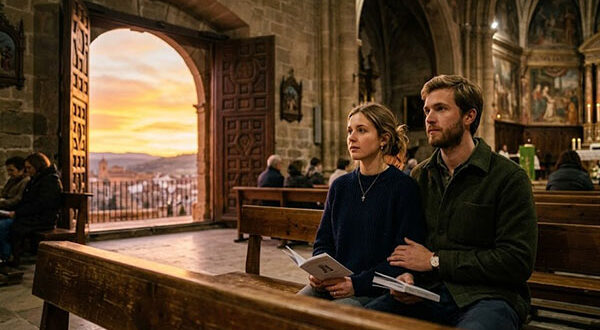
On many occasions, a common question arises among the faithful: does attending Mass on Saturday evening really fulfill the Sunday obligation? Some do it out of convenience, others out of necessity… and there are even those who view it with a certain suspicion, as if it were some kind of “spiritual shortcut.”
However, the Catholic Church, with millennia of wisdom and a profound pastoral sense, has answered clearly: yes, the Mass celebrated on Saturday evening is fully valid for fulfilling the Sunday obligation. But understanding why it is valid opens a much richer door: it introduces us to the theology of time, of Sunday, and of the Paschal mystery.
This article does not only aim to clarify a rule, but to help you rediscover the deep meaning of the Lord’s Day.
1. The Sunday Obligation: More Than an Obligation
The command to sanctify Sunday is rooted in the Decalogue itself:
“Remember the sabbath day, to keep it holy” (Exodus 20:8)
For Christians, this command reaches its fullness on Sunday, the day of Christ’s Resurrection. It is not merely a legal obligation, but a spiritual necessity: the Sunday Eucharist is the heart of Christian life.
The Catechism of the Church expresses this clearly:
“The Sunday celebration of the Lord’s Day and his Eucharist is at the heart of the Church’s life” (CCC 2177)
Therefore, the obligation is not a burden, but a gift: a real encounter with the living Christ.
2. Where Does the Saturday Evening Mass Come From?
This is where many are surprised. The practice of anticipating the Sunday celebration on Saturday evening is not a modern invention without foundation, but has deep roots in both biblical tradition and the liturgical development of the Church.
a) The Biblical Understanding of the Day
In the Jewish mindset, inherited by the early Church, the day does not begin at midnight, but at sunset.
We see this in the account of creation:
“And there was evening and there was morning, the first day” (Genesis 1:5)
This means that Sunday begins liturgically on Saturday evening.
Therefore, participating in Saturday evening Mass is not “moving Sunday forward,” but rather already entering into it.
b) Liturgical Development in the Church
This practice became especially established after the Second Vatican Council (1962–1965), which sought to facilitate the participation of the faithful in the Eucharist without losing its profound meaning.
Canon Law clearly states:
“A person who assists at a Mass celebrated anywhere in a Catholic rite either on the holy day itself or on the evening of the preceding day satisfies the obligation” (Canon 1248 §1)
This is not a minor concession: it is a full juridical and theological affirmation.
3. Why Is It Valid? Deep Theological Reasons
It is not enough to know that it is valid. It is important to understand why, in order to avoid a superficial experience.
a) Unity of the Paschal Mystery
The Mass is not a repetition, but the making-present of Christ’s sacrifice. Every Eucharist participates in the same Paschal mystery.
Therefore, what matters is not so much the “chronological moment” as the liturgical moment: if the Church is already celebrating Sunday, then we are in Sunday.
b) The Church Has Authority Over Sacramental Discipline
Christ entrusted the Church with the authority to order liturgical life:
“Whatever you bind on earth shall be bound in heaven” (Matthew 18:18)
The Church, as a mother, adapts norms to facilitate the salvation of her children without altering the essence of the sacrament.
c) Pastoral Dimension: The Salvation of Souls
The supreme law of the Church is clear: salus animarum suprema lex (the salvation of souls is the supreme law).
In a society with complex schedules, Sunday work, and fast-paced rhythms, Saturday evening Mass:
- Allows those who cannot attend on Sunday to fulfill the obligation
- Encourages conscious participation
- Prevents the obligation from becoming unattainable
4. Is It the Same as Going on Sunday? A Nuanced Answer
Here we must be honest and go deeper.
Yes, it is valid. But it is not always ideal.
The Church has never intended for Saturday to replace Sunday, but to anticipate it. Sunday remains:
- The proper day of the Resurrection
- The day of the gathered community
- The day of rest and sanctification
If one can attend on Sunday, it is spiritually richer to live the whole day as the Lord’s Day.
5. Risks of Misunderstanding
As good pastoral guidance, it is important to point out certain dangers:
a) Reducing Mass to “checking a box”
Going on Saturday just “to get it over with” can empty its spiritual meaning.
The Eucharist is not a task. It is an encounter.
b) Disconnecting from Sunday as a Holy Day
If Saturday Mass is not accompanied by a Christian living of Sunday (rest, prayer, family, charity), the full meaning is lost.
6. Practical Applications for Christian Life
How can we live this reality well?
1. Discern with the right intention
- If you go on Saturday out of necessity → you are living the precept well
- If it is out of convenience → examine your heart
2. Sanctify Sunday as well
Even if you attend on Saturday:
- Dedicate time to God
- Avoid excessive consumerism
- Live charity
3. Better preparation for the Eucharist
Saturday evening Mass can be a great opportunity to:
- Enter Sunday with recollection
- Begin spiritual rest
7. A Spiritual Key: Entering into “God’s Time”
The great underlying message is this: Christian time is not only chronological, it is theological.
God does not measure as we do.
Saturday evening Mass reminds us that:
- Sunday is not just a day, it is a mystery
- The Church gradually introduces us into that mystery
- The liturgy transforms time into grace
Conclusion: More Than Valid, a Gateway to Mystery
Yes, Saturday evening Mass is valid for fulfilling the obligation. But reducing it to that would be staying on the surface.
Lived well, it is:
- An anticipatory entry into the Paschal mystery
- A pastoral gift of the Church
- An opportunity to live Sunday more deeply
The final question should not only be “Does it count?”, but:
Am I living the Eucharist as the true center of my life?
Because, in the end, what is at stake is not a schedule… but an encounter with the living Christ.