Related Articles
There are prayers that arise from a human need: to ask for help, implore forgiveness, find comfort, or give thanks. And there are others that lead us directly to the heart of adoration: they invite us to lift our gaze towards God and acknowledge His infinite holiness.
Among the latter, the Trisagion holds a special place as one of the oldest and most solemn expressions of Christian praise.
Its name comes from the Greek triságion, which literally means “thrice holy.” In just a few words, it expresses one of the fundamental truths of our faith: God is infinitely holy, and His glory deserves to be proclaimed without ceasing.
“Holy God, Holy Mighty One, Holy Immortal One, have mercy on us.”
This brief invocation, repeated for centuries by generations of Christians, is not simply a pious formula. It is a prayer deeply rooted in Sacred Scripture, connected with the liturgy of both East and West, and closely related to the mystery of the Most Holy Trinity.
But where does the Trisagion come from? Why is it repeated three times? What connection does it have with the angels, the prophet Isaiah, and the liturgy of the Church? And how can we incorporate it into our spiritual lives?
To understand its true richness, we must explore its biblical, historical, and theological roots.
1. What Exactly Is the Trisagion?
The word Trisagion comes from the Greek triságion: tris means three, and hágios means holy. Its meaning is therefore “thrice holy.”
In the Christian liturgical tradition, the term refers especially to this ancient invocation:
Sanctus Deus, Sanctus Fortis, Sanctus Immortalis, miserere nobis.
In English:
Holy God, Holy Mighty One, Holy Immortal One, have mercy on us.
The prayer is addressed to God and brings together two inseparable spiritual movements:
- Adoration: it acknowledges the holiness, might, and immortality of God.
- Supplication: it implores His mercy in the face of our smallness, frailty, and sinful condition.
We are not dealing with a prayer intended to inform God of who He is. God does not need us to remind Him of His attributes. We are the ones who need to proclaim His greatness in order to order our hearts, acknowledge our dependence on Him, and learn to live in His presence.
The Trisagion teaches us precisely this: before asking for anything, we must recognize who the One we are addressing truly is.
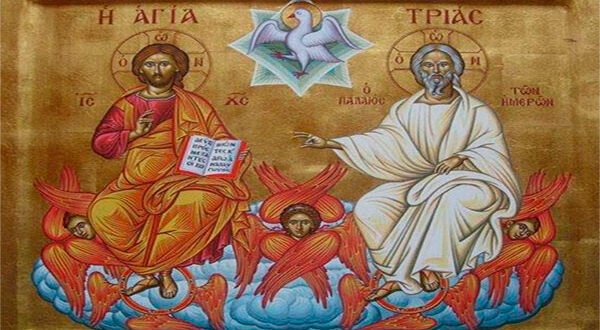
It is worth clarifying that the word Trisagion can be used in different contexts. There is the liturgical Trisagion, especially well known in the Eastern Churches, and there is also the Seraphic Trisagion, a form of Trinitarian devotion that spread throughout Catholic spirituality. Both are related to the proclamation of God’s threefold holiness, but they should not be confused as though they were exactly the same composition.
This distinction will help us understand its history more clearly.
2. Its Biblical Origin: The Vision of the Seraphim Before God’s Throne
To discover the spiritual roots of the Trisagion, we must turn to the Book of the Prophet Isaiah.
In chapter six, we encounter one of the most impressive visions in all of Sacred Scripture.
Isaiah beholds the Lord seated upon a high and exalted throne. Around Him appear the seraphim, heavenly creatures who remain in an attitude of adoration before the divine majesty.
The prophet describes what he hears:
“Holy, holy, holy is the LORD of hosts; the whole earth is full of his glory!” (Isaiah 6:3).
This proclamation constitutes one of the most important biblical foundations of the spirituality of the Trisagion.
The seraphim do not utter the word holy just once, but three times. This repetition expresses the fullness of divine holiness and the intensity of an adoration that knows no weariness.
It is not merely a rhetorical repetition. The threefold proclamation reveals that God’s holiness surpasses everything we can imagine.
The term “seraphim” comes from Hebrew and is associated with the idea of burning. In Christian tradition, the seraphim have been contemplated as heavenly spirits characterized by the ardour of their love and their contemplative closeness to God.
Isaiah’s vision thus presents us with a fundamental reality: adoration is not a human invention, but a reality that originates in Heaven.
When the Church praises God, she does nothing other than unite herself spiritually with that heavenly liturgy.
The Echo of Isaiah’s Vision in the Book of Revelation
The threefold proclamation of divine holiness appears again in the final book of the Bible.
Saint John, in the Book of Revelation, contemplates a vision of the heavenly throne and the living creatures surrounding God:
“Holy, holy, holy, is the Lord God Almighty, who was and is and is to come!” (Revelation 4:8).
The similarity with Isaiah is evident.
In both passages, we find heavenly adoration proclaiming God’s holiness through threefold repetition.
Furthermore, Revelation introduces an extraordinary temporal dimension: God is the One who was, who is, and who is to come.
His existence does not depend on time. He is not subject to change, ageing, or disappearance.
God is eternal, and His holiness endures forever.
These two biblical visions form the spiritual background of the Christian tradition of the Trisagion.
3. The Trisagion in the Liturgical Tradition of the Church
The invocation “Holy God, Holy Mighty One, Holy Immortal One” acquired extraordinary importance in the Christian liturgical tradition, especially in the East.
Its antiquity is considerable. Although we cannot establish with absolute certainty the exact moment of its composition, there are testimonies to its use in the ancient Church.
The formula appears connected with the liturgical tradition of Constantinople and is documented in the context of the Christological controversies of the fifth century.
Here it is important to distinguish between what we know historically and what belongs to legendary tradition.
The Tradition of the Earthquake in Constantinople
An ancient ecclesiastical narrative connects the appearance of the Trisagion with an earthquake that occurred in Constantinople during the fifth century, in the time of Patriarch Saint Proclus (434–446).
According to this account, while the population, the emperor, and the patriarch were imploring divine protection against the tremors, a child was supposedly lifted miraculously towards Heaven. Upon returning, he is said to have announced that he had heard the angels singing:
“Holy God, Holy Mighty One, Holy Immortal One.”
The people then supposedly repeated the invocation and, according to the narrative, the earthquake ceased.
This story is well known and has been transmitted by various ancient ecclesiastical sources. However, it should not be presented as a historically proven event. The Catholic Encyclopedia itself warns of the lack of credibility of certain elements of this account and indicates that the hymn probably predates the event to which its origin is attributed.
What truly matters is that the Trisagion already belonged to the ancient Christian tradition and that its use spread widely throughout the Eastern Churches.
An Essential Prayer in Eastern Liturgy
In the Byzantine liturgical traditions, the Trisagion occupies an especially prominent place.
It is sung during the Divine Liturgy, in the context of the entrance procession of the Gospel, and it also appears in other celebrations and offices.
Its presence is not merely ornamental. It constitutes a solemn proclamation of God’s holiness before His Word is heard.
The earthly Church thus joins in heavenly praise. The faithful are not simply spectators of a ceremony, but members of a community called to participate in the worship of God.
This dimension is particularly beautiful: when a Christian sings the Trisagion, he is using a prayer that has accompanied the faith and liturgy of numerous Christian peoples for centuries.
The Eastern tradition also preserves an extraordinary musical richness in the performance of this hymn, whose melodies convey solemnity, recollection, and a spirit of adoration.
4. The Trisagion in the Roman Liturgy: Good Friday
Although the Trisagion is especially associated with the Eastern Churches, we also find it in the Latin liturgical tradition.
One of the most significant moments is the celebration of the Passion of the Lord on Good Friday.
During the Adoration of the Holy Cross, in the traditional Roman rite, the so-called Improperia, also known as the Reproaches, are sung.
In them, the Church presents the words with which Christ seems to address His people, reminding them of the benefits they have received from God and contrasting them with the ingratitude shown towards Him during His Passion.
In this context, the Trisagion is interspersed with the Reproaches, being sung alternately in Greek and Latin.
The Greek form reads:
Ágios o Theós, Ágios Ischyrós, Ágios Athánatos, eléison imás.
And its corresponding Latin version:
Sanctus Deus, Sanctus Fortis, Sanctus Immortalis, miserere nobis.
In English:
Holy God, Holy Mighty One, Holy Immortal One, have mercy on us.
This alternation between Greek and Latin is one of the most beautiful features of this chant.
We are not dealing with two different prayers, but with the same supplication proclaimed in two languages that have played a fundamental role in the history of Christian liturgy.
In the traditional rite, the Trisagion is interspersed with the Reproaches and repeated throughout this part of the celebration.
An Important Liturgical Clarification: The Trisagion Is Not the Sanctus of the Mass
It is relatively common to confuse the Trisagion with the Sanctus sung during Holy Mass.
Although both are related to the threefold proclamation of divine holiness, they are not exactly the same hymn.
The Sanctus of the Mass comes directly from Isaiah’s proclamation in Isaiah 6:3:
“Holy, Holy, Holy is the Lord God of hosts.”
By contrast, the liturgical Trisagion incorporates the attributes “God,” “Mighty,” and “Immortal,” followed by a plea for mercy.
We can therefore distinguish between:
- The Sanctus: a hymn of praise that proclaims God’s holiness and forms part of the Eucharistic liturgy.
- The Trisagion: an invocation that proclaims God’s holiness, might, and immortality, while imploring His mercy.
- The Seraphic Trisagion: a Trinitarian devotional form that develops the praise of God, taking the threefold proclamation of Isaiah as its reference.
This distinction allows us to understand the richness of the liturgical tradition more clearly without confusing compositions which, although related, have different structures and functions.
5. The Mystery of the Most Holy Trinity: Why Is God Called Holy Three Times?
We now come to the deepest theological aspect of the Trisagion.
The threefold repetition of the word “Holy” has traditionally been contemplated in connection with the mystery of the Most Holy Trinity.
Christianity does not believe in three gods, but in one God in three truly distinct Persons: Father, Son, and Holy Spirit.
The Catechism of the Catholic Church teaches this clearly:
“The Trinity is One. We do not confess three Gods, but one God in three persons.” (CCC, 253).
The threefold proclamation of divine holiness therefore invites us to contemplate the mystery of the one and triune God.
Nevertheless, an important theological clarification must be made: the text of Isaiah does not contain an explicit explanation of the three divine Persons. Its Trinitarian interpretation belongs to the Christian reading of Scripture in the light of the full revelation accomplished by Jesus Christ.
In the entirety of Revelation, the Church recognizes the manifestation of the Father, the Son, and the Holy Spirit.
The threefold holiness thus constitutes a particularly appropriate expression of Trinitarian faith, although it should not be interpreted as though each of the three words “Holy” corresponded exclusively to one divine Person.
One God, Three Persons
The mystery of the Trinity does not mean that the Father is one-third of God, the Son another third, and the Holy Spirit the final third.
Nor does it mean that there are three successive manifestations of one and the same Person.
Catholic doctrine teaches that each divine Person is fully God because all three possess one and the same indivisible divine nature.
The Father is God, the Son is God, and the Holy Spirit is God. Nevertheless, they are not three gods, but one God.
The Catechism develops this teaching in paragraphs 253–255, explaining both the unity of the divine nature and the real distinction between the Persons.
When we pray the Trisagion, our adoration is directed towards the one true God.
We are not dividing His divinity or distributing His attributes among the Persons.
We are proclaiming that God is holy, mighty, and immortal in the fullness of His one divine being.
Holiness: The Attribute That Expresses God’s Absolute Perfection
What does it truly mean to say that God is holy?
In biblical language, divine holiness expresses God’s absolute transcendence, perfection, and purity.
God is not simply the best of all beings, nor an extraordinarily perfect creature.
God is the source of all holiness, the absolute Good, and the foundation of all perfection.
Everything that exists receives its existence from Him. Everything that is good participates in His goodness.
That is why, when Isaiah hears the seraphim proclaim God’s threefold holiness, he contemplates a reality that radically surpasses the human condition.
The creature cannot be compared with the Creator.
And yet, God has chosen to draw near to man, call him to holiness, and make him a participant in divine life through grace.
Here we encounter one of the great paradoxes of Christianity: the infinitely holy God does not remain indifferent to human misery, but comes to meet man in order to save him.
6. Holy God, Holy Mighty One, Holy Immortal One: The Meaning of Each Invocation
Each of the three expressions of the Trisagion contains a profound spiritual teaching.
They are not simply adjectives placed one after another. Each one helps us contemplate a dimension of divine greatness.
Holy God
The first invocation proclaims that God is absolutely holy.
His holiness does not depend on any creature, cannot increase or diminish, and is not subject to the circumstances of history.
Man can become holy because he participates in divine grace. God, on the other hand, is holy by nature.
This first proclamation reminds us that all true spirituality must begin by recognizing the absolute primacy of God.
In a culture that frequently makes man the measure of all things, the Trisagion restores the correct perspective: it is not God who must adapt Himself to our desires, but we who must order our lives according to His will.
Holy Mighty One
The second invocation acknowledges the infinite power of God.
Divine might must not be confused with human strength, which can manifest itself through violence, domination, or coercion.
God is almighty because nothing can limit His power and because everything that exists depends on Him.
Sacred Scripture proclaims:
“For nothing will be impossible with God.” (Luke 1:37).
These words appear in the announcement of the birth of Jesus, when the Angel Gabriel explains to Mary that Elizabeth, despite her advanced age, has also conceived a son.
The context shows us that God’s power is manifested in the fulfilment of His promises and in His saving action.
For the Christian, proclaiming “Holy Mighty One” means remembering that no difficulty, persecution, or suffering has the final word over history.
God does not promise that His children will be free from every tribulation, but He does promise that His grace can sustain them in the midst of it.
Holy Immortal One
The third invocation contemplates the eternity of God.
Everything belonging to the created world is subject to change. Men are born, grow old, die, and generations pass away.
Civilizations, institutions, and human structures also change.
God, however, is not subject to death or the passage of time.
Scripture proclaims:
“I am the Alpha and the Omega, the first and the last, the beginning and the end.” (Revelation 22:13).
God is eternal. He has no beginning and will have no end.
His existence depends on nothing and no one.
For us, this truth has an extraordinary spiritual consequence: we can entrust our lives to the One who never changes and whose faithfulness endures forever.
Have Mercy on Us
The final part of the invocation introduces a supplication that transforms the proclamation of divine attributes into a deeply personal prayer.
After acknowledging who God is, man presents himself before Him in his poverty.
We do not approach the Trisagion as people who consider themselves deserving of divine mercy, but as sinners who need His forgiveness.
God’s holiness is not a threat to those who approach Him with a contrite heart. It is precisely the reason why we can trust in His mercy.
As the Psalmist teaches:
“The LORD is gracious and merciful, slow to anger and abounding in steadfast love.” (Psalm 145:8).
The Trisagion reminds us that authentic adoration is never separated from humility.
The more we recognize God’s greatness, the more aware we become of our need for Him.
7. The Seraphic Trisagion: A Catholic Devotion in Honour of the Most Holy Trinity
In addition to the liturgical hymn we have studied, there is a form of devotion known as the Seraphic Trisagion or Angelic Trisagion, particularly associated with the praise of the Most Holy Trinity.
Its spirituality is inspired by Isaiah’s vision and by the adoration of the heavenly beings described in the Book of Revelation.
The expression “Seraphic” refers to the seraphim, those heavenly spirits who continually proclaim God’s holiness.
This devotion develops Trinitarian praise through invocations, prayers, and meditations on the divine attributes.
It should not be confused with a universal liturgical formula or with a prayer having one single, unchanging structure. Different versions and forms of praying it have circulated throughout history.
Saint Anthony Mary Claret and the Spread of the Trisagion
In Spain, one figure of particular importance for the spread of this devotion was Saint Anthony Mary Claret (1807–1870), Archbishop and founder of the Missionary Sons of the Immaculate Heart of Mary.
His interest in the praise of the Most Holy Trinity is reflected in various writings and publications.
A historical-biographical study published by the Claretian Missionaries documents that in 1848 a Trisagi was published at the request of devotees of the Most Holy Trinity. Later, Claret published a work in Vic in 1856 entitled Origen del Trisagio (Origin of the Trisagion), consisting of 64 pages and intended to explain and spread this devotion.
The work included a section devoted to reflections in the form of a novena, related to the nine choirs of angels, and another explaining the biblical foundation and historical spread of this prayer.
This detail is interesting because it demonstrates that the Trisagion was not merely a prayer preserved in Eastern liturgical books, but also found an important place in Spanish Catholic popular spirituality.
In a pastoral letter from 1853, Claret exhorted the faithful to adore the mystery of the Most Holy Trinity and continually praise God, among other ways, through the recitation of the Trisagion.
This insistence reveals an essential dimension of his spirituality: Christians should not approach God only to ask Him for things, but also to acknowledge His glory and praise Him for who He is.
Why Is It Associated with the Nine Choirs of Angels?
Christian tradition has developed a reflection on the different choirs of angels, especially based on biblical references to seraphim, cherubim, thrones, dominions, virtues, powers, principalities, archangels, and angels.
A classic exposition of this hierarchy is found in the treatise The Celestial Hierarchy, attributed to Dionysius the Areopagite, a Christian author from the late fifth or early sixth century, traditionally known as Pseudo-Dionysius.
His classification distinguishes three hierarchies, each consisting of three orders.
This tradition profoundly influenced medieval theology and Christian spirituality.
However, we must distinguish between what Scripture explicitly states and later theological development. The Bible mentions different categories of heavenly beings, but it does not provide a single, complete, systematic classification of the nine choirs.
The devotion of the Seraphic Trisagion uses this tradition to invite Christians to unite themselves spiritually with the praise of the angels.
It does not intend for man to imitate their nature materially, but rather to learn from them the fundamental disposition of every creature before God: to adore, serve, and glorify the Creator.
8. How Can the Trisagion Be Prayed?
The Trisagion can be incorporated into personal and family prayer in a simple, respectful, and deeply spiritual way.
There is no need to possess extensive theological knowledge or undergo any special preparation. It is enough to approach God with faith, humility, and recollection.
The fundamental invocation can be prayed as follows:
In Latin:
Sanctus Deus, Sanctus Fortis, Sanctus Immortalis, miserere nobis.
In English:
Holy God, Holy Mighty One, Holy Immortal One, have mercy on us.
It can be repeated three times, accompanied by a brief meditation on God’s holiness, power, and eternity.
A simple way to incorporate it into personal prayer is the following:
- Begin by making the Sign of the Cross, invoking the Father, the Son, and the Holy Spirit.
- Remain silent for a few moments, placing your heart in God’s presence.
- Recite the Trisagion slowly, seeking to understand each of its invocations.
- Repeat the prayer and offer God a particular intention: the conversion of sinners, the perseverance of the family, the sanctification of priests, or the needs of the Church.
- Conclude with a Trinitarian doxology: “Glory be to the Father, and to the Son, and to the Holy Spirit. As it was in the beginning, is now, and ever shall be, world without end. Amen.”
This proposal is a simple form of personal prayer, not a compulsory liturgical rubric or a single official formula of the Trisagion.
The Trisagion in Family Life
One of the most beautiful applications of this prayer is to restore it within family life.
In a Christian home, where worries, fatigue, financial difficulties, and everyday problems so often accumulate, dedicating a few minutes to the adoration of God can become a source of spiritual unity.
Parents can teach their children the meaning of its three invocations:
- God is holy: we must strive to live in grace and turn away from sin.
- God is mighty: we can trust in Him when difficulties arise.
- God is immortal: our hope does not end with this life.
In this way, children do not merely learn a prayer by heart, but begin to understand who God is and what it means to live under His gaze.
Family prayer does not have to be complicated to be fruitful. Sometimes, a few minutes of shared recollection can teach more than many words.
9. The Trisagion and the Spiritual Life of Today’s Catholic
We might ask ourselves what purpose such an ancient prayer serves in a society marked by speed, noise, distractions, and a loss of sensitivity towards the sacred.
The answer is simple: precisely because we need to recover our sense of God.
We live in an age in which many people approach religion primarily in search of emotional well-being, peace of mind, or solutions to their problems.
There is nothing wrong with asking God for help. Our Lord Jesus Christ Himself taught us to present our needs to the Father.
However, Christian life cannot be reduced to a succession of requests.
God is not an instrument for achieving our personal objectives. He is our Creator, our Lord, and our ultimate end.
The Trisagion helps us recover this perspective.
Learning to Adore in a Society That Has Forgotten Adoration
Adoration is a fundamental attitude of religion.
It means acknowledging that God is God and that we are creatures who depend on Him.
This truth can be uncomfortable for a deeply individualistic mentality that regards personal autonomy as the supreme value.
However, acknowledging our dependence on God does not degrade us. On the contrary, it places us in the truth of our existence.
Man did not give himself life, he is not the absolute owner of the universe, and he cannot guarantee his own eternity.
When we pray the Trisagion, we humbly accept this reality.
God’s Holiness Calls Us to Conversion
We cannot sincerely proclaim God’s holiness while deliberately living with our backs turned to His commandments.
The Trisagion must also become a call to conversion.
If God is holy, we are called to abandon sin and seek a life in accordance with the Gospel.
Saint Peter expresses this requirement of Christian holiness when he writes:
“As he who called you is holy, be holy yourselves in all your conduct.” (1 Peter 1:15).
Holiness is not an aspiration reserved for a few religious people or extraordinary individuals.
It is a universal vocation that extends to all the baptized.
The father of a family is called to sanctify himself through his responsibilities, marital fidelity, and dedication to his loved ones. The worker, through honesty and justice. The priest, through fidelity to his ministry. The young person, through purity, formation, and the sincere search for truth.
True devotion does not distance us from our everyday obligations: it helps us fulfil them in a holy manner.
Adoration Teaches Us to Trust
The invocation “Holy Mighty One” has particular importance for those going through difficult moments.
When circumstances seem to exceed our abilities, we need to remember that our hope does not depend exclusively on our own strength.
God’s omnipotence does not mean that we will automatically obtain everything we desire, but that His will is sovereign and that His providence never ceases to act.
The Christian can suffer, experience uncertainty, and even go through moments of spiritual darkness without losing trust in God.
Prayer does not always immediately change our circumstances, but it helps us face them through faith.
Eternity Must Guide Our Existence
Finally, “Holy Immortal One” invites us to recover the perspective of eternity.
One of the great temptations of our time is to live as though earthly existence were our only horizon.
We worry about well-being, success, comfort, and material security, forgetting that our lives are called to something infinitely greater.
Christ came to open the gates of eternal life for us.
The Trisagion reminds us that our ultimate destiny is not found in passing things, but in God.
This awareness should not produce contempt for the world or indifference towards human needs. Rather, it should help us live properly in the world without turning temporal goods into our idols.
10. The Trisagion as a School of Humility and Contemplation
There is one particularly important spiritual lesson that we can draw from this ancient prayer: to learn to live as Christians, we must first learn to look towards God.
Contemporary man spends a great deal of time looking at himself, analysing his emotions, defending his interests, and seeking recognition.
Christian prayer, however, invites us to come out of this self-enclosure.
When we proclaim God’s holiness, we cease to occupy the centre of our own existence.
We are not the ones who determine what is good and what is evil according to our preferences. We are not the ones who establish the truth. We are not the ones who decide what deserves adoration.
God is the centre.
This attitude of adoration leads us to humility, but also to profound inner freedom.
Those who recognize God as Lord no longer need to turn everything into an instrument of their own satisfaction.
They can accept their limitations, ask for forgiveness, correct their mistakes, and begin again.
They also learn to look upon others with greater charity because they recognize that we are all God’s creatures and that we are called to participate in His holiness.
Authentic adoration, therefore, must never become a practice isolated from charity.
It would make no sense to proclaim divine holiness while despising our neighbour, sing of God’s mercy while refusing to forgive, or praise the Creator while living in injustice.
The Trisagion must help us transform our lives.
11. The Trisagion as a Prayer That Unites the Church on Earth with the Liturgy of Heaven
There is one final dimension of the Trisagion that deserves our attention.
When the Church sings “Holy, Holy, Holy,” she is not merely performing an act of human devotion. She is expressing one of the most beautiful truths of Christian liturgy: the prayer of the Church participates in heavenly praise.
The Catechism of the Catholic Church teaches that the liturgy is the work of the Most Holy Trinity and that, through it, the Church blesses the Father, through Christ, in the Holy Spirit (CCC, 1077–1083).
This teaching allows us to understand more clearly the relationship between earthly and heavenly worship.
In Holy Mass, the faithful unite themselves with the praise of the angels and saints. We are not witnessing a mere symbolic representation, but the participation of the pilgrim Church in the heavenly liturgy.
That is why the Sanctus of the Mass has extraordinary depth: when the priest and the faithful proclaim God’s holiness, their voices are spiritually united with the praise that Sacred Scripture describes in Isaiah and Revelation.
The Trisagion belongs to this same tradition of adoration.
Its presence in the Eastern liturgies, its use on the Roman Good Friday, and its spread throughout popular spirituality show us how one and the same truth of faith can be expressed through different forms of prayer.
Throughout the centuries, the Church has preserved this proclamation of divine holiness as a treasure of her spiritual heritage.
Conclusion: May Our Entire Lives Become a Trisagion
The Trisagion is much more than an ancient prayer that deserves to be preserved for its historical value.
It is an invitation to recover the meaning of adoration, contemplate God’s greatness, and understand that our entire existence must be directed towards Him.
When we say “Holy God,” we acknowledge that He is the origin and end of everything that exists.
When we say “Holy Mighty One,” we place our trust in His omnipotence and providence.
When we say “Holy Immortal One,” we lift our gaze towards eternity and remember that our true hope lies in the life Christ has promised us.
And when we plead “have mercy on us,” we acknowledge our condition as creatures in need of forgiveness, grace, and salvation.
In a world that so often forgets God, recovering this prayer also means recovering the fundamental order of Christian life: God first, God at the centre, and God as the ultimate destination of our existence.
It is not enough to pronounce the word “Holy” three times. We must strive to ensure that our actions, words, decisions, and thoughts become increasingly worthy of the One whom we adore.
May we learn from the seraphim to praise without weariness, from the saints to live faithfully, and from Jesus Christ to offer our lives to the Father.
And when our strength fails, may we return to this ancient, simple, and profound invocation, which has accompanied the prayer of the Church for centuries:
Sanctus Deus, Sanctus Fortis, Sanctus Immortalis, miserere nobis.
Holy God, Holy Mighty One, Holy Immortal One, have mercy on us.
Glory be to the Father, and to the Son, and to the Holy Spirit.
As it was in the beginning, is now, and ever shall be, world without end. Amen.
Sources and References for Further Study
- Sacred Scripture: Isaiah 6:1–7; Revelation 4:1–11; Luke 1:26–38; 1 Peter 1:13–16.
- Catechism of the Catholic Church: paragraphs 232–255 (the mystery of the Most Holy Trinity) and 1077–1083 (the liturgy, the work of the Most Holy Trinity).
- Saint Anthony Mary Claret: Origen del Trisagio (Origin of the Trisagion) (Vic, 1856).
- Dionysius the Areopagite (Pseudo-Dionysius): The Celestial Hierarchy.
- Catholic Encyclopedia: entry “Agios O Theos,” concerning the Trisagion and its presence in the Roman liturgy of Good Friday.
One final reflection: The most perfect prayer is not necessarily the one that contains the most words, but the one that helps us recognize who God is and truly surrender our lives to Him. The Trisagion teaches us to begin with what is essential: to adore God for His infinite holiness.