Related Articles

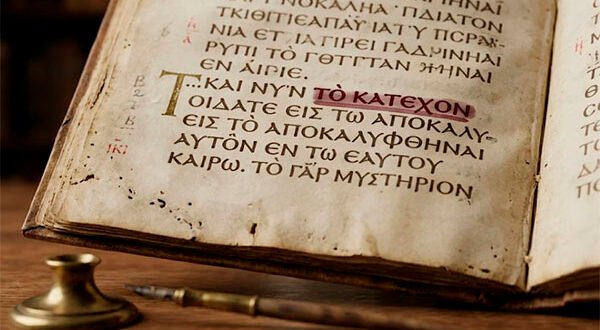
There are expressions in Sacred Scripture which, despite having been meditated upon for centuries by saints, the Fathers of the Church, and great theologians, continue to preserve a profound mystery. One of them is the Katechon, a Greek term that appears in Saint Paul’s Second Letter to the Thessalonians and has given rise to numerous interpretations throughout the history of Christianity.
Saint Paul speaks of a force that restrains the manifestation of the man of lawlessness, preventing him from being fully revealed before the glorious coming of Jesus Christ. What is the Apostle referring to? Is it an institution, an authority, a spiritual force, or a disposition of Divine Providence? Is it connected with the Antichrist and the events that will precede the end of time?
This is no minor question. It introduces us to one of the most enigmatic passages in Christian eschatology, that is, the theological reflection on the last things: the consummation of history, the Second Coming of Christ, the Last Judgment, and God’s definitive victory over evil.
Nevertheless, it is necessary to approach the Katechon with prudence. The Church has not dogmatically defined any specific identification of this reality. Therefore, we must not turn a theological interpretation, however ancient or suggestive it may be, into a mandatory article of faith.
What truly matters is understanding what Saint Paul teaches: evil does not have unrestricted control over history, the Antichrist does not appear independently of God’s permissive will, and no force of iniquity can frustrate the definitive triumph of Jesus Christ.
1. What Does the Word Katechon Mean?
The word Katechon comes from the Greek κατέχον (to katéchon), an expression related to the verb κατέχω (katéchō), whose meaning can include restraining, holding back, containing, preventing, or keeping something under control.
In the context of the Second Letter to the Thessalonians, it is used to designate that which restrains or holds back the manifestation of the man of lawlessness.
There is a particularly interesting linguistic detail: Saint Paul uses two different grammatical forms:
- Tò katéchon (τὸ κατέχον): a neuter form that can be translated as “that which restrains him” or “what holds him back.”
- Ho katéchōn (ὁ κατέχων): a masculine form meaning “the one who restrains him” or “the one who holds him back.”
This difference has been the subject of theological reflection for centuries. It seems to indicate that the reality exercising this function can be considered both from an impersonal dimension—a force, power, or institution—and from a personal dimension, that is, someone exercising this function.
Nevertheless, grammar alone does not allow us to identify the Katechon. Nor does it prove that these are necessarily two different realities. Saint Paul does not provide an explicit explanation of its identity in the text that has come down to us.
What is clear is its function: to prevent iniquity from reaching the moment of its full manifestation before the appointed time.
2. The Fundamental Passage: Saint Paul and the Mystery of Lawlessness
The fundamental reference is found in 2 Thessalonians 2:1–12. It is worth reading the entire passage, because the words concerning the Katechon cannot be properly understood when separated from their context.
Saint Paul writes to a Christian community concerned that the Day of the Lord might already have arrived. Some people had spread messages that could lead them to believe that Christ’s coming was imminent or had already taken place.
In this context, the Apostle asks them not to be deceived or alarmed.
He announces that, before the glorious manifestation of Jesus Christ, there will be a great rebellion and the man of lawlessness will appear.
The text says:
“Let no one deceive you in any way. For that day will not come, unless the rebellion comes first, and the man of lawlessness is revealed, the son of destruction” (2 Thessalonians 2:3).
A little later, Saint Paul introduces the mysterious reality that concerns us:
“And you know what is restraining him now so that he may be revealed in his time. For the mystery of lawlessness is already at work; only he who now restrains it will do so until he is out of the way” (2 Thessalonians 2:6–7).
And he continues by explaining the outcome:
“And then the lawless one will be revealed, whom the Lord Jesus will kill with the breath of his mouth and destroy by the manifestation of his coming” (2 Thessalonians 2:8).
These words contain several fundamental teachings.
First: the mystery of lawlessness was already at work in apostolic times. Evil does not suddenly appear at the end of history. Its roots have been present in the world long before its definitive manifestation.
Second: there is a temporal limitation on the expansion of iniquity. The manifestation of the man of destruction does not take place whenever he wishes, but at the time corresponding to the divine plan.
Third: the Antichrist will not have the final word. His power will be destroyed by Jesus Christ at His glorious coming.
This final statement is especially important. The passage does not end by speaking about the power of the Antichrist, but about the absolute victory of Christ.
The Katechon must be understood within this perspective: not as an independent force fighting against God on equal terms with evil, but as a reality subject to Divine Providence.
3. The Mystery of Lawlessness: An Evil That Is Already at Work in the World
To understand the Katechon, it is necessary to examine another Pauline expression: mysterium iniquitatis, the mystery of lawlessness.
Saint Paul states that this mystery was already at work when he wrote to the Thessalonians.
What does this mean?
It does not simply refer to the existence of people who commit sins, nor to the ordinary presence of human weaknesses. Its meaning points to something deeper: the action of evil working against the order willed by God and preparing the conditions for an increasingly profound rebellion against His authority.
Sin, when it becomes a deliberate and persistent attitude, can acquire a collective dimension. People transmit errors, construct unjust structures, normalize behaviours contrary to natural law, and even come to present evil as though it were good.
This reality has a spiritual, moral, and social dimension.
Sacred Scripture offers other testimonies to this opposition to God.
Saint John writes:
“Children, it is the last hour; and as you have heard that antichrist is coming, so now many antichrists have come” (1 John 2:18).
The Apostle is not saying that all these antichrists are necessarily the definitive Antichrist. He is showing that opposition to Christ is already manifested throughout history through those who deny His identity and reject the truth He has revealed.
Our Lord also warns:
“And because lawlessness will be increased, the love of many will grow cold” (Matthew 24:12).
The relationship between these two passages allows us to understand an essential dimension of the problem: the advance of iniquity does not consist solely of the external persecution of the Church. It can also manifest itself through the internal weakening of faith, the loss of charity, and the gradual abandonment of truth.
The Katechon appears precisely in this setting: while the mystery of lawlessness is at work, something restrains it so that it does not yet reach its definitive manifestation.
4. The Interpretation of the First Christians: Was the Roman Empire the Katechon?
One of the oldest and best-known interpretations identifies the Katechon with the Roman Empire and its political authority.
This explanation is particularly important because it appears in Christian authors from the early centuries.
To understand it, we must place ourselves in the historical context of early Christianity.
The first Christians lived under Roman rule. The Empire constituted a political and legal structure which, despite its injustices, persecutions, and religious contradictions, maintained a certain institutional order across vast territories.
From this perspective, the disappearance of that power could be associated with the arrival of a situation of disorder that would facilitate the manifestation of the Antichrist.
This did not mean claiming that the Roman Empire was a Christian institution or that all its emperors were good rulers. In fact, some of them cruelly persecuted Christians.
The interpretation referred to its function as a political authority and a restraint against chaos.
Tertullian and the Continuation of the Empire
One of the most significant testimonies appears in Tertullian, a Christian writer from the late second and early third centuries.
In his work Apologeticus, chapter 32, he explains why Christians prayed for the emperors and for the stability of the Roman Empire.
Tertullian states that the fulfilment of the terrible events that would precede the end was being delayed by the continued existence of the Empire.
His reasoning is closely related to the traditional interpretation of the Katechon.
It is important to clarify that Tertullian does not provide a complete exegetical commentary on 2 Thessalonians 2 in that passage, but his testimony constitutes highly relevant historical evidence of the ancient association between Roman stability and the postponement of the final events.
Saint John Chrysostom: The Most Explicit Interpretation
An even more direct testimony is found in Saint John Chrysostom, one of the great Fathers of the Church and a Doctor of the Church.
In his Fourth Homily on the Second Letter to the Thessalonians, when commenting precisely on verses 6 and 7 of chapter two, he raises the question:
What is it that prevents the manifestation of the Antichrist?
Chrysostom mentions two interpretations: some thought it was the grace of the Holy Spirit, while others identified the restraining power with the Roman Empire.
Chrysostom himself expresses his preference for the second explanation.
His reasoning is that Saint Paul would have spoken in veiled terms to prevent his words from being interpreted as a desire for the destruction of the Empire, which could have provoked unnecessary persecution against Christians.
According to this interpretation, as long as imperial authority remained in place, there would be a power capable of restraining the emergence of a situation of anarchy in which the man of lawlessness could impose his dominion.
Chrysostom goes so far as to associate the future disappearance of that authority with the subsequent manifestation of the lawless one.
Saint Augustine: Prudence in the Face of Mystery
We also find an extraordinarily important reflection in Saint Augustine, in Book XX, Chapter 19, of The City of God.
Saint Augustine examines Saint Paul’s words and expressly acknowledges the difficulty of identifying that which restrains the Antichrist.
He mentions the interpretation of the Roman Empire, but also other explanations he had encountered.
One of them associated the mystery of lawlessness with the wicked and hypocrites who remain within the Church, whose presence and multiplication could prepare the setting for the appearance of the Antichrist.
The saint does not present these interpretations as definitive certainties. In fact, he humbly acknowledges that he does not know for certain what the Apostle meant.
His attitude constitutes a lesson of enormous value for any reflection on eschatology: when Scripture leaves a question open, the Christian must not turn conjectures into dogmas.
The Roman interpretation, therefore, has important patristic precedents. It is not a modern invention or a theory that arose exclusively in contemporary circles.
But we must not forget that the Fathers recognized the difficulty of the passage and that the identification of the Katechon has not been defined by the Magisterium as a truth binding upon Catholics.
5. Other Interpretations of the Katechon: A Spiritual Force?
Although the interpretation of the Roman Empire has considerable historical importance, it is not the only one that has been proposed.
Throughout the centuries, other explanations have emerged in an attempt to understand the nature of the force that restrains the manifestation of the Antichrist.
It is important to know them, while always distinguishing between theological interpretations and teachings that the Church presents as certain doctrine.
A. The Action of the Holy Spirit
Some interpreters have associated the Katechon with the action of the Holy Spirit.
This idea begins with a theological consideration: the Holy Spirit acts continuously in the Church and in the world, enlightening consciences, strengthening the faithful, and sustaining the work of evangelization.
His action opposes sin and allows the truth of Christ to continue being proclaimed even amid the greatest difficulties.
From this perspective, the Katechon could be understood as a reference to the divine action that restrains the advance of iniquity.
However, something must be clarified: there is no doctrinal definition expressly identifying the Holy Spirit with the Katechon of 2 Thessalonians.
Furthermore, Saint John Chrysostom was familiar with this interpretation, but preferred the identification with the Roman Empire.
B. The Angelic Powers
Another possibility associates the Katechon with the intervention of angels in the providential governance of the world.
Sacred Scripture presents angels as spiritual creatures at the service of God, who carry out His commands and participate in the protection of the chosen people.
In the Book of Daniel, we find a significant example:
“At that time shall arise Michael, the great prince who has charge of your people” (Daniel 12:1).
The Book of Revelation also describes the battle of Saint Michael and his angels against the dragon:
“Now war arose in heaven, Michael and his angels fighting against the dragon” (Revelation 12:7).
These passages allow us to understand that the history of salvation does not unfold exclusively within a visible and human dimension. There is also a spiritual reality in which angels serve God’s designs.
Some interpreters have connected this dimension with the Katechon, although we cannot claim that Saint Michael is necessarily the person to whom Saint Paul refers.
C. The Preaching of the Gospel
A third interpretation considers the Church’s evangelizing mission as a reality that restrains the advance of iniquity.
Jesus Christ announces in the Gospel:
“And this gospel of the kingdom will be proclaimed throughout the whole world as a testimony to all nations, and then the end will come” (Matthew 24:14).
The Church has the mission of proclaiming the truth, calling people to conversion, and leading men and women towards salvation.
As long as this mission continues, the Gospel continues to be proclaimed among the nations, and God’s grace continues to act in history.
From this perspective, some have associated Christian preaching with the restraining function of the Katechon.
Nevertheless, Matthew 24:14 does not expressly identify evangelization with Saint Paul’s Katechon. This is a possible theological connection, not an established equivalence in Scripture.
What should we conclude from all these interpretations?
That there is a reality that restrains evil, but its specific identity remains open to theological discussion.
What we must not lose sight of is that none of these realities possesses autonomous power in opposition to God. Every authority, every spiritual mission, and every angelic action ultimately depends upon Divine Providence.
6. The Katechon and the Providence of God: Evil Has Limits
This is probably the most important theological aspect of the entire subject.
The existence of the Katechon leads us to reflect on a fundamental truth of the Catholic faith: God is the Lord of history, and nothing can escape His sovereignty.
Evil exists. The devil acts. Human beings can freely reject God and build societies opposed to His law.
But none of these realities possesses absolute power.
The Catechism of the Catholic Church teaches that God is the sovereign Lord of His plan and that Divine Providence guides history towards its fulfilment (CCC 302–314).
This does not mean that God is the author of sin or that He approves of the injustices committed by human beings.
It means that, even when He permits painful events to occur, His power is capable of bringing forth a good that surpasses our immediate understanding.
Saint Augustine develops this question in his reflection on the origin of evil and Divine Providence. Moral evil proceeds from the disordered use of created freedom, not from God. Nevertheless, God can permit it without losing His dominion over creation.
This distinction is essential to understanding the Katechon.
We must not imagine two powers confronting one another on equal terms: one representing good and the other representing evil, fighting over control of the universe.
That would be contrary to Catholic doctrine.
God has no adversary capable of endangering His sovereignty. Satan is a fallen spiritual creature whose power is limited and whose definitive condemnation is assured.
The Catechism expresses this clearly in numbers 391–395: Satan was created good by God, became evil through a free decision, and his activity, although real, cannot prevent the building of the Kingdom of God.
Therefore, the Katechon must be considered within this reality: iniquity can act, but it cannot determine for itself the moment of its manifestation or the final outcome of history.
7. The Katechon and the Antichrist: What Does the Church Actually Teach?
Speaking about the Katechon inevitably leads us to speak about the Antichrist.
The figure of the Antichrist appears in different passages of the New Testament, although they do not all employ exactly the same terminology.
Saint John expressly uses the term “antichrist” in his letters. Saint Paul, on the other hand, speaks of the man of lawlessness or the lawless one.
The Catechism of the Catholic Church takes up this teaching in numbers 675–677, within the section devoted to the Church’s final trial.
Number 675 teaches:
“Before Christ’s second coming the Church must pass through a final trial that will shake the faith of many believers.”
The Catechism explains that this trial will be accompanied by a religious deception offering people an apparent solution to their problems, but at the price of abandoning the truth.
It adds that the supreme religious deception will be that of the Antichrist: a pseudo-messianism in which man glorifies himself and takes the place of God and His Messiah.
This teaching is fundamental because it allows us to understand that the Antichrist should not be reduced to a political, military, or revolutionary figure.
Its deepest meaning is religious: it represents rebellion against God and the pretension to construct human salvation apart from Jesus Christ.
The Antichrist Is Not Simply Someone Who Persecutes Christians
External persecution is one of the possible manifestations of opposition to Christ, but Antichristian deception can be much subtler.
It can appear as a doctrine that promises happiness by eliminating every reference to God.
It can appear as an ideology that considers man to be the absolute measure of truth and goodness.
It can manifest itself in a society that seeks to replace natural moral law with arbitrary human decisions.
And it can also enter the religious sphere when an appearance of spirituality is preserved while the Christian message is emptied of its supernatural content.
Not every political injustice, philosophical error, or social conflict constitutes, in itself, a manifestation of the Antichrist. Hasty identifications must be avoided.
But we can recognize that any proposal that deliberately places man in the position of God reproduces, at its root, the same temptation of rebellion against the Creator.
The Catechism, in number 676, warns precisely against forms of secularized messianism that seek to bring about within history a hope of salvation that can only reach its fullness beyond it.
This warning is enormously relevant today.
8. Can the Katechon Be Identified with the Catholic Church?
This is a question that deserves special consideration.
In certain theological and traditional circles, the Katechon has been associated with the Catholic Church, its spiritual authority, or the continued existence of a Christian social order.
The explanation has a certain logic: the Church proclaims revealed truth, administers the sacraments, combats error, forms consciences, and calls people to live according to God’s law.
Wherever the Christian faith preserves its influence, it can also contribute to restraining certain manifestations of moral and social corruption.
The history of Europe offers numerous examples of Christianity’s influence on the formation of institutions, laws, universities, hospitals, and structures of assistance for those most in need.
However, we must distinguish between a theological interpretation and a doctrinal statement.
The Church has not defined that the Katechon is the Catholic Church, the Papacy, or a particular historical form of Christian political organization.
Nor would it be correct to automatically identify every crisis within the Church with the disappearance of the Katechon.
The Church can experience periods of weakness, persecution, confusion, and even serious scandals committed by some of her own members. But her supernatural mission does not depend on the strength of a particular civilization.
Christ promised His disciples:
“And behold, I am with you always, to the end of the age” (Matthew 28:20).
He also declared:
“The gates of hell shall not prevail against it” (Matthew 16:18).
These words do not mean that the Church is exempt from suffering, persecution, or crises. They mean that Jesus Christ remains faithful to His promise and that the Church will not be destroyed by the forces of evil.
The Church may lose social influence, suffer persecution, and experience serious difficulties, but she continues to be the Body of Christ and the instrument willed by God for the salvation of mankind.
Therefore, it is legitimate to study the possible relationship between the Katechon and the mission of the Church, but this identification must not be presented as a defined teaching.
9. What Is the Relationship Between the Katechon and the Spiritual Crisis of Our Time?
Although we cannot claim that we are living through the moment of the disappearance of the Katechon, Saint Paul’s passage offers valuable criteria for interpreting some contemporary challenges.
We live in an age in which certain cultural movements seek to separate human freedom from any reference to objective truth.
Freedom is frequently presented as the ability to choose without limits, as though good and evil were merely social constructs.
But Catholic tradition teaches something very different.
True freedom does not consist in doing absolutely anything, but in being able to choose what is good.
Saint Thomas Aquinas explains that natural law is the participation of the rational creature in the eternal law of God. Through reason, human beings can know certain fundamental principles of moral goodness, although their knowledge can be obscured by sin, bad habits, and errors.
When a society progressively loses the ability to distinguish between good and evil, the foundations that make it possible to build a truly human coexistence are also weakened.
Here we can find a pastoral application of the concept of restraining iniquity.
The Family as a School of Spiritual Resistance
The Christian family has an irreplaceable mission.
It is the first place where children learn to distinguish between what is right and what is wrong, where they discover the meaning of sacrifice, obedience, respect, and charity.
When parents transmit the faith, teach their children to pray, and educate them according to Christian morality, they contribute to forming people capable of resisting influences that seek to lead them away from God.
The family is not the Katechon in the technical sense of Saint Paul’s expression, but it participates in the mission of preserving the moral order and transmitting Christian truth.
Defending the Truth Against Relativism
Another challenge of our time is the tendency to consider all opinions equally valid in moral terms and to claim that no truth can be presented as universal.
However, Christianity cannot renounce the revealed truth in order to adapt itself to the cultural preferences of each age.
Jesus Christ did not say that He was one opinion among many.
He said:
“I am the way, and the truth, and the life” (John 14:6).
Fidelity to Christ requires defending the truth with charity, but also with firmness.
This does not mean imposing the faith by force or despising those who think differently. It means refusing to renounce what God has revealed.
Prayer and the Sacramental Life
Prayer, Holy Mass, frequent Confession, the Eucharist, and the recitation of the Holy Rosary are fundamental means of strengthening spiritual life.
A Christian cannot effectively combat evil if he neglects his own relationship with God.
The struggle against iniquity begins within the human heart.
A person who strives to live in a state of grace, practise justice, reject sin, and grow in charity helps ensure that the light of Christ remains present in the world.
We cannot control the final events of history, but we can remain faithful to our Christian vocation in the present.
10. A Necessary Warning: Do Not Turn the Katechon into a Conspiracy Theory
Interest in the Katechon has grown in certain circles that reflect on the end times, the crisis of institutions, and the future of Christian civilization.
This interest can be legitimate when it arises from a desire to understand Scripture and deepen one’s knowledge of eschatology.
Nevertheless, there is a danger: turning the Pauline mystery into a tool for interpreting every political or social event as an unmistakable sign of the end of the world.
Throughout history, numerous identifications of the Antichrist and the forces supposedly restraining him have been proposed. Many of them have been shaped by the conflicts and concerns of their respective eras.
That is why it is essential to remember the words of Our Lord:
“But concerning that day and hour no one knows, not even the angels of heaven, nor the Son, but the Father only” (Matthew 24:36).
The Church does not teach that we should live obsessed with calculating dates, discovering hidden identities, or interpreting every event as the definitive fulfilment of a prophecy.
Christian eschatology is not a discipline intended to feed fear.
Its purpose is to remind us that history has a meaning, that Christ will return in glory, and that we will all appear before the judgment of God.
Christian hope does not consist in knowing all the details of the future in advance, but in remaining faithful to Jesus Christ.
11. How Should a Catholic Live in the Face of the Mystery of the Katechon?
Studying the Katechon should not lead us to anxiety, but rather to greater spiritual vigilance.
Saint Paul did not write to the Thessalonians so that they would live in terror at the appearance of the Antichrist. He wrote to correct their errors, strengthen their faith, and prevent them from being deceived.
This teaching remains perfectly valid today.
We can draw several practical conclusions.
First: preserve the faith in its entirety.
We must not adapt the Gospel to ideological fashions or abandon Christ’s teachings out of fear of being rejected by the world.
Second: live in a state of grace.
The best preparation for the coming of Christ does not consist in discovering who the Antichrist will be, but in living reconciled with God through prayer, the sacraments, and a coherent moral life.
Third: defend the truth without losing charity.
Christians are called to combat error, but must never forget that they are also called to love their neighbour. Doctrinal firmness does not justify hatred, unjust violence, or contempt for other people.
Fourth: pray for the Church and for those in authority.
Christian tradition has always recognized the importance of praying for those who bear responsibilities of government. Saint Paul himself urges that supplications, prayers, and intercessions be made for all people, including those in authority (1 Timothy 2:1–2).
This prayer does not mean approving all their decisions, but asking God that those who exercise authority may act according to justice and the common good.
Fifth: keep hope alive.
Christians know that evil can acquire great historical power, but they also know that its dominion is limited and temporary.
We must not confuse the state of the world with the definitive destiny of humanity.
The final word does not belong to sin, persecution, or the Antichrist.
It belongs to Jesus Christ.
12. The Final Victory Belongs Not to the Katechon, but to Jesus Christ
There is a detail in Saint Paul’s passage that deserves to be remembered.
When the Apostle describes the manifestation of the man of lawlessness, he does not present an endless battle between equivalent forces.
He states that Jesus Christ will destroy the lawless one with the breath of His mouth and with the manifestation of His coming.
This image possesses extraordinary theological force.
The power of the Antichrist, however great it may appear, will not be able to withstand the glorious presence of the Lord.
The Book of Revelation develops this same perspective through the image of the definitive battle between Christ and the forces of evil.
The Lamb conquers because He is the Lord of history.
The Catechism of the Catholic Church, in number 677, teaches that the Kingdom of God will not reach its fullness through a historical triumph of the Church understood as a progressive expansion of her temporal power, but through God’s definitive victory over the final unleashing of evil.
This statement protects us from two opposing errors.
The first consists in thinking that evil will ultimately prevail and that human history is condemned to failure.
The second consists in believing that we can build, through our own efforts, a perfect society that makes God’s definitive intervention unnecessary.
Christian hope surpasses both extremes.
We work for good, defend the truth, educate our children, transmit the faith, and strive to transform our society according to the Gospel. But we know that the fullness of the Kingdom will not be the work of a merely human undertaking.
It will be a gift from God.
And when Jesus Christ returns in glory, every rebellion against Him will come to an end.
Conclusion: While the Mystery of Lawlessness Is at Work, Christian Hope Remains
The Katechon is one of the most enigmatic concepts in Christian eschatology.
Saint Paul presents it as that which restrains the manifestation of the man of lawlessness until the appointed time arrives.
The first Christian writers, such as Tertullian and Saint John Chrysostom, associated it especially with the continued existence of the Roman Empire. Saint Augustine, for his part, examined different interpretations and acknowledged the difficulty of reaching a definitive identification.
Throughout the centuries, other explanations have also been proposed, relating it to the action of the Holy Spirit, the angelic powers, the evangelizing mission, and Divine Providence.
But we must remember something essential: the specific identity of the Katechon is not a dogma of the Catholic Church.
What does belong to the very heart of our faith is that God governs history, that evil does not possess unlimited power, that the Church will undergo a final trial, and that Jesus Christ will return in glory to defeat His enemies definitively.
For this reason, the mystery of the Katechon should not become a source of constant speculation, but rather a call to vigilance, fidelity, and perseverance.
In a world that frequently seeks to live as though God did not exist, Christians are called to bear witness to a truth that does not change with the passing of the ages.
We do not know when the final moment will arrive. We do not know all the details of what Saint Paul announced to the Thessalonians. But we do know the One who holds the destiny of history in His hands.
And that certainty must sustain our hope.
Because, although the mystery of lawlessness continues to be at work, although truth is despised, and although the Church may undergo the most difficult trials, Christ remains King, Lord, and Judge of the living and the dead.
It will not be the Antichrist who has the final word.
It will not be the power of this world.
It will not be iniquity.
The final word will belong to Jesus Christ.
Christus vincit, Christus regnat, Christus imperat.
Christ conquers, Christ reigns, Christ commands.
Biblical, Patristic, and Doctrinal Sources
Sacred Scripture
- 2 Thessalonians 2:1–12: the man of lawlessness and the Katechon.
- 1 John 2:18–22: the antichrists and opposition to Christ.
- Matthew 24:12–14 and 24:36: iniquity, evangelization, and uncertainty concerning the final moment.
- Matthew 16:18: Christ’s promise to His Church.
- Daniel 12:1: Saint Michael and the final tribulation.
- Revelation 12:7–12: the battle of Saint Michael against the dragon.
Church Fathers
- Tertullian, Apologeticus, chapter 32.
- Saint John Chrysostom, Homilies on the Second Epistle to the Thessalonians, Homily IV.
- Saint Augustine, The City of God, Book XX, Chapter 19.
Magisterium of the Church
- Catechism of the Catholic Church, numbers 302–314: Divine Providence.
- Catechism of the Catholic Church, numbers 391–395: the fall of the angels and the activity of Satan.
- Catechism of the Catholic Church, numbers 668–682: the glorious return of Christ.
- Especially, numbers 675–677: the Church’s final trial and God’s definitive victory.